

Best Mental Health Apps for Students Compared (2026)
Compare the top mental health apps for college and high school students in 2026. Find the right app for your budget, need, and situation with an honest breakdown of free options, school partnerships, and evidence-backed tools.
Updated:
If you might hurt yourself, feel unable to stay safe, or are worried about someone else right now, do not start with an app comparison. Call or text 988 in the U.S., text HOME to 741741 for Crisis Text Line, or contact The Trevor Project if you are an LGBTQ+ young person who needs immediate support. Those are crisis resources. A meditation timer, chatbot, mood tracker, or therapy marketplace is not the right first step when safety is on the line.
For everything below that crisis line, mental health apps can be useful mental health resources for students—but only when they match the actual problem. A student who needs to sleep before an exam, a student whose anxiety is blocking assignments, and a student who needs a therapist are not shopping for the same tool. The first move is to name the need, then check whether your school already pays for access.
The need is not imaginary. A 2026 UnitedHealthcare survey of 2,031 respondents found that 69% of college students experienced a mental or behavioral health concern in the past year, and 25% of students who did not seek help cited cost as the barrier.[1] The Healthy Minds Study 2024–2025 data report, summarized in a 2026 campus guide, found that 45% of students screened positive for depression or anxiety, while only 38% received counseling.[2] That gap is where apps often get marketed—and where students need the most protection from vague promises.
There is also better evidence for some digital tools than the usual wellness-app language suggests. A 2026 randomized trial across 26 U.S. colleges with 6,205 students found that guided digital CBT self-help reduced the prevalence of any mental disorder compared with referral alone at 6 weeks, 6 months, and 2 years; service uptake at 6 months was 74.4% in the digital CBT group versus 30.2% in the referral group.[3] That supports a narrow, important conclusion: structured digital CBT can help and can get more students into support. It does not mean every app with calming colors is evidence-based therapy.
Quick Comparison: Which App Fits Which Student Need?
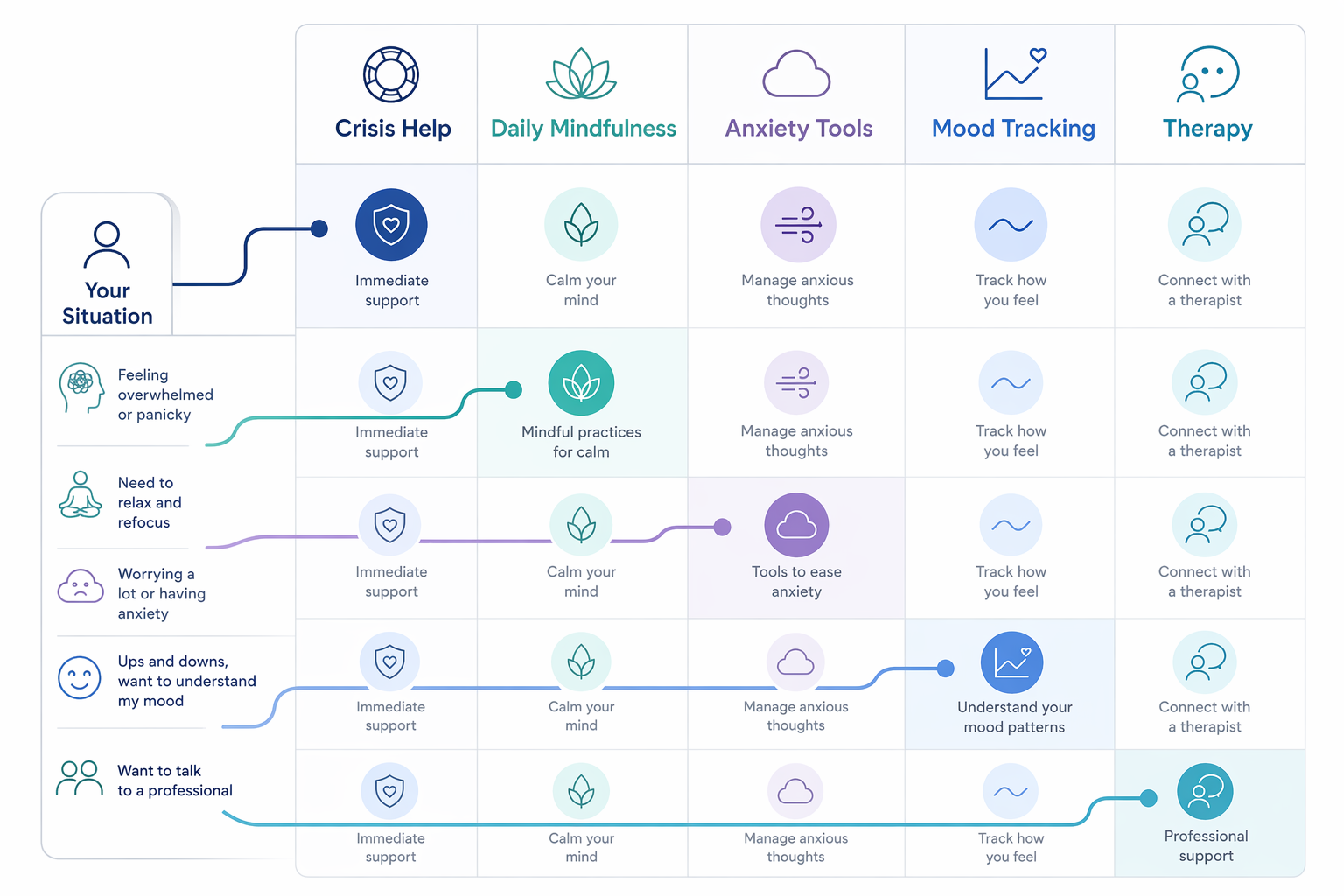
| Student situation | Best first direction | Cost/access notes | Strongest use case | Evidence basis | Main limitation |
|---|---|---|---|---|---|
| I may not be safe right now | 988, Crisis Text Line, The Trevor Project | Free, 24/7 crisis resources | Immediate human crisis support | Crisis services, not app-based self-care | Not a replacement for emergency care if there is immediate danger |
| I want a daily calming habit | Headspace first if your school provides it; Calm if the student plan is available | Headspace is reported free at 2,000+ U.S. universities; Calm student pricing was reported at $8.99/year through Student Beans, but pricing should be rechecked | Meditation, breathing, sleep, and routine-building | Headspace is described as using an evidence-based mindfulness curriculum; Calm is widely reviewed for sleep and mindfulness features | Helpful for stress habits, but not enough for crisis care or therapy needs |
| Anxiety is interfering with school | MindShift CBT | Completely free, according to 2026 app guides | CBT-based anxiety tools without a subscription | Built on CBT techniques and developed with Anxiety Canada | Self-guided; does not diagnose or replace therapy |
| I need to understand mood patterns | Moodfit | Free mood tracking; premium unlocks deeper analytics | Tracking mood, sleep, habits, and CBT-style self-insight | Campus guide describes CBT-based tools and insights | Tracking can clarify patterns, but it does not provide clinical care by itself |
| I want a coping companion or chatbot | Wysa | Free tier available; optional coaching may cost extra | AI-guided coping prompts using CBT, DBT, and mindfulness concepts | 2026 guide describes it as an AI chatbot using CBT, DBT, and mindfulness | AI support has limits; do not treat it as a therapist |
| I think I need ongoing therapy | Talkspace, especially if your school discounts it | Reported at $69/week for therapy with text and live sessions; some university partnerships offer discounted rates | Ongoing access to licensed therapy when campus counseling is unavailable or too slow | Therapy access model, not just self-help content | Cost can be the deciding factor; verify insurance, school benefits, and current pricing |
If You Need Help Right Now
The “right app” answer changes the moment safety is uncertain. If you are thinking about suicide, self-harm, violence, or you cannot trust yourself to get through the next few hours safely, use a crisis line or emergency support before opening any wellness app. If you are on campus, that may also mean contacting an RA, campus security, a trusted staff member, or a friend who can physically stay with you while you reach help.
This is not because apps are useless. It is because apps are usually designed for self-guided coping, skill practice, tracking, or scheduled care. A student in immediate danger should not be asked to sort through subscription pages, onboarding quizzes, chatbot disclaimers, or meditation categories.
- Call or text 988 if you are in the U.S. and need suicide or crisis support.
- Text HOME to 741741 for Crisis Text Line.
- Contact The Trevor Project if you are an LGBTQ+ young person in crisis.
- If there is immediate physical danger, call emergency services or go to the nearest emergency department.
If You Want a Daily Calming Habit
For students who are not in crisis but feel constantly keyed up, wired at night, or unable to reset between classes, Headspace and Calm are the two most obvious places to look. The decision is less about which brand has prettier sleep content and more about access: does your school already make one of them free or nearly free?
Headspace: Best When Your School Pays for It
Headspace is the first app to check if you want meditation, mindfulness, breathing exercises, and a daily structure that does not require you to design your own routine. A 2026 student app guide reports that Headspace is free for students at 2,000+ U.S. universities and describes its mindfulness curriculum as evidence-based.[4] That school-access detail matters more than it may look. A student who would never pay for another monthly subscription may still use a tool if it is already covered through their university login.
Headspace is best for the student who wants a repeatable habit: a short session before bed, a breathing exercise before a presentation, a guided meditation after a hard call home. It is less convincing as the main answer for a student whose anxiety is causing missed classes, panic, or avoidance. In that case, calming down for ten minutes can help the next hour, but it may not be enough structure for the larger problem.
Calm: Good for Sleep and Wind-Down, If the Student Price Still Applies
Calm is the other strong option for students who mainly want help sleeping, unwinding, and building a low-pressure mindfulness routine. CNET’s 2026 mental health app guide highlights Calm’s sleep stories and mood tracking features, while a 2026 student guide reports a Calm student plan at $8.99/year through Student Beans.[5][4] That price is low enough to be realistic for many students, but it should be verified before anyone counts on it; app pricing and student offers change.
Choose Calm over Headspace if sleep content is the main draw and the student plan is available. Choose Headspace first if your school gives you free access, especially if you want a more structured mindfulness habit. If neither is free or discounted, do not assume paying for a meditation app is mandatory. Your school counseling center, wellness office, library, or student health portal may already have free workshops, recordings, or app partnerships that are easy to miss.
If Anxiety Is Interfering With School
When anxiety is not just background stress but is starting to change behavior—skipping class, avoiding email, freezing before tests, rereading the same paragraph for an hour—MindShift CBT deserves a serious look before paid wellness subscriptions. A 2026 mental health app guide describes MindShift CBT as completely free, built on CBT techniques for anxiety, and developed with Anxiety Canada.[6]
The important word here is “CBT.” Cognitive behavioral therapy tools are not magic, and an app version is not the same as working with a therapist. But CBT-based exercises tend to give students something concrete to do with anxious thoughts: identify a pattern, test a prediction, plan an exposure, or separate a feeling from the next action. That is different from being told to “just relax” when the assignment is still due.
MindShift CBT is the strongest free pick in this comparison for students whose main problem is anxiety. It is also the app most closely aligned with the digital-CBT evidence that makes this category worth taking seriously, although the 2026 college RCT studied guided digital CBT self-help rather than proving that every CBT-labeled app produces the same outcomes.[3] That distinction matters. Use the evidence as a reason to consider structured CBT tools, not as a blank check for any app’s marketing page.
A reasonable way to use MindShift CBT is to pick one school-linked anxiety problem, not your entire life at once. For example: “I avoid starting papers because I’m afraid they’ll be bad,” or “I panic before lab presentations.” Work through the relevant thought and behavior tools around that pattern. If the anxiety keeps escalating, causes major impairment, or comes with panic symptoms that feel unmanageable, that is a sign to contact campus counseling, a primary care provider, or another clinician.
If You Need to Understand Your Mood Patterns
Some students do not start with a neat label like anxiety or depression. They start with “I keep crashing,” “I’m fine for a few days and then I disappear,” or “I don’t know if this is stress, sleep, food, my period, my workload, or everything.” That is where Moodfit can be useful.
A 2026 campus guide describes Moodfit as offering free mood tracking with CBT-based tools and insights, with premium features unlocking deeper analytics.[7] The free version is the part students should test first. Tracking can help reveal whether low mood follows poor sleep, missed meals, social overload, conflict, exam weeks, alcohol use, or long stretches without movement. It can also give a student something clearer to bring to counseling than “I’ve been bad lately.”
Mood tracking has a limit: it can become another assignment, and for some students it can turn into rumination. If logging makes you feel more trapped in the feeling, keep it lighter. Track once a day, use broad labels, and stop if the app becomes a place where you punish yourself for having symptoms.
Moodfit is a better fit for pattern-finding than for immediate relief. If you need a breathing exercise tonight, Headspace or Calm may feel easier. If anxiety is the main pattern you already recognize, MindShift CBT is more directly targeted. If the tracking shows persistent low mood, self-harm thoughts, major sleep disruption, or difficulty functioning, the next step is human support.
If You Want an AI Coping Companion
Wysa sits in a different category from the meditation apps and trackers. It is an AI chatbot designed to guide users through coping exercises, with a 2026 guide describing it as using CBT, DBT, and mindfulness approaches; the same source notes a free tier with optional coaching.[8] For a student who is lonely at 11 p.m. and needs a prompt to slow down, name a feeling, or try a grounding exercise, that can be genuinely useful.
The caution is also obvious: an AI chatbot is not a therapist, and it should not be treated as one because it can produce comforting conversation. Wysa is best used as a coping companion for lower-risk moments: spiraling after a social conflict, procrastinating because of stress, or needing a guided exercise when no one is available. It is not the place to outsource decisions about diagnosis, medication, trauma treatment, or safety.
Students considering Wysa should look closely at what is free, what requires paid coaching, and what happens if they disclose risk. The right use case is narrow but real: a low-friction nudge toward coping skills when the alternative is scrolling, isolating, or doing nothing.
If You Think You Need Therapy but Cost Is the Problem
This is the decision point where app roundups often get careless. Therapy apps and self-guided wellness apps do not solve the same problem. If you need an ongoing relationship with a licensed therapist, a free breathing app may help you get through the afternoon, but it does not replace care.
Talkspace is the most relevant app here because it offers therapy access rather than only self-guided content. A 2026 guide lists Talkspace at $69/week for therapy with text and live sessions and notes that some university partnerships offer discounted rates.[6] That price may be workable for some students and impossible for others. Before paying, check four places: your school counseling center, your student health insurance portal, your benefits or wellness page, and any partnership page your university maintains for teletherapy.
Campus counseling is still worth trying even if you assume there will be a wait. Some schools offer triage appointments, group therapy, short-term counseling, referrals, or same-day urgent support. Others partner with teletherapy providers in ways that are not obvious from the app’s public pricing page. The student who pays out of pocket first may be spending money they did not need to spend.
Talkspace makes the most sense when the real need is ongoing therapy and the access route works: your school discounts it, insurance covers it, campus counseling refers you to it, or the weekly cost is manageable. It makes less sense when you mainly need sleep support, a free anxiety tool, or a place to track mood patterns. Do not buy therapy access just because an app roundup put it next to meditation apps as if they were interchangeable.
The School-Benefits Check Should Come Before the App Store
The most practical mistake is downloading first and checking benefits later. Students often have access through a university email address, counseling center page, wellness office, student government program, athletics department, residence life program, or health insurance plan. Headspace is the clearest example in this comparison because student access is reported across 2,000+ U.S. universities.[4] Talkspace is another because school discounts may change the entire cost calculation.[6]
Use this quick order before entering a credit card:
- Search your school site for “mental health app,” “Headspace,” “Talkspace,” “teletherapy,” “wellness app,” and “student assistance program.”
- Check the counseling center and student health insurance pages, not only the main student-life page.
- Try free options first when the need matches: MindShift CBT for anxiety, Moodfit for tracking, and free tiers where appropriate.
- Verify 2026 pricing inside the app or on the current offer page before relying on figures listed in any article, including this one.
- If symptoms are worsening or interfering with daily functioning, use the app as a bridge into human support rather than as the whole plan.
A Practical Pick by Situation
If safety is at risk, skip the app list and use 988, Crisis Text Line, The Trevor Project, emergency services, or immediate campus support. If you want a daily calming routine and your school provides Headspace, start there. If sleep content is the main appeal and the student plan is still available, Calm can be a low-cost fit. If anxiety is interfering with school and money is tight, MindShift CBT is the strongest free starting point. If you need to see patterns in mood, sleep, and habits, try Moodfit before paying for deeper analytics. If you want an AI-guided coping prompt, Wysa can help in lower-risk moments, but keep its limits clear. If you need therapy, look at Talkspace only after checking school discounts, insurance, and campus counseling options.
Mental health apps can lower the first step: open a breathing exercise, write down a thought, track a pattern, start a CBT worksheet, or connect with therapy. That is useful. It is not the same as crisis care, diagnosis, medication management, or a longer therapeutic relationship when those are needed.
References
- Survey Finds Widespread Mental, Behavioral Health Challenges Among Young Adults and College Students, UnitedHealth Group, April 28, 2026
- Healthy Minds Study 2024–2025 Data Report, UCLA Center for Health Policy Research
- Effectiveness of digital cognitive behavioural therapy guided self-help for common mental disorders in college students, Nature Human Behaviour, 2026
- Mental Health Apps Free for Students, GetEduMail, 2026
- Best Mental Health Apps, CNET, 2026
- 10 Best Apps for Mental Health, Eleanor Health, 2026
- Student Mental Health Apps: A 2026 Campus Resource Guide, Flourish, 2026
- Top 5 Free Mental Health Apps, Holon Health, 2026
Comments
Join the discussion with an anonymous comment.