
What's in Bernie Moreno's Canada Wildfire Sanctions Bill
Senator Bernie Moreno's bill to sanction Canada over cross-border wildfire smoke is unprecedented in targeting a NATO ally with economic penalties for environmental harm. This analysis breaks down each provision — from asset blocking to ambassador expulsion — and evaluates the bill's legislative and diplomatic feasibility.
Updated:
Senator Bernie Moreno’s Canada wildfire sanctions bill is unusual before the politics even begin: it would point a sanctions machine normally associated with hostile governments, terrorist networks, or grave national-security threats at Canada, a NATO ally, over wildfire smoke crossing the border. The package described in the July 17 bill summary includes asset blocking, financial restrictions, visa consequences, and a declaration that Canada’s ambassador is persona non grata until the smoke no longer affects the United States.[1]
As of July 18, 2026, the bill is still at the front end of the legislative process. It was previewed on July 16, full text was released on July 17, and formal introduction was expected the week of July 20.[1][2] There was no public Congressional Budget Office score, committee assignment, cosponsor list, or White House position available in the materials reviewed. That matters because this is not yet a policy the federal government is preparing to implement. It is a legislative instrument being placed on the table.
That distinction is the right place to start a Bernie Moreno Canada wildfire sanctions bill analysis. The hard question is not only whether Ohioans and other Americans have a legitimate grievance about hazardous smoke. They do. The hard question is what this bill would legally require, who would have to make each decision, and what consequence would follow once those decisions are made.
What the bill would have to trigger
The operative trigger, as summarized by Semafor, is a presidential determination that Canadian wildfires harmed air quality in the United States.[1] That sounds simple until it is treated like statutory machinery rather than a press-release sentence.
A presidential determination is not the same thing as a senator saying smoke reached Ohio, Michigan, New York, or Pennsylvania. It would require the executive branch to decide that wildfire smoke from Canada had a qualifying effect on US air quality. The materials available do not show a numerical threshold, a named agency process, or a required evidentiary record for that determination. If the released bill text contains more detail than the summaries capture, that would be important; on the public summaries available now, the trigger appears broad.
Broad triggers can be politically useful because they let elected officials respond to visible harm without building a technical standard into every clause. They can also become enforcement problems. Wildfire smoke moves with weather systems, mixes with other pollutants, and can affect different regions at different intensities over different time windows. A bill that turns that fact pattern into sanctions needs to say, or at least let the executive branch decide, what level of causal showing is enough.
| Mechanism | What the available summaries say | Key implementation question |
|---|---|---|
| Trigger | The president determines Canadian wildfires harmed US air quality. | What evidence, threshold, and time period are enough? |
| Sanctioned targets | Responsible Canadian officials would face asset blocking and financial restrictions. | Who counts as responsible for wildfire smoke from remote or naturally ignited fires? |
| Visa consequences | Sanctioned individuals would face visa revocations. | Would this reach only named officials or broader categories of Canadian personnel? |
| Diplomatic rupture | Canada’s ambassador would be declared persona non grata until smoke no longer affects the US. | How would a public-health trigger control the status of an ambassador? |
| Sunset | Sanctions lift when the president confirms smoke effects have ended and Canada has taken corrective action. | What counts as corrective action after a fire season, and who verifies it? |
| Exceptions | The bill includes exceptions for diplomacy, safety, and national security. | How much discretion would those exceptions leave the president? |
The sanctions architecture is the center of the bill
The bill’s most consequential provisions are not the statements of blame. They are the penalties that would follow once the president makes the required determination. The reported package would block assets and impose financial restrictions on Canadian officials deemed responsible for the wildfire pollution emergency.[1] The Hill’s account similarly described the proposal as a sanctions bill aimed at Canada over wildfire smoke, with economic and diplomatic consequences attached to the Canadian government’s alleged failure to manage fires.[2]
Asset blocking is a severe legal move. In ordinary sanctions practice, it prevents property and interests in property from being transferred, paid, exported, withdrawn, or otherwise dealt in when they come within US jurisdiction. Financial restrictions can also affect access to dollar transactions, US financial institutions, or related services. The summaries do not say that every Canadian official would be sanctioned. They point instead to officials treated as responsible. That word does a great deal of work.
Responsibility is easier to allege in a speech than to administer in a sanctions program. A finance minister, public-safety minister, provincial forestry official, emergency-management officer, or career fire-management professional can all be near the policy chain without having the same legal role. If a remote lightning-caused fire is managed under a modified-response policy, who is the sanctionable actor: the federal government, a provincial agency, a minister who approved the framework, an official who allocated aircraft elsewhere, or no individual at all? The bill’s feasibility depends on whether that chain can be made administrable.
The novelty is not that Congress is angry about smoke. Members of Congress have complained about Canadian wildfire management before. The novelty is using a sanctions model against a close ally for environmental harm. The American Enterprise Institute noted in 2025 that no recent US sanctions bill had targeted Canada on an environmental issue.[7] The available materials also do not identify a clear precedent for applying an IEEPA-style economic sanctions framework to a sovereign partner over wildfire management.
That does not make the bill unserious. It makes it structurally aggressive. Congress can write statutes that press the executive branch toward sanctions, but the more unusual the target and conduct, the more pressure falls on definitions, exceptions, and executive discretion. Here, the gap between “Canadian wildfire smoke harmed US air quality” and “specific Canadian officials should be financially sanctioned” is the central legal and administrative gap in the proposal.
Visa revocations and the ambassador clause go further than ordinary blame
The visa provision follows the same logic as many sanctions bills: if an individual is sanctionable, the United States can also restrict that person’s ability to enter the country. Semafor’s summary says the bill includes visa revocations for sanctioned individuals.[1] That is still a serious step when the affected persons are officials of Canada rather than officials of an adversarial state.
The ambassador provision is more startling. The bill would declare Canada’s ambassador persona non grata until smoke no longer affects the United States.[1] In diplomatic law, persona non grata is not a routine policy reprimand. It is the formal language a receiving state uses when it no longer accepts a diplomat’s presence. Applying that status to Canada’s ambassador because of wildfire smoke would move the bill from public-health retaliation into diplomatic rupture.
The condition attached to the ambassador clause also creates a practical puzzle. Smoke effects are seasonal, meteorological, and geographically uneven. If smoke affects Minnesota but not Ohio, or New England but not the Great Lakes, has the condition ended? If the smoke clears for several days and returns with a new plume, does the ambassador provision revive? The summaries do not answer those questions. They show the clause’s political force, but not yet its administrative precision.
The sunset clause is doing more work than it first appears
The reported sunset clause says the sanctions would lift automatically when the president confirms both that smoke effects have ended and that Canada has taken corrective action.[1] The word “and” is important. If the summaries are accurate, the bill would not end sanctions merely because the air clears. It would require a presidential finding about Canadian conduct.
That second condition may be the harder one. “Corrective action” can mean very different things in wildfire policy: more suppression near communities, different forest-management practices, more aircraft, more prescribed burning outside fire season, changes in intergovernmental coordination, or new smoke-warning systems. Some of those actions are federal; some are provincial; some are operational decisions made during fast-moving fire conditions. A statutory sunset that depends on corrective action needs either a definition or enough executive discretion to survive ambiguity.
The bill also reportedly includes exceptions for diplomacy, safety, and national security.[1] Those exceptions are not decorative. They are the pressure valves that could let the executive branch keep channels open with Ottawa, avoid interfering with emergency response, and manage broader defense and intelligence interests. In a bill aimed at Canada, those exceptions may be what separates a maximalist message from an unworkable mandate.
Why the bill appeared now
The wildfire context is not incidental. By mid-July, Canadian fires were affecting air quality across parts of the United States, and the numbers were large enough to make the issue hard to dismiss as a routine summer nuisance. Reuters reported 858 active Canadian wildfires as of July 16, with Ontario recording 483 fires year to date compared with 351 in 2025 and a 10-year average of about 320; about 1.9 million hectares had burned, and Toronto ranked as having the world’s worst air quality on July 15.[4]
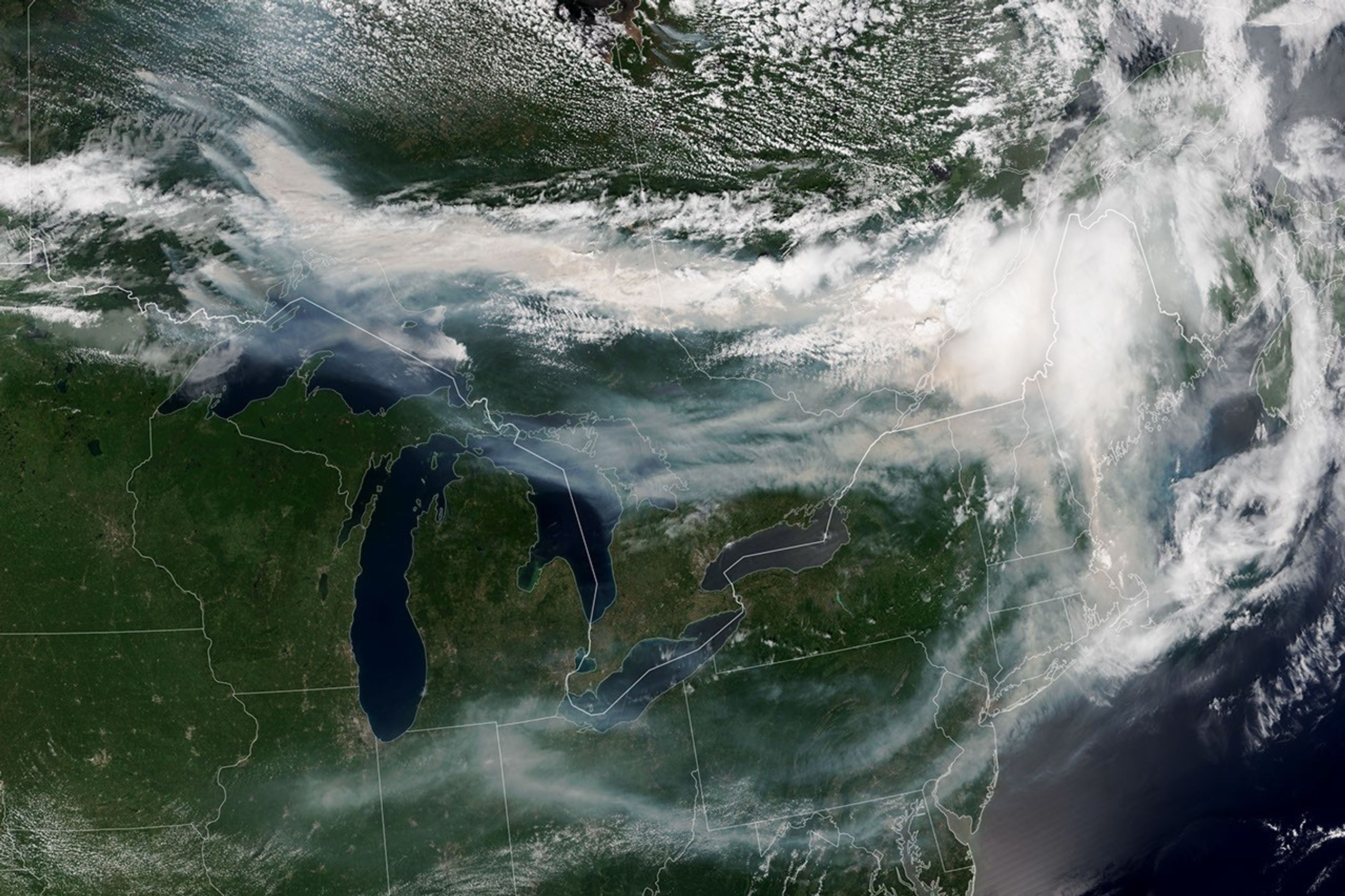
The local Ohio hook is even sharper. 13ABC/WTVG reported that Toledo’s air quality index exceeded 600 during the smoke event.[3] That figure is the kind of fact that changes the political texture of the story. A sanctions bill against Canada can sound theatrical in Washington. An AQI above 600 in Toledo turns the grievance into a constituent-health problem before it becomes a diplomatic problem.
Moreno’s office framed the bill as an attempt to hold the Canadian government responsible for what it called a wildfire pollution emergency.[5] Separately, Moreno said he was studying a victims compensation fund that would be funded by additional tariffs.[3] That tariff-funded compensation idea should be kept in its lane. Based on the available reporting, it is an adjacent proposal under study, not the central enacted mechanism of the sanctions bill.
There is also a partisan and cross-border history here. CBC reported that Republican complaints about Canadian wildfire smoke had appeared for a third consecutive year, and it quoted Prime Minister Mark Carney responding that “climate change is everyone’s responsibility — including the United States.” CBC also quoted US Ambassador Pete Hoekstra describing the smoke as “a shared challenge demanding a shared response.”[6] Those two comments point in opposite governing directions: one toward blame and leverage, the other toward coordination.
The legal background helps, but it does not solve the problem
Cross-border pollution is not a new legal idea. The familiar reference point is the Trail Smelter arbitration, decided in 1941, which is often cited for the principle that a state should not use or permit use of its territory in a way that causes serious injury in another state. But Trail Smelter involved industrial pollution from a smelter, not smoke from large, climate-influenced wildfire systems, and the available materials do not support treating it as a direct blueprint for sanctions against Canada over fire management.
That difference matters. A smelter has owners, emissions, controls, and a more traceable operating decision. A wildfire season has lightning, drought, temperature, forest conditions, suppression limits, provincial and federal authority, and smoke transport across hundreds or thousands of miles. A legal principle about transboundary harm can explain why Americans are entitled to care about Canadian-origin smoke. It does not by itself establish that the United States can or should impose economic sanctions on Canadian officials for the way Canada manages remote fires.
The AEI analysis is useful here because it resists the easy version of the claim. It treats the smoke problem as a cross-border externality while also emphasizing that the efficient response “almost certainly blends Canadian and US actions,” including US-side investments such as air filtration.[7] That is a less satisfying sentence for a campaign clip, but it is closer to how the policy problem behaves.
Canada cannot simply turn every remote fire off
The bill’s theory depends on the idea that Canada has failed to act responsibly. Some criticism may focus on planning, resources, or policy choices. But wildfire suppression is not an on-off switch, especially in remote areas. Canada’s modified-response doctrine allows some remote, naturally ignited fires to burn while concentrating suppression resources near settlements and priority assets; the AEI framework describes that approach as a form of resource triage rather than mere neglect.[7]
That does not mean every Canadian decision is immune from criticism. It means the criticism has to identify a decision that could realistically have been different and would likely have reduced cross-border harm without imposing larger costs or risks elsewhere. If aircraft are finite, crews are finite, and fires are spread across remote terrain, “suppress more” is not yet a policy instruction. It is a demand for a different allocation rule.
This is where sanctions fit awkwardly. Sanctions punish or coerce. Wildfire governance often requires shared monitoring, mutual aid, public-health alerts, building filtration, workplace rules, school guidance, and emergency coordination. A tariff-funded victims fund, if Moreno develops it, would at least address harm after exposure. Asset blocking against Canadian officials would try to force a management change, but the available record does not show the mechanism by which blocked assets would produce fewer smoke days in Toledo, Detroit, or Buffalo.
Canada would have options, but none are clean
If the United States actually imposed sanctions on Canadian officials under a statute like this, Canada would not be limited to protest notes. One possible countermeasure discussed in legal and policy circles is Canada’s Foreign Extraterritorial Measures Act, which can be used to block or counter certain foreign measures affecting Canadian interests. The research record does not show that Canada has invoked it in this wildfire context, so it should be treated as a theoretical option rather than an active response.
Diplomatically, the ambassador clause would force a different kind of confrontation. Sanctioning a minister or forestry official would be serious. Declaring the ambassador persona non grata would attack the channel through which the two governments would ordinarily manage the dispute. That may be the point as political signaling. It is also why the provision would make allies, agencies, and financial institutions read the bill more carefully than they might read an ordinary statement of outrage.
The national-security exception could soften the collision. The United States and Canada share defense, intelligence, trade, border, and emergency-management interests. If the bill became law, any administration would have to decide whether enforcing the harshest provisions would improve Canadian fire policy enough to justify damage to those interests. That is not a moral question alone. It is an implementation question.
Legislative feasibility is still mostly unknown
Congressional feasibility cannot be measured responsibly from the announcement alone. The bill had not yet been formally introduced as of the reporting window, and the public record lacked a committee assignment, cosponsor list, CBO score, or White House position.[1][2] Those are not clerical details. They are the first signs of whether a bill is becoming legislation or remaining a message.
The bill could still matter even if it never reaches the president’s desk. Members introduce bills to build bargaining positions, pressure agencies, create media hooks, signal to constituents, and define the terms of a dispute. A senator from Ohio responding to hazardous smoke does not need imminent enactment for the bill to have political utility. The question is whether that utility should be confused with near-term policy likelihood. It should not.
A serious legislative path would require answers that the summaries do not yet provide: how the president would make the smoke-harm determination; how responsible officials would be identified; how the ambassador provision would interact with diplomatic practice; how exceptions would be administered; what corrective action would end sanctions; and how the United States would handle Canadian countermeasures. Until those questions are answered, the bill is more precise as a signal than as an operating manual.
What to make of it now
The strongest case for Moreno’s bill is that wildfire smoke is not an abstraction for the Americans breathing it. When an Ohio city sees an AQI above 600, a senator asking whether another government’s choices contributed to the harm is not manufacturing the underlying public-health concern.[3] Cross-border smoke creates real costs for households, workers, schools, hospitals, and local officials who do not control Canadian fire policy.
The weakest part of the bill is the leap from that harm to sanctions against a close ally. The proposal assumes that Canadian officials can be made sanctionable for wildfire smoke in a way that is legally defensible, diplomatically tolerable, and operationally useful. The available materials do not establish that chain. They show a hard public-health problem and a forceful punitive response, with several missing links between the two.
That is the best current reading of the bill: structurally unprecedented, politically legible, and not dismissible as mere noise, but legally, diplomatically, and legislatively uncertain. It is a serious signal of US anger over Canadian wildfire smoke. It is not yet a likely near-term policy.
References
- Republican senator goes after Canada for wildfire smoke, Semafor, July 17, 2026, link
- GOP senator to introduce bill to sanction Canada over wildfire smoke, The Hill, link
- Sen. Bernie Moreno looks to hold Canadian government responsible, 13ABC/WTVG, July 16, 2026, link
- Canadian wildfire smoke chokes Toronto, threatens US cities, Reuters, link
- Moreno Announces Bill to Sanction Canada, Senate press release, link
- Republicans blast Canada over wildfire smoke, CBC News, link
- Canadian Wildfires and American Smoke, AEI, link
Comments
Join the discussion with an anonymous comment.