
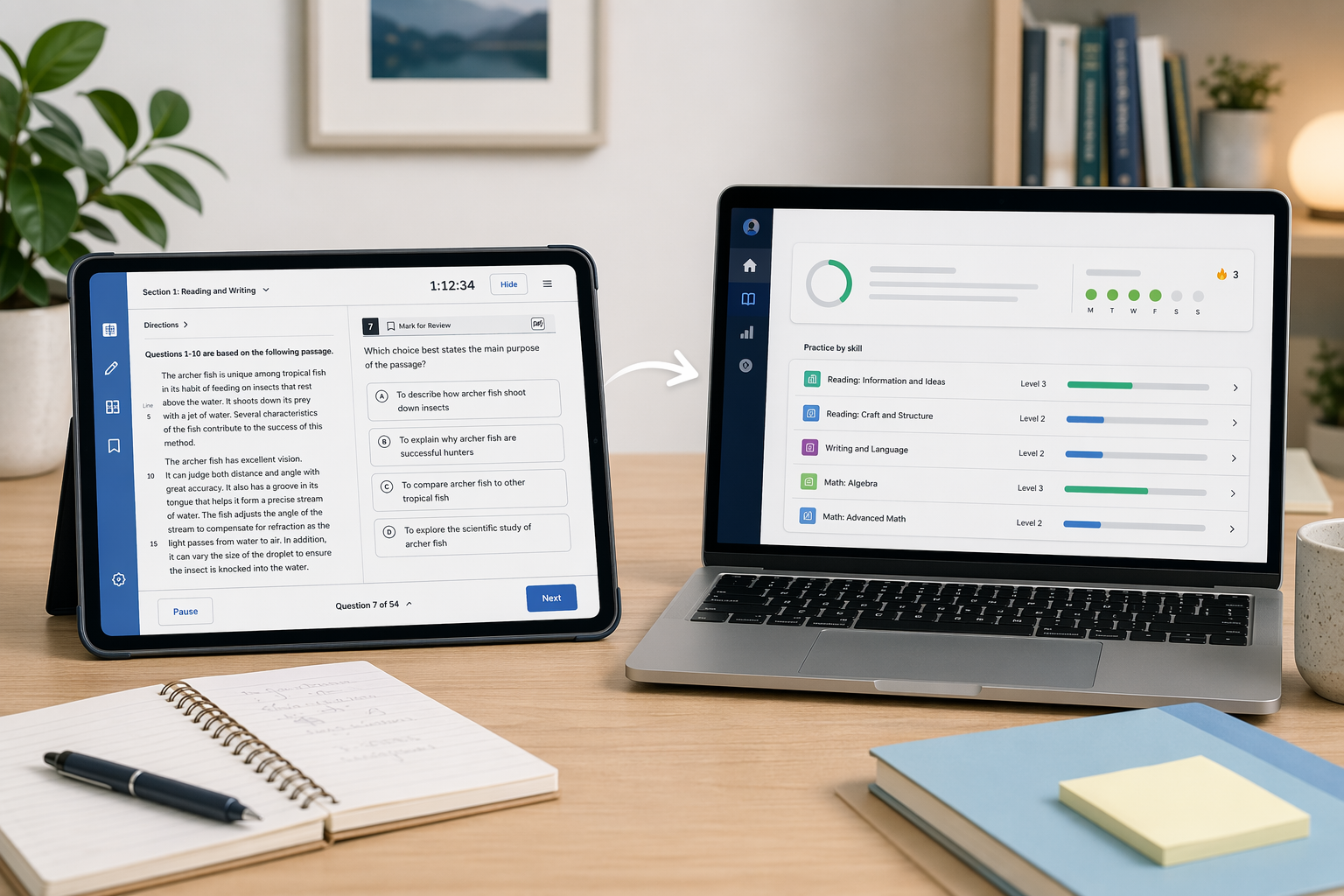
How Khan Academy SAT Practice Works with Bluebook
Since the 2024 digital SAT transition, full-length practice tests moved to College Board's Bluebook app while Khan Academy now focuses on skill-based exercises. This article explains how the two tools work together, the practical workflow students should follow, and what the free ecosystem delivers — and where its limits lie.
Updated:
If you came looking for Khan Academy SAT practice tests and cannot find them, you are not missing a button. Since January 2024, full-length Digital SAT practice tests have lived in College Board’s Bluebook app, not inside Khan Academy.[1] Khan Academy SAT practice still exists, but its job changed: it is now the place for lessons, skill drills, and targeted practice after you know what went wrong.
That split is the key to using the free system correctly. Bluebook is for full-length, adaptive test simulation. Khan Academy is for repairing the skills that Bluebook exposes. Treating one as a replacement for the other is how students lose a week doing sincere work in the wrong place.
The Two Tools Have Different Jobs
A Bluebook practice test gives you the closest free version of the actual digital SAT testing experience: the app, the timing, the section structure, and the adaptive format. Khan Academy does not try to recreate that full test environment. It takes the skills behind the test and turns them into smaller practice sets, explanations, and lessons.
| Tool | Use it for | Do not expect it to do |
|---|---|---|
| Bluebook | Full-length Digital SAT practice tests and test-day simulation | Teach every missed skill in a lesson-by-lesson sequence |
| My Practice | Reviewing Bluebook results and connecting missed questions to Khan Academy practice | Replace actual study time |
| Khan Academy | Skill practice, video lessons, and targeted remediation | Run full-length Digital SAT practice tests |
College Board describes the current workflow as a connection between Bluebook results, the My Practice portal, and Khan Academy practice: students take a practice test, review results, then use Khan Academy links tied to missed-question skills.[2] That may sound like an extra step, but it is actually cleaner than guessing which lessons to open after a disappointing score.
If the mechanical part is what is blocking you — where to download Bluebook, how to start the test, or where the score report appears — use this separate walkthrough on taking SAT practice tests with Bluebook and Khan Academy. Once the test is taken, the more important question is what you do with the result.
The Workflow That Makes Khan Academy Useful
The strongest free SAT routine in 2026 is not “do Khan Academy for a while” and then “take a practice test someday.” It is a loop: test, review, practice the exposed skills, then test again. The order matters because the first Bluebook test gives your Khan Academy work a target.
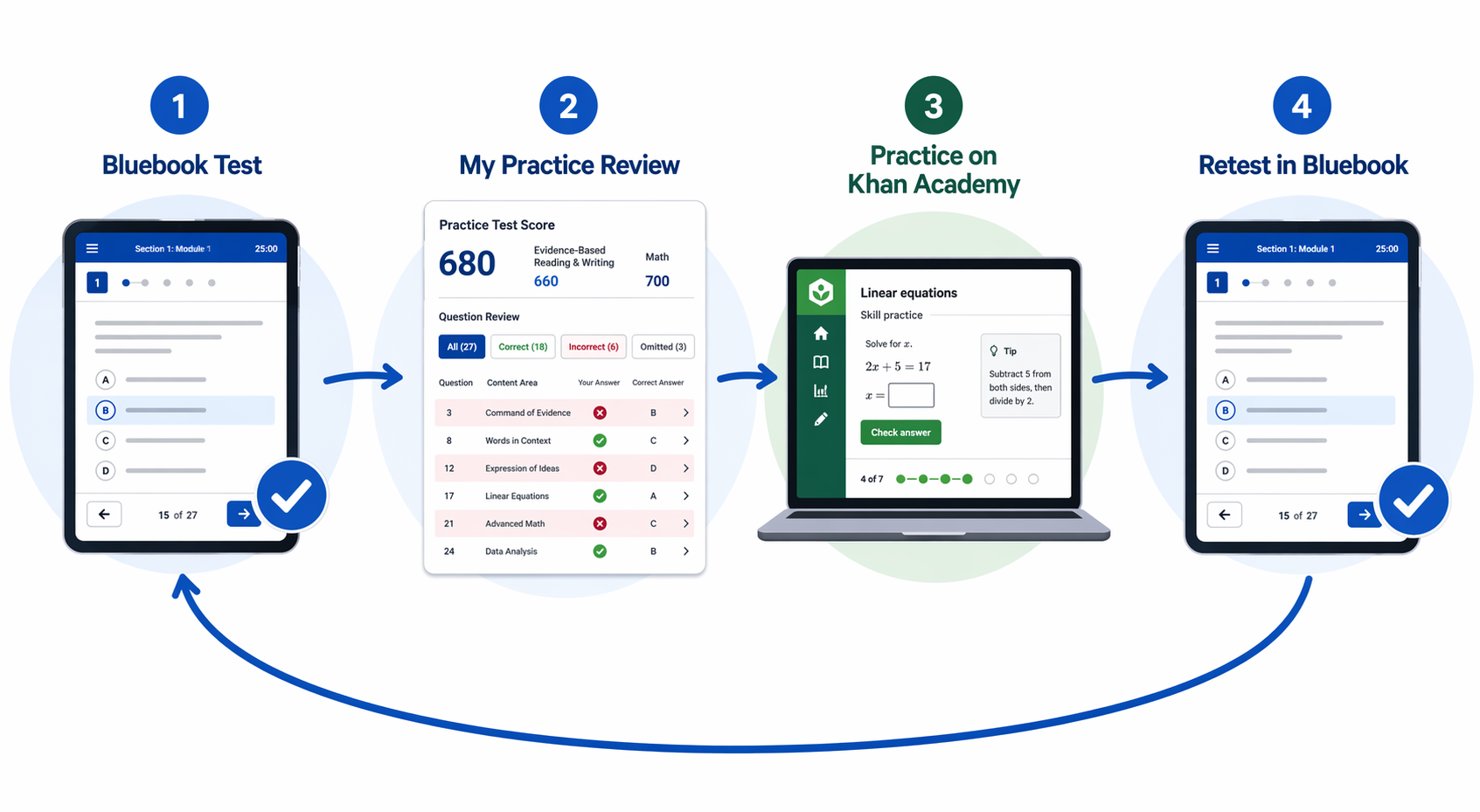
- Take a full-length practice test in Bluebook under realistic conditions.
- Open My Practice and review the score report after the results import.
- Use the “Practice on Khan Academy” path for missed-question skills.
- Work through the relevant Khan Academy practice, moving through Foundations, Medium, and Advanced material where available.
- Return to Bluebook for another full-length test when enough practice has passed.
Start With a Real Bluebook Test, Not a Warm-Up Week
The first Bluebook test does not have to be pretty. Its purpose is to stop the vague diagnosis of “I’m bad at math” or “reading is my problem” and replace it with a smaller list of skills. A student who waits until they “feel ready” to take the first practice test often spends the opening stretch reviewing comfortable material while the real weak spots stay hidden.
Use normal testing conditions as much as possible: one sitting, the Bluebook timer, limited interruptions, and no pausing to look up formulas or grammar rules. A practice test taken in fragments can still teach something, but it will not tell you as much about endurance, pacing, or score readiness.
Use My Practice as the Bridge
After the Bluebook test, results appear through College Board’s My Practice system. This is where the free ecosystem earns its keep: missed questions can connect to Khan Academy practice for the underlying skills, so the student is not left staring at a score report and inventing a study plan from scratch.[2]
Do not review only the final score. Look for the skills attached to missed or uncertain questions, especially the ones that repeat. One wrong question in a category may be a slip. Several misses in the same area usually deserve a Khan Academy session before the next full test.
Let Khan Academy Do the Remediation
Once you enter Khan Academy from a missed skill, stay narrow at first. If a student missed a linear equations question, the next move is not a random hour of all SAT Math. It is the linked skill practice, the relevant lesson if needed, and enough similar questions to see whether the mistake was conceptual, procedural, or just rushed.
The Foundations, Medium, and Advanced levels are useful here because they keep students from treating every weakness the same way. A student who cannot start a problem belongs in Foundations. A student who understands the idea but breaks down when the wording gets denser may need Medium or Advanced practice. Those are different problems, and they call for different work.
For a longer weekly cadence, pair this loop with a Khan Academy and Bluebook SAT study plan. The important habit is that Khan Academy sessions should usually answer a question raised by a test result, not just fill time.
Retest Before You Declare the Problem Fixed
Khan Academy progress can show that a student is getting better at a skill in isolation. It cannot, by itself, prove that the student will recognize that skill quickly inside a timed, adaptive SAT section. That is why the loop has to return to Bluebook.
A better next test does not have to show a huge score jump to be useful. Sometimes the win is smaller: fewer careless misses in the same category, more time left at the end of a module, or a score report that reveals a new priority because the old one has stopped dominating the error pattern.
Do Not Read the Khan Academy Dashboard Too Literally
Khan Academy’s Digital SAT course is not balanced equally across the two sections. As reported in current overviews and reviews, the Math side lists 37 skills across 12 units, while Reading and Writing lists 11 skills across 4 units — roughly a 3-to-1 difference.[1][3] Those counts may change as the course is updated, but the imbalance is worth noticing as of this article’s 2026 publication.
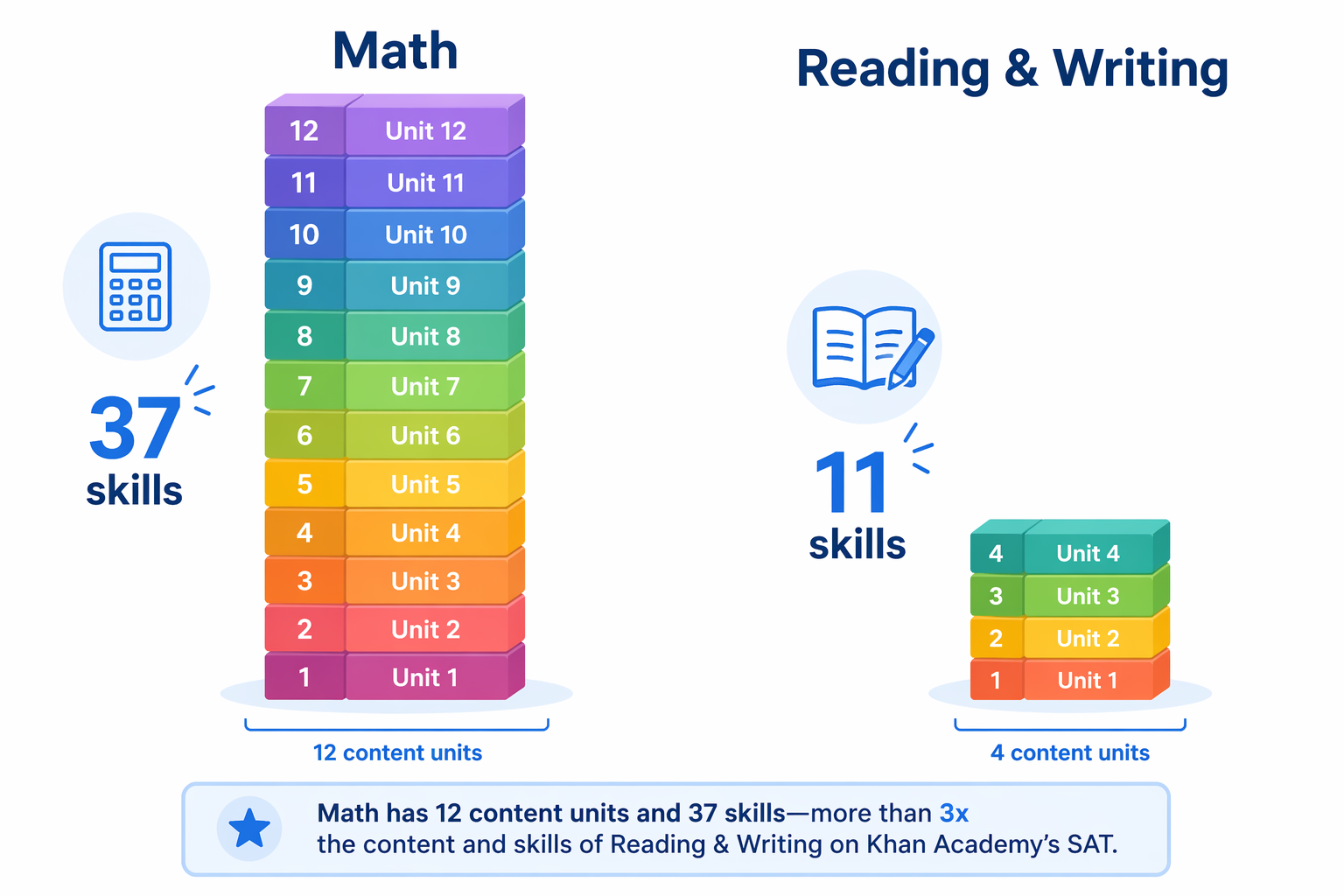
That does not mean every student should spend three times as long on Math. It means the dashboard size is not a study-time prescription. Math is broken into more visible parts, so progress can feel slower even when the work is appropriate. Reading and Writing may look smaller, but a weakness in transitions, command of evidence, grammar, or rhetorical synthesis can still cost real points.
Let Bluebook results decide the allocation. If the score report keeps pointing to Math, the larger Khan Academy Math structure is helpful. If Reading and Writing is the section holding the score down, do not let the smaller course menu convince you it needs only a light pass.
What the Score-Improvement Evidence Can and Cannot Prove
The best-known score-improvement figure attached to Official SAT Practice is encouraging, but it needs careful handling. A 2017 College Board study of about 250,000 students found that 6 hours of Official SAT Practice was associated with a 90-point SAT increase, while 20 hours was associated with a 115-point increase. The reported gains were consistent across gender, race, family income, and ethnicity.[4]
That is a large study, and it is one reason the free official ecosystem deserves to be taken seriously. But it predates the current Digital SAT, the January 2024 Bluebook transition, and the present Khan Academy course structure. It supports the idea that sustained official practice can be valuable; it does not guarantee that a student in 2026 will gain a specific number of points after a specific number of Khan Academy hours.
The practical takeaway is simple enough: use the free system seriously before assuming paid prep is necessary, but measure your own progress with repeated Bluebook tests instead of borrowing someone else’s old average as a promise.
Where Khan Academy SAT Practice Is Thin
The free system is strong enough to be the first plan for many students. It is not a complete SAT coaching program. Several independent reviews converge on similar concerns: Khan Academy is weaker on test-taking strategy, pacing practice, answer explanations, and advanced support for students already aiming at very high section scores.[3][5][6][7]
Strategy Is Not the Same as Skill
Khan Academy can help a student learn the grammar rule, the algebra move, or the reading skill behind a question. It is less direct about test behaviors such as when to skip, how to recover after a time sink, how to recognize common trap answers, or how to choose between two plausible Reading and Writing answers under pressure.
Those behaviors matter most when a student already understands much of the content but keeps losing points in predictable ways. A student who says, “I knew how to do it after I saw the answer,” may not need another lesson first. They may need pacing practice, decision rules, and a review routine that catches the pattern.
Most Skill Practice Is Not Full Test Pacing
Khan Academy exercises are useful partly because they isolate skills. That same isolation limits what they can show. A student can improve on untimed or lightly timed practice sets and still struggle to make decisions quickly across a full Bluebook module.
This is not a reason to skip Khan Academy. It is a reason to keep Bluebook in the rotation. Skill practice teaches the move; full-length testing checks whether the student can find and execute that move when it is mixed with everything else.
Explanations May Not Be Enough for Every Miss
Reviewers have also criticized Khan Academy answer explanations as uneven or too thin for some students.[5][6][7] That criticism should be read with a little caution because some review sites sell their own paid prep. Still, the complaint is familiar to anyone who has watched a student nod at an explanation and then miss the same kind of question two days later.
When an explanation does not resolve the mistake, the next step is not to reread it five times. Have the student write what the question was testing, why the wrong answer was tempting, and what clue would have pointed to the correct answer. If they cannot do that, the skill is not repaired yet.
High Scorers May Hit the Ceiling Sooner
Students targeting 700+ per section may still get value from Khan Academy, especially for cleaning up a specific gap. But the same independent reviews repeatedly flag a thinner advanced ceiling: fewer hard, strategy-rich questions and less specialized support for students trying to turn an already-strong score into an elite one.[3][5][6][7]
That is the point where the question changes from “Is Khan Academy good?” to “Is it enough for this target score?” If that is the decision you are making, use a target-score framework like Is Khan Academy SAT Prep Free Enough for Your Target Score? rather than judging the platform in the abstract.
What About Khanmigo and Schoolhouse?
Khanmigo, Khan Academy’s optional AI tutor, can explain concepts conversationally and may help a student who gets stuck in a lesson. It is not the center of the official SAT workflow, and the available material does not establish SAT-specific score gains from Khanmigo use. Reviews describe it as an optional paid add-on at $4 per month, not as a proven replacement for the Bluebook-to-Khan practice loop.[6]
Schoolhouse SAT Bootcamps are also adjacent rather than central. They are free, peer-led bootcamps that run for 4 weeks, meet 2 times per week, and are limited to students scoring 400–690 per section.[8] That range makes them potentially useful for many students, but not for everyone, and they should not be confused with Khan Academy’s regular SAT practice course.
The Practical Boundary
For many students, the right first system is the free one: take Bluebook tests, review results in My Practice, use Khan Academy for the skills that actually caused missed questions, and return to Bluebook often enough to see whether the work transfers. That sequence is stronger than using either tool alone.
Its boundary is just as important. Bluebook plus Khan Academy gives a strong official baseline, not a full strategy coach or an advanced-score program by itself. Use it first, use it in order, and let the next Bluebook score tell you whether the free loop is still solving the right problem.
References
- Guide to Transitioning to the Digital SAT, Khan Academy Blog
- Official Digital SAT Prep on Khan Academy, College Board
- Khan Academy SAT Prep Review, TestPrepInsight
- Khan Academy SAT Preparation Success Points To Post-SAT Future, Forbes, November 26, 2024
- Khan Academy SAT Will Never Be Enough — Here’s Why, PrepScholar
- Khan Academy SAT Prep Review, PrepMaven
- Is Khan Academy Enough for SAT Prep? What Every Parent Needs to Know, College Prep Genius
- SAT Bootcamp, Schoolhouse
Comments
Join the discussion with an anonymous comment.