
SAT
A practical guide to the digital SAT Reading & Writing section — covering the adaptive format, the best official and third-party practice resources, and a structured review method that turns practice tests into real score improvements.
Updated:
A SAT English practice test can tell you plenty. It can show that you are running out of time, missing punctuation questions you thought were easy, or getting trapped by answer choices that sound “academic” but do not match the passage. What it cannot do, by itself, is teach you what to change next.
That is where many students lose weeks. They take a full test, write down the score, feel either relieved or discouraged, and then hunt for another test. The better move is slower and more useful: understand the digital Reading and Writing format, use official practice first, review mistakes by skill, drill the weak spots, and wait long enough before the next full test for the work in between to matter.
Start With the Test You Are Actually Taking
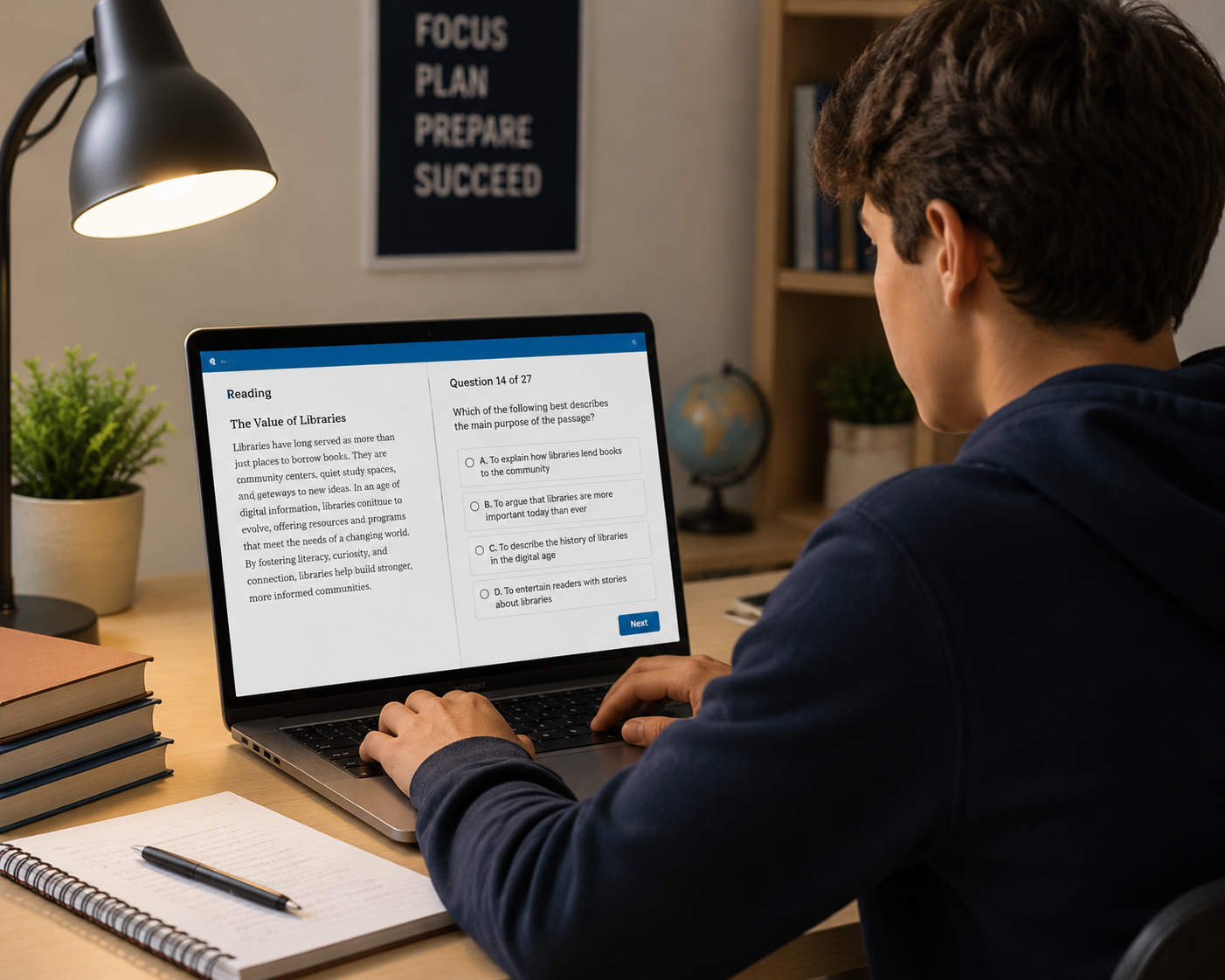
The current SAT Reading and Writing section is not the old long-passage SAT with a digital coat of paint. It is 64 minutes total, divided into two 32-minute modules, with 54 questions across the section. Each question is tied to its own short passage, usually 25 to 150 words, so you are repeatedly reading, deciding, answering, and resetting instead of staying with one long passage for a cluster of questions. [1]
That short-passage design is good news for many students. A rough science paragraph does not haunt you for ten questions. A grammar question does not require you to remember a whole page of context. But the format also punishes vague practice. If your resource still gives you old-style long reading passages, or if it mixes older SAT Writing questions without saying so clearly, it may still build some general reading skill, but it is not a clean SAT English practice test for the exam you will see.
The content is easier to train when you stop calling it all “English.” The Reading and Writing section is commonly broken into four domains: Craft and Structure at about 28%, Information and Ideas at about 26%, Standard English Conventions at about 26%, and Expression of Ideas at about 20%. [2]
| Domain | What it tends to feel like in practice | What to review after a miss |
|---|---|---|
| Craft and Structure | Vocabulary in context, text structure, purpose, and how words or lines function | What the question asked you to notice, not just what the passage was about |
| Information and Ideas | Main ideas, details, inferences, command of evidence, and data-based reading | Where the correct answer is supported and where the wrong answer overreaches |
| Standard English Conventions | Grammar, punctuation, sentence boundaries, agreement, and usage | The exact rule tested, especially if you answered by ear |
| Expression of Ideas | Transitions, logical order, concision, and rhetorical choices | The job the sentence or transition needed to do in the paragraph |
This table is not meant to become wall art above your desk. Its purpose is simpler: when a score report says Reading and Writing went badly, you need to know whether that means grammar rules, evidence choices, vocabulary-in-context, transitions, or something else. Those are different problems, and they need different practice.
The Adaptive Format Changes How Practice Should Feel
The Reading and Writing section is adaptive by module. Your performance on Module 1 helps determine whether you receive an easier or harder Module 2; the harder second module is the path associated with access to the highest scores. [3][4]
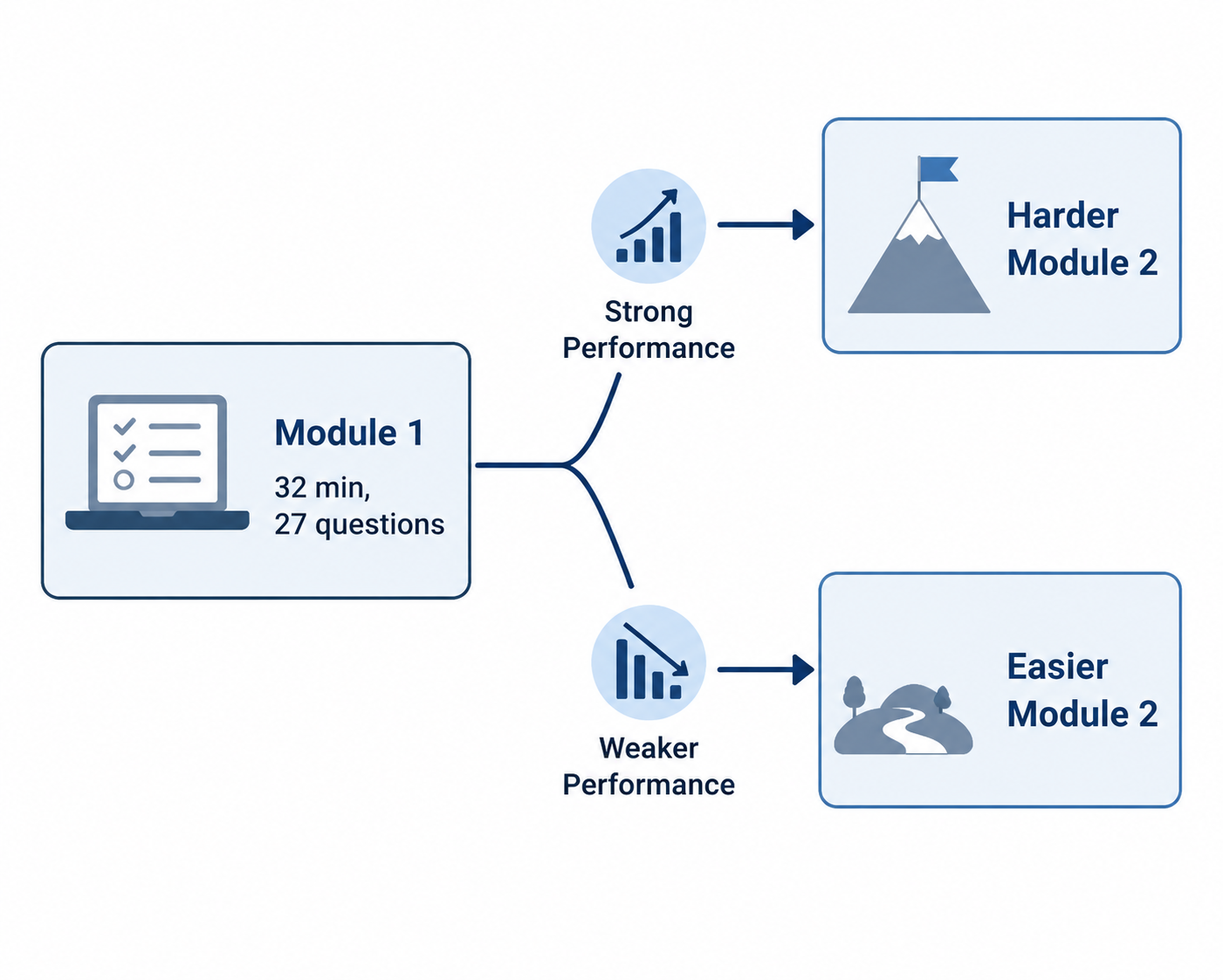
This does not mean one careless question ruins your score. It does mean a half-focused practice test is a bad measurement. If you take Module 1 while checking your phone, pausing for snacks, or treating the first ten questions as a warm-up, the test may route you in a way that does not represent your real ability. Then the final score becomes hard to interpret.
For practice, treat Module 1 like it counts because it does. Work in one sitting when you are taking a full test. Use the official timing. Do not pause to look up a grammar rule. Do not turn a full practice test into a worksheet. Save that kind of learning for review and drilling afterward.
Use Official Practice as the Baseline, Not the Backup Plan
The best first answer to “Where can I find a SAT English practice test?” is still boring: use the official College Board ecosystem before you start collecting links. Bluebook offers 8 full-length adaptive practice tests, listed as Practice Tests 4 through 11. The Student Question Bank lets students filter by test, domain, skill, and difficulty. Khan Academy is the only free platform using official College Board questions. [5]
Those three tools are not interchangeable. They do different jobs, and using each one for the right job is what keeps practice from turning into score-watching.
Bluebook: for realistic full-test conditions
Bluebook is where you go when you need the closest available rehearsal for the digital SAT experience: timing, interface, module structure, and adaptive behavior. Use it for diagnostics and periodic full tests, not for daily casual practice. There are only so many official full-length tests, and burning through them every weekend usually gives you less information, not more.
After a Bluebook test, the score is the beginning of the work. If you want a fuller list of traps to avoid in the testing interface and review process, the guide to Bluebook digital SAT practice mistakes is useful before your next official test.
Khan Academy: for guided official practice
Khan Academy is the best next place when you know the general area that needs work but still want structure. If Standard English Conventions keeps sinking your score, you can work through lessons and practice sets instead of randomly searching “SAT grammar questions” and hoping the examples match the current exam.
For many students, Khan Academy is enough for the first stage of Reading and Writing prep because it keeps the practice official and organized. Paid tools can still help, especially when you want more explanations, extra volume, or a different dashboard, but they should be additions to a stable base. If you are deciding whether to stay with Khan or add a paid system, this comparison of Khan Academy and AI SAT tutors can help you sort the tradeoffs.
Student Question Bank: for targeted drilling
The Student Question Bank is the tool students often underuse because it looks less exciting than a full test. That is exactly why it is valuable. Once your review shows that you are missing, say, transition questions or command-of-evidence questions, you can filter practice instead of waiting for those question types to appear naturally on another full test.
This is the difference between practicing and sampling. A full test samples your current performance under pressure. Targeted drilling changes the performance. You need both, but not in equal amounts every week.
A Practice Test Workflow That Actually Produces Decisions
A useful SAT English practice cycle is not complicated, but it does require patience. College Board recommends spacing full practice tests at least two weeks apart and using the Student Question Bank for targeted practice between tests. [5]
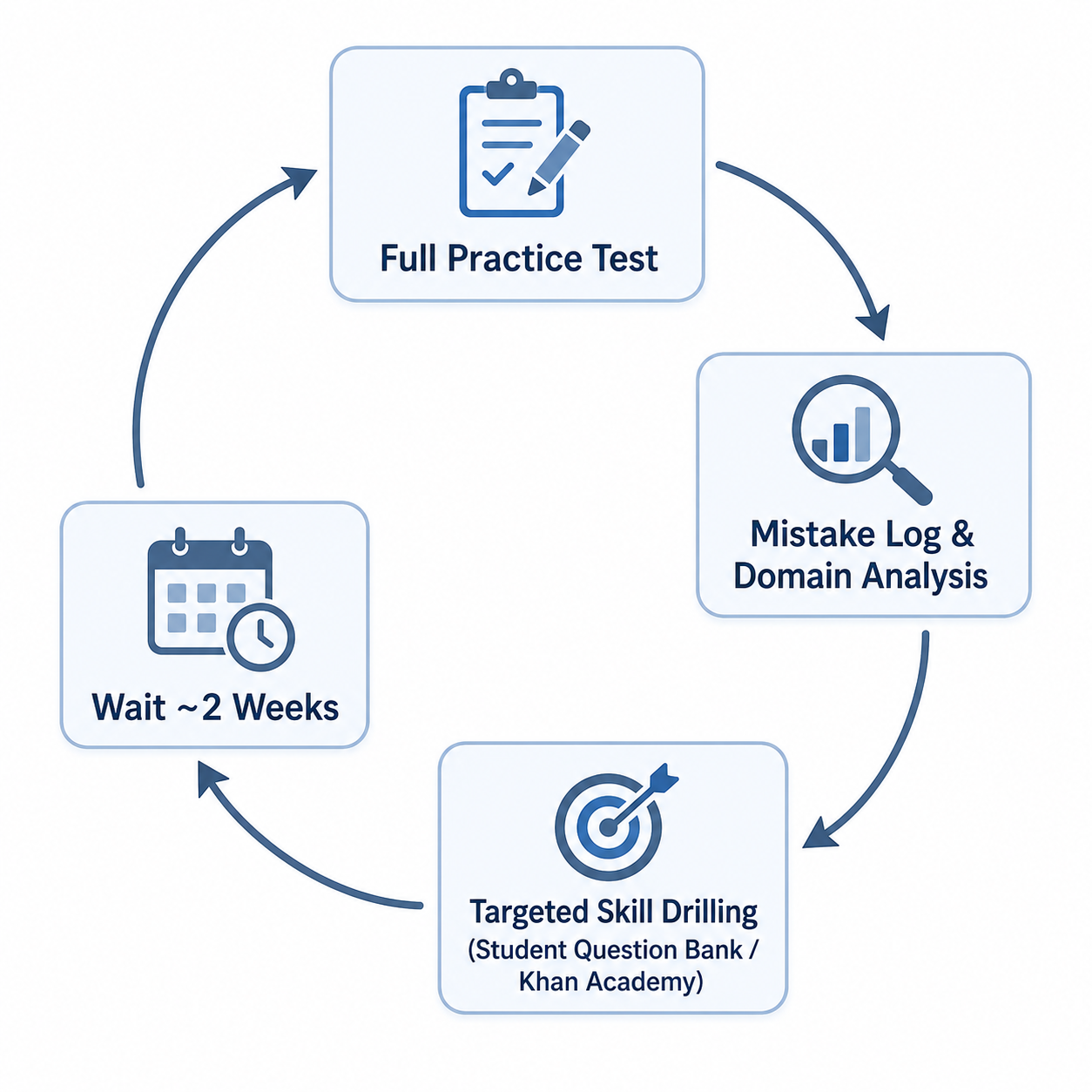
- Take one official diagnostic or full Bluebook test under realistic timing.
- Review Reading and Writing by domain, not just by total score.
- Build a mistake log that separates careless errors from skill gaps.
- Drill the weakest skills with Khan Academy or the Student Question Bank.
- Redo missed or similar questions after a delay.
- Take another full test after about two weeks, then repeat the cycle.
If you are planning across a whole semester or summer, this rhythm fits naturally into a longer digital SAT practice schedule. For a full-test strategy across Reading and Writing plus Math, use the broader SAT Exam Prep Guide rather than trying to make an English-only plan do every job.
How to Review a SAT English Practice Test
The review should take longer than students expect. Not forever, not performatively, but long enough that every missed question becomes a decision about what to practice next. A fast review that only says “I knew that” is usually just disappointment in disguise.
First, separate careless errors from skill gaps
A careless error is not just any question you think you “should have” gotten right. Be stricter. Mark it careless only if you can now answer it correctly, explain why, and identify the specific testing behavior that caused the miss: misread the word “except,” ignored a comma, chose too quickly, skipped the graph label, or failed to reread the sentence after inserting the answer.
A skill gap means you did not know what to do, could not narrow the answer choices for a valid reason, or used a shaky shortcut. “It sounded right” is a skill gap for grammar. “It felt too extreme” may be a useful instinct for inference questions, but it is not a complete explanation. You need to locate the evidence or the rule.
Then, tag each miss by domain and smaller skill
Your mistake log can be a spreadsheet, notebook, or document. The tool matters less than the categories. For each missed or guessed Reading and Writing question, record the test, module, question number, domain, smaller skill, reason missed, and next action.
| Log column | What to write |
|---|---|
| Domain | Craft and Structure, Information and Ideas, Standard English Conventions, or Expression of Ideas |
| Skill | For example: transition, sentence boundary, inference, vocabulary in context, command of evidence |
| Reason missed | Careless read, rule not known, evidence mismatch, time pressure, tempting wrong answer |
| Fix | Review rule, drill 10 similar questions, redo later, slow down on question stem |
| Redo date | A later date when you will attempt the question again without looking at the explanation |
The smaller skill label is the part that turns the log into a study plan. “Grammar” is too broad. “Comma splice and semicolon confusion” gives you something to fix. “Reading” is too broad. “Chose an answer that was true but not supported by the passage” gives you a pattern to watch.
Use explanations, but do not let them do all the work
For each missed question, write your own one- or two-sentence explanation before reading someone else’s. For a grammar question, name the rule. For a transition question, state the relationship between the ideas. For an evidence question, point to the words in the passage that make the correct answer necessary.
Then read the official or platform explanation and revise your note. If the explanation says the correct answer is “more precise,” write what it is more precise about. If it says an answer is “unsupported,” write which word or claim goes beyond the passage. This is tedious in the way piano scales are tedious: not glamorous, but hard to replace.
Redo missed questions after a delay
Redoing a missed question immediately mostly tests whether you remember the explanation. Redoing it later tests whether the reasoning stuck. Put missed questions back in front of yourself after several days, mixed with similar questions if possible, and cover your old notes before answering.
If you miss it again, do not just mark it wrong twice. Change the next action. A repeated transition miss may need a short lesson on logical relationships. A repeated punctuation miss may need rule review before more questions. A repeated inference miss may mean you are still choosing answers that are plausible rather than proven.
What to Drill Between Full Tests
The two weeks between full practice tests should not be empty waiting time. They are where most of the score movement has a chance to happen. Use your mistake log to choose one or two priorities, then practice enough similar questions to see whether the pattern changes.
- If you miss sentence-boundary questions, review independent and dependent clauses, then drill punctuation questions until you can explain every comma, period, colon, semicolon, and dash.
- If you miss transitions, stop memorizing transition lists in isolation and practice naming the relationship between the two ideas before looking at the answer choices.
- If you miss vocabulary-in-context questions, practice replacing the word with your own plain prediction before reading the options.
- If you miss evidence or inference questions, force yourself to underline or restate the exact support before choosing an answer.
- If timing is the issue, practice short timed sets rather than retaking full tests every time you feel anxious.
A good drill set has a narrow purpose. “I did 40 English questions” is less useful than “I did 12 transition questions and missed 4 because I confused contrast with continuation.” The second sentence tells you what tomorrow’s practice should be.
Where Third-Party SAT English Practice Fits
Third-party resources can be helpful, especially once you have already taken an official diagnostic and know what you are trying to improve. Erica Meltzer’s books are often used for targeted reading and grammar instruction. UWorld can be useful for high-volume question practice and explanations. PrepScholar can help students who want a more guided prep structure. The right add-on depends on your score goal, budget, and whether you need lessons, questions, analytics, or accountability.
The caution is that not every page labeled current or updated is actually aligned to the digital SAT Reading and Writing section. PrepScholar notes that many free third-party SAT reading practice tests use outdated paper-format structures or passage difficulty levels that do not match the current digital test, which can skew score expectations. [6]
Before using an unofficial SAT English practice test, check it against the current format. Does it use short passages attached to individual questions? Does it separate Reading and Writing skills in a way that resembles the digital test? Are explanations specific enough to teach the rule or reasoning? Does it avoid pretending to give an official score from a non-official test design?
Free tools and AI-supported practice can be useful as supplements, but they need the same scrutiny. A resource such as a Gemini free SAT practice test may help you generate extra practice or experiment with explanations, but it should not replace Bluebook for official test rehearsal. If you are building a full set of resources, use a SAT prep toolkit that starts with official materials and adds outside tools only for a clear purpose.
A Simple Resource Order That Prevents Wasted Practice
If you are starting now, do not open ten tabs. Use this order.
- Take one official Bluebook test or diagnostic-style practice session seriously enough that the results mean something.
- Review Reading and Writing misses by domain and smaller skill.
- Use Khan Academy for official guided practice in the weak areas.
- Use the Student Question Bank to filter and drill specific skills and difficulties.
- Add third-party books, platforms, or AI tools only when you can name what they are doing that the official materials are not.
- Wait about two weeks before the next full test, then compare patterns rather than just scores.
That last comparison matters. If your score rises but the same punctuation errors remain, the next plan should still include punctuation. If your score stays flat but careless Module 1 mistakes drop, you may be building the control you need before the score catches up. If your timing improves but inference accuracy falls, you may have sped up the wrong part of the process.
The strongest SAT English practice plan is not the one with the most tests. It is the one where each test produces a short list of skills to fix, each drill set responds to that list, and each new full test is spaced far enough away to show whether the practice worked.
References
- SAT Reading and Writing, College Board.
- Digital SAT Reading & Writing Section, Test Innovators.
- The Digital SAT: The SAT Is Changing Again, JRA Educational Consulting.
- Digital SAT Changes: Complete 2026 Guide, Test Prep Scout.
- Build Your Study Plan, College Board.
- The Best SAT Reading Practice Tests, PrepScholar.
Supporting Resources
- A Complete Guide to Kaplan SAT Prep Plans for 2026 →
A detailed breakdown of every Kaplan SAT prep plan for 2026, including On Demand, Live Online, Bootcamp, Unlimited Prep, and Private Tutoring, with honest pricing, features, and limitations to help you decide which plan is worth your money.
- SAT Exam Prep Guide: Best Tools, Study Plans, and Section Strategies for the Digital SAT →
A complete prep hub for high school students taking the digital SAT in 2026, covering the right tool stack, timeline-matched study plans, and section-specific strategies — with a free-first approach built around Bluebook, Khan Academy, and spaced repetition flashcard apps.
- How to Use SAT Practice Test 1 as a Diagnostic Baseline →
Learn how to use the original digital SAT Practice Test 1 as a free diagnostic baseline — where to find it after its Bluebook removal, how to score it, and how to interpret results to build a targeted study plan while understanding why it is noticeably easier than the current SAT.
Comments
Join the discussion with an anonymous comment.