
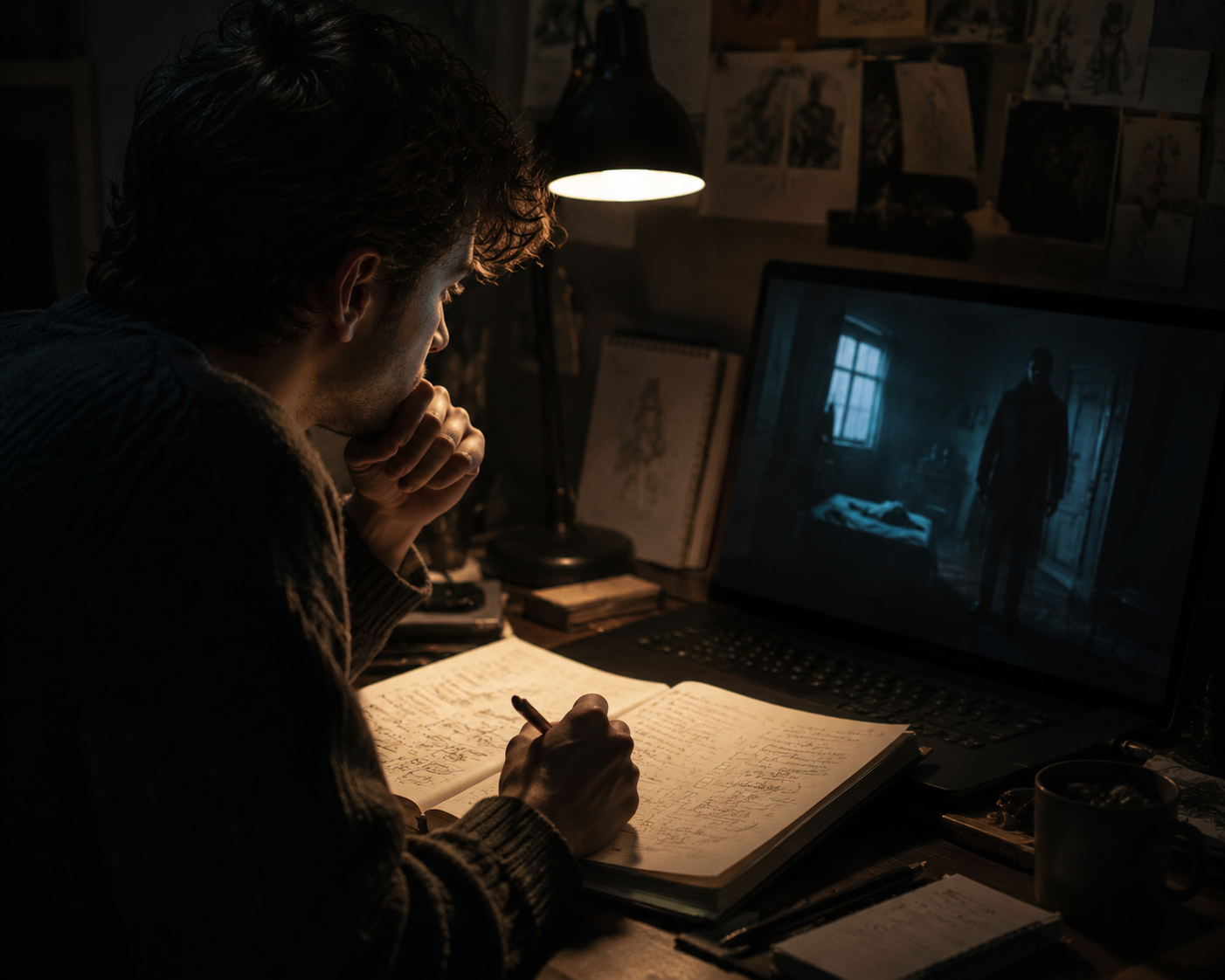
How to Study Horror Icon Acting Techniques
Actors can move beyond passive viewing by using a structured methodology to analyze horror performances. This guide breaks down vocal, physical, and psychological techniques from iconic horror actors and provides a repeatable scene-analysis framework for deliberate practice.
Updated:
A horror icon is easy to admire and surprisingly hard to study. If an actor watches only for impact, the notes tend to come out useless: terrifying stare, great scream, creepy stillness. None of that tells you what to rehearse on Monday afternoon, how to repeat it on take seven, or how to keep your voice and nervous system intact while doing it.
The useful version of a horror icon acting techniques study starts smaller. Pick one scene. Find the playable circumstances. Separate the work into vocal, physical, and psychological demands. Then write down what can be practiced safely without copying the whole performance like a costume.
That distinction matters in horror because the genre exposes the actor’s instrument. Breath is not hidden. Tension is not hidden. The timing of a turn, the choice to blink or not blink, the way a scream begins in the body before it reaches the mouth: all of it sits close to the surface. Maika Monroe has called horror “arguably the hardest genre for an actor,” a claim that is less useful as a ranking than as a warning about the workload involved.[1]
Turn Watching Into Scene Work
The cleanest starting point is not the scare. It is the scene. Maggie Flanigan Studio’s guide to studying acting in movies recommends breaking a scene through previous circumstance, emotional relationship, objective, and action: what just happened, who this person is to the actor’s character, what the character wants, and what the character does to get it.[2] That is ordinary acting homework, which is exactly why it belongs here. Horror does not cancel scene study; it punishes the actor who skips it.
Before analyzing a possession, a final-girl chase, or a villain’s stillness, write the scene in playable terms. “She is scared” is not enough. “She needs her brother to believe her before the thing reaches the door” gives the performer a pressure line to follow. “He is evil” is not enough. “He needs the victim to accept his rules” gives the stillness a tactic.
| Study pass | Question to answer | What to write down |
|---|---|---|
| Circumstance | What happened immediately before this moment? | The event the actor appears to be carrying into the first beat |
| Relationship | Who has power, history, intimacy, or danger in the room? | The relationship pressure that changes the actor’s behavior |
| Objective | What does the character need right now? | A playable want, not a mood label |
| Action | What does the actor do to pursue that want? | Verbs such as threaten, plead, delay, seduce, test, hide, provoke |
| Craft domain | Where is the labor most visible? | Vocal, physical, psychological, or a combination |
| Practice note | What can be isolated safely? | One small exercise, boundary, or observation for rehearsal |
This keeps the actor from turning study into mimicry. You are not trying to “do Toni Collette” or “do Candyman.” You are trying to identify the actor’s choices under pressure: where the breath changes, when the body commits, how the character keeps pursuing something even when the circumstances become extreme.
The Three Domains Worth Separating
Horror performances often look indivisible because the image is so strong. A face in a doorway, a body crawling backward, a scream held longer than comfort allows: the viewer receives one shock. The actor studying it has to take it apart.
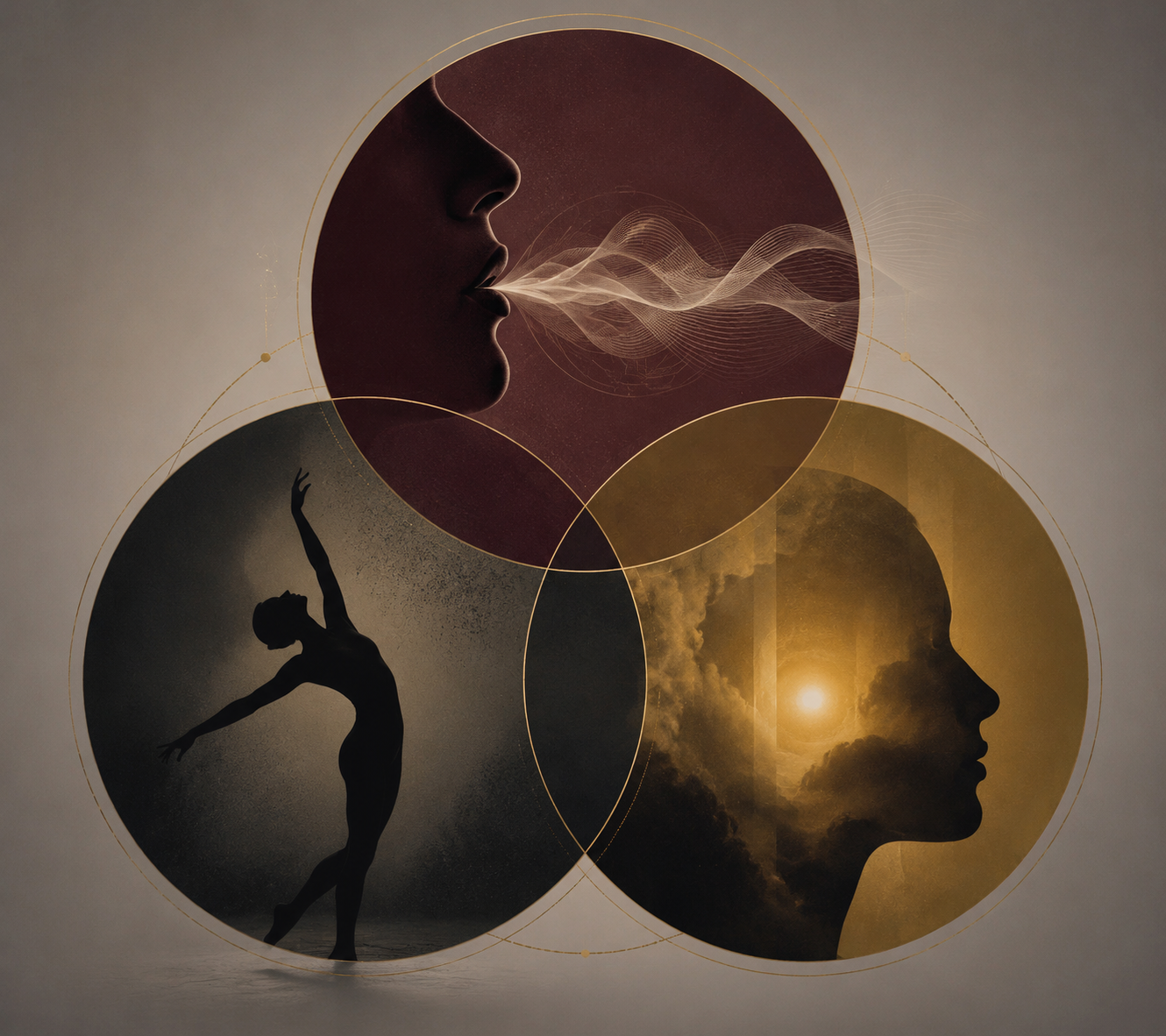
Use three domains as a temporary separation, not a permanent theory. First, what is the voice doing? Second, what is the body doing? Third, what route into fear, threat, grief, control, or obsession seems to be operating? After that, put the domains back into the scene objective. A technically impressive scream that does not pursue anything is still only a noise.
Vocal Technique: Study the Scream Before You Attempt It
The amateur note is “great scream.” The actor’s note is more specific: where does the breath begin, how open is the jaw, does the sound sit forward or press in the throat, does it break, does it cut off, and what happens in the silence after it?
StageMilk’s horror acting guide gives a simple safety principle for screaming: start quietly and move the sound toward the nasal cavity rather than forcing volume from the throat.[1] That is not a decorative tip. It changes how you watch. When a horror actor screams repeatedly, the question is not only whether it sounds frightening. It is whether the performer appears to be using breath, resonance, and release in a way that could survive rehearsal and multiple takes.
This is where fan-service language gets lazy. Calling a scream “raw” can praise the result while erasing the management behind it. A scream may look uncontrolled because the character is uncontrolled. The actor still needs technique. Watch for preparation: the inhale before the shock, the muscular bracing, the use of pitch, and whether the performer lets the sound end or keeps clamping after the cut-off.
- Track breath: mark the inhale, held breath, gasp, scream, sob, or silence.
- Track placement: note whether the sound seems throaty, forward, nasal, chest-heavy, whispered, or released.
- Track escalation: notice whether the actor jumps to full volume or builds through smaller sounds.
- Track recovery: watch what the actor does after the sound, because recovery is part of the performance.
- Practice cautiously: rehearse shape, breath, and resonance at low intensity before adding volume.
Growls, demonic textures, and strangled panic deserve the same caution. The study task is not to reproduce Linda Blair’s vocal extremity or any other famous sound at full force in a bedroom. It is to identify what kind of vocal event the scene uses, what it communicates, and what training or supervision would be needed before attempting anything similar.
Physical Commitment: The Body Has to Know the Room
Horror acting is often discussed as emotion, but a great deal of it is logistics under terror. The actor has to hit marks in darkness, miss furniture by inches, coordinate with stunt teams, sustain awkward positions, and make repeated takes look like first-time danger.
Backstage’s horror acting guide points to Samara Weaving’s physical demands in “Azrael,” including hanging upside down in trees, and Jamie Lee Curtis’s stunt coordination work in “Halloween.”[3] Those examples are useful because they move the conversation away from aura. Physical commitment is not “being fearless.” It is preparation, spatial awareness, trust, and repeatability.
When studying a chase or attack scene, pause before the impact moments. Where does the actor look before moving? How early does the body anticipate the turn? Is the fear carried high in the shoulders, low in the hips, in frozen feet, in hands that keep searching for an exit? The body usually tells you what the character knows before the dialogue does.
Essie Davis’s preparation for “The Babadook” has been discussed in relation to butoh-influenced movement work, a reminder that unusual horror physicality may come from disciplined movement sources rather than spontaneous weirdness. The practical lesson is not that every actor should study the same form. It is that distorted movement still needs an organizing principle.
- Map the space: doors, furniture, weapons, stairs, windows, hiding places, and camera-facing angles.
- Mark the body’s center: lifted chest, collapsed ribs, locked pelvis, forward head, grounded feet, or floating balance.
- Watch transitions: fear often appears in the shift from stillness to motion, not only in the motion itself.
- Separate acting from stunt work: do not rehearse falls, restraints, weapons, or impacts without appropriate supervision.
Villain stillness belongs here too. A motionless figure is not automatically powerful. Study the stillness as physical action: what is fixed, what remains available, where the gaze lands, whether the actor seems relaxed, predatory, dissociated, ceremonial, or simply waiting. A still body can be full of tactics; it can also be empty posing. The difference is visible if you watch long enough.
Psychological Access: There Is More Than One Door Into Fear
The most delicate part of horror study is psychological access. Actors do not all enter fear the same way, and they should not be pressured to prove seriousness by harming themselves. The work is to find a playable route, not to romanticize distress.
Ivana Chubbuck describes one repeatable fear-induction exercise: identify 15–20 reasons for living, select the most powerful one, and imagine that reason being threatened.[4] The value of the exercise is its structure. It gives the actor an objective-based survival stake rather than asking for vague terror. It also makes the boundary obvious: if the exercise becomes destabilizing, the actor needs to stop, adjust, or work with a qualified teacher.
Other actors use different doors. Daniel Kaluuya has discussed drawing on lived experience with racism for the Sunken Place scene in “Get Out,” while Mary Elizabeth Winstead has been cited in relation to imagination-based work in heightened horror and fantasy circumstances.[5] Those are not interchangeable methods. Lived experience, imaginative substitution, technical concentration, and relationship-based objectives can all produce truthful behavior, but they carry different costs and boundaries.
A useful journal entry therefore avoids declaring what the actor “must have felt.” Write what is observable first: the breath stops, the eyes fix, the voice thins, the body resists looking, the hand reaches before the character commits. Then write a cautious hypothesis about the route: perhaps the actor is playing disbelief, bargaining, humiliation, survival, revenge, or dissociation. Keep the word perhaps. It prevents bad certainty.
Toni Collette’s reported practice of spending an hour on an elliptical after “Hereditary” shoots to clear the work is worth treating as craft information, not trivia.[1][3] The exit from an intense scene belongs in the study notes. If the analysis only records how an actor enters anguish and never asks how a performer leaves it, the method is incomplete.
A Repeatable Study Routine
Use one scene for a full pass rather than grazing across ten famous moments. A possession scene, a home-invasion sequence, a villain monologue, a chase, or a grief eruption can all work. The scene should be demanding enough to reveal craft, but not so chaotic that you cannot track choices.
- Watch once without pausing. Record your immediate response in plain language.
- Watch again for scene circumstances: previous event, relationship, objective, and action.
- Watch only the voice. Keep your notes on breath, pitch, volume, resonance, silence, and recovery.
- Watch only the body. Track posture, weight, gaze, rhythm, space, and any stunt or movement demands.
- Watch for psychological access. Name observable behavior before guessing at inner process.
- Choose one safe practice item. Do not rehearse the entire iconic performance.
For example, a hypothetical student studying a final-girl scene might discover that the most useful practice item is not the scream. It might be the three seconds before the scream: the breath catches, the body refuses to move, the eyes search for confirmation, and the objective changes from hiding to escaping. That can become a low-intensity rehearsal exercise in breath and decision-making without forcing the actor into full panic.
Another student studying a villain might find that the lesson is relaxation. Brian Timoney’s case study of Jack Nicholson describes Nicholson’s months-long asylum immersion for “One Flew Over the Cuckoo’s Nest” and emphasizes a relaxation-to-neutral technique.[6] The duration of Nicholson’s preparation is widely repeated with some variation, so it should not be treated as a neat formula. The more useful point is that menace can come from looseness as much as tension. If the body is over-signaling “scary,” the audience can see the actor working.
Character Grounding Keeps the Horror Playable
The more extreme the scene, the more ordinary the actor’s playable question may need to be. Backstage’s guide points to a “why now?” approach to horror backstory: why does this event break open at this moment, for this person, in this scene?[3] That question helps prevent generalized hysteria. It also helps with villains and supernatural figures, whose danger often collapses when the actor plays only the audience’s label for them.
Tobin Bell’s work as Jigsaw is a useful kind of study object for this reason. The performance does not ask the actor to copy a voice or posture first. It asks a better question: how does the character justify the action to himself? Once that justification is playable, vocal tempo, physical economy, and psychological pressure have somewhere to live.
The same applies to a victim role. If the character is only “terrified,” the actor has nowhere to go except louder. If the character needs to protect a child, conceal knowledge, test whether a captor is lying, or stay conscious long enough to escape, then fear becomes active. The horror remains heightened, but the acting problem becomes specific.
What to Put in the Journal
The journal is where admiration becomes study. It should not read like a review. Keep it closer to rehearsal notes: observable choice, possible function, safe practice version, and boundary.
| Journal field | Example of a useful note | Example of a weak note |
|---|---|---|
| Observable choice | The actor inhales twice before speaking and does not blink during the reply. | The actor is incredibly creepy. |
| Scene function | The stillness delays the other character and forces them to fill the silence. | The stillness is iconic. |
| Domain | Physical stillness with vocal restraint. | Scary vibe. |
| Practice version | Rehearse a low-volume objective scene using stillness to pressure a partner. | Try to act like that character. |
| Boundary | No full-volume screaming; no restraint or fall work without supervision. | Push harder until it feels real. |
If you already use structured study tools, this will feel familiar. The same discipline behind methods like retrieval practice or building a study guide from a syllabus can apply here: isolate the material, test what you can recall, and convert observation into a repeatable exercise. The difference is that the “material” is a living instrument, so the ethical boundary matters more.
Practice Without Copying the Icon
Copying has a short shelf life. You may learn the outline of a famous stare, limp, whisper, or scream, but you will also inherit choices that belonged to another actor’s body, face, training, director, camera setup, and edit. Study should make you more available, not more imitative.
A better exercise is extraction. Take one craft element and move it into neutral material. Practice a breath pattern on a simple line. Practice stillness while pursuing a clear objective in an ordinary scene. Practice a low-intensity fear trigger through Chubbuck’s survival-stakes structure, then release it and write down what helped you come back.[4] Practice a physical hesitation before crossing a room, without adding a horror face on top of it.
This is also where the limits of the source base should keep everyone honest. Much of the available material on horror acting craft comes from trade publications, acting schools, coach interviews, and performer accounts rather than peer-reviewed research focused specifically on horror performance. That does not make it useless. It does mean the framework should be treated as practitioner synthesis: good for organizing observation and rehearsal, not as settled science.
Horror icons are not templates to copy wholesale. They are case studies. The actor’s job is to mine them for isolated, deliberate, and ethically managed craft practice: a safer scream, a clearer objective, a braver physical commitment, a more precise way into fear, and an equally precise way back out.
References
- A Comprehensive Guide To Acting In Horror Movies, StageMilk
- A Detailed Guide On How To Study Acting In Movies, Maggie Flanigan Studio
- How to Act in a Horror Movie, Backstage
- Scared Acting, Backstage
- How to Act Truthfully in Horror and Fantasy, Casting Networks
- Case Study: Jack Nicholson's Method Acting, Brian Timoney Acting
Comments
Join the discussion with an anonymous comment.