

How Congress Works: A Complete Study Guide for AP Government
This comprehensive study guide covers the structure, powers, committees, and legislative process of the U.S. Congress, helping AP Government and college civics students master Article I and how bills become laws.
Updated:
Congress starts to make sense when it stops being a pile of terms and becomes one machine. Article I creates a national legislature with two chambers, separate election cycles, different constituencies, and a lawmaking process that forces agreement at several points before anything reaches the president. That design is why Congress can feel slow even when everyone can name the problem being debated.
The organizing question is not just “What does Congress do?” It is “Where does this fact belong?” A term length belongs to chamber design. A tax power belongs to Article I. A markup belongs to committees. A veto override belongs to the last stage of the bill process. Once those pieces are sorted, the exam unit becomes much less slippery.
Article I Gives Congress the Blueprint
The Constitution places Congress in Article I, before the presidency and the federal courts. That placement matters for study purposes because Congress is not an afterthought in the constitutional system; it is the branch given the legislative power. The modern Congress has 535 voting members and traces its first meeting to 1789, but those facts are useful mainly because they point back to the same design choice: national lawmaking was placed in a representative body, not in one person’s hands.[1]
The Founders did not design Congress to be quick. Colleen Sheehan, quoted in the National Constitution Center’s materials on Congress, describes the design as placing “obstacles in the path of factions.” Hamilton’s language in Federalist No. 70 also treats Congress as a place for “deliberation and circumspection.”[1] That does not mean every delay is noble or every procedure is wise. It does mean students should expect the process to contain friction: two chambers, committees, floor rules, identical passage, and presidential action.
A quick current-events note can help separate popularity from structure. Gallup reported that 10% of Americans approved of Congress and 86% disapproved in polling conducted April 1–15, 2026.[2] That number may explain public frustration, but it does not explain how Congress works. Exams usually want the mechanics: who has the power, which chamber acts, what vote threshold applies, and where a bill is in the process.
Bicameralism: The House and Senate Are Built Differently
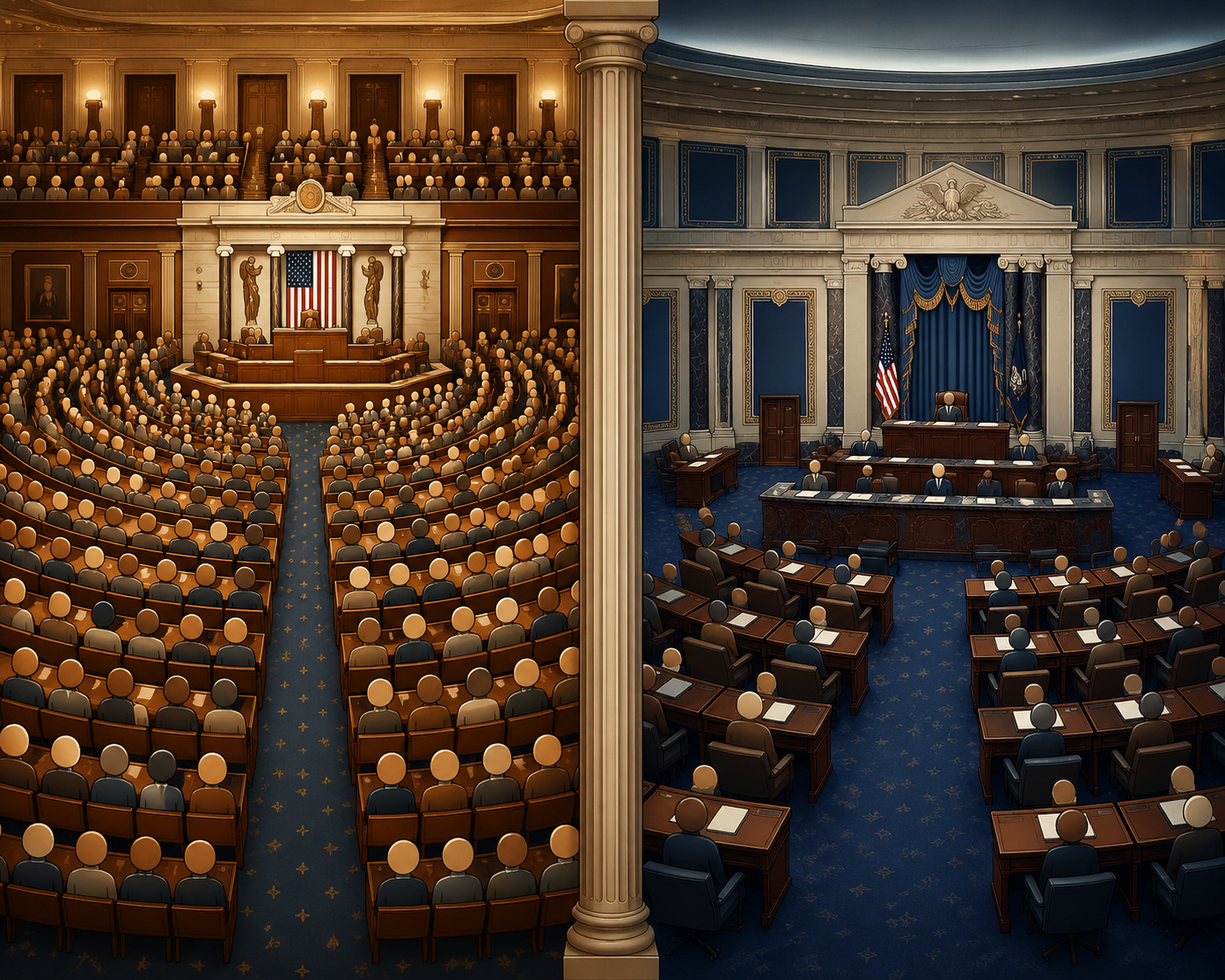
Bicameralism means Congress has two chambers: the House of Representatives and the Senate. Do not treat them as two versions of the same room. They differ in size, term length, constituency, constitutional qualifications, rules, and exclusive powers. Many exam mistakes begin when a student remembers a power correctly but attaches it to the wrong chamber.
| Feature | House of Representatives | Senate |
|---|---|---|
| Membership | 435 members | 100 members |
| Representation | Population-based by state | Two senators per state |
| Term length | 2 years | 6 years, staggered so about one-third are up every 2 years |
| Minimum age | 25 | 30 |
| Citizenship requirement | 7 years | 9 years |
| Major exclusive powers | Initiates revenue bills; initiates impeachment charges | Confirms appointments; ratifies treaties; holds impeachment trials |
The House has 435 members, with seats apportioned by state population. Representatives serve two-year terms, must be at least 25 years old, and must have been U.S. citizens for at least seven years. The House’s shorter terms and population-based districts make it the chamber more directly tied to shifts in public opinion.[3]
The Senate has 100 members, two from each state. Senators serve six-year terms, with roughly one-third of the chamber up for election every two years. Senators must be at least 30 years old and must have been U.S. citizens for at least nine years. The Senate’s equal state representation and longer terms make it a very different institution from the House, even though both chambers must usually agree before a bill becomes law.[3]
That last phrase, “both chambers must usually agree,” carries a lot of exam weight. A bill does not become law because the House passes it. It does not become law because the Senate likes the idea. The two chambers must pass identical text before the bill can be sent to the president.[4]
Congressional Powers: Enumerated, Implied, and Chamber-Specific
Congressional power comes in layers. Some powers are listed directly in the Constitution. Some are implied from the authority Congress needs in order to carry out listed powers. Some belong to only one chamber. If those categories blur together, the unit becomes a memorization trap.
Enumerated Powers
Enumerated powers are powers specifically listed in the Constitution. Article I, Section 8 gives Congress power to tax, borrow money, regulate interstate and foreign commerce, coin money, establish post offices, declare war, raise and support armies, provide a navy, and pass laws needed to execute its constitutional responsibilities.[5] These are not just vocabulary words; they are the constitutional foundation for what Congress can do.
The power to tax and spend is especially important because it gives Congress control over national revenue and public funding. The power to regulate commerce explains why Congress appears in so many policy areas involving economic activity across state or national borders. The power to declare war separates Congress’s formal constitutional authority from the president’s role as commander in chief.
Implied Powers and the Necessary and Proper Clause
The Necessary and Proper Clause, sometimes called the elastic clause, lets Congress make laws necessary and proper for carrying out its enumerated powers. This is the constitutional basis for implied powers: powers not named word-for-word in the text but connected to responsibilities the Constitution does name.[5]
For exam writing, the safest move is to connect the implied power back to an enumerated power. Do not simply say, “Congress can do this because of the elastic clause.” Say what listed power Congress is trying to carry out, then explain how the Necessary and Proper Clause supports the means Congress chose.
Exclusive Chamber Powers
Some congressional powers belong specifically to the House or the Senate. The House originates revenue bills and initiates impeachment by approving charges. The Senate confirms presidential appointments by majority vote, ratifies treaties by a two-thirds vote, and holds impeachment trials, with a two-thirds vote required to convict.[3][6]
| Power | Who Acts | Exam Distinction |
|---|---|---|
| Revenue bills | House initiates | The Senate can still act on legislation, but revenue bills begin in the House |
| Impeachment charges | House | A majority vote initiates impeachment |
| Impeachment trial | Senate | A two-thirds vote is required to convict |
| Appointments | Senate | Confirmation requires a majority vote |
| Treaties | Senate | Ratification requires a two-thirds vote |
Impeachment is the place where students most often need to slow down. The House does not conduct the trial. The Senate does not initiate the charges. The House impeaches; the Senate tries the case. Conviction and removal require the Senate’s two-thirds threshold.[6]
Committees Are Where Congress Filters the Work
The full House and full Senate cannot give equal attention to every proposal. Committees make Congress workable by dividing labor, developing expertise, holding hearings, revising bills, and deciding which proposals move forward. A student who skips committees usually ends up with a cartoon version of lawmaking: bill introduced, debate happens, vote happens. The real path is more selective than that.
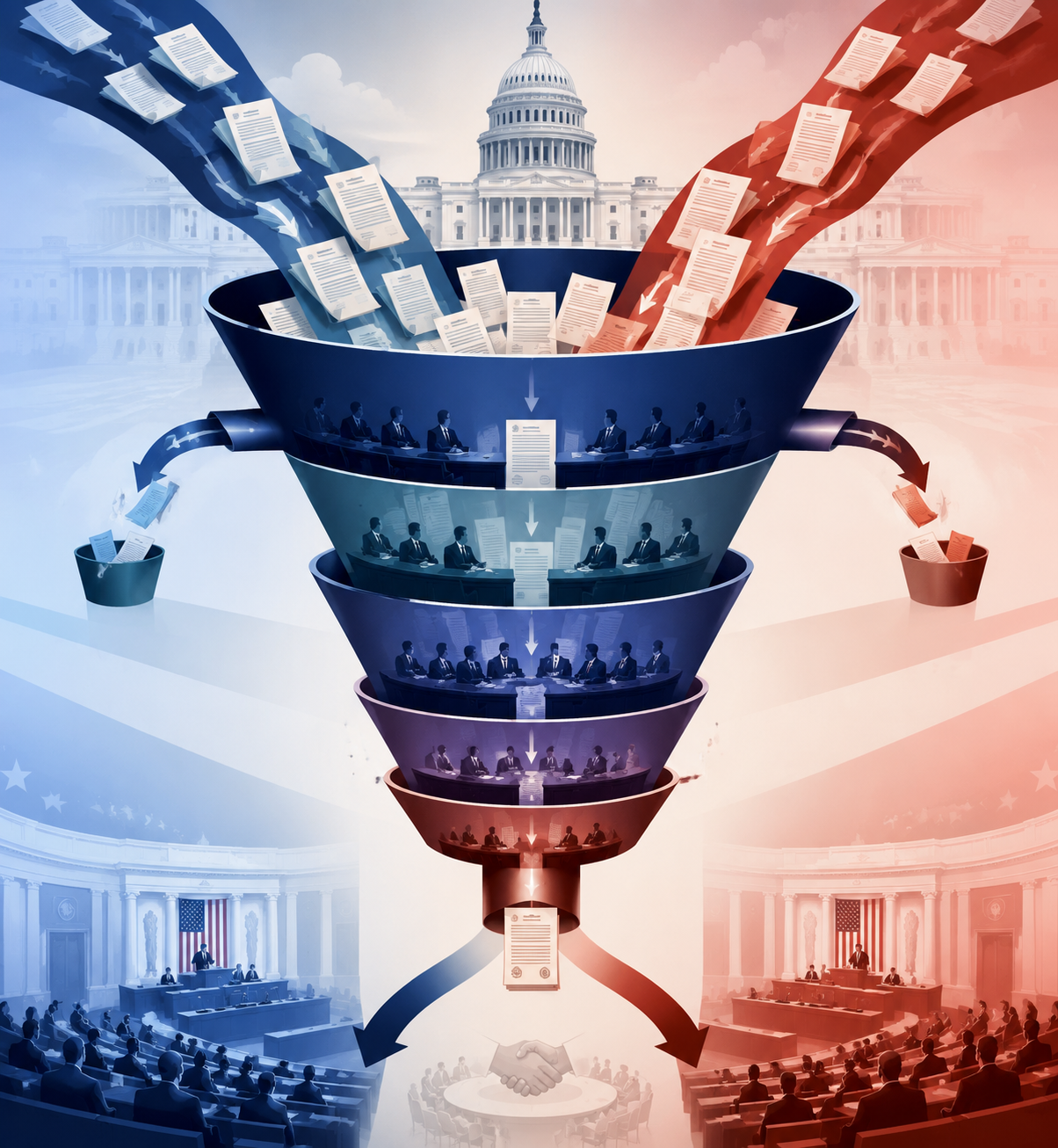
Congress uses several committee types. Standing committees are permanent committees organized around continuing policy areas. Select committees are usually temporary or created for special purposes. Joint committees include members from both chambers. Conference committees are temporary committees used to reconcile different House and Senate versions of a bill. Current committee counts can change, but one widely cited snapshot lists 20 House standing committees, 16 Senate standing committees, and more than 200 total committees and subcommittees.[7]
The taxonomy matters, but referral and markup matter more for understanding the process. Referral is the assignment of a bill to the committee or committees that handle its subject matter. A bill on agriculture, defense, taxation, or education does not float around Congress waiting for anyone to pick it up; it is sent into the committee structure where members and staff examine it more closely.
Markup is the committee stage where members debate, amend, and vote on the bill’s actual language before deciding whether to report it to the floor.[7] That is why markup is not the same thing as floor debate. Markup happens inside committee; floor debate happens before the full chamber under that chamber’s rules.
Committees can also be where bills die. A committee may hold hearings and revise a proposal, but it may also decline to move it forward. The House process includes a discharge petition as a possible bypass mechanism, but the ordinary path still runs through committee review.[4]
How a Bill Becomes a Law
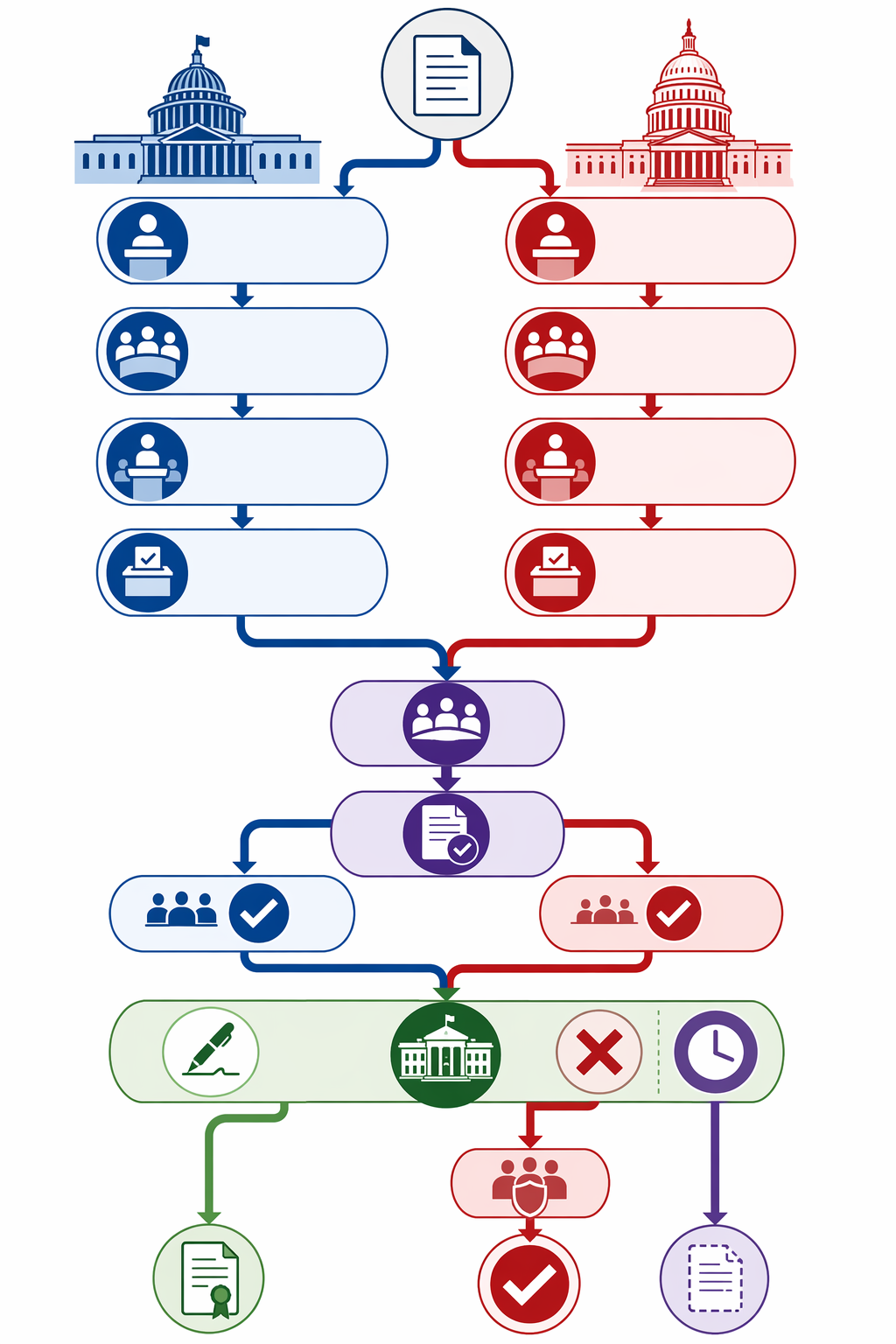
The bill-to-law sequence is the center of the Congress unit because it forces together Article I, bicameralism, committees, floor rules, presidential action, and checks and balances. The basic idea is simple: a bill must survive introduction, committee review, floor action, passage in both chambers, identical final approval, and presidential action. The details are where points are won or lost.
| Stage | What Happens | Common Exam Trap |
|---|---|---|
| Introduction | A member introduces a bill; House bills receive H.R. numbers and Senate bills receive S. numbers | A bill can begin in either chamber unless a special rule applies, such as revenue bills originating in the House |
| Committee referral | The bill is sent to the relevant committee | Referral is not the same as a floor vote |
| Committee action | Hearings, markup, amendments, and committee vote may occur | Markup is where bill language can change before floor debate |
| Floor debate | The full chamber considers the bill under House or Senate rules | House and Senate debate rules are not the same |
| Chamber vote | The chamber votes on passage | House majority math and Senate majority math differ |
| Other chamber | The bill must pass the second chamber too | One chamber’s passage is not enough |
| Conference or reconciliation | Differences between House and Senate versions are resolved | The final text must match |
| Identical passage | Both chambers approve the same text | Similar bills are not enough |
| Presidential action | The president signs, vetoes, allows the bill to become law without signature, or pocket vetoes it if conditions apply | A veto and pocket veto are not the same |
| Veto override | Both chambers can override with a two-thirds vote | The override must succeed in both chambers |
1. Introduction
A bill begins when a member of Congress introduces it. In the House, a bill is placed in the hopper. House bills receive “H.R.” numbers, while Senate bills receive “S.” numbers.[4][8] The number is not decoration; it tells you where the bill was introduced.
Most bills can be introduced in either chamber. Revenue bills are the major exception students should remember because the House has the constitutional role of originating them.[3]
2. Committee Referral
After introduction, the bill is referred to the committee or committees with jurisdiction over the subject. This is the first major narrowing point. The bill has a title and number, but it is not yet being debated by the full chamber.
In your notes, label this stage as sorting. Congress is deciding which smaller group will examine the bill before the full chamber spends time on it.
3. Committee Action: Hearings, Markup, and Vote
Committee action can include hearings, witness testimony, expert input, revision, and markup. During markup, committee members debate and amend the bill’s text. The committee then decides whether to report the bill to the full chamber.[7][8]
This is why a bill can change before the public sees dramatic floor speeches. The committee stage is not a waiting room. It is a workroom, and sometimes a graveyard.
4. Floor Debate Under House or Senate Rules
Once a bill reaches the floor, chamber rules matter. In the House, the Rules Committee plays a major role in setting the terms of debate, including how long debate may last and what amendments may be considered.[8] This fits the House’s size: 435 members cannot operate as if every member can speak indefinitely on every bill.
The Senate is smaller and has different norms. Senate debate often depends on unanimous consent agreements, and the filibuster can extend debate or block movement unless the chamber can overcome it under Senate rules.[4][8] The exam distinction is straightforward: House debate is more tightly structured; Senate debate is less majoritarian and more vulnerable to delay.
5. Chamber Vote
After debate, the chamber votes. A simple majority in the full House is commonly described as 218 of 435 members. A simple majority in the full Senate is commonly described as 51 of 100 senators, with the vice president able to break ties.[4]
Those numbers assume full membership and ordinary majority passage. They should not be confused with supermajority thresholds such as treaty ratification, impeachment conviction, or veto override.
6. The Other Chamber Must Act
If the House passes a bill, it goes to the Senate. If the Senate passes a bill, it goes to the House. The second chamber may approve it, reject it, ignore it, or pass a different version.[4] A student diagram should never jump from “passed the House” straight to “president signs” unless the Senate has also passed the same text.
7. Conference Committee and Reconciliation
If the House and Senate pass different versions, Congress must resolve the differences. A conference committee can be formed with members from both chambers to produce a compromise version.[7][8] This is not a third chamber. It is a temporary mechanism for reconciling text.
The key word is identical. The Constitution’s bicameral design requires both chambers to agree to the same bill before it goes to the president. Similar policy goals do not count if the legislative text differs.
8. Final Passage in Both Chambers
After differences are resolved, both the House and Senate must pass the final identical version. This stage can feel repetitive, but it is constitutionally important. Congress is not sending an idea to the president; it is sending an agreed-upon text.
9. Presidential Action
Once Congress sends an enrolled bill to the president, several outcomes are possible. The president may sign it, making it law. The president may veto it and return it to Congress. If the president does not sign it within 10 days, excluding Sundays, it becomes law if Congress remains in session. If Congress adjourns during that 10-day window and prevents return of the bill, the president can use a pocket veto, and the bill does not become law.[4][8]
The pocket veto is easy to confuse with an ordinary veto. An ordinary veto can be overridden. A pocket veto occurs under the adjournment condition and does not return the bill for an override vote.
10. Veto Override
If the president vetoes a bill, Congress can still make it law by overriding the veto with a two-thirds vote in both chambers. That is a high threshold by design. RepresentUs, citing Congressional Research Service Report RS22188, states that historically only about 7% of vetoes have been overridden.[6]
For exam purposes, the override rule belongs in two places at once: the legislative process and checks and balances. It is part of how a bill can become law, and it is also one way Congress can check the president.
Oversight: Congress Checks the Executive Branch
Oversight is not a separate decoration added after lawmaking. It grows out of Congress’s constitutional powers. If Congress funds programs, creates agencies, confirms officials, declares war, and writes statutes, it also has reasons to ask how executive officials are carrying out the law.
Congress uses hearings and subpoenas to investigate executive action, gather information, and question officials. It also uses the budget process and the power of the purse to shape what the executive branch can do. These tools matter because the president administers federal law, but Congress writes the laws and controls much of the funding structure.[6]
Foreign policy and national security show the overlap clearly. Congress has the power to declare war, raise and support armies, provide a navy, and fund military activity.[5] The War Powers Resolution of 1973 is one example of Congress trying to limit or structure presidential military action.[6] Students should not reduce this to “the president handles war.” The Constitution divides war powers, and the branches often contest the boundary.
Appointments and treaties are Senate-centered checks. The president nominates many executive and judicial officials, but the Senate confirms appointments by majority vote. The president negotiates treaties, but the Senate must ratify treaties by a two-thirds vote.[3][6] These are not powers of Congress as a single undifferentiated body; they are Senate powers.
Impeachment is the sharpest congressional check, and the chamber distinction must stay clean. The House initiates impeachment charges by majority vote. The Senate conducts the trial. Conviction requires a two-thirds Senate vote.[3][6] Saying “Congress impeaches and removes” is too loose for an exam answer unless the House and Senate roles are separated.
What to Attach to Each Part of the System
When reviewing Congress, sort facts by function. This prevents the common problem of knowing many correct details but having no way to use them in an answer.
- Article I: legislative power, enumerated powers, Necessary and Proper Clause, bicameral design.
- House design: 435 members, population-based districts, two-year terms, revenue bills, impeachment charges.
- Senate design: 100 members, equal state representation, six-year staggered terms, appointments, treaties, impeachment trials.
- Committees: referral, hearings, markup, reporting bills, conference reconciliation.
- Floor rules: House Rules Committee, structured debate, Senate unanimous consent, filibuster.
- Presidential action: signature, veto, 10-day no-signature rule, pocket veto, two-thirds override.
- Oversight: hearings, subpoenas, budget control, War Powers Resolution, confirmations, treaties, impeachment.
A strong AP Government answer usually does more than name a fact. It connects the fact to institutional design. The House’s two-year terms explain responsiveness. The Senate’s equal state representation explains why less populous states have equal Senate voting power. Committee markup explains why bills can change before floor debate. Identical passage explains why one chamber’s approval is not enough. A veto override explains both lawmaking and checks and balances.
Exam-Ready Congress Distinctions
| Do Not Confuse | Correct Distinction |
|---|---|
| Committee markup and floor debate | Markup revises bill text in committee; floor debate happens before the full chamber |
| House passage and lawmaking | A bill still needs Senate passage, identical text, and presidential action |
| Veto and pocket veto | A veto is returned to Congress; a pocket veto depends on adjournment during the 10-day window |
| Impeachment and conviction | The House impeaches; the Senate tries and may convict by two-thirds vote |
| Treaty negotiation and treaty ratification | The president negotiates; the Senate ratifies by two-thirds vote |
| Enumerated and implied powers | Enumerated powers are listed; implied powers rely on the Necessary and Proper Clause |
| Standing and conference committees | Standing committees are permanent; conference committees reconcile House and Senate bill versions |
The cleanest way to study Congress is to keep asking where each fact sits in the system. If it describes who is represented, it belongs to bicameralism. If it describes what Congress may do, it belongs to Article I powers. If it describes where a bill is examined and changed, it belongs to committees. If it describes how a proposal survives both chambers and reaches the president, it belongs to the legislative process. If it describes Congress monitoring, limiting, or removing executive power, it belongs to oversight.
Congress is complicated, but it is not random. The House and Senate are built differently, committees filter the workload, bills must pass through a deliberately demanding sequence, and oversight tools let Congress check the executive branch. Map each detail back to that structure, and the Congress unit becomes a system to understand rather than a list to survive.
References
- Module 7: The Legislative Branch: How Congress Works, National Constitution Center.
- Congress and the Public, Gallup, April 1–15, 2026.
- Congress of the United States, Encyclopaedia Britannica.
- How Laws Are Made, USA.gov.
- Article I, Section 8, National Constitution Center.
- What Does Congress Do?, RepresentUs.
- United States congressional committee, Wikipedia.
- The Legislative Process, U.S. House of Representatives.
Comments
Join the discussion with an anonymous comment.