
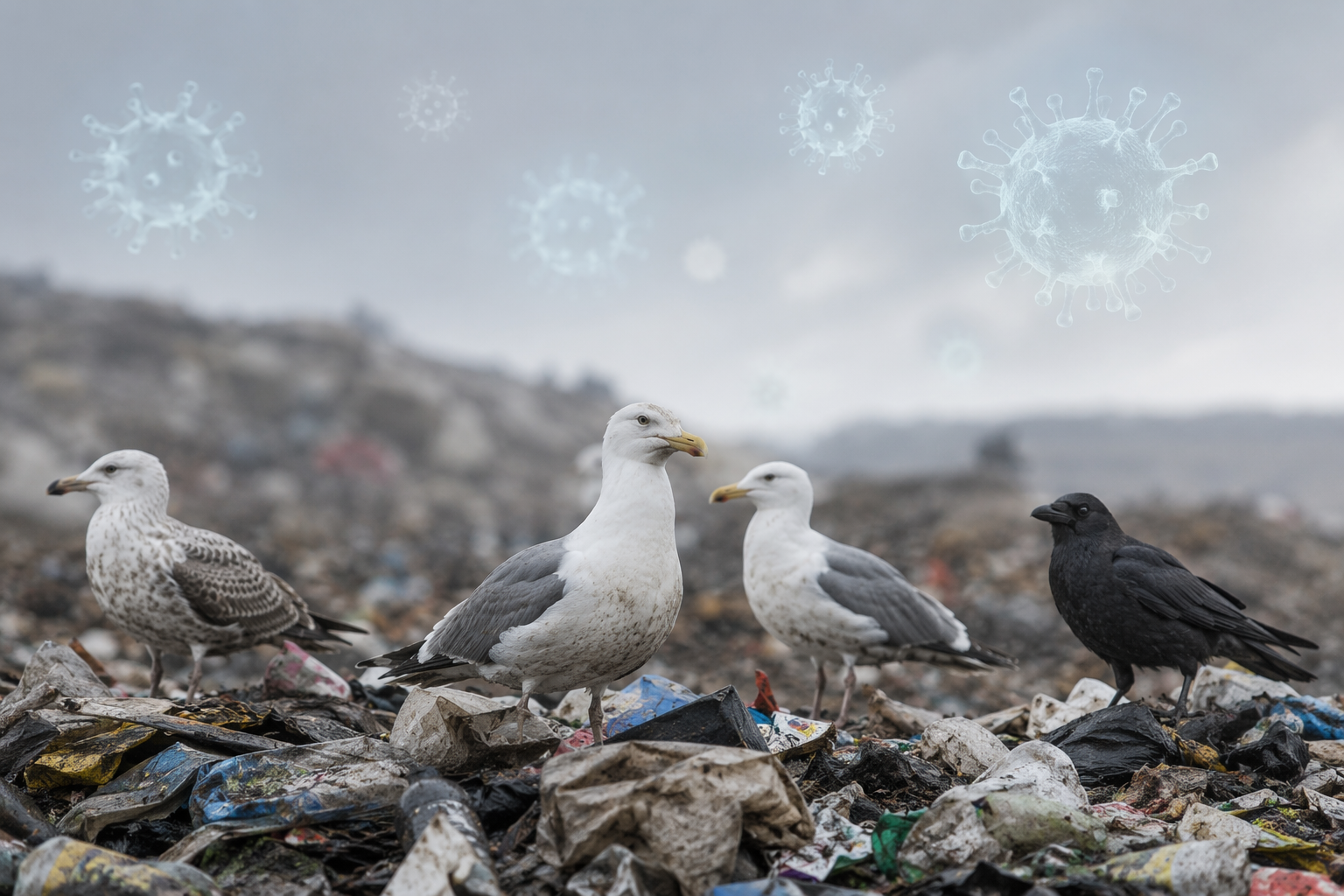
Can Gulls and Crows Carry Human Norovirus? A Student's Guide
This guide helps students interpret the Summa et al. (2018) study on human norovirus detection in wild birds, explaining the methods, key findings, and limitations of RT-PCR detection versus infectious transmission risk.
Updated:
If you searched for “norovirus outbreak in sea birds study,” there is one quick cleanup to do first: “Sea Bird” can point readers toward cruise-ship outbreak reporting, but this guide is about actual birds — mainly gulls and crows — in a peer-reviewed wild bird study. The paper students usually need is Summa et al. 2018, which tested fecal samples from Finnish dump sites and detected human norovirus RNA in 27% of wild bird samples, with the bird hosts identified by DNA barcoding.[1]
That result is worth remembering. It is also worth not over-reading. The study shows that human norovirus RNA was present in some wild bird feces collected under human-waste exposure conditions. It does not, by itself, prove that gulls or crows were infected in the biological sense, shedding infectious virus, maintaining human norovirus as reservoirs, or transmitting it back to people.
The result students quote first: 31 positive bird samples
Summa et al. collected 115 avian fecal samples, 100 rat samples, and 85 mouse samples from Finnish dump sites between 2008 and 2013. Human norovirus RNA was detected in 31 of the 115 bird samples, or 27%. By comparison, 2 of 100 rat samples were positive, and none of the 85 mouse samples were positive.[1]
| Sample group | Samples tested | Human norovirus RNA detected | What the comparison helps students see |
|---|---|---|---|
| Wild birds | 115 | 31 positive; 27% | The main finding: detection was relatively common in this sampling context. |
| Rats | 100 | 2 positive; 2% | Detection occurred, but much less often than in the bird samples. |
| Mice | 85 | 0 positive; 0% | No human norovirus RNA was detected in this sample set. |
The genogroup breakdown also matters. Of the 31 positive avian samples, 25 were genogroup II and 6 were genogroup I.[1] Students do not need to turn that into a full norovirus taxonomy lecture, but they should notice that the authors were not just reporting an undifferentiated “norovirus positive” signal. They were detecting human norovirus RNA and typing it into major human norovirus genogroups.
The bird-versus-rat-versus-mouse comparison is part of why the paper is memorable. If the only result were “some animal feces contained human norovirus RNA,” the interpretation would be much looser. Instead, the avian samples stood out against two mammal sample groups collected in the same broad dump-site surveillance frame.[1] That still does not make birds proven transmitters, but it does make the bird signal harder to dismiss as a stray laboratory curiosity.
The dump site is not a background detail
The samples came from Finnish dump sites, not from open-ocean seabird colonies, remote nesting cliffs, or a clean marine food web.[1] That distinction is not decorative. Dump sites are places where wild animals can encounter human-associated waste. If a gull or crow picks up human norovirus RNA there, the study may be telling us something about environmental exposure and movement of contaminated material, not necessarily about a stable wildlife reservoir.
This is where students often lose precision. “Detected in gulls and crows at dump sites” quietly turns into “sea birds spread norovirus.” The first phrase is anchored to the study design. The second phrase adds habitat, mechanism, and transmission direction that the study did not establish.
A careful discussion section should keep the setting visible. The study supports the idea that wild birds feeding or moving through human-impacted waste environments can carry detectable human norovirus RNA in feces. It does not show that seabirds in general, or birds in marine environments specifically, are a routine source of human infection.
How the study knew both “norovirus” and “which bird”
The strongest teaching value of Summa et al. is in the workflow. The researchers were not catching birds, swabbing them, and watching disease develop. They were working from fecal samples collected in the environment. That creates two separate identification problems: whether human norovirus RNA is present, and which animal produced the feces.
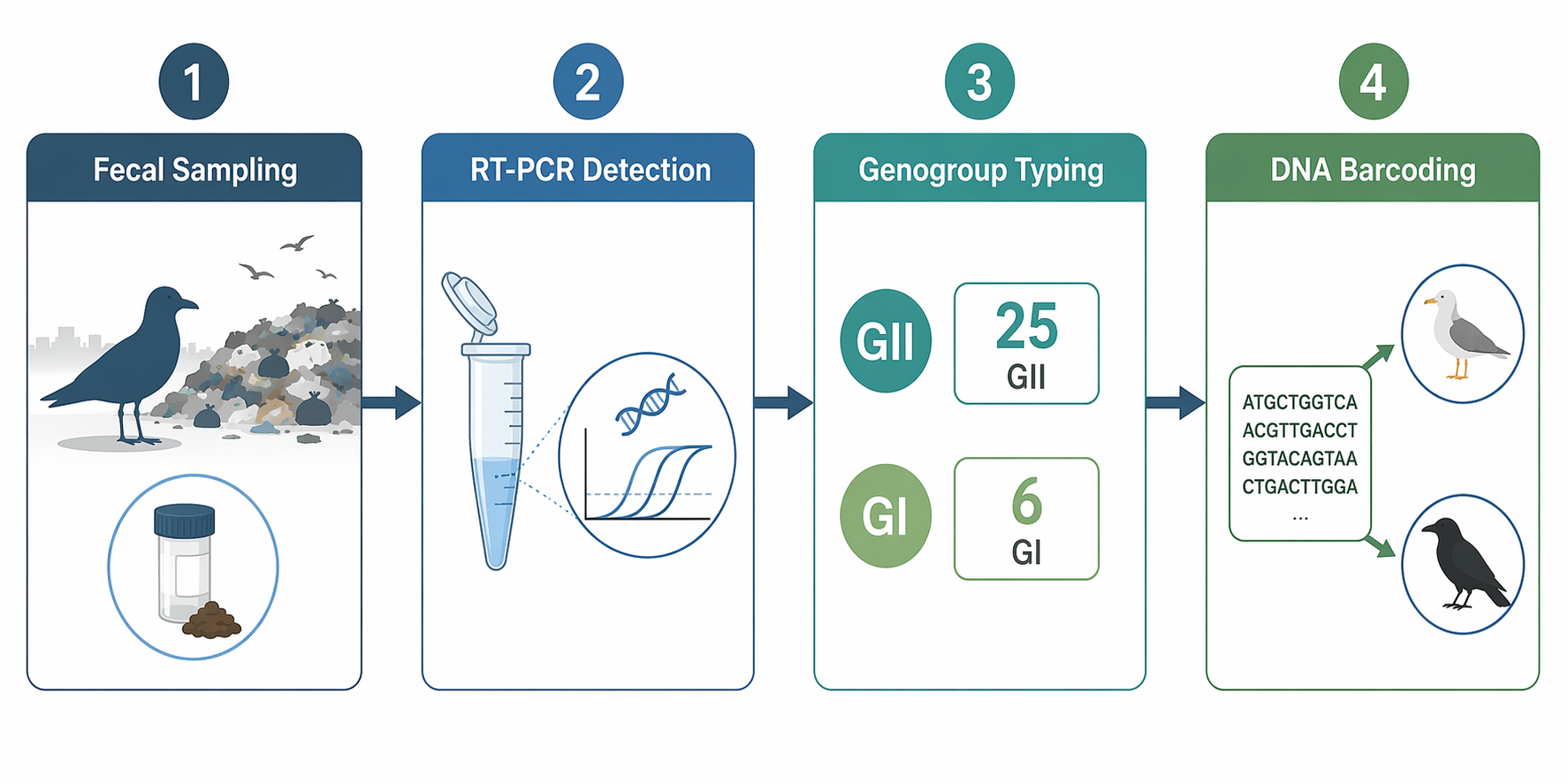
For the virus side, the authors used RT-PCR-based detection. In plain language, reverse transcription turns viral RNA into complementary DNA, and PCR amplifies target sequences so they can be detected. That is a powerful approach when the question is, “Is this genetic target present in the sample?” It is less powerful if the question is, “Could this sample infect a person?”
For the host side, the authors used DNA barcoding to identify the animal source of the feces. DNA barcoding lets researchers use genetic sequence information from the sample to assign the host, which is especially useful when field crews collect feces without capturing or watching every animal. In this study, the positive avian samples were associated with gulls and crows.[1]
That combination is clever for wildlife surveillance. It lets researchers connect a pathogen signal with a likely host from messy environmental material. It also leaves the usual environmental-sample problems in place: feces can be exposed after deposition, viral RNA can persist after infectivity is gone, and host assignment is not the same thing as proving internal infection.
A useful way to read the workflow
- Sampling tells you where the evidence came from: feces collected at Finnish dump sites during 2008–2013.[1]
- RT-PCR tells you that target human norovirus RNA sequences were detected in some samples.
- Genogroup results tell you that the detected RNA belonged to GI or GII, with GII more common among the avian positives.[1]
- DNA barcoding tells you which bird group likely produced the fecal sample: gulls and crows in the positive avian set.[1]
- None of those steps, alone or together, demonstrates infectious bird-to-human transmission.
Detection is not infectivity
This is the methodological limit that most often gets flattened. RT-PCR can detect viral genetic material even when the virus particle is damaged, no longer infectious, or present only as a fragment. A positive RT-PCR result is excellent evidence that the target RNA sequence was in the tested material. It is not automatically evidence that an intact infectious virus was present.
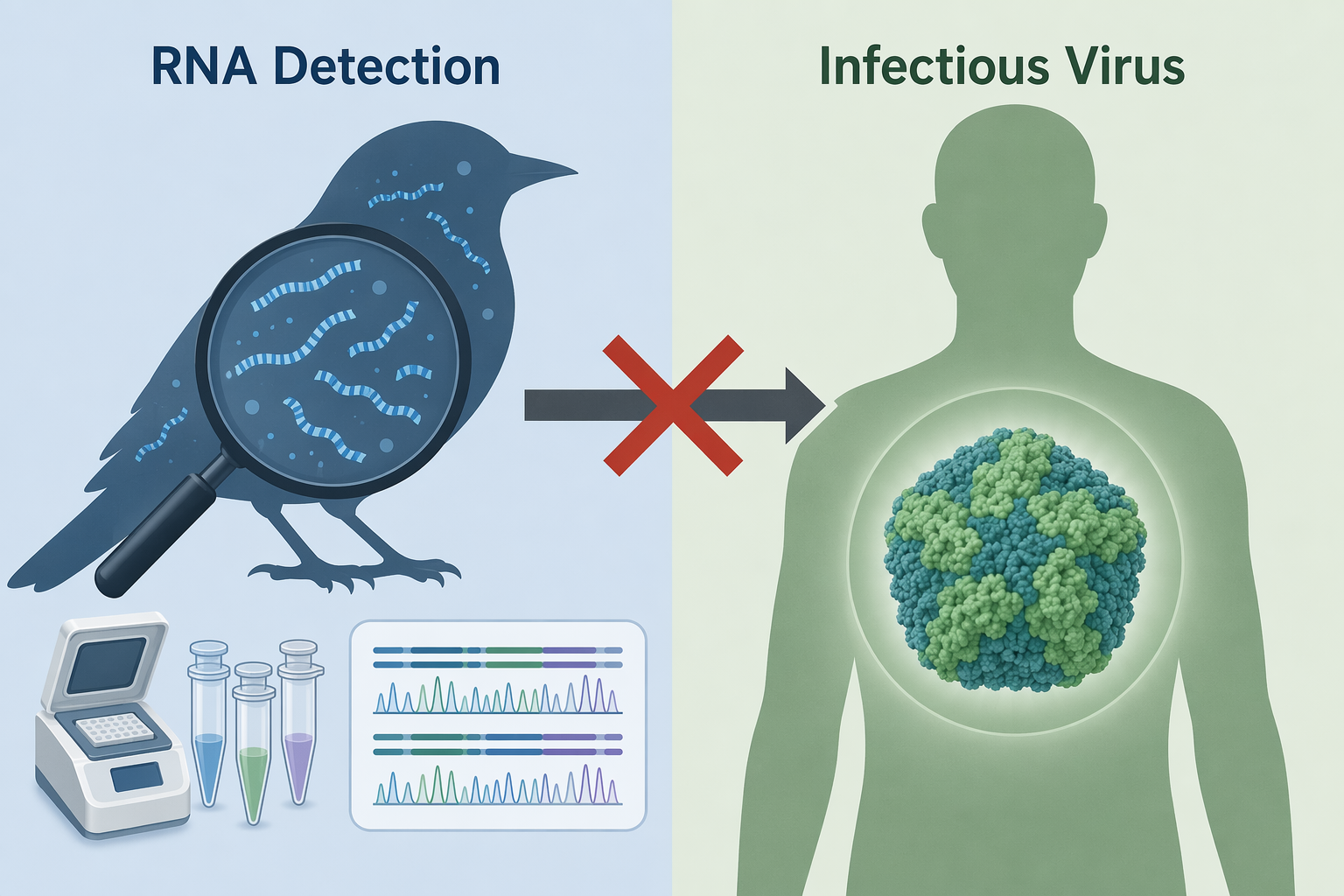
For this paper, that distinction opens several competing interpretations. A bird could ingest contaminated material and pass viral RNA through the gut without supporting viral replication. A bird could mechanically move contaminated fecal material on or through its body. Or, more strongly, a bird could be biologically infected and shed infectious human norovirus. Summa et al. supports concern about the first broad category — environmental carriage of human norovirus RNA — but it does not settle the stronger claims about active infection, reservoir status, or onward transmission.
The broader biology makes caution reasonable. Human norovirus is generally treated as host-species-specific, and human norovirus is not described as naturally infecting animals in the same way it infects people. Detection in bird feces is therefore interesting precisely because it strains the simple expectation. But an interesting detection does not erase the need for infectivity evidence.
In a student paper, the safest wording is not “gulls infected with norovirus” unless the assigned source gives direct evidence for infection. A better formulation is: “Summa et al. detected human norovirus RNA in fecal samples attributed to gulls and crows, suggesting that these birds may carry or disseminate human norovirus genetic material in human-impacted environments.” That sentence keeps the observation strong and the mechanism open.
Why the later outbreak investigation matters
A useful comparison comes from Sips et al. 2020, a One Health investigation during a waterborne norovirus outbreak. In that investigation, geese and waterfowl feces were tested, and human norovirus was not detected in those samples.[2]
That finding does not cancel Summa et al. The studies were asking different questions in different contexts. Summa et al. was a surveillance-style study of wild bird and rodent feces at dump sites, where human waste exposure was part of the ecological picture. Sips et al. was an outbreak investigation looking for possible contributors in a specific real-world event.[1][2]
The comparison is useful because it prevents a lazy generalization. If birds at dump sites can have detectable human norovirus RNA, it does not follow that waterfowl are usually involved when a waterborne norovirus outbreak occurs. A positive environmental surveillance result creates a hypothesis. An outbreak investigation tests possible routes in a particular event. Those are related forms of evidence, not interchangeable ones.
What students can safely conclude
The Summa et al. paper is important because it showed human norovirus RNA in wild bird feces outside a described human outbreak setting, and it paired viral detection with host identification by DNA barcoding. The 27% avian detection rate is not a throwaway number; it is the central reason the study belongs in discussions of wildlife surveillance, environmental contamination, and possible One Health interfaces.[1]
The same paper is limited because it was not designed to prove infectious transmission. It did not show that the detected RNA represented intact infectious virus. It did not show that birds were productively infected. It did not trace a chain from human waste to bird feces to human illness. It did not turn gulls and crows into confirmed zoonotic transmitters of human norovirus.
For coursework, the clean conclusion is this: gulls and crows can carry detectable human norovirus RNA in feces under dump-site, human-waste exposure conditions, based on the Summa et al. sample set. That is evidence for possible environmental carriage and a hypothesis worth testing. It is not proof that wild birds transmit infectious human norovirus to people.
Comments
Join the discussion with an anonymous comment.