
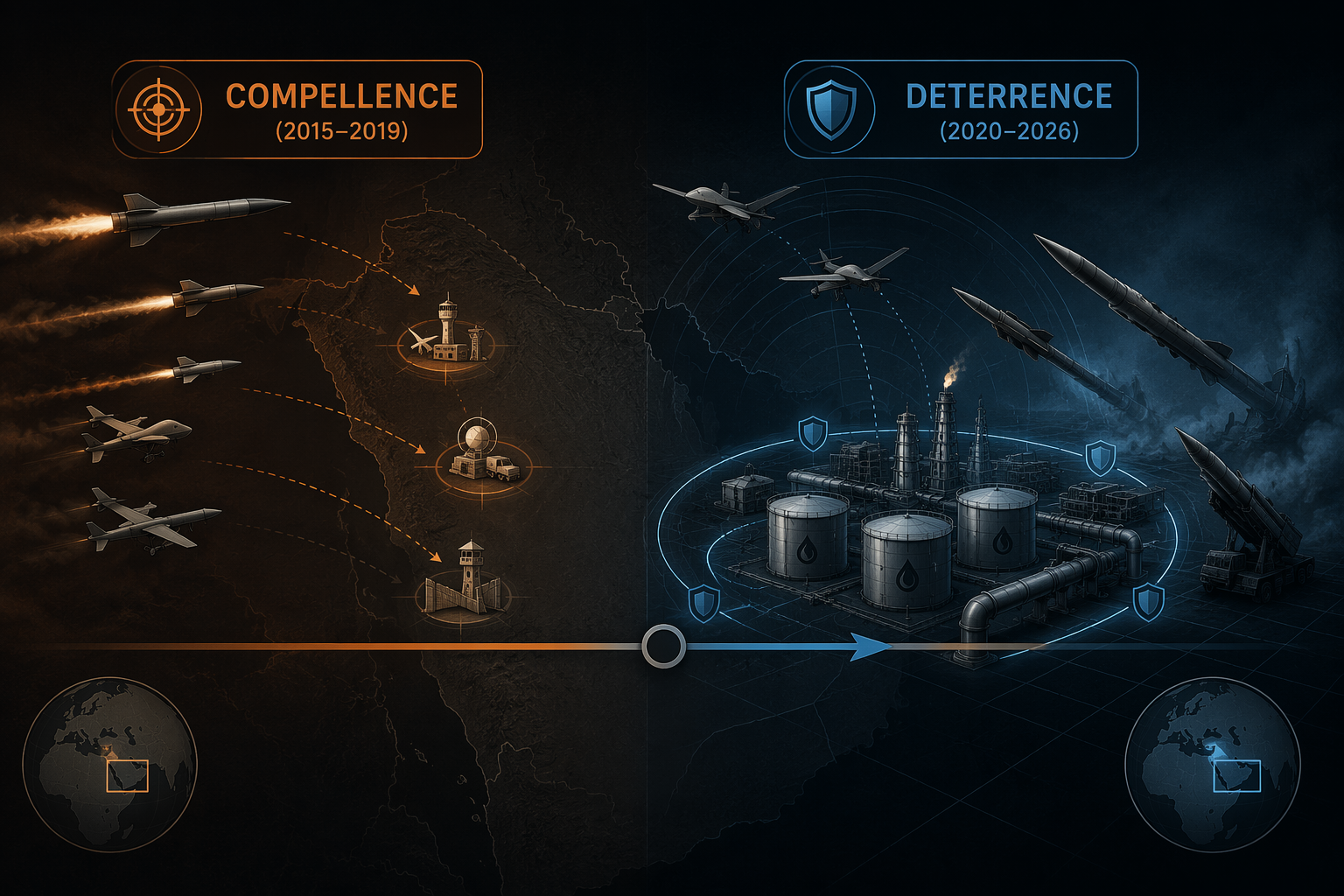
Houthi Oil Threats Shifted from Compellence to Deterrence
This analytical brief for IR students examines the Houthi campaign against Saudi oil facilities from 2015 to 2026, tracing its shift from a compellence strategy aimed at forcing Saudi withdrawal from Yemen to a deterrence strategy enabled by Iranian precision strike technology. It explains why this case challenges traditional deterrence theory and what it reveals about the changing balance of power between states and non-state actors.
Updated:
Abdul Malik al-Houthi’s July 2026 warning against Saudi oil facilities belongs in a study of coercion, not only in a news file. The immediate setting was renewed escalation around Yemen: Reuters reported on July 16 that the Houthi leader threatened Saudi oil facilities if Riyadh escalated in Yemen, while Al Jazeera had reported two days earlier on a Houthi threat to impose a “siege” on Saudi Arabia after an attack on Sanaa airport.[1][2] The analytical question is not simply whether the Houthis might strike again. It is what changed when threats against oil infrastructure moved from trying to force Saudi Arabia out of Yemen to warning Saudi Arabia not to come back in.
That distinction matters because the same target can serve different strategic purposes at different moments. A missile fired at an airport, an oil depot, or a processing plant during an intense intervention can be part of a compellence campaign: hurt the adversary until it changes what it is doing. A similar threat after a truce, negotiations, or a reduced Saudi role can become deterrent: make re-entry look too costly. Students often flatten those two logics into a single label, usually “proxy war” or “deterrence.” The Houthi case is useful precisely because that flattening loses the most interesting part of the case.
Start With the Verb: Compel or Deter
For an international relations paper, “the Houthis attacked Saudi oil facilities” is not yet an argument. The verb has to be sharper. Compellence tries to make an adversary do something it is not doing now: withdraw, halt an operation, negotiate, lift restrictions, or absorb new costs until policy changes. Deterrence tries to keep an adversary from doing something it might do: re-enter a war, intensify airstrikes, restore a blockade, or widen the battlefield.
The target list alone will not answer that question. Oil infrastructure is valuable in both logics. What changes is the political setting around the target. During the height of the Saudi-led intervention, Houthi cross-border strikes could be read largely as pressure on Saudi Arabia to reduce or end its campaign. After the most intense phase of cross-border warfare and amid later negotiations, threats to oil facilities increasingly signaled a conditional warning: escalation in Yemen could again place Saudi strategic infrastructure at risk.
This is why ACLED’s 2015–2022 dataset is the spine of the case. It does not treat the entire war as one blur of rockets and drones. It counts nearly 1,000 rocket and missile events and more than 350 drone events in Houthi cross-border aerial warfare from 2015 to 2022, and it identifies a post-2020 shift in purpose from compellence toward deterrence.[3] Those figures do not prove every individual strike had the same intention. They do give students a disciplined way to ask whether the campaign’s meaning changed with time.
The Campaign Did Not Mean the Same Thing in 2015, 2019, 2021, and 2026
In the first phase, roughly 2015 through 2019, Houthi cross-border fire was tied to a war in which Saudi Arabia was already deeply engaged. The coercive message was direct: the intervention would not remain cost-free at home. Military sites, airports, cities, and energy infrastructure all helped carry that message because they turned Yemen’s war into a Saudi domestic-security and economic problem.
ACLED’s data show the scale and rhythm of that adaptation. The report records a 360% increase in combined drone-and-missile attacks from 2019 to 2020, a jump that should not be reduced to “more capability” alone.[3] It also marks a strategic transition. By 2020, the Houthis were no longer only using cross-border attacks to punish Saudi intervention already underway. They were increasingly using the demonstrated ability to strike Saudi territory as leverage over what Saudi Arabia might do next.
That is the hinge in the case. A weaker actor that can only harass a border post has one kind of coercive reach. A weaker actor that can repeatedly threaten airports, energy sites, and urban centers has another. The first can impose battlefield costs. The second can create a standing vulnerability that decision-makers must price into future choices. The Houthi threat to Saudi oil facilities in 2026 draws its force from that accumulated record, not from the novelty of the sentence itself.
| Period | Dominant coercive logic | What the oil threat was doing analytically |
|---|---|---|
| 2015–2019 | Compellence | Raising the cost of an ongoing Saudi-led intervention and pressing for a change in behavior |
| 2020–2022 | Transition toward deterrence | Using expanded drone and missile reach to signal that Saudi escalation would carry costs inside Saudi Arabia |
| 2023–2026 | Deterrence claim, with thinner systematic data | Warning against renewed Saudi escalation, documented more through current reporting than through a dataset comparable to ACLED’s 2015–2022 coverage |
The table is intentionally modest about the last period. Post-truce data from 2022 to 2026 are sparser than the ACLED series for 2015–2022, so the later deterrence claim rests more heavily on reported threats and political context than on a dense public count of cross-border aerial events. That does not make the claim unusable. It does mean a careful student should not write as if the same kind of evidence covers every year.
Why Oil Infrastructure Became the Hard Test
Oil facilities are not just another target category. They connect battlefield signaling to state revenue, insurance, investor confidence, global energy prices, and alliance management. A strike on a military base may show reach. A credible threat to oil processing, storage, export terminals, or refineries asks a more uncomfortable question: can a non-state actor hold strategic infrastructure at risk in a way that states must treat as more than nuisance violence?
That question makes the Houthi case sharper than a generic drone-warfare example. The Houthis did not need to defeat Saudi Arabia’s armed forces in conventional terms. They needed to show that Saudi choices in Yemen could have consequences at sites whose value exceeded the immediate physical damage. Airports and cities helped demonstrate range and psychological pressure. Oil facilities added strategic-economic leverage.
This is also where vague labels become expensive. Calling the campaign “Iranian proxy warfare” captures part of the story, especially the technology pipeline, but it can obscure Houthi coercive behavior as a campaign with its own timing and targets. Calling it “deterrence” from the beginning makes the opposite mistake, because much of the earlier violence was better understood as pressure to alter an ongoing intervention. The case sits at the boundary of several concepts; that is why it is useful.
The Technology Mechanism: Stand-Off Reach at Non-State Cost
The campaign’s strategic meaning changed because the means changed. CSIS describes Houthi use of systems linked to Iranian designs and transfers, including Qasef UAVs identified as copies of Iran’s Ababil-T, Burkan-2H missiles derived from Iran’s Qiam-1, and Quds cruise missiles.[4] These systems matter analytically because they turn a local actor into a stand-off strike actor. The Houthis did not need to move conventional forces across Saudi territory to threaten high-value sites.
Stand-off capability changes the offense-defense balance in three ways. First, it stretches the battlespace beyond the front line. Second, it lets the attacker probe defenses repeatedly and cheaply. Third, it forces the defender to protect many fixed assets while the attacker chooses timing, route, and mix of drones, rockets, missiles, or cruise missiles. Even failed attacks can impose alert costs, interception costs, and political attention.
The cost asymmetry is especially important, though the numbers should be handled carefully. CSIS notes that some Houthi drones may cost only a few hundred dollars, while public estimates cited elsewhere put some systems closer to $20,000; by contrast, Patriot interceptors are commonly discussed at more than $1 million per shot.[4][5] The exact drone price is uncertain and varies by system. The analytical point survives that uncertainty: cheap incoming weapons can force expensive defensive responses, especially when the defended target is economically or politically critical.
This mechanism keeps the analysis from becoming a story about the Houthis simply getting “bolder.” Boldness is not a sufficient explanation. A threat becomes more credible when it is backed by weapons that can plausibly reach the target, navigate defenses, and create damage disproportionate to their cost. Iranian-linked precision strike technology supplied that mechanism, even if the precise mix of local adaptation, foreign assistance, and direct operational control varies by incident.
Abqaiq-Khurais: The Case Everyone Remembers, and the One That Must Be Handled Carefully
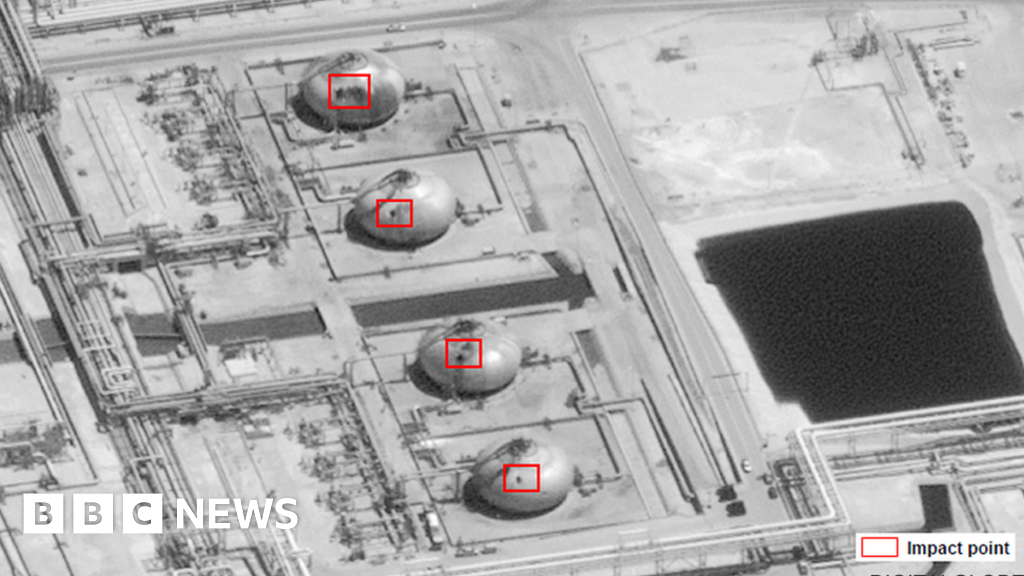
The September 2019 Abqaiq-Khurais attack is the sharpest illustration of the case, but it should not be allowed to swallow the whole analysis. CSIS’s Anthony Cordesman described 19 strikes, 17 successful hits, and roughly 5.7 million barrels per day of Saudi production knocked out.[5] Those figures show why the incident became a reference point for infrastructure vulnerability: the physical attack was limited in scale compared with a conventional war, but the effect on a core node of the oil system was enormous.
It is also the incident that most clearly warns students against tidy attribution. The Houthis claimed responsibility, but U.S. officials attributed the attack directly to Iran, and Cordesman’s analysis argued that the apparent direction of attack was difficult to reconcile with a launch path from Yemen.[5] A good case study can use Abqaiq-Khurais for two points at once: precision strike systems can expose strategic infrastructure, and attribution can remain politically and technically contested.
The Soufan Center also emphasized the global oil-market shock from the attack, underlining that the consequences were not confined to Saudi domestic security.[6] For coercion theory, this matters because the audience for a strike on oil infrastructure is larger than the immediate target state. Markets, allies, insurers, and rival governments all observe whether a state can protect the infrastructure on which others depend.
Reinforcing Cases: Ras Tanura, Jeddah, and the Defensive Burden
Later incidents reinforced the same lesson without needing to become separate case studies. The Washington Institute’s analysis of continued Houthi strikes highlighted attacks involving Ras Tanura and Saudi oil infrastructure while also stressing the cost imbalance between relatively cheap drones and costly missile-defense interceptors.[7] Ras Tanura mattered because it pointed toward export infrastructure, not just symbolic targets.
The March 2022 attack on a Jeddah oil depot, timed around the Formula 1 Grand Prix, added a different kind of signaling. Reporting and analysis from the Rosa Luxemburg Foundation described the strike on a Saudi Aramco facility and its consequences in the context of a globally visible event.[8] The timing did part of the work. A target near an international spectacle can convert a local war message into a reputational and commercial signal.
The defender’s problem is not only interception. The Baker Institute’s analysis of U.S. responses to attacks on Persian Gulf oil infrastructure discussed the politics and military implications of air-defense deployments and Patriot battery withdrawals.[9] Defending oil infrastructure is a continuous allocation problem: batteries, radars, crews, diplomatic reassurances, and escalation calculations all have to be placed somewhere, and the attacker does not have to announce the next route.
The Red Sea escalation after 2023 broadened the same logic into maritime trade and energy flows. The Atlantic Council noted that Houthi attacks in the Red Sea hurt global trade and reported suspensions or route changes by major firms including BP, Shell, and Trafigura.[10] Those maritime attacks are not identical to strikes on Saudi oil facilities, and they should not be folded into the same dataset. They do show that the coercive repertoire expanded from cross-border strikes into threats against commercial circulation.
How to Use This Case in an IR Essay
A strong essay should not begin by announcing that the Houthis are “an Iranian proxy” and then treating every attack as proof of the same claim. Proxy relationships are part of the case, especially when discussing weapons, training, design lineage, and regional strategy. But proxy warfare is not a substitute for analyzing coercive logic. The question is what behavior the attacker was trying to change or prevent, and how the available weapons made that threat credible.
- Use compellence for the 2015–2019 phase when the campaign is best read as pressure against an ongoing Saudi-led intervention.
- Use deterrence for the later phase when threats increasingly warned Saudi Arabia against renewed escalation.
- Use proxy warfare to explain external support and Iranian-linked technology, not to erase Houthi agency or campaign timing.
- Use offense-defense balance to explain why cheap precision weapons can impose high protection costs on a richer state.
- Use attribution uncertainty, especially Abqaiq-Khurais, as a limitation in the argument rather than as an inconvenience to hide.
A useful exam answer might therefore make a narrow claim: the Houthi campaign shows how a non-state actor, enabled by external precision-strike technology, can move from punishing an ongoing intervention toward deterring renewed escalation by holding strategic infrastructure at risk. That claim is stronger than saying “drones changed war” and more precise than saying “Iran deterred Saudi Arabia.”
What the Case Does Not Prove
The case does not prove that the Houthis can always hit Saudi oil infrastructure at will. Air defenses adapt, routes change, diplomacy intervenes, and some attacks fail. It also does not prove that every strike claimed by the Houthis was launched, planned, or controlled in the same way. The Abqaiq-Khurais dispute is the clearest reminder that public claims, intelligence assessments, and technical evidence can point in different directions.
Nor does the case prove that deterrence succeeded in a clean, measurable way. Deterrence is hard to observe because the desired outcome is often non-action. If Saudi Arabia does not escalate, analysts still have to separate the effect of Houthi threats from diplomacy, war fatigue, U.S. pressure, Saudi domestic priorities, and broader regional calculations. The Houthi threat is part of the cost environment, not a single-variable explanation.
The best-supported conclusion is narrower and more important: from 2015 to 2022, systematic evidence shows a large Houthi cross-border aerial campaign whose purpose shifted over time; by 2026, renewed threats against Saudi oil facilities draw on that earlier record and function mainly as deterrent warnings against renewed Saudi escalation. The post-2022 portion of the case is real, but the evidence base is thinner and more journalistic.
The Analytical Payoff
This case matters for international relations students because it makes several familiar concepts misbehave. Deterrence is usually taught through states, nuclear weapons, and clearly attributed retaliation. Here, a non-state actor uses relatively cheap precision systems, contested attribution, and infrastructure vulnerability to shape the choices of a much richer state. Proxy warfare explains part of the capability story, but not the full coercive pattern. Asymmetric warfare explains the power imbalance, but not the shift from compellence to deterrence.
The Houthi threat to Saudi oil facilities is therefore not analytically interesting because it is the latest dramatic warning. It is interesting because it rests on a decade-long transformation in what a non-state actor could credibly threaten. Cheap precision weapons did not give the Houthis conventional superiority. They gave them coercive reach against strategic infrastructure, and that reach blurred the boundaries among proxy war, deterrence theory, and the state’s traditional monopoly on long-range coercion.
References
- Houthi leader threatens Saudi oil facilities if Riyadh escalates in Yemen, Reuters, July 16, 2026.
- Leading Houthi threatens ‘siege’ on Saudi Arabia after Yemen airport attack, Al Jazeera, July 14, 2026.
- Beyond Riyadh: Houthi Cross-Border Aerial Warfare 2015–2022, ACLED.
- The Iranian and Houthi War against Saudi Arabia, Center for Strategic and International Studies.
- Strategic Implications of the Strikes on Saudi Arabia, Center for Strategic and International Studies.
- IntelBrief: Houthis Drone Attack Targets Major Saudi Oil Facilities, The Soufan Center.
- Continued Houthi Strikes Threaten Saudi Oil and Global Economic Recovery, The Washington Institute.
- The Yemen Rebel Attack on Saudi Aramco Oil Facility and Its Consequences, Rosa Luxemburg Foundation.
- The U.S. Response to Attacks on Persian Gulf Oil Infrastructure, Baker Institute.
- Houthi attacks in the Red Sea hurt global trade and slow the energy transition, Atlantic Council.
Comments
Join the discussion with an anonymous comment.