

Curated H5N1 Bird Flu Study Resources for Students
This guide curates authoritative H5N1 bird flu resources from CDC, WHO, FAO, and peer-reviewed journals, organized by learning objective so students can efficiently study virus biology, epidemiology, transmission, and clinical presentation.
Updated:
Why the source split matters
If you are trying to study H5N1 bird flu and every tab seems to answer a different question, the fix is not more tabs. It is matching each source to the question you actually need answered. WHO is the cleanest place for cumulative human case history; CDC is better for U.S. case framing and monitoring; FAO and USDA/APHIS handle animal and livestock spread; and review articles plus clinical references explain mechanism and symptoms. The headline numbers only make sense inside those reporting systems: WHO's cumulative table was updated on 7 July 2026 and lists 878+ confirmed human cases with a historical CFR around 52% [1]; CDC's situation summary was updated in March 2026 and reports 71 U.S. human cases from 2024 through May 2026, mostly in dairy and poultry workers, with conjunctivitis as the dominant symptom [2]; CDC's monitoring page says 33,100+ people had been monitored and 1,340 tested for novel influenza A since February 2022 as of 27 June 2026 [3]; FAO reported 763 HPAI outbreak events in 31 countries over a five-week window ending 28 May 2026 [4]; and USDA/APHIS reported 1,107 dairy herds across 17 U.S. states as of 27 May 2026, with detections in swine, goats, alpaca, and sheep [5][6].
| Source | Best for | Update / currentness | Use with care |
|---|---|---|---|
| WHO cumulative human cases [1] | Canonical global human case history and cumulative counts. | Publication page dated 7 July 2026; the full table may sit in a linked PDF [1]. | Do not use it as a U.S. monitoring page or as a live animal-outbreak tracker. |
| CDC Situation Summary [2] | U.S. human case framing, symptom pattern, and occupational context. | Last updated March 2026 [2]. | Useful for context, but not the freshest monitoring source. |
| CDC Monitoring [3] | Current U.S. monitoring and testing counts for novel influenza A. | As of 27 June 2026 [3]. | Not a source for global cumulative human history. |
| FAO Global AIV Update [4] | Cross-country animal outbreak pace and species spread. | Update published 28 May 2026 [4]. | Do not substitute it for U.S.-only livestock accounting. |
| USDA/APHIS H5N1 HPAI Resources [5] | Federal U.S. animal-health framing and response materials. | Living resource page [5]. | Use it with the livestock dashboard if you need herd counts. |
| USDA livestock dashboard [6] | U.S. livestock detections, especially dairy herds and other mammals. | Dashboard data cited as of 27 May 2026; interactive source [6]. | Do not quote herd counts without the date and attribution. |
| J. Virology review [7] | Virus biology, clades, and the dairy cattle epizootic in one synthesis. | 2025 open-access review [7]. | This is not a live surveillance page. |
| StatPearls Avian Influenza [8] | Student-level overview of virology, transmission, and clinical framing. | 2025 NCBI Bookshelf entry [8]. | Use it for orientation, not for current counts. |
| Yale Medicine explainer [9] | Readable clinical bridge when you need a fast orientation. | Consumer-facing explainer [9]. | Too general for primary epidemiology or deep virology. |
| AAO clinical statement [10] | Ophthalmology-specific detail on conjunctivitis and eye presentation. | June 2026 specialty statement [10]. | Too narrow to carry the whole topic. |
| PMC review [11] | Broader synthesis on virology and therapeutic strategies. | 2025 review [11]. | Use after the basics; it is denser than the student-facing pages. |
| CDC interim recommendations [12] | Exposure precautions and prevention guidance around infected animals. | Living guidance [12]. | Not the place to learn the full scientific background. |
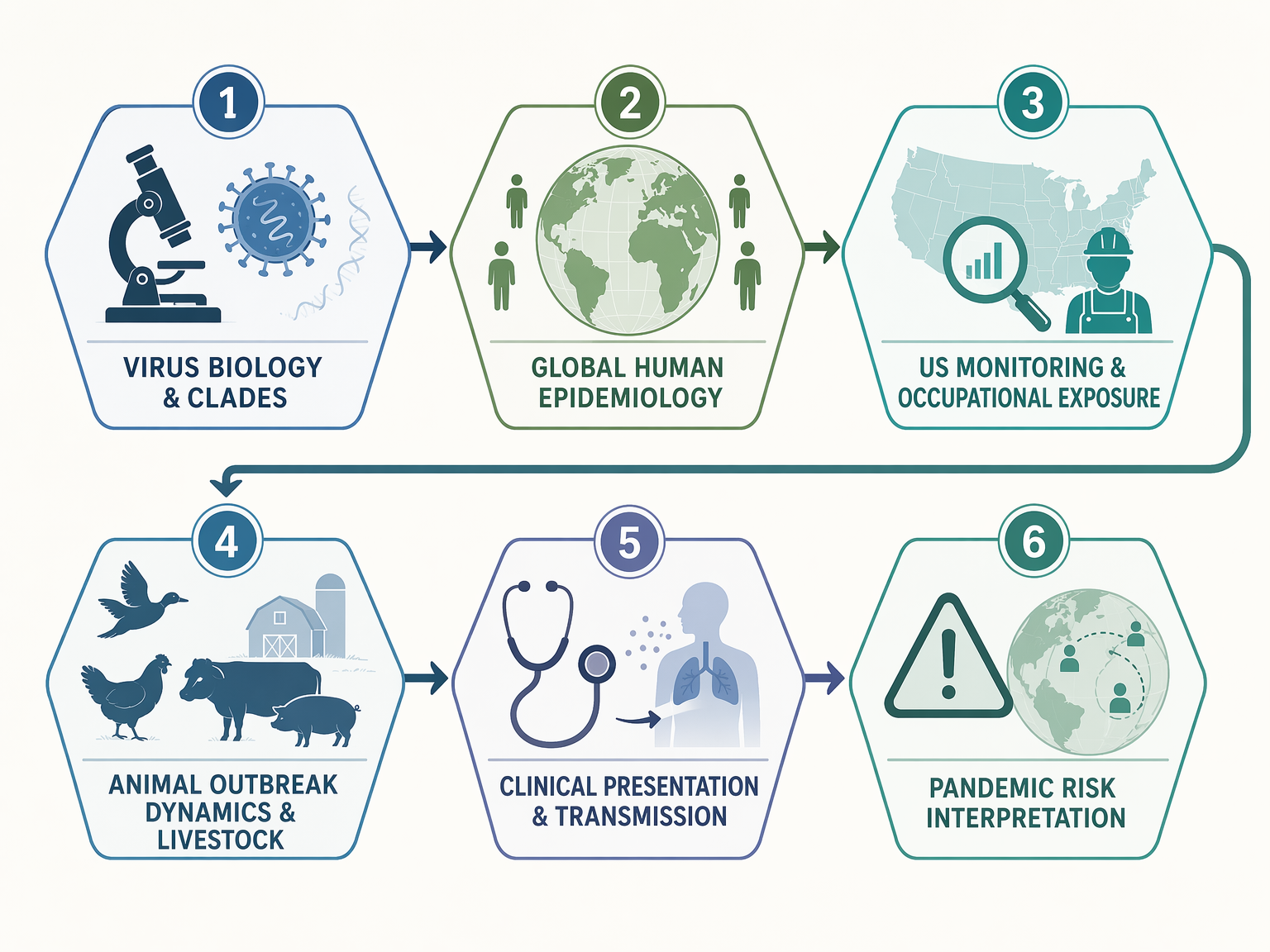
Match the source to the learning objective
- Virus biology and clades: start with the J. Virology review for the 2.3.4.4b context, then use StatPearls for a cleaner student-level pass, and keep the broader PMC review for deeper mechanistic or therapeutic detail [7][8][11].
- Global human epidemiology: use WHO for the cumulative human case history, then use the CDC situation summary only if you need the U.S. slice of the story [1][2].
- U.S. monitoring and occupational exposure: use CDC Monitoring for current screening numbers and CDC interim recommendations for what exposure guidance looks like in practice [3][12].
- Animal outbreak dynamics and livestock: use FAO for international animal spread, USDA/APHIS for U.S. federal context, and the livestock dashboard when you need herd-level livestock detections [4][5][6].
- Clinical presentation: use the CDC situation summary for broad symptom pattern, Yale Medicine for a readable bridge, and the AAO statement when the eye presentation is the point [2][9][10].
- Pandemic-risk interpretation: keep reviews in view, but do not turn a cumulative historical CFR into a forecast; that older global number needs context from the newer clade 2.3.4.4b literature and from U.S. worker presentations [1][2][7].
A workable order for studying H5N1
- First pass: read WHO and CDC side by side so you separate global human history from the current U.S. picture [1][2].
- Second pass: move to CDC Monitoring and FAO so you can see how human monitoring and animal spread are tracked on different clocks [3][4].
- Third pass: add USDA/APHIS and the livestock dashboard if your assignment touches dairy cattle, other mammals, or farm exposure [5][6].
- Fourth pass: read the J. Virology review and StatPearls together if you need clades, transmission biology, or pathogenesis in one coherent frame [7][8].
- Last pass: use Yale Medicine, the AAO statement, and the broader PMC review to tighten up clinical language, specialty detail, and therapeutic framing [9][10][11].
That sequence keeps the topic legible. You do not need every H5N1 link on the internet; you need the page that matches the job in front of you, and you need to check the update date before you quote the number.
References
- Cumulative number of confirmed human cases for avian influenza A(H5N1) reported to WHO, 2003-2026 (7 July 2026) — WHO, 7 July 2026
- Situation Summary: Avian Influenza A(H5N1) — CDC, March 2026
- H5 Monitoring — CDC, 27 June 2026
- Global avian influenza update — FAO, 28 May 2026
- H5N1 HPAI Resources — USDA APHIS
- HPAI confirmed cases in livestock — USDA APHIS
- J. Virology review by Krammer et al. — Journal of Virology, 2025
- Avian Influenza — StatPearls / NCBI Bookshelf, 2025
- H5N1 Bird Flu: What to Know — Yale Medicine
- Novel H5N1 Bird Flu Outbreak - Clinical Statement — American Academy of Ophthalmology, June 2026
- Comprehensive H5N1 review — PMC, 2025
- HPAI Interim Recommendations — CDC
Comments
Join the discussion with an anonymous comment.