
First Amendment Rights for Parents Banned from School Property
Learn what First Amendment protections apply when a public school bans a parent from campus, and get a step-by-step action plan for responding to a trespass notice.
Updated:
If a public school has banned you from campus, the short answer is this: yes, a school can sometimes keep a parent off school property, especially during the school day, when administrators are responsible for student safety and orderly operations. But a public school cannot use a trespass notice as a shortcut for punishing a parent’s viewpoint, silencing criticism, or cutting the parent out of legally protected participation in a child’s education.
The First Amendment may protect a parent who criticizes a coach, principal, teacher, superintendent, or school board. It does not protect threats, stalking, harassment, physical disruption, refusing to leave restricted areas, or conduct that materially interferes with school operations. That distinction matters more than the volume of the conflict. A heated parent may still have rights; a parent with a legitimate complaint can still cross a legal line.
This is not legal advice, and state law can change the details. But if you are holding a ban letter right now, the most important questions are practical: what exactly does the notice say, what facts does it rely on, how long does it last, what places and events does it cover, and how do you appeal?
What a School Can Ban, and What It Cannot Punish
A public school is not the same kind of First Amendment space at every hour and in every location. During the school day, classrooms, hallways, front offices, parking lots, and student areas are usually treated as places where the district has broad authority to control access. The school does not have to let every parent walk into every part of the building whenever they want.
That changes when the school opens a setting for public expression, such as a school board meeting or another public event. In that kind of limited public forum, the district may enforce reasonable rules about time, place, decorum, and topic, but it may not favor one viewpoint over another. A rule that keeps speakers on agenda items is different from a rule that lets praise through and blocks sharp criticism.
A 2017 education-law discussion of the Second Circuit’s framework explains this split in practical terms: schools have more control over nonpublic areas such as classrooms and hallways during the school day, while public events like board meetings and sports events require viewpoint-neutral limits when the district has opened the space for public use.[1]
That is why the same sentence can be treated differently depending on where and how it happens. A parent who says at a board meeting, “The superintendent mishandled my child’s discipline case,” is engaging in public criticism. A parent who follows an employee to a car, blocks a doorway, or keeps shouting after being told a meeting is over has created a conduct problem. The school may respond to the conduct. It may not pretend the conduct exists just because the criticism is uncomfortable.
The Conduct-Versus-Speech Line
Most parent-ban disputes become confused because everyone uses safety words. The parent says, “I was just advocating for my child.” The district says, “The parent was abusive and disruptive.” The useful question is narrower: what specific act caused the ban?
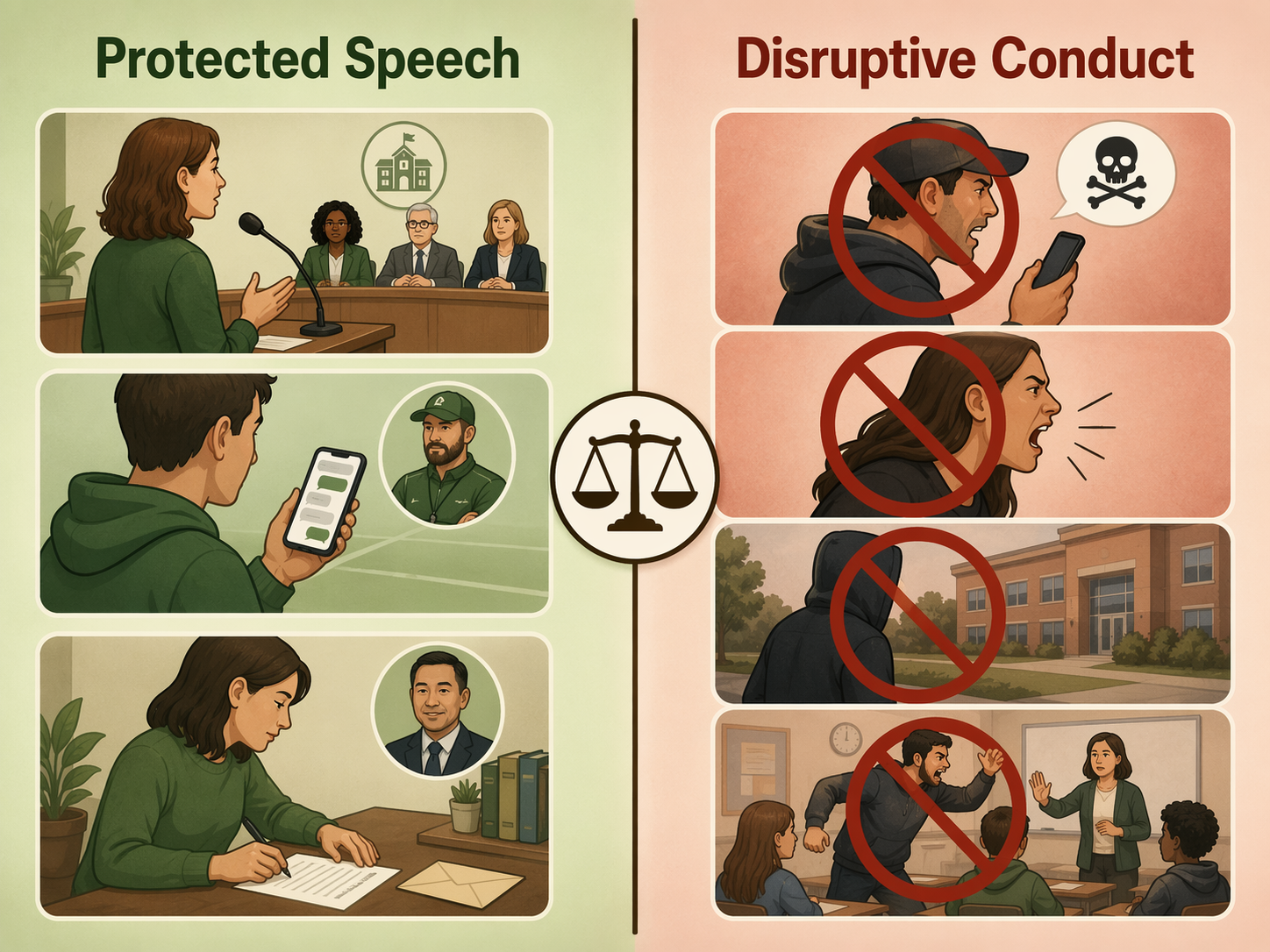
The Sixth Circuit’s 2023 decision in McElhaney v. Williams is a good starting point because it involved ordinary school conflict rather than a grand constitutional drama. A parent texted a coach criticizing how the coach handled the parent’s child’s playing time. The court held that “schools cannot regulate the content of the parents’ speech about their child to a school employee who interacts with the child,” and the parent’s criticism was protected.[2]
That holding does not mean every angry message is protected. It means a school cannot treat the viewpoint of the message itself as the offense. Criticizing a coach’s judgment is different from threatening the coach. Accusing an administrator of unfairness is different from sending repeated messages at all hours after a clear no-contact instruction. Telling a board member they made a bad decision is different from stalking that board member outside school channels.
| Issue to Separate | Likely First Amendment Concern | Likely School Authority |
|---|---|---|
| Criticism of staff decisions | The school may not punish the parent merely because the criticism is sharp, embarrassing, or personally directed. | The school may regulate when, where, and how the parent communicates if the rule is viewpoint-neutral. |
| Threats or intimidation | Calling a threat “advocacy” will not make it protected speech. | The school may restrict access to protect staff and students. |
| Disruption inside the building | A complaint about a child may be protected, but the method can still be restricted. | The school may remove or exclude a person who blocks operations or refuses lawful directions. |
| Board-meeting criticism | Public-comment rules must not suppress one side of a debate. | The board may enforce neutral rules about time, topic, and order. |
| Vague labels such as offensive or inappropriate | A rule using broad subjective labels may chill protected criticism. | The district needs a clearer, lawful basis tied to disruption, threats, harassment, or neutral meeting rules. |
Vague labels deserve special attention. In March 2025, the Ninth Circuit in Hartzell v. Marana Unified School District ruled that a district policy barring “offensive or inappropriate” parent speech could be facially unconstitutional, and the court applied the Tinker material-disruption standard. The case came at a motion stage rather than after a full trial judgment, but the warning is clear: a school cannot rely on elastic words that allow officials to punish whatever criticism they dislike.[3]
The Eleventh Circuit made a related point in Moms for Liberty v. Brevard Public Schools. In 2024, the court ruled that blanket bans on “abusive” or “personally directed” speech at school board meetings were facially unconstitutional. The board could control meeting order, but it could not use broad decorum language to suppress criticism of officials.[4]
For a banned parent, these cases turn into a document review. If the notice says you are banned because you threatened someone, the fight will center on whether the alleged threat actually happened and whether the restriction is appropriately tailored. If the notice says you are banned because your comments were “offensive,” “inappropriate,” “abusive,” or “personally directed,” without more, the First Amendment concern is stronger.
The Notice Itself May Be the Weak Point
A school ban is not just a spoken instruction from a frustrated administrator. If it is going to carry legal consequences, the parent needs to know what conduct is alleged, what property is covered, how long the ban lasts, and how to challenge it. The lack of those details can become as important as the First Amendment issue.
In State v. Green, a Washington appellate court held in 2010 that parents must receive notice of their right to appeal a school trespass ban, and failure to provide that notice violated procedural due process. The case is older than the recent speech rulings, but the basic due-process point remains practical: a parent cannot meaningfully contest a ban if the school does not tell the parent how to do so.[5]
More recent litigation shows the same pressure on overbroad exclusions. In Vollmecke v. Independence School District, a Missouri federal case from 2024, a parent challenged a one-year ban that allegedly came without an appeal opportunity. The matter led to a settlement and policy revision, so it should not be described as a final merits ruling that binds every district. But it is a useful warning about long bans with no review process.[6]
A Vermont dispute ended with a school district paying nearly $150,000 to a parent who had been banned from board meetings after critical speech. Because that result came through a settlement, it does not prove that every similar ban is unlawful. It does show that districts can face serious exposure when they exclude a parent from public meetings because of criticism.[7]
In Schmidt v. Huff, a federal district court in Kansas allowed claims to proceed in August 2025 after a parent was banned from “all district property and events” following the parent’s submission of a photo to Libs of TikTok. The court treated the alleged ban as potentially overbroad and retaliatory, and allowed claims against school officials to move forward. That was a preliminary-stage ruling, not the final word on the facts, but it fits the same pattern: sweeping bans tied to disfavored expression draw close scrutiny.[8]
What to Do Today
Do not start by arguing constitutional doctrine in the front office. Start by building a clean record. A parent who responds with organized documents, narrow requests, and calm insistence is in a better position than a parent who gives the district a new disruption to cite.
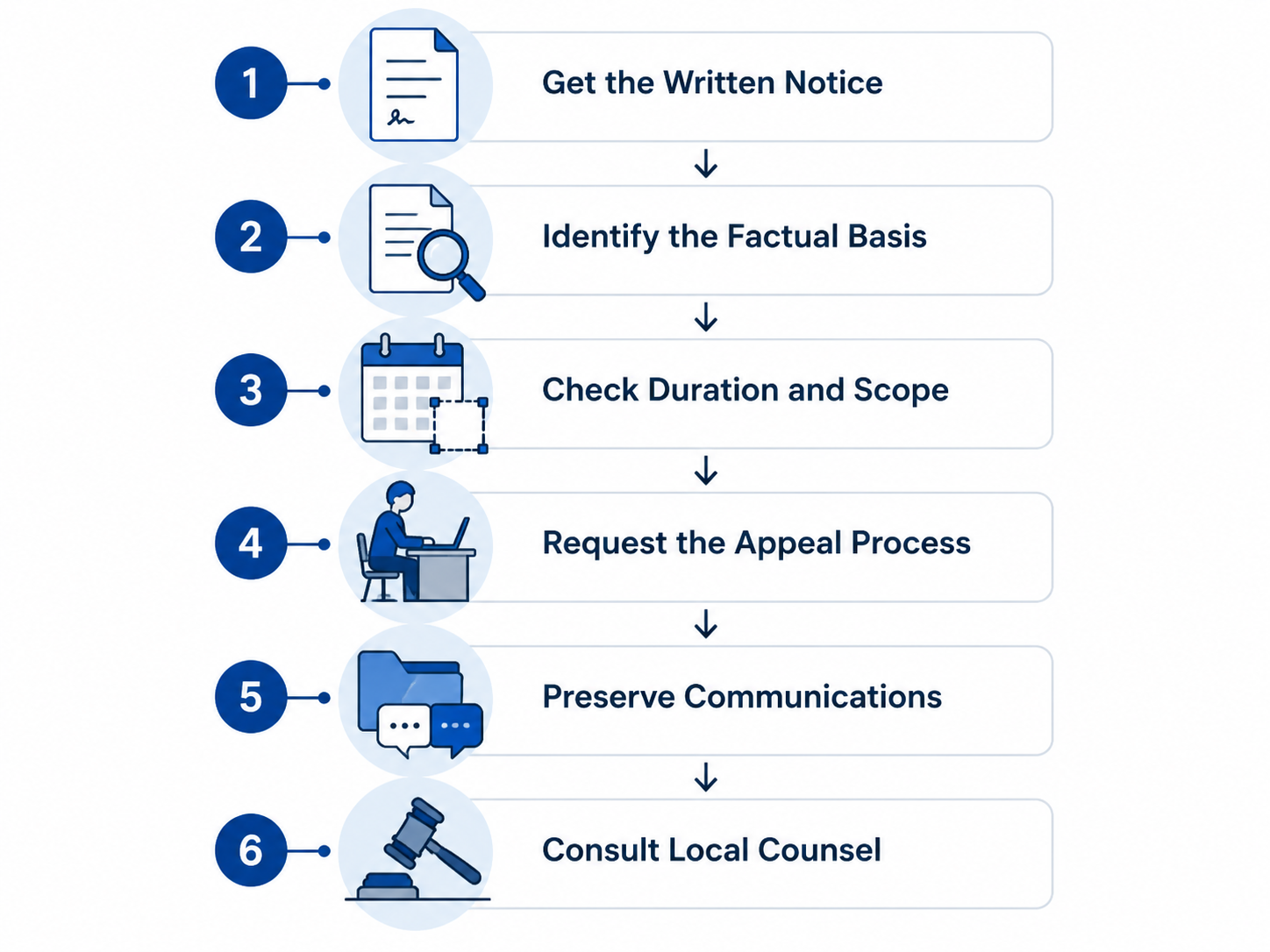
| Step | Action | Why It Matters |
|---|---|---|
| 1 | Get the ban in writing. | A written notice fixes the school’s stated reason, scope, duration, and appeal language. |
| 2 | Identify the factual basis. | The key question is whether the school cites conduct, protected criticism, or vague labels. |
| 3 | Check the scope and duration. | A narrow safety restriction is different from an indefinite ban from all property and events. |
| 4 | Ask for the appeal process. | Due process concerns increase when the notice gives no review path. |
| 5 | Preserve communications and witnesses. | Texts, emails, meeting notices, recordings where lawful, and names of witnesses can clarify what actually happened. |
| 6 | Protect required participation in your child’s education. | If an IEP, 504 plan, discipline process, or required meeting is involved, ask for lawful access or accommodations. |
1. Get the Written Notice
If you were only told verbally to stay away, ask for the written trespass notice, exclusion letter, board policy, or administrative directive. Keep the request short. For example: “Please provide the written notice stating the basis, scope, duration, and appeal process for any restriction on my access to district property or events.”
Do not fill the request with accusations. The point is to make the district state its position. A written notice that says “until further notice,” covers “all district property and events,” gives no facts, and lists no appeal route is very different from a 10-day restriction from the front office after a specific incident involving refusal to leave. The law often turns on those differences.
2. Separate the Alleged Conduct from the Viewpoint
Read the notice with a pen in hand. Underline every factual allegation. Circle every judgment word. “Entered the assistant principal’s office without permission at 2:15 p.m. and refused three requests to leave” is a factual allegation. “Displayed offensive and inappropriate conduct toward staff” is mostly a conclusion unless the notice explains what happened.
Then ask what the school is really punishing. If the notice describes threats, repeated unwanted contact, blocking movement, entering restricted areas, or disrupting students, the school has a stronger safety argument. If the notice focuses on your criticism of staff competence, special-education decisions, discipline decisions, curriculum choices, or board governance, the First Amendment question becomes more serious.
This is where many parents hurt their own position. “Everything I said is protected speech” is too broad. A better response is precise: “I dispute that my communication contained a threat or materially disrupted school operations. The notice appears to restrict me because of my criticism of district decisions, and it does not identify any specific disruptive conduct.”
3. Check Duration, Places, and Events
A ban can be too broad even if the school had a real concern. The scope should match the problem. A restriction from entering the main office without an appointment is not the same as a ban from every building, every athletic event, every board meeting, and every parent conference.
- Does the notice have an end date?
- Does it say which buildings or events are covered?
- Does it distinguish school-day access from public meetings?
- Does it allow scheduled meetings about your child?
- Does it explain who can modify or lift the restriction?
An indefinite ban should be challenged differently from a short cooling-off restriction. A district may be able to justify temporary limits after a genuine disruption. It is harder to justify a ban that has no end point, no review, and no distinction between a classroom hallway during the school day and a public-comment period at a board meeting.
4. Request the Appeal or Review Process
Ask in writing for the appeal process even if the notice does not mention one. The request should be specific enough that the district must answer the procedural question, not just repeat that safety is important.
Please identify the process for appealing or seeking review of the trespass/exclusion notice dated [date]. Please also provide the policy or regulation authorizing the restriction, the factual basis for the restriction, the person who will review it, the deadline for submitting materials, and whether the restriction remains in effect during review.If the school says there is no appeal, preserve that response. If it gives a deadline, meet it. If the facts are serious or the ban is broad, this is the point where local counsel may matter because state trespass laws, school-access statutes, and administrative procedures vary.
5. Preserve the Record Without Escalating the Conflict
Save the ban notice, envelope, emails, texts, voicemail logs, meeting invitations, board agendas, sign-in records, and any prior complaints you made. Write a timeline while the details are fresh. Identify who was present, what was said, and what happened next. If recordings exist, be careful: recording laws vary by state, and an unlawful recording can create a new problem.
Also preserve proof of what the ban prevents you from doing. A missed IEP meeting, barred board-comment opportunity, excluded parent-teacher conference, or denied school event may matter more than a general feeling of being unwelcome. The consequence should be concrete.
6. Ask for Access or Accommodations for IEP, 504, and Required Meetings
A trespass order should not be used to block a parent from participating in legally required special-education processes. TexasLawHelp explains that a trespass order cannot legally prevent a parent from participating in IEP meetings under IDEA, and parents may also have separate complaint paths under Section 504 or the ADA.[9]
A school still may control how participation happens. Depending on the facts, that may mean a scheduled appointment, remote participation, a district-office meeting, security presence, or written communication through a designated administrator. The point is not that the parent must get unrestricted campus access. The point is that the district must not use the ban to erase required parent participation.
Because my child has an IEP/504-related process pending, please confirm how the district will ensure my participation despite the access restriction. I am available for a scheduled in-person meeting, remote meeting, or another lawful accommodation that allows me to participate meaningfully.How to Read Common Ban Language
The words in the notice matter because they reveal the district’s theory. Some phrases point toward a legitimate safety response. Others raise questions because they blur criticism, discomfort, and disruption.
| If the Notice Says | Ask This | Possible Response |
|---|---|---|
| “Disruptive conduct” | What specific conduct, on what date, disrupted which school operation? | Ask for the factual basis and any incident report. |
| “Offensive or inappropriate language” | Was the problem the viewpoint, or a material disruption? | Ask the district to identify the neutral rule and the disruption it relies on. |
| “Abusive toward staff” | Does the notice describe threats, harassment, or only criticism? | Separate protected criticism from conduct the school can restrict. |
| “All district property and events” | Why is a districtwide ban necessary? | Ask for a narrower restriction and access to public meetings or child-related meetings. |
| “Until further notice” | When will the restriction be reviewed? | Request an end date, review date, and appeal process. |
There is no magic phrase that wins the dispute. A school can write a beautiful letter and still be wrong on the facts. A parent can have an ugly email chain and still have a valid First Amendment claim if the actual punishment targets viewpoint. The record has to be read as a whole.
When to Get Help Quickly
Some bans can be handled first through a written appeal to the superintendent, board policy process, or district complaint channel. Others need faster help because the consequences are immediate or the allegations are serious.
- Contact a local education or civil-rights attorney if the notice accuses you of threats, harassment, stalking, or criminal trespass.
- Seek special-education advocacy help if the ban interferes with an IEP, evaluation, manifestation determination, placement meeting, or 504 process.
- Use board-policy complaint procedures when the restriction appears tied to board-meeting criticism.
- Consider state civil-rights, disability-rights, or education-agency complaint paths when the ban blocks legally protected participation.
- Do not violate the ban to prove a point; that can turn a constitutional dispute into a trespass case.
Local law matters here. Some states provide specific school-trespass procedures, appeal rights, parent-access rules, or broader free-speech protections. Others give districts more room to control access. A national First Amendment argument is only one layer of the problem.
A Narrow, Strong Challenge Beats a Loud One
The strongest challenge usually does not sound like, “I was angry and had a right to speak.” It sounds more like this: “The district punished my viewpoint, gave no specific factual basis, imposed an overbroad or indefinite exclusion, failed to provide an appeal path, or blocked legally protected participation in my child’s education.”
That formulation does not excuse threats or disruption. It forces the school to justify the actual restriction it imposed. If the school has real safety facts, it should be able to state them clearly, limit the restriction to the problem, and provide a review process. If it cannot, the weakness is no longer just that the parent feels excluded. The weakness is sitting in the document.
References
- When Can Schools Ban a Parent or a Third Party From School Property and School Events, Pullman & Comley
- Sixth Circuit Sides with Parent in Free Speech Case, Ennis Britton, 2023
- Ninth Circuit Ruling Expands Free Speech Rights of School Parents, AALRR, March 2025
- Lawsuit: Ban on Personally Directed Criticism of School Board Members Violates the First Amendment, Institute for Free Speech
- Appeals Court Supports Parent’s Right to Be on School Grounds, ACLU of Washington, 2010
- Vollmecke v. Independence School District, Washington University First Amendment Clinic
- School District Pays Nearly $150K to Parent Banned from Board Meetings, Loevy + Loevy
- Parent Submits Photo of School Postings to LibsOfTikTok, Gets Restricted from Accessing School Property or Events, Reason / The Volokh Conspiracy, August 14, 2025
- Parents’ Rights to Participate in Their Children’s Education, TexasLawHelp
Comments
Join the discussion with an anonymous comment.