
What the Fairlife Ransomware Attack Teaches Cybersecurity Students
This case study breaks down the July 2026 Fairlife ransomware attack, explaining how the incident unfolded across IT and OT systems, why it forced a full US production halt at a major Coca-Cola brand, and the practical lessons cybersecurity students can extract about incident response, OT compromise, and regulatory disclosure under uncertainty.
Updated:
The useful starting point in the Fairlife ransomware attack is not the malware family, because no ransomware group has been named. It is the production halt. On July 16, 2026, The Coca-Cola Company disclosed that an unauthorized third party had accessed Fairlife production-related systems, that the event involved ransomware, and that all U.S. Fairlife production had been suspended while Canadian operations were unaffected.[1]
That single sentence already gives cybersecurity students more to work with than a clean after-action diagram. The incident touched systems close enough to manufacturing that Coca-Cola stopped U.S. production. It also left the most tempting questions unanswered: which systems, which actor, whether data was stolen, whether a ransom was demanded, and when production would resume.
As of July 18, 2026, this case should be read as a live incident snapshot, not a finished breach story. That matters. Students often learn incidents backward, after investigators have labeled every phase and assigned every action to a threat actor. Fairlife is more realistic: defenders, operators, lawyers, executives, suppliers, and customers all have to make decisions before the facts are complete.
What is known so far
The highest-authority source is Coca-Cola’s own disclosure. The company said it detected unauthorized third-party access to certain Fairlife production-related systems on July 16, 2026, confirmed a ransomware event, activated incident response and business continuity protocols, engaged outside cybersecurity experts, notified law enforcement, and suspended all U.S. Fairlife production.[1]
| Known fact | What it supports | What it does not prove |
|---|---|---|
| Unauthorized third-party access was detected on July 16, 2026 | The event was serious enough to trigger same-day disclosure and response | It does not identify the attacker or initial access method |
| The event involved ransomware | This was more than a generic technology outage | It does not prove data exfiltration or double extortion |
| The affected environment included Fairlife production-related systems | The incident reached systems connected to manufacturing operations | It does not prove PLC manipulation, safety-system compromise, or plant-floor sabotage |
| All U.S. Fairlife production was suspended | The cyber event produced a physical operational consequence | It does not show how long the halt will last |
| Canadian operations were unaffected | The impact was not described as global across all Fairlife operations | It does not prove Canada was technically isolated from every affected system |
| Materiality had not yet been determined | The company was still assessing business and financial significance | It does not mean the incident is immaterial |
BleepingComputer reported that Coca-Cola had not resumed U.S. Fairlife production as of the filing date and emphasized the operational significance of halting facilities that produce ultra-filtered milk, a perishable product.[2] TechCrunch also noted that Fairlife had been estimated by BeverageDaily at roughly $4 billion in 2024 sales, a useful scale marker but not an official Coca-Cola revenue figure.[3]
Those details make this a useful Fairlife ransomware case study for cybersecurity students because the analytical work starts where certainty ends. “Production-related systems” is an important phrase. It is not a blank check to invent a programmable logic controller compromise, a destroyed batch, or a manipulated valve sequence. It is enough, however, to say that the incident crossed into the operational side of the business.
The incident-response cascade matters more than the attacker name
The disclosed response sequence is unusually useful for teaching because it puts several normally separate classroom topics into one chain: detection, containment, business continuity, outside forensics, law enforcement notification, and securities disclosure. Coca-Cola did not wait for a complete forensic narrative before taking operational and governance steps.[1]
- Detection: Coca-Cola identified unauthorized access to Fairlife production-related systems on July 16, 2026.[1]
- Classification: the company described the event as ransomware, which changed the response from routine outage handling to a security incident with possible extortion, containment, and recovery implications.[1]
- Containment and continuity: Coca-Cola activated incident-response and business-continuity protocols and suspended all U.S. Fairlife production.[1]
- External support: the company engaged outside cybersecurity experts, a sign that the response required independent forensic and recovery capacity beyond ordinary internal troubleshooting.[1]
- Public and legal response: Coca-Cola notified law enforcement and filed an SEC Form 8-K the same day the event was detected.[1]
In a lab exercise, students can freeze the timeline at each point and ask what a responder would know. At detection, the team may know that a system is behaving abnormally but not whether credentials are still being abused. At containment, the team may know that production is unsafe to continue but not whether every affected host has been found. At disclosure, the company may know the event is serious but not whether it is financially material.
This is why the production suspension is not just a business detail. In a dairy operation, uptime is tied to raw materials, sanitation cycles, cold-chain timing, packaging schedules, and downstream distribution. The research available so far does not establish how much product was lost at Fairlife or which exact process steps were interrupted. The defensible statement is narrower: ransomware affected production-related systems, and Coca-Cola suspended U.S. production while it responded.[1][2]
Why “production-related systems” should be handled carefully
SecurityWeek described the incident as affecting Fairlife production-related systems and connected it to the SEC disclosure, while Bitdefender framed the case in the broader pattern of ransomware reaching the IT-OT boundary in manufacturing.[4][5] That is the right level of caution. The phrase points toward operational technology risk, but it does not reveal the architecture.
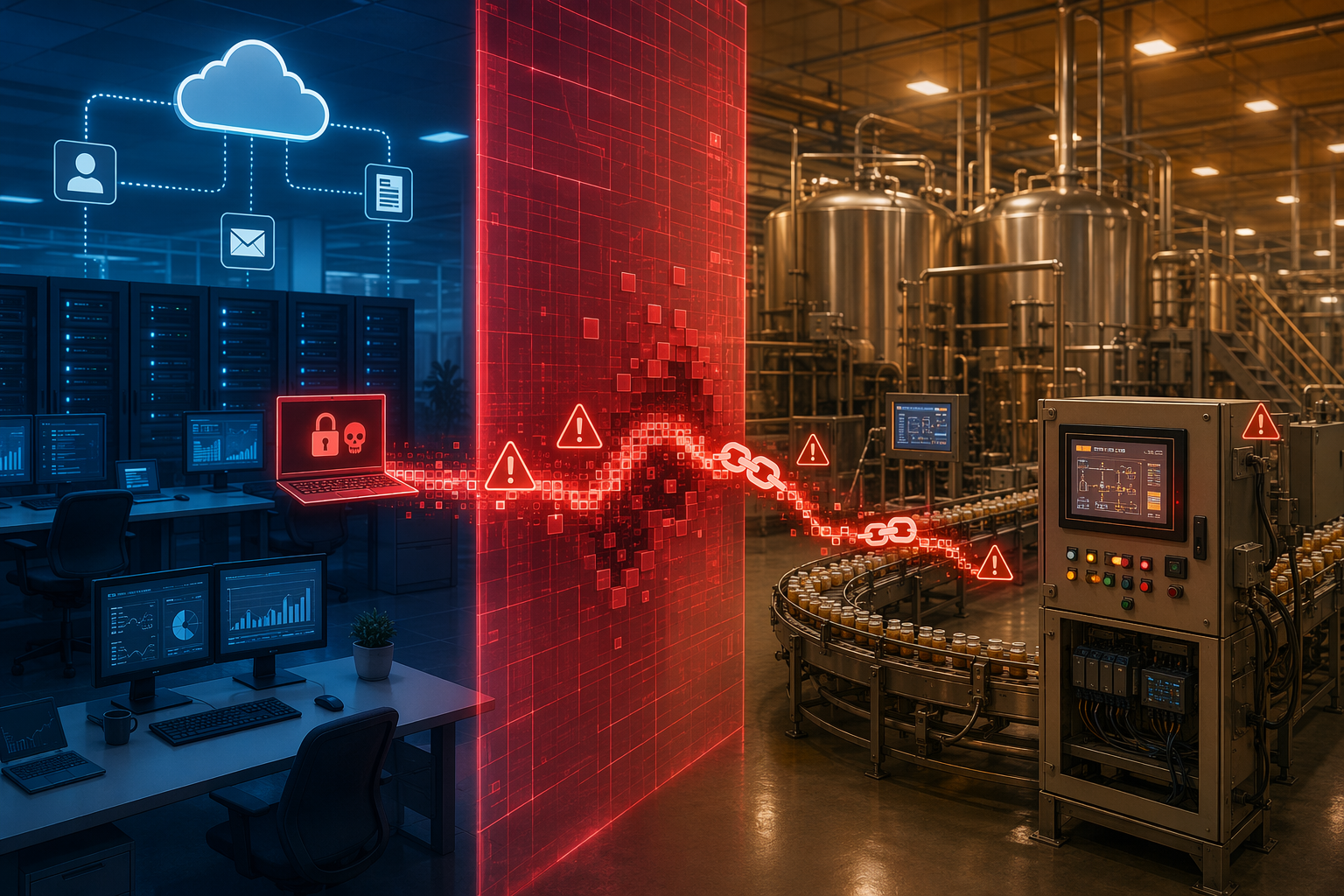
A production-related system could mean many things: scheduling software, quality systems, historians, human-machine interface workstations, manufacturing execution systems, identity infrastructure used by plant systems, or other platforms that production depends on. Some of those sit closer to traditional IT. Some sit closer to industrial control. Without disclosure of the affected assets, students should resist filling in the diagram with equipment names.
The important lesson is not that ransomware always directly controls machinery. It is that production can stop even when the attacker’s path is messier than a cinematic plant takeover. If operators cannot trust the systems that coordinate production, verify quality, support sanitation, track batches, or connect plant workflows, stopping production may be the safer decision.
That distinction matters in incident reports and classroom writeups. “Ransomware affected production-related systems” is supported. “Attackers sabotaged industrial controllers” is not supported by the public record as of July 18, 2026. A strong analyst knows the difference.
Food manufacturing raises the pressure
Fairlife is not just a technology story with a dairy logo attached. Food and beverage production has timing pressure that many office-only ransomware scenarios do not. Milk is perishable. Processing environments have sanitation requirements. Production stoppages can ripple into suppliers, distributors, retailers, and consumers before the forensic report is complete.
The sector data explains why attackers keep returning to this environment. Food and Ag-ISAC recorded 265 food-sector ransomware attacks in 2025, representing 4.2% of all ransomware incidents globally in its reporting.[6] TXOne Networks, citing Claroty survey data, reported that more than one-third of food and beverage firms said one hour of downtime costs at least $1 million, and it also cited FMI 2023 data placing food processor profit margins around 1.6%.[7]
Those numbers should support, not overwhelm, the Fairlife case. They do not prove the cost of this specific incident. They do show why a ransomware operator might view food manufacturing as an attractive pressure environment: downtime is expensive, products may spoil, margins can be thin, and recovery decisions are tied to physical operations rather than just file restoration.
The JBS benchmark shows what Fairlife is not yet
The obvious comparison is JBS, but the comparison is useful only if it stays disciplined. In May 2021, meat processor JBS was hit by ransomware attributed to REvil, paid an $11 million Bitcoin ransom, saw facilities across three countries shut down, and stood down 7,000 Australian employees.[8]
Fairlife has some surface similarities: a major food producer, ransomware, production disruption, and a high-pressure recovery environment. The differences are just as important. No ransomware group has publicly claimed the Fairlife attack in the available reporting. No ransom amount has been disclosed. No payment has been reported. No data theft has been confirmed or denied. No full operational recovery timeline has been announced.
Students should use JBS as a benchmark for what a mature public ransomware narrative can look like after attribution, ransom, and multinational operational effects become known. They should not import those facts into Fairlife. Similar sector, different public record.
The SEC filing is part of the incident, not paperwork after it
Coca-Cola filed the Fairlife disclosure under Item 1.05 of Form 8-K, the SEC cybersecurity incident disclosure framework that became effective on December 18, 2023.[4][9] For governance students, the striking line is that materiality was “not yet determined.”[1]
That phrase is not a dodge. It is a governance reality in a live incident. Materiality depends on facts that may still be moving: duration of production interruption, financial impact, recovery cost, legal exposure, customer effects, insurance position, and whether data was accessed or exfiltrated. The company had enough information to disclose a significant cybersecurity event involving a production halt, but it had not yet completed the materiality assessment.
Wilson Sonsini’s first-year review of cybersecurity incident Form 8-K filings notes that companies have used Item 1.05 filings while investigations were still in progress, including cases where materiality language remained qualified.[9] The Fairlife filing gives students a concrete example of that tension: public markets want timely information, while responders are still collecting evidence.
A weak case study treats disclosure as the last slide. A stronger one treats it as a live workstream with its own risks. Say too little, and investors may lack information about a production-disrupting event. Say too much, and the company may accidentally overstate facts, reveal response details, or create later inconsistencies. The Fairlife disclosure is brief, but its brevity is itself worth studying.
How to analyze the case without overclaiming
A practical student analysis should separate evidence into three buckets: disclosed facts, reasonable operational implications, and unsafe conclusions. This habit is not academic neatness. It is how real incident teams avoid building response plans on assumptions.
| Bucket | Fairlife example | How to write it |
|---|---|---|
| Disclosed fact | Coca-Cola suspended all U.S. Fairlife production after ransomware affected production-related systems | State directly and cite the disclosure |
| Reasonable implication | The event created enough uncertainty or risk around production workflows to justify a halt | Frame as an inference from the production suspension |
| Unsafe conclusion | Attackers manipulated PLCs or physically damaged equipment | Do not state without evidence |
| Disclosed fact | Materiality had not yet been determined | Treat the case as unresolved from a governance standpoint |
| Reasonable implication | The company was still assessing business impact while disclosing | Tie the point to live-incident decision-making |
| Unsafe conclusion | The event was immaterial because the company had not yet determined materiality | Do not confuse pending assessment with a negative finding |
The same discipline applies to data theft. Ransomware incidents often involve extortion, but the public Fairlife record does not confirm exfiltration. The correct phrasing is that data theft has not been confirmed in available disclosures and reporting. It is not correct to call the event a confirmed double-extortion attack.
Attribution needs the same restraint. No public claim by a ransomware group appears in the materials available for this snapshot. That limits what students can say about tactics, techniques, procedures, negotiation behavior, or actor motivation. The case is still valuable without a named crew because the defender-side decisions are visible.
What students should practice from this incident
The Fairlife case works well as a classroom exercise because it forces tradeoffs. A student team can be assigned one role as plant operations, one as incident response, one as legal and disclosure, one as executive leadership, and one as communications. Each team gets the same incomplete public facts and has to decide what to do next.
- Build a timeline using only dated facts first, then add undated reporting separately.
- Map likely dependencies between corporate IT, identity systems, plant systems, production scheduling, quality assurance, and business continuity without claiming specific compromised assets.
- Write two incident summaries: one for technical responders and one for executives deciding whether production can safely resume.
- Draft a disclosure update that preserves uncertainty instead of hiding it.
- List what evidence would be needed before changing the case classification from ransomware affecting production-related systems to confirmed OT/ICS compromise.
For incident response, the hard question is not “Was this bad?” It plainly disrupted production. The harder question is what evidence would justify each next move: keeping production stopped, restarting one facility, isolating specific networks, rebuilding identity infrastructure, notifying customers, expanding disclosure, or treating data theft as likely.
For OT security, the case shows why segmentation, asset inventory, remote-access control, backup validation, and recovery playbooks cannot be treated as plant-side afterthoughts. The public record does not show which of those controls failed or succeeded at Fairlife. It does show the consequence of uncertainty around production systems: the business stopped U.S. production rather than assume normal operations were safe.
For governance, the lesson is that disclosure timing and technical certainty rarely align neatly. Coca-Cola’s same-day filing gives students a current example of a company telling the market what it knew while reserving judgment on materiality.[1] That is not a tidy ending. It is the part most like the job.
What remains unknown
The unresolved facts are not gaps to decorate with guesses. They are the case. As of July 18, 2026, the public record does not identify the ransomware group, the initial access vector, the full scope of affected systems, whether data was exfiltrated, whether a ransom was demanded, whether a ransom was paid, the financial impact, or the production resumption timeline.
That is why the Fairlife ransomware attack is worth studying now, before the narrative hardens. It shows how ransomware analysis changes when the victim makes perishable goods, when production systems are involved, when a public company must disclose under uncertainty, and when the responsible answer is not to complete the story too early.
References
- The Coca-Cola Company Announces Technology Disruption Involving fairlife Operations, The Coca-Cola Company, July 16, 2026.
- Coca-Cola says Fairlife ransomware attack halts US dairy production, BleepingComputer.
- Coca-Cola suspended production at its Fairlife dairy after a ransomware attack, TechCrunch, July 16, 2026.
- Coca-Cola Suspends US Fairlife Production Due to Ransomware Attack, SecurityWeek.
- Coca-Cola Fairlife Ransomware Attack, Bitdefender.
- Navigating the 2025 Food and Agriculture Sector Ransomware Landscape, Food and Ag-ISAC.
- From Farm to Fallout: Ransomware’s Impact on the Food Chain, TXOne Networks.
- JBS S.A. ransomware attack, Wikipedia.
- Snapshot: The First Year of Cybersecurity Incident Filings on Form 8-K Since Adoption of New Rules, Wilson Sonsini, February 2025.
Comments
Join the discussion with an anonymous comment.