
What the Data Says About the AI Gender Gap in Education
Research from over 30 studies reveals the size, causes, and trajectory of the AI gender gap in education—and why it matters for students, educators, and inclusive policy.
Updated:
The strongest recent evidence on the AI gender gap in education does not point to a simple story about interest. It points to a behavior gap that shows up repeatedly: across 18 studies covering 143,000 people in 25 countries, women were about 20% less likely than men to use generative AI tools.[1] That is too broad to dismiss as a campus anecdote, but it is also too blunt to treat as a diagnosis of women students themselves.
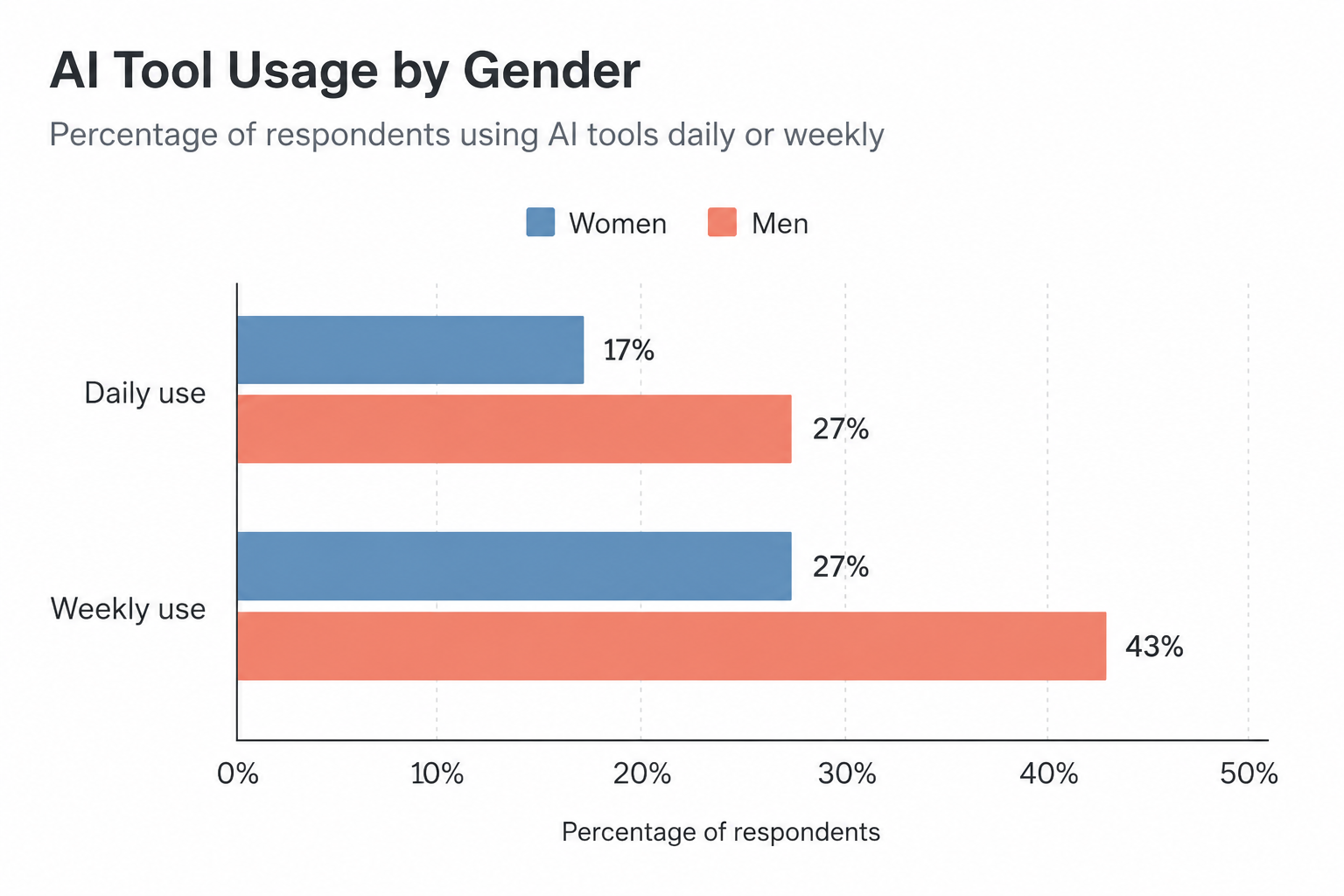
The pattern is visible in current college life. In a 2026 Gallup-Lumina study of U.S. college students, 27% of male students said they used AI daily, compared with 17% of female students.[2] UK student data show a similar split at a different rhythm of use: 43% of male students reported weekly AI use, compared with 27% of female students.[3] These numbers measure use, not ability. They tell us who is turning to AI tools more often, not who can learn them, critique them, or build with them.
Usage Gaps Are Real, but They Are Not Capability Gaps
A careful reading starts by separating adoption from competence. A student who uses a chatbot every day may be experimenting productively, outsourcing work carelessly, checking drafts, generating practice questions, or asking for explanations. A student who uses AI less often may be avoiding a weak tool, following a strict course policy, worrying about hallucinated citations, or choosing not to risk an academic integrity problem. The same frequency count can hide very different academic behaviors.
That distinction matters because colleges often respond to a usage gap as though it were mainly a confidence gap. Confidence may matter for some students, but the better-supported finding is narrower and more useful: women students, on average, are reporting more caution about AI use in higher education contexts. A 2026 systematic review of 30 studies found consistent gender differences in AI tool use and reported that female students showed greater ethical caution and greater concern about losing critical thinking skills.[4]
Those concerns are not eccentric. They map onto the actual risks students face when AI is inserted into coursework without clear rules. A hallucinated source can damage a research paper. A polished but shallow answer can hide the fact that the student has not understood the concept. A vague syllabus warning can leave students guessing whether using AI to brainstorm, summarize, translate, outline, or revise crosses a line. In that setting, lower use can be a rational response to uncertainty.
The practical lesson is not that cautious students should be pushed to use AI more often. It is that AI use has to be made legible. Students need to know which uses are permitted, which uses are academically risky, and how to verify what a system produces. A tool that helps a student generate practice problems or test an explanation is different from a tool that writes a submission-ready answer. For students comparing options, resources such as AI study tools that teach instead of just giving answers and an AI hallucination checklist for students are not side issues; they answer the exact fears that make some students hesitate.
What Student Adoption Data Can and Cannot Tell Us
The U.S. and UK figures are useful because they bring the broad gender gap into ordinary student behavior. Daily use and weekly use are not abstract measures. They describe how often AI is becoming part of study routines: drafting, note review, coding help, explanation, test preparation, translation, and administrative shortcuts. If male students are building more frequent habits around these systems, they may also be getting more chances to learn where the tools help and where they fail.
But frequency is still a limited measure. It does not tell us whether students are using AI in ways that improve learning. It does not tell us whether they are receiving feedback on the quality of their instructions, their verification habits, or their final work. It does not tell us whether a student used AI because the assignment encouraged it, because a peer did, because the student had no time, or because the student had learned a disciplined method.
This is where campus policy often lags behind the evidence. If a college only tracks whether students use AI, it may miss the educational question that matters most: whether students are learning to use AI in ways that preserve judgment. A student who uses ChatGPT Study Mode for real learning is in a different position from a student who asks a system for a finished answer and submits the result. Any serious study of the AI gender gap in education has to keep that distinction in view.
Caution Looks Different When the Risk Is Uneven
The evidence gets clearer when attitudes are read alongside structure. If women students are less likely to use generative AI, the next question is not simply whether they have been encouraged enough. It is whether they are studying in fields where AI is presented as a tool for advancement, or in fields where automation arrives mainly as a threat.
A Barcelona School of Economics working paper sharpens that point. It finds that women are more enrolled in degrees with high routine task intensity, which are more prone to automation, and less enrolled in degrees with high AI exposure.[5] That is a different kind of gender gap from a chatbot usage statistic. It suggests that students are not all meeting AI from the same side of the classroom. For some, AI is framed as a skill to acquire; for others, it may be framed as a force that could devalue the work their degree prepares them to do.
That distinction should change how colleges interpret lower adoption. A student in a field with high routine-task content may have good reason to ask harder questions before embracing an AI tool. Will the tool help her learn the underlying work, or will it replace the practice she needs? Will employers expect AI fluency but provide little training? Will automation reduce entry-level tasks that used to help graduates build expertise? These are not signs of weak interest. They are questions about the terms under which students are being asked to adapt.
This also means AI education cannot be reserved for computer science majors or students already confident with technical tools. If the students most exposed to automation are not the same students most likely to receive strong AI coursework, the campus has built a policy mismatch. General education courses, writing programs, business programs, health-related fields, education programs, and social science courses all need versions of AI literacy that are accurate, discipline-specific, and honest about limits.
Enrollment Is Improving, but the Measure Needs Care
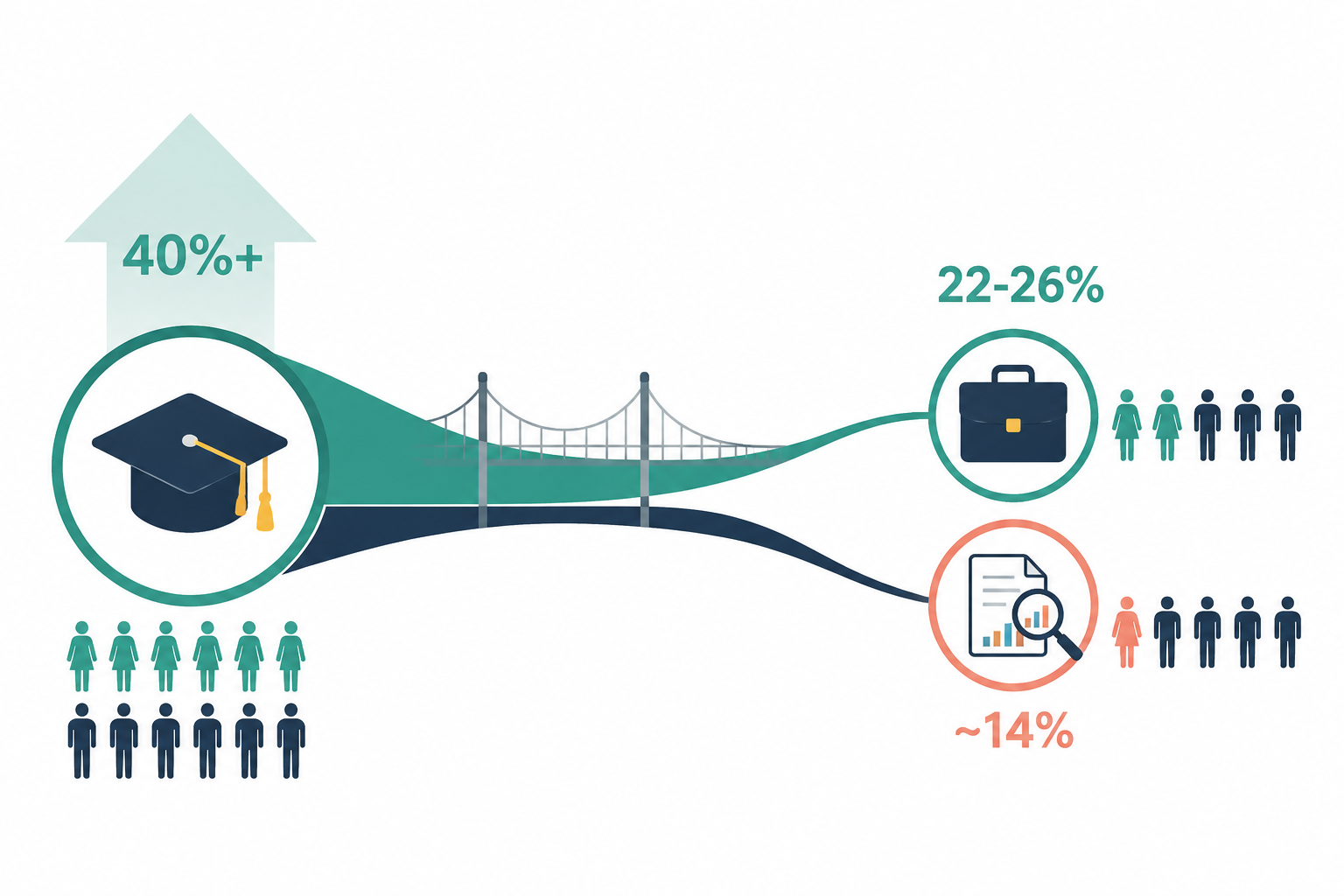
There is also evidence of progress. Research.com reports that more than 40% of AI degree students in the United States are women in 2026, up from roughly 32% in 2024.[6] If that measure is capturing AI-specific degree programs consistently, it is a meaningful sign that the pathway into formal AI study may be widening.
The same source, however, also mentions a figure of roughly 28%, which appears to reflect a definitional difference between AI-specific programs and broader AI-adjacent fields.[6] That discrepancy is not a small footnote. Enrollment numbers depend heavily on what counts as an AI degree: a named artificial intelligence program, a computer science program with an AI concentration, a data science degree, an online certificate pathway, or another AI-adjacent credential. A rising share in one definition can coexist with a much lower share in another.
Still, the improvement should not be waved away. If women’s participation in AI degree programs is rising, that matters for advising, course design, and recruitment. It suggests that the story is not fixed. Students are entering AI pathways when those pathways are visible and available. The mistake would be to treat a narrowing enrollment gap as proof that the broader problem has solved itself.
The Pipeline Still Narrows After College
The downstream numbers are still stark. Nesta’s gender diversity report places women at only 22–26% of the global AI workforce and 13.83% of AI research paper authors.[7] Those figures do not tell us what any individual student will do, and they do not prove that college enrollment alone causes workforce representation. They do show that the pathway from student interest to AI employment and research leadership remains narrow.
That is why degree enrollment progress and tool-use gaps have to be read together. If more women are entering AI degree programs while women students overall use generative AI less often, colleges should not choose the more convenient statistic and ignore the other. The better interpretation is that different parts of the pipeline are moving at different speeds. Formal enrollment may be improving in some AI programs, while everyday AI fluency, exposure in nontechnical majors, and professional pathways still need attention.
The author data also matters because research participation shapes what gets studied, funded, evaluated, and built. If women are underrepresented among AI paper authors, then the questions asked about AI in education may also be narrower than they should be. That is especially important in a field where measurement choices carry consequences: which students count, which harms count, which use cases count as success, and which forms of caution are treated as barriers rather than evidence.
What Colleges Should Do With This Evidence
The data does not support blaming women for lagging AI adoption. It also does not support complacency because one enrollment measure is improving. The more responsible policy reading is narrower and more actionable: women students are using AI less often in several current datasets, they report more caution about ethics and critical thinking, they are differently distributed across fields with different automation risks, and their representation thins sharply in the AI workforce and research pipeline.
A campus response should start with clarity. Students need course-level guidance that distinguishes allowed, discouraged, and prohibited AI uses. They need assignments that make verification part of the work, not an optional afterthought. They need examples of learning-first use, such as asking a system to quiz them, compare explanations, identify weak reasoning, or help them plan revision. A list of free AI study tools is most useful when it is paired with instruction on what the tools are good for and how students should check them.
Advising also needs to be more explicit. Students outside computer science should be able to see where AI coursework fits their degree, what kind of mathematical or programming preparation is actually required, and which pathways lead from introductory literacy to more technical work. That matters most for students in fields where automation risk is high but AI exposure in the curriculum is low.
Finally, institutions need better subgroup data. Many of the available studies use binary gender categories, and the English-language evidence base is especially strong for U.S. and European contexts. Colleges making policy for real students need to know how AI use differs by major, first-generation status, race, income, disability, language background, and course policy, not only by gender. Otherwise, a broad usage gap can become a vague talking point instead of a guide to better academic design.
The fairest conclusion is also the most practical one: lower AI use among women students should be treated as a signal to improve the learning environment, not as a deficiency to correct in the students. Verified accuracy, transparent rules, learning-first tools, visible routes into AI coursework, and protection for students whose future work is most exposed to automation are the parts of the evidence that colleges can act on now.
References
- The Gender Gap in Generative AI, Harvard Business School Working Paper 25-023, https://www.hbs.edu/ris/download.aspx?name=25-023.pdf
- AI Routine for College Students, Despite Campus Limits, Gallup, https://news.gallup.com/poll/704090/routine-college-students-despite-campus-limits.aspx
- The AI gender gap, Datawrapper, https://www.datawrapper.de/blog/ai-gender-gap
- Gender differences in AI tool use in higher education, Springer, 2026, https://link.springer.com/article/10.1007/s44217-026-01116-6
- AI and Digital Technology Gender Gaps in Higher Education, Barcelona School of Economics, https://bse.eu/research/working-papers/ai-and-digital-technology-gender-gaps-higher-education
- AI Degree Student Demographics Report, Research.com, 2026, https://research.com/online-degrees/artificial-intelligence/ai-degree-student-demographics-report
- Gender Diversity in AI, Nesta, https://www.nesta.org.uk/report/gender-diversity-ai/
Comments
Join the discussion with an anonymous comment.