
385-Million-Year-Old Amber Rewrites Plant Evolution Story
The discovery of 385-million-year-old Devonian amber in China pushes back the origin of complex resin by 65 million years and forces paleontologists to rethink why plants evolved resin production—long before insects existed.
Updated:
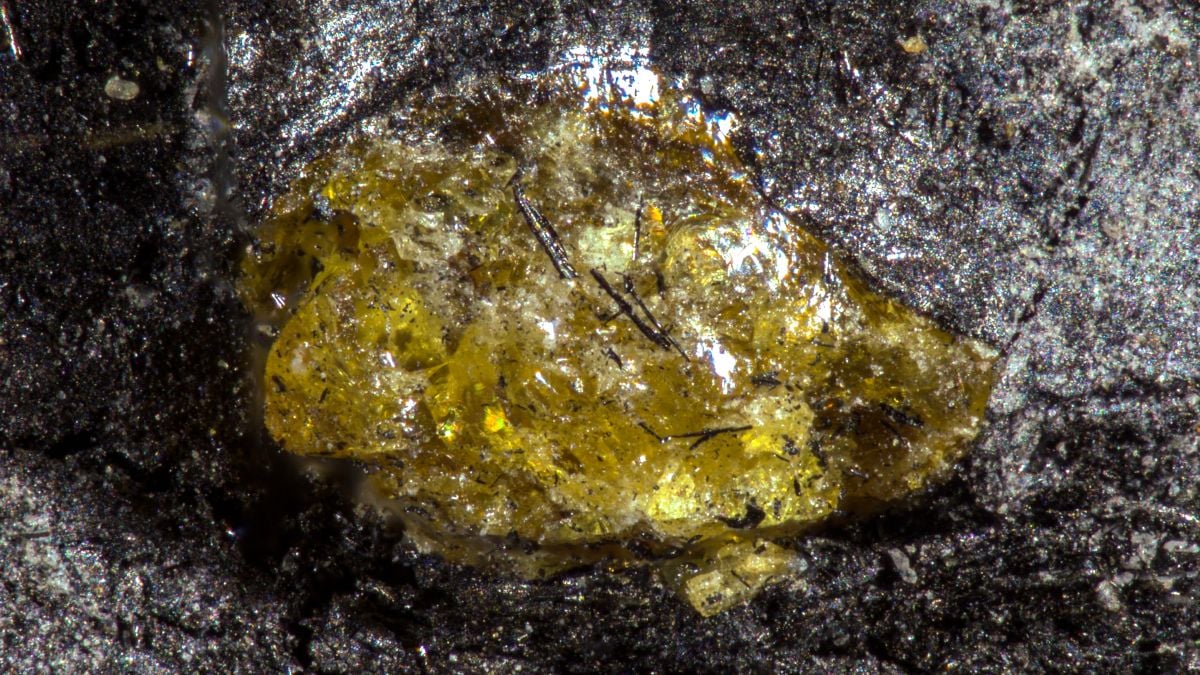
In a 10 kg coal sample from the Hujiersite Formation in Xinjiang, China, researchers had to sort through 241 microscopic fragments, each only 0.1–1.5 mm wide, before the material could even be considered amber. The age estimate, about 385 million years, places the pieces in the Middle Devonian and makes them about 65 million years older than the previous amber record [1].
How The Fragments Earned The Name Amber
That caution is the point. Lead researcher Cihang Luo said that an amber identification at roughly 385 million years old would be extraordinary, so the team first treated the grains simply as resin-like organic material [1]. The account here follows secondary reporting on the Science Advances paper, which is enough to trace the verification chain even though it is not the journal article itself.
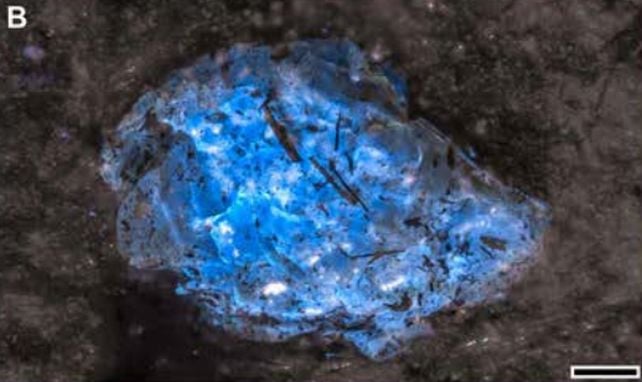
- Under ultraviolet light, the best candidates fluoresced bright blue, which made the fragments easier to isolate from coal [1].
- The team then hand-picked the specks rather than assuming every shiny grain belonged in the sample [1].
- FTIR added carbonyl absorption peaks, a chemical pattern consistent with resin [1].
- GC-MS completed the check by matching a conifer-type resin molecular profile [1].
That sequence matters more than the headline age. The claim is built from visible screening, manual sorting, and two independent chemistry checks; it does not depend on shape alone. And it is amber without inclusions: no insect, no leaf, no preserved bit of bark [1].
What 385 Million Years Changes
The age is what shifts the biological story. By the Middle Devonian, land plants were already becoming more structurally elaborate, with wood, roots, and leaves entering the fossil record, but seed plants were not yet part of these forests [3]. So when the amber chemistry looks conifer-like, the obvious conclusion is not that conifers were somehow already there; it is that non-seed vascular plants were capable of far more sophisticated resin chemistry than paleobotanists had previously demonstrated [1][2][3].
The source plant species remains unconfirmed because no plant tissue came along for the ride. The current attribution is narrower and more defensible: the resin probably came from progymnosperms or arborescent lycopsids, inferred from co-occurring fossils and the resin's chemistry, not from a preserved trunk or leaf [2].
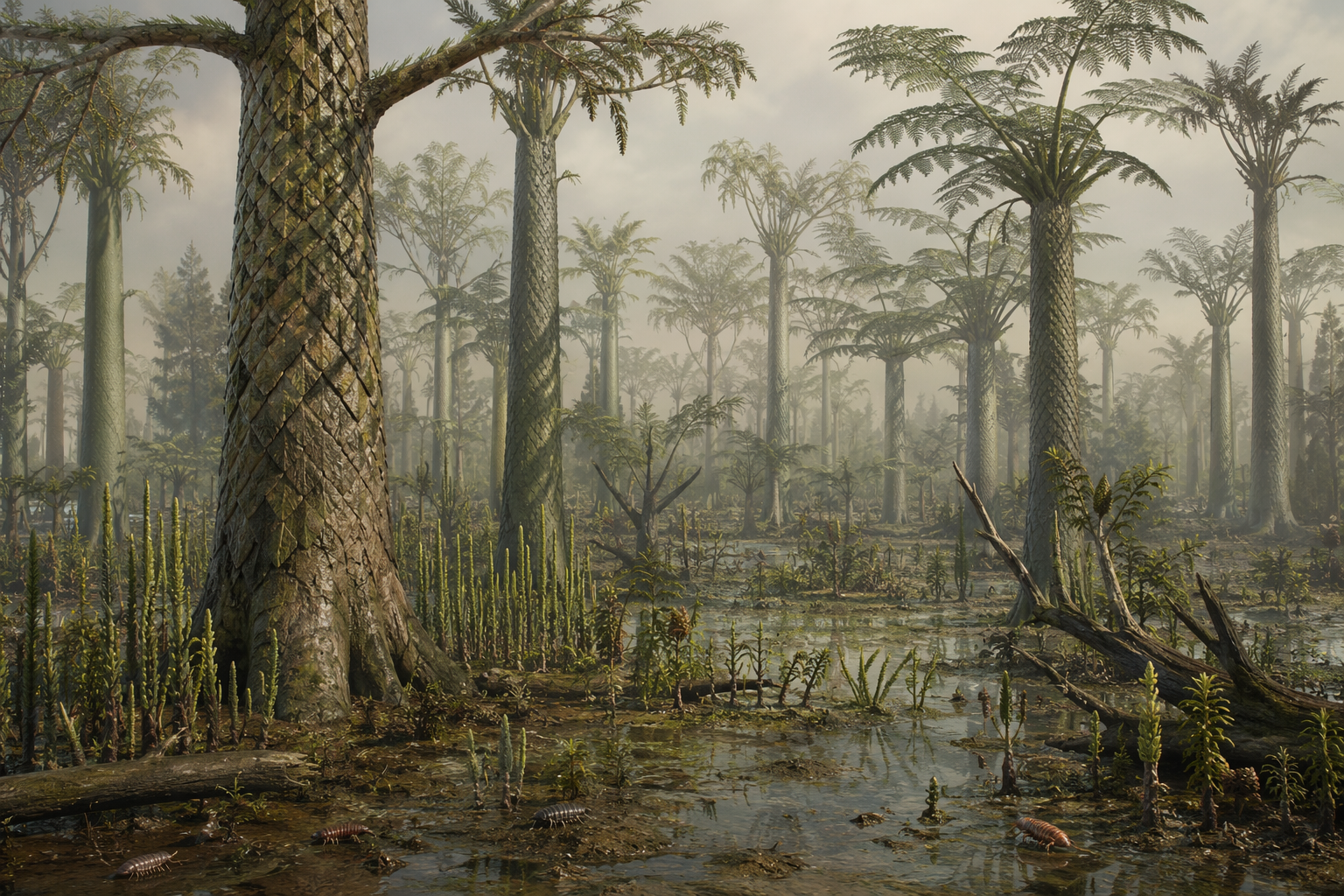
That is also why the record matters for the broader Devonian landscape. The find does not say that every early forest was sticky with amber, only that at least some non-seed plants were already making a resin chemically close to what later conifers would produce [1][2].
What Resin Was Probably Doing
The most plausible function is also the least glamorous. In a Devonian ecosystem, resin makes immediate sense as a wound sealant and antifungal barrier, because terrestrial food webs were still relatively simple and the later insect-focused defense story had not yet taken shape [2][3]. Luo noted that those food webs "were much less complex than those of later forests," and no insect bore holes are known from Devonian plant fossils; the first unambiguous insect herbivory appears later in the Carboniferous [2].
That keeps the conclusion sober but substantial. This Devonian amber does not preserve an ancient fly or a tiny forest scene. It does preserve a molecular benchmark: complex resin biosynthesis was already present in non-seed plants long before the classic seed-plant forests and the insect-dominated ecological stories that amber is usually asked to tell [1][2][3].
References
- World's oldest amber comes from a world 150 million years before dinosaurs — ScienceAlert
- Earliest amber found in China changes story of plant evolution — Haaretz — 2026-07-15
- Devonian Period: Plants — Britannica
Comments
Join the discussion with an anonymous comment.