

How Cristiano Ronaldo's Retirement Planning Impacts Students
Learn how Cristiano Ronaldo's two-decade retirement planning system—diversifying income, owning equity, and building a personal brand as an asset—can help students create their own long-term career and financial plan.
Updated:
Cristiano Ronaldo’s retirement impact is easiest to misunderstand if the story starts with money. The more useful starting point is stranger: he says he began preparing for retirement “since 25, 26, 27-years-old,” long before the public had any reason to treat him as close to finished.[1] For students, that timing matters more than the celebrity scale. It means the transition plan began while the main career still felt secure.
That is not how most people plan. Students often wait until the deadline becomes visible: senior year, the final semester, the week before applications close, the night before an exam. Ronaldo’s version is the opposite. He used the high-energy years of his football career to build options for the lower-certainty years after it.
The numbers are huge, but they should be handled carefully. Forbes estimated in June 2026 that Ronaldo’s net worth had reached $1.2 billion and that his career earnings had reached $2.1 billion, making him the first active athlete to cross $2 billion in career earnings.[2] Forbes also estimated that he earned $300 million in the previous 12 months, including $235 million on-field and $65 million off-field, ranking him as the world’s highest-paid athlete for the fourth straight year.[3] These are estimates, not audited personal accounts; Forbes noted that Ronaldo’s representatives declined to comment.[2]
The part students can copy is the sequence
No student can copy Ronaldo’s audience, salary, genetics, transfer market, sponsorship access, tax position, or bargaining power. Treating his career as a simple “work harder” lesson would be lazy. The transferable part is narrower and more useful: he appears to have treated his peak years as a window for building assets that could survive the end of the role that made him famous.
A student version of that sequence is not glamorous. It looks like choosing one skill before it is urgent, documenting proof of work before applications open, building a network before needing referrals, and learning basic money habits before the first full-time paycheck. The useful question is not, “How do I become Ronaldo?” It is, “What am I doing now that still helps me when this chapter ends?”
That is why this belongs beside study systems, not celebrity finance. The same habit behind protected study time in Eton-style academic routines shows up here at a larger scale: do not rely on motivation arriving at the perfect moment. Build a structure early enough that it can compound quietly.
Paid once is different from owning a piece
The most important distinction in Ronaldo’s post-football planning is between being paid for attention and turning attention into ownership. Endorsements can be enormous, and his reported lifetime Nike deal has been valued at more than $1 billion.[4] But an endorsement is still a payment tied to a contract. Equity is different. It gives the holder a claim on something that may grow, fail, or become more valuable without being tied only to another appearance fee.
That shift appears across his portfolio. His CR7 Hotels business includes five properties through a 50/50 joint venture with Pestana Hotel Group, with a 151-room Riyadh flagship announced in early 2026.[4] CR7 Fitness has been described as a franchise model rather than a simple brand license.[4] Forbes reported equity-linked moves including a stake in Whoop, which was valued at $10.1 billion after a $575 million funding round in March 2026, and an investment in Perplexity AI in December 2025.[2] Sports Illustrated also reported that Ronaldo took 25% ownership of Spanish second-division club UD Almería in February 2026.[5]
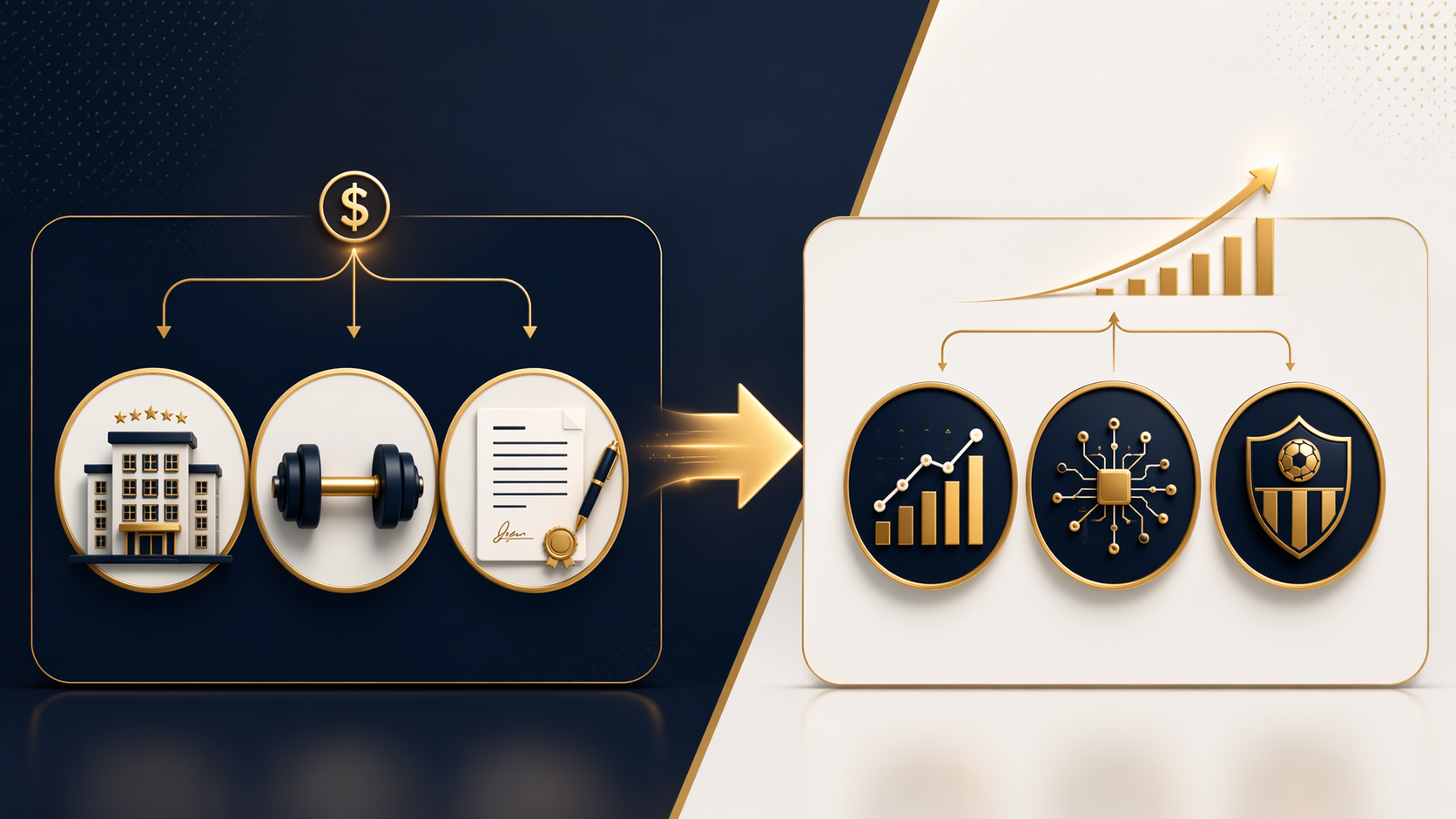
For students, the lesson is not to start buying companies. It is to notice the direction of movement. A one-time tutoring job, design commission, campus shift, or internship can be useful because it pays. But the longer-term question is whether any part of that work creates an asset: a portfolio piece, a recommendation, a reusable template, a public project, a small business process, a professional relationship, or a skill that raises the value of the next opportunity.
| Ronaldo-scale version | Student-scale translation |
|---|---|
| Endorsement income | Paid work, scholarships, internships, assistantships |
| Equity stakes | Portfolio projects, reusable systems, small ownership where realistic |
| Global fan base | Reputation with classmates, professors, employers, online peers |
| Late-career transition plan | Graduation, career change, visa, funding, or job-search plan before pressure peaks |
This is where a student has to be honest. A busy semester can make every opportunity look equal because everything consumes time. They are not equal. Some opportunities end the moment the payment clears. Others leave proof, access, or skill behind. The second kind is usually more valuable when the next transition arrives.
Diversification is not doing everything
Ronaldo’s business interests are often described as an empire, but for planning purposes the more useful word is diversification. Hotels, fitness, apparel, technology, sports ownership, social media, and club salary do not all behave the same way. They carry different risks, timelines, and sources of value. That matters because a footballer’s main earning engine eventually weakens, even if Ronaldo’s has lasted unusually long.
Students hear “diversify” and sometimes translate it into overcommitment: three clubs, two internships, a side hustle, research, volunteering, content creation, and a full course load. That is not a plan; that is exhaustion with a better label. Diversification only helps if the pieces reinforce rather than erase each other.
A cleaner student version could be small: one academic track, one professional skill, one visible proof of work, and one relationship-building habit. A computer science student might keep coursework as the main track, use one open-source or campus project as proof, work a few hours in a related support role, and maintain contact with one mentor. A psychology student might combine research methods, a campus lab role, a short writing portfolio, and informational interviews. These are hypothetical examples, not evidence that either path guarantees an outcome.
The planning burden is lighter when goals become routines. A study schedule app can turn vague ambitions into recurring blocks, and a personalized study app stack can keep tools from becoming another distraction. The career version works the same way: if a plan cannot survive an ordinary week, it is probably decoration.
A fan base is an asset only when trust survives
Ronaldo’s audience is not a normal audience. Forbes described him as having nearly 1 billion followers across Instagram, Facebook, and X, including about 674 million on Instagram around mid-2026, the largest fan base of any person on earth.[2] That number should not be treated as fixed; social platforms change, remove accounts, and update measurement. Still, the broad point is clear: his attention base is itself an economic asset.
Students do not need a public following for this lesson to matter. Reputation is the campus-sized version of audience. It is built when people learn that a student replies on time, shows up prepared, writes clearly, finishes group work, credits others, and can be trusted with slightly harder tasks next time. It is damaged when the same people have to chase, repair, or explain that student’s work.
The mistake is thinking personal brand means constant posting. Sometimes the strongest student brand is quiet and specific: the person who understands data cleaning, the person who can lead a review session, the person who writes readable lab notes, the person who knows how to organize a chaotic project. Visibility helps only when there is something durable behind it.
This is also why proof of work matters. A resume line says what happened. A portfolio, GitHub repository, writing sample, presentation deck, case competition memo, design file, or research poster shows how someone thinks. Over time, those artifacts let other people remember and recommend a student for reasons more concrete than “hardworking.”
The Saudi move is strategic, not a student career hack
Ronaldo’s move to Saudi Arabia is tempting to frame as a universal lesson in taking the biggest offer. That would flatten the facts. Forbes has described the arrangement as including a salary of more than $200 million annually, zero personal income tax, and a 15% club stake.[2] Those conditions belong to an athlete with rare leverage, not to an ordinary late-career professional, much less a student deciding between internships.
The student-sized takeaway is not “choose the highest number.” It is to compare offers by what they change. Does the role build a skill that transfers? Does it put the student near serious people? Does it create proof of work? Does it reduce financial pressure enough to make better academic or career choices? Does it close off a path that would be hard to reopen?
Money matters, especially for students without family backup. But an offer can be high in cash and low in future leverage. Another can be modest but put a student inside a lab, firm, school, studio, clinic, or team where the next opportunity becomes easier to reach. The right answer depends on constraints; pretending otherwise is how advice becomes careless.
Planning before pressure changes the quality of decisions
Ronaldo’s exact retirement date remains uncertain. Reuters reported that the 2026 World Cup is confirmed as his last international tournament, while club play may continue beyond that.[6] That uncertainty is part of the point. A transition plan does not require knowing the final date. It requires admitting that the current role will not last forever.
Students usually live with several known endings: graduation, funding deadlines, lease dates, visa timelines, application cycles, exam weeks, internship seasons. The calendar is not mysterious. What is hard is acting early enough that choices still exist.
There is a sharp difference between planning and rescue. A 48-hour cram schedule can be useful when the emergency is already here, but it is not the model for building a life after college. The emergency version narrows options. The early version gives students room to compare, ask for help, revise, and recover from one bad bet.
This is where Ronaldo’s timeline is useful precisely because it is excessive. Planning since the mid-twenties is not normal for most people. But the gap between “two decades ahead” and “two days ahead” leaves plenty of room for a student to improve. A semester ahead is already better than a week. A year ahead is better than panic after graduation.
Post-career value can rise if the brand was built deliberately
The Athletic used David Beckham as a precedent for the possibility that commercial power can increase after retirement, and it also reported Ronaldo saying he had been planning since age 25.[7] Beckham is not a perfect comparison, and no one should assume post-career earnings automatically rise. The useful point is narrower: when a person’s reputation, business interests, and audience are deliberately built before the ending, the ending may become a transition rather than a cliff.
Students have smaller cliffs, but they are real. The end of a degree can remove campus housing, student discounts, advising access, research affiliation, work authorization structures, health coverage, or the simple identity of being enrolled. Waiting until the last month to notice those dependencies makes every decision more emotional.
A better transition plan names what disappears and what should already be in motion. If a student loses access to a professor, ask for the recommendation early. If a campus job ends, save the work samples and supervisor contact. If a scholarship runs out, map the funding gap before the final bill. If a major no longer fits, test an adjacent path before abandoning everything at once.
A student-sized retirement planning framework
Ronaldo’s plan works as a student framework only after it is stripped of billionaire conditions. The useful version is modest enough to start this semester.
- Build one reliable skill: choose a skill that can be practiced weekly and recognized by other people, such as writing, coding, data analysis, teaching, design, lab technique, budgeting, or public speaking.
- Create one visible proof of work: turn effort into something reviewable, such as a portfolio page, research poster, GitHub project, case study, essay, presentation, or documented campus project.
- Add one opportunity stream beyond grades: seek a role, mentor, assistantship, internship, competition, tutoring client, or community project that creates experience outside the transcript.
- Practice one small ownership habit where possible: save templates, document processes, keep rights to personal work when allowed, build a small portfolio, or learn how equity and contracts actually function before signing anything important.
- Write one transition plan before graduation forces it: list what ends, what continues, who can help, what money is needed, and what decisions must be made before the final semester.
None of this promises wealth, passive income, or independence from ordinary constraints. It does something less flashy and more useful: it reduces the chance that a student reaches the end of a degree with only grades and anxiety to show for it.
Cristiano Ronaldo’s retirement impact on students is not inspiration in the vague sense. It is a reminder that the best transition plans are built while the current chapter still feels secure.
References
- Ronaldo says he will retire 'soon' to spend more time with family, Reuters, Nov. 5, 2025.
- How Cristiano Ronaldo Became A Billionaire, Forbes, June 5, 2026.
- Forbes profile, Forbes, May 2026.
- How Cristiano Ronaldo Built a $1.2B Business Empire, GK Kapital.
- UD Almería stake report, Sports Illustrated, February 2026.
- Ronaldo 2026 World Cup retirement coverage, Reuters.
- Ronaldo, Messi, Modric and the retirement question, The Athletic, June 27, 2026.
Comments
Join the discussion with an anonymous comment.