
What Cristiano Ronaldo's Career Timeline Teaches Students
Explore Cristiano Ronaldo's career journey from Madeira to global stardom and discover seven evidence-backed lessons on goal-setting, discipline, and resilience that students can apply to their own academic success.
Updated:
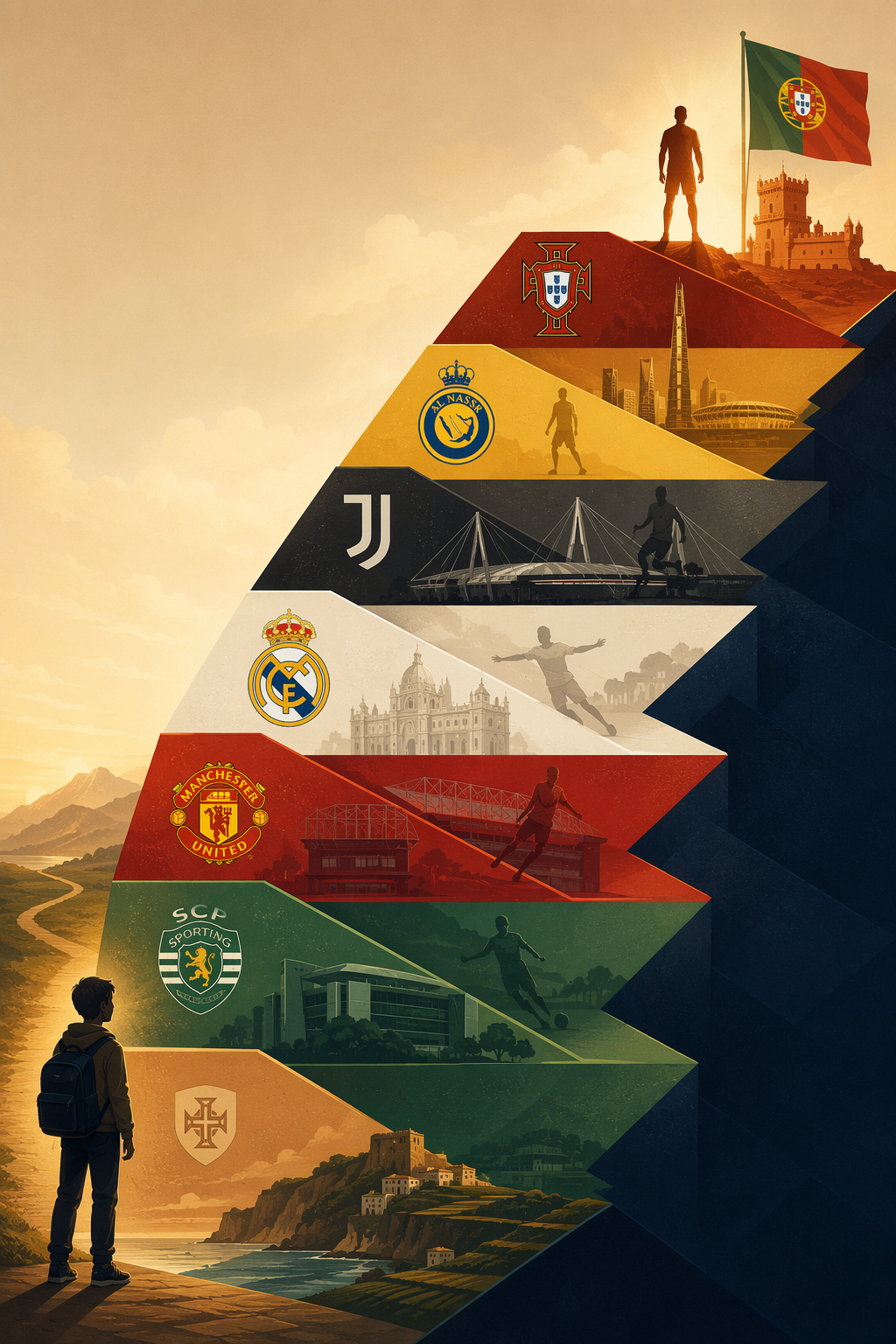
A useful Cristiano Ronaldo career timeline for students starts with dates, not slogans. Ronaldo was born on February 5, 1985, in Funchal, Madeira, and his path moved through Sporting CP, Manchester United, Real Madrid, Juventus, Al-Nassr, and Portugal’s national team before he reached the July 2026 record lists that now make his career look almost unreal.[1][2]
That long arc matters because students are often told to “work hard” without being shown what hard work had to survive. In Ronaldo’s case, the pressure points are visible: leaving home at 12, dealing with a heart condition as a teenager, being booed after the 2006 World Cup, changing leagues and roles, and still producing measurable results decades later.[1][3]
Cristiano Ronaldo Career Timeline: The Short Version
Before taking lessons from the career, it helps to see the route in order. The goal is not to memorize every trophy, but to notice how each phase demanded a different kind of response.
| Phase | Key facts students can use |
|---|---|
| 1985-1997: Madeira childhood | Born in Funchal, Madeira, on February 5, 1985; grew up in a family described in biographical sources as financially strained.[1][3] |
| 1997-2003: Sporting CP academy | Moved to Lisbon at 12 to join Sporting’s academy; later dealt with tachycardia and cardiac ablation surgery as a teenager.[1][3] |
| 2003-2009: Manchester United | Signed in August 2003 for a reported £12 million, a record fee for a teenager at the time; won his first Ballon d’Or after the 2007-08 season.[2] |
| 2009-2018: Real Madrid | Transferred for a reported €94 million in 2009; scored 451 goals in 438 appearances for the club.[2][4] |
| 2018-2021: Juventus | Moved at 33 for a reported €100 million; scored 101 goals in 134 appearances and became the first player to win league titles in England, Spain, and Italy.[2] |
| 2023 onward: Al-Nassr | After leaving Manchester United in 2022, joined Al-Nassr and scored 54 goals in 2023, finishing as the world’s top scorer for that calendar year.[2] |
| Portugal national team | By July 2026, listed with 233 caps and 146 international goals, both men’s world records; captained Portugal at his sixth World Cup in 2026.[5][2] |
Lesson 1: Start Before You Feel Fully Ready
Ronaldo’s first major turning point was not a stadium final. It was leaving Madeira for Lisbon at age 12 to join Sporting CP’s academy.[1] That is young enough to matter. A 12-year-old is not simply “chasing a dream”; he is leaving familiar streets, family routines, and the comfort of being known.

The tempting lesson is to say, “Be brave.” That is too vague for school. The better lesson is that a serious goal often asks for an uncomfortable first environment before confidence has arrived. Ronaldo did not move after becoming a finished professional. He moved into the place where the standard was higher than his current comfort level.
There is one caution students should not skip. Ronaldo reportedly left formal schooling at 14 to focus on football.[3] That fact belongs in a biography, but it should not become advice. His path was unusually high-risk and attached to an elite sports pipeline. For most students, the transferable move is not quitting school; it is placing yourself near stronger practice, stronger feedback, and clearer standards while keeping your education intact.
Student application: choose one subject where you are still waiting to “feel ready,” then enter the harder version of practice this week. That might mean joining the advanced math help session, asking the teacher to mark one essay paragraph before the due date, or doing timed questions before you feel prepared. The first goal is not confidence. The first goal is contact with the real standard.
Lesson 2: Treat Obstacles as Information, Not Identity
At around 15, Ronaldo was diagnosed with tachycardia, a condition involving an abnormally fast heartbeat, and underwent cardiac ablation surgery; biographical accounts say he returned to training days later.[3] The fact is dramatic, but the study lesson is not that students should ignore health or rush recovery. The lesson is that an obstacle should be named accurately before it is allowed to define the whole person.
In school, students often turn one result into an identity. A failed quiz becomes “I’m bad at science.” A messy presentation becomes “I can’t speak.” A late assignment becomes “I’m lazy.” Ronaldo’s teenage medical problem was serious, but it was also specific: a condition, a procedure, a recovery period, and then a return. That sequence is more useful than a label.
Student application: after a setback, write it as a diagnosis instead of a verdict. For example: “I lost marks because I did not show working,” “I ran out of time on the final two questions,” or “I revised definitions but not application problems.” Once the problem is specific, the next practice session has a target.
Lesson 3: Set Goals That Can Be Counted
Manchester United signed Ronaldo in August 2003 for a reported £12 million, described in career summaries as a record fee for a teenager at the time.[2] He arrived as a gifted, entertaining winger. By the 2007-08 season, the evidence had changed: 42 goals in all competitions, the Premier League and Champions League double, 31 league goals, the European Golden Shoe, and his first Ballon d’Or at age 23.[2][4]
For students, this is where “big dreams” need numbers attached. Ronaldo’s improvement was not visible only because people praised his attitude. It was visible because the output changed. Goals increased. Awards followed. His role shifted from promising winger to decisive scorer.
A school goal works the same way. “Do better in English” is not enough to guide behavior. “Raise my essay score by improving evidence paragraphs,” “complete 20 algebra questions without checking notes,” or “review vocabulary for 15 minutes on four school nights” gives the student something to count and correct.
Student application: build a small scoreboard for one class. Track the behavior you control, not only the final grade. If you need a structure, a simple homework tracker can help; the comparison of Google Sheets, Notion, and printable homework tracker templates is useful when you want the tracking method to match your study style.
Lesson 4: Use Public Setbacks as Private Feedback
The 2006 World Cup left Ronaldo in a hostile spotlight, especially in England after the Wayne Rooney incident. Biographical accounts describe him being booed by England fans afterward.[3] The next phase is why this matters for students: in the 2006-07 season, Ronaldo scored 23 goals, helped Manchester United win the Premier League, and was named PFA Player of the Year.[2]
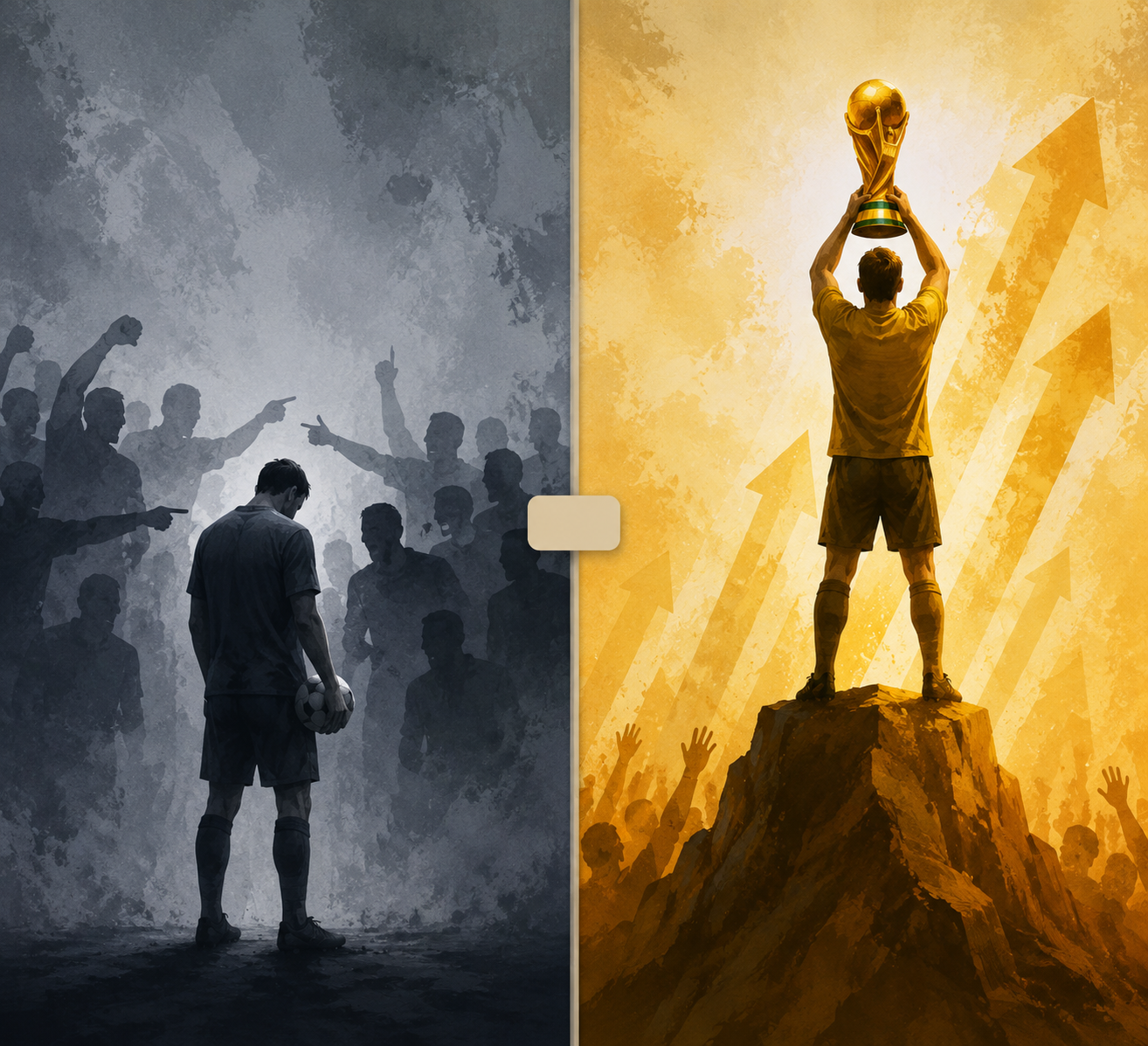
This is the cleanest resilience lesson in the timeline because it has a before and after. The setback was not imaginary. The response was not hidden. There was noise, then there was a season of improved production. That does not prove booing caused the improvement, and it would be careless to claim it did. What the timeline does show is that Ronaldo’s next measurable phase did not collapse under the pressure.
Students get smaller versions of this: a low grade shown on the online portal, a weak answer in class, a tryout that does not go well, a teacher’s comment that stings because it is partly true. The useful move is to separate embarrassment from instruction. Embarrassment says, “Everyone saw.” Instruction asks, “What should change before the next attempt?”
Student application: after a public mistake, do not make the first repair emotional. Make it procedural. Ask for one correction target, redo one sample problem, rewrite one paragraph, or practice one skill under timed conditions. The faster the setback becomes a practice plan, the less time it has to become a reputation in your own head.
Lesson 5: Build a System Strong Enough to Repeat
Ronaldo’s Real Madrid years are the part of the timeline where talent alone becomes an insufficient explanation. He joined the club in 2009 for a reported €94 million transfer fee, and Real Madrid lists him with 451 goals in 438 appearances.[2][4] He became the club’s all-time top scorer and won four Champions League titles there.[4]
A student does not need to care about transfer fees to learn from this phase. The useful question is simpler: how does performance stay high after the first success? One good test score can come from a burst of panic. One strong season can come from momentum. But hundreds of goals across nearly a decade require repeatable preparation, recovery, adjustment, and standards.
In school, a repeatable system usually has fewer moving parts than students think. It needs a place to record assignments, a fixed time to start, a way to test memory without looking, and a feedback loop after graded work returns. The system should be boring enough to survive a busy week.
- Record the task the day it is assigned, not the night before it is due.
- Practice retrieval, not just rereading.
- Check errors by type: content gap, careless mistake, timing problem, or unclear explanation.
- Protect one recovery habit, such as sleep, because tired practice often looks productive while producing weak recall.
Student application: choose one routine you can repeat for four weeks. Do not design a perfect study routine. Design a system that still works on a normal Tuesday when you are tired, distracted, and tempted to postpone.
Lesson 6: Adapt When the Level Changes
At 33, Ronaldo moved from Real Madrid to Juventus for a reported €100 million, the highest fee ever paid for a player over 30 according to career summaries.[2] He then scored 101 goals in 134 appearances and became the first player to win league titles in England, Spain, and Italy.[2]
That part of the timeline is a useful correction for students who assume that one successful method should work forever. The jump from middle school to high school, from high school to college, or from regular to honors classes often exposes methods that used to be enough. The student may still be capable, but the environment has changed.
Adaptation is not the same as starting over. It means keeping the useful core and changing the method around it. A student who earned strong grades by rereading notes may need practice questions. A student who did well by memorizing facts may need to explain cause and effect. A student who could finish homework late at night may need earlier work blocks when assignments become longer.
Student application: when a class gets harder, do not first ask, “Am I smart enough?” Ask, “Which part of my old method no longer matches the task?” That question keeps your attention on adjustment, where you still have choices.
Lesson 7: Respond to a Bad Chapter With a New Measurable Chapter
Ronaldo’s second Manchester United spell ended publicly in 2022. The timeline did not stop there. After joining Al-Nassr, he scored 54 goals in 2023, finishing as the world’s top scorer for the calendar year.[2] Students should be careful with this example: a professional athlete’s move between clubs is not the same as a student moving between classes, schools, or friend groups. Still, the response pattern is transferable.
A bad chapter becomes less powerful when the next chapter has evidence. Not excuses, not a speech, not a claim that people misunderstood you. Evidence. Finished assignments. Better attendance. Cleaner lab reports. More accurate practice tests. A corrected habit over several weeks.
By July 2026, Ronaldo was listed with 976 senior career goals, the men’s all-time record; he was also listed as the first player with 100 or more goals at four clubs.[5] His Portugal record stood at 233 caps and 146 international goals, both men’s world records, and he had scored in 24 consecutive calendar years from 2002 through 2025.[5] Longevity does not erase difficult chapters. It places them inside a longer record.
Student application: if you are recovering from a weak semester, make the next six weeks visible. Track assignments submitted on time, practice scores, revision sessions, or teacher feedback. Do not try to repair your reputation by arguing with the old evidence. Build new evidence.
What Not to Copy From Ronaldo’s Timeline
A serious career timeline should not turn every unusual fact into advice. Ronaldo’s early poverty, his school departure at 14, his elite academy access, and his global fame are not normal conditions. His billionaire status and enormous online following are part of the public record, but they are not the best moral of the story for a student trying to pass chemistry or finish an English essay.[2]
The safer lesson is narrower and more useful. His timeline shows how long-range achievement can be built through phases: entering harder environments, naming obstacles accurately, setting measurable goals, using setbacks as feedback, repeating systems, adapting to new levels, and building fresh evidence after failure. It does not prove that willpower alone makes every outcome possible.
That is still enough. Students do not need a celebrity myth. They need a way to look at a difficult week and decide what the next practice block should be.
References
- Cristiano Ronaldo, Britannica
- Cristiano Ronaldo, Wikipedia
- Cristiano Ronaldo Biography, Biography.com
- Cristiano Ronaldo dos Santos Aveiro, Real Madrid CF
- List of career achievements by Cristiano Ronaldo, Wikipedia
Comments
Join the discussion with an anonymous comment.