

Cloud Migration Strategy for Certification Beginners
Learn the cloud migration strategies tested in entry-level cloud certification exams — including the 7 Rs, migration phases, and adoption frameworks — and understand how these concepts directly appear in exam questions.
Updated:
Cloud migration strategy for beginners is usually tested as recognition, not as a full architecture design exercise. In an entry-level exam, you are more likely to see a short scenario about a legacy application, a SaaS replacement, a workload that needs only minor tuning, or a system that should stay where it is for now. Your job is to spot the strategy term, the migration phase, or the adoption-framework perspective that best fits the clue.
That is why the useful study map is small: learn the 7 Rs well, understand the assess-plan-migrate-operate flow, and know that cloud adoption frameworks organize migration around business, people, governance, platform, security, and operations concerns. Public cloud spending forecasts help explain why migration appears in certification objectives at all; Future Processing, citing Gartner, notes a forecast of US$679 billion in public cloud end-user spending in 2024. But the exam value is not the size of the market. It is knowing which answer choice matches the scenario. [1]
What Exams Usually Want From Migration Strategy
Beginner certification questions usually simplify migration into a decision pattern. A company wants to move quickly with few code changes. A team wants to modernize an application for cloud-native services. A business unit wants to replace an old tool with a managed SaaS product. A compliance requirement means a workload cannot move yet. Those are not random story details; they are answer-choice signals.
The wording varies by vendor. AWS materials often discuss migration readiness, mobilization, and portfolio planning. Google Cloud and IBM describe migration in phases such as assess, plan, migrate, and operate or optimize. Azure materials frame many decisions through the Cloud Adoption Framework. The names are not identical, but they orbit the same exam-level idea: decide what should move, choose how it should move, execute the move, then run and improve it.
Keep one caveat in mind while studying: real migration decisions involve budget, compliance, identity, networking, data gravity, licensing, outage windows, application dependencies, and internal politics. Certification questions compress that mess into cleaner stems. Do not confuse the simplified exam pattern with the full job.
The 7 Rs Are the Main Answer-Choice Framework
The 7 Rs are the most compact way to study migration strategy because they turn vague phrases like “move to cloud” into distinct choices. The model has some history and variation: Gartner’s earlier 5 Rs model was later expanded by AWS into a 7 Rs version, and you may still see 5R, 6R, or 7R versions depending on the provider or training material. For entry-level exams, the important part is not arguing about the official count. It is recognizing the decision each R represents. [1]
| Strategy | Exam clue | Best short meaning |
|---|---|---|
| Rehost | Move fast, minimal change, lift and shift | Move the workload to cloud infrastructure with little or no redesign |
| Relocate | Move an existing platform or environment as-is | Transfer a workload or environment without changing its architecture |
| Replatform | Make small optimizations without rewriting | Move and adjust selected components to use cloud capabilities |
| Refactor | Modernize, cloud-native, major code or architecture change | Redesign the application to better fit cloud services |
| Repurchase | Replace with SaaS or a commercial product | Stop using the old application and buy or subscribe to a new one |
| Retire | No longer needed, remove duplicate or unused system | Decommission the workload |
| Retain | Keep for now, compliance, dependency, not ready | Leave the workload in its current environment |
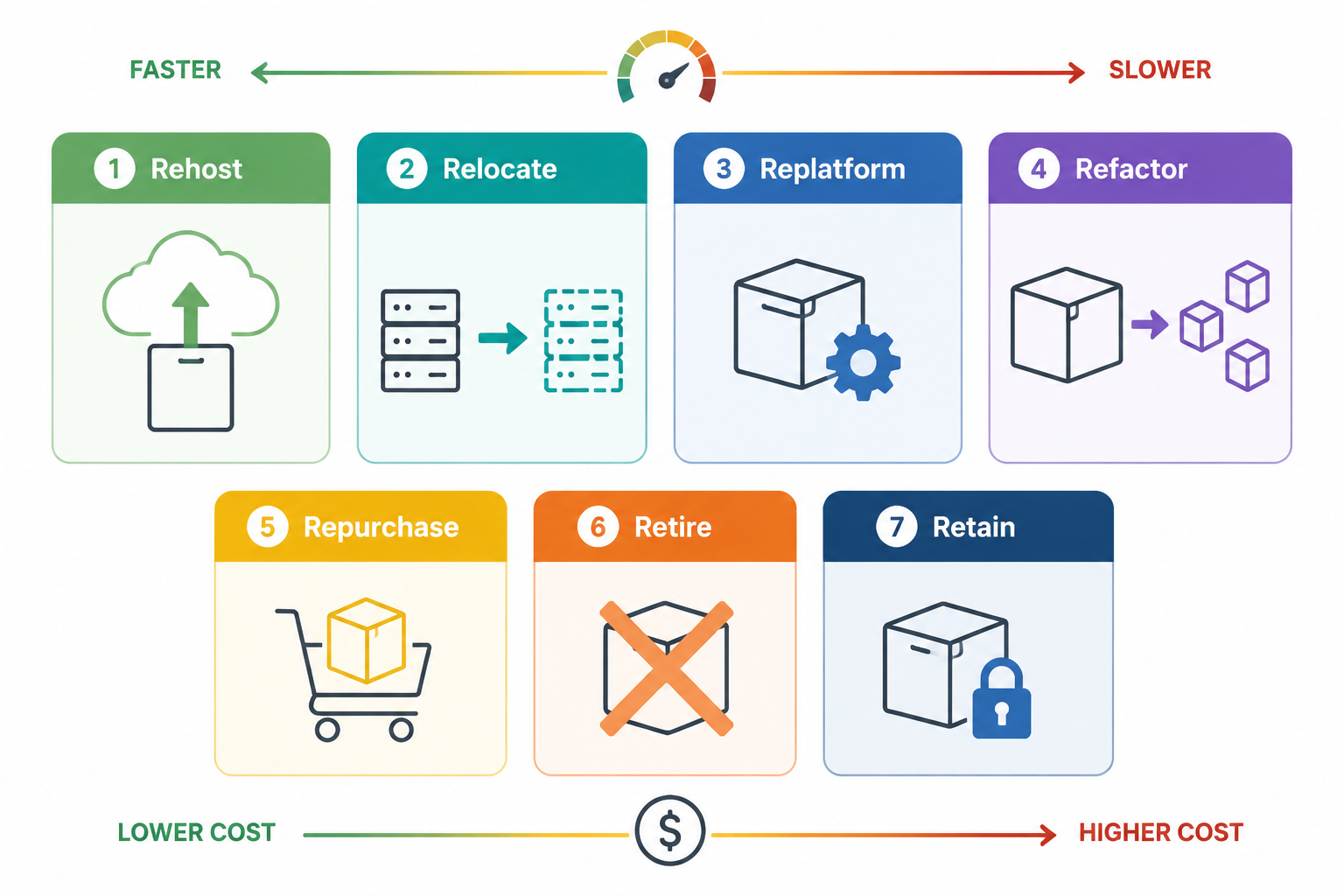
Rehost: the lift-and-shift answer
Choose rehost when the question emphasizes speed, minimal changes, or moving an application from an on-premises server to cloud infrastructure without redesigning it. This is the classic “lift and shift” pattern. Akamai describes lift and shift as the fastest approach but also the least optimized for cloud, which is exactly the tradeoff exams like to test. [2]
A rehost answer is usually wrong when the stem says the team wants to break a monolith into services, adopt serverless, or redesign the application for elasticity. Those clues point away from speed and toward deeper change.
Relocate: move the platform without changing the workload
Relocate is easy to miss because it sounds close to rehost. In the 7 Rs breakdown, relocation is about moving a workload or environment without making substantial application changes. The exam clue is usually that the existing platform can be transferred as a unit rather than rebuilt piece by piece. [1]
For beginner exams, do not overcomplicate this one. If rehost is “move the application with little change,” relocate is often “move the existing environment or platform with little change.” If the wording does not make a platform-level move clear, rehost may be the more likely answer.
Replatform: small cloud improvements without a rewrite
Replatform sits between rehost and refactor. The workload moves, and the team makes some useful changes, but it does not redesign the entire application. A common exam-style clue is replacing a self-managed database with a managed database service while leaving most application logic intact.
The elimination trick is simple: if there are no meaningful changes, think rehost. If there are selective optimizations, think replatform. If the application is being redesigned for cloud-native architecture, think refactor.
Refactor: the expensive modernization answer
Refactor is the strategy for major application or architecture change. It is the answer when the stem talks about cloud-native design, rewriting code, improving scalability through architectural change, or addressing technical debt as part of the move. Akamai contrasts this with lift and shift by describing refactoring as the most expensive approach but the one most oriented toward cloud-native optimization. [2]
That “most expensive” clue matters. Beginner exams often ask for the fastest or least disruptive option. In those cases, refactor is usually too heavy. When the question instead prioritizes long-term modernization over speed, refactor becomes more plausible.
Repurchase: replace the application, often with SaaS
Repurchase means the organization stops migrating the old application as an application and instead replaces it with a new product, commonly a SaaS option. If a company moves from a custom or legacy customer-management tool to a cloud-based subscription product, the exam is probably pointing at repurchase.
This is where basic service-model knowledge helps. SaaS means the provider delivers the application for customers to use; PaaS gives developers a managed platform for building or running applications; IaaS provides infrastructure resources such as compute, storage, and networking. Cisco and IBM both explain these service models as part of cloud migration fundamentals. [3][5]
Retire: remove what no longer earns its keep
Retire is the clean-up answer. The workload is unused, duplicated, obsolete, or no longer valuable enough to move. In a real migration portfolio, retiring applications can reduce cost and complexity before the actual move begins. In an exam stem, look for language such as “no longer used,” “duplicate system,” or “business process discontinued.”
Retain: keep it where it is, at least for now
Retain is not failure. It means the organization deliberately keeps a workload in its current environment. The usual clues are compliance restrictions, latency requirements, unresolved dependencies, licensing limits, or a business reason to delay the move.
This is a favorite wrong-answer trap. If a question asks what to do with an application that cannot move yet, do not force a migration strategy just because the topic is cloud. Retain may be the most accurate answer.
How the Rs Fit Into Migration Phases
The 7 Rs answer the “how should this workload be handled?” question. Migration phases answer the “where are we in the process?” question. Google Cloud describes cloud migration as a journey that includes assessing, planning, migrating, and optimizing workloads. IBM similarly presents cloud migration through assessment and planning, migration execution, and ongoing operation or optimization. [4][5]
| Phase idea | What happens | Exam signal |
|---|---|---|
| Assess | Inventory workloads, dependencies, risks, business goals, and readiness | The organization is deciding what it has and what should move |
| Plan | Choose migration strategies, sequence workloads, prepare teams and tooling | The organization is building the migration approach |
| Migrate | Move, test, cut over, and validate workloads | The organization is executing the move |
| Operate or optimize | Run, monitor, secure, govern, and improve the migrated workloads | The organization is managing cloud workloads after migration |
AWS often inserts the word “mobilize” between assessment and migration. That should not throw you. At exam level, mobilize means getting the organization ready to execute: filling readiness gaps, preparing the landing zone, setting up governance, and building momentum for migration. It is a bridge between discovering what needs to happen and actually moving workloads.
A question about identifying applications, dependencies, and business value is probably in the assess phase. A question about choosing rehost versus refactor, sequencing waves, or preparing tooling is closer to planning or mobilizing. A question about cutover, testing, and validation belongs to migration. A question about monitoring, cost optimization, security operations, or continuous improvement belongs after migration.
Adoption Frameworks: Know the Shape, Not Every Page
Cloud adoption frameworks are broader than migration strategy. They organize the people, process, governance, security, and operational work needed to adopt cloud responsibly. For beginner exams, that usually means recognizing what kind of concern a scenario describes, not memorizing every framework document.
AWS Cloud Adoption Framework is commonly summarized through six perspectives: business, people, governance, platform, security, and operations. Future Processing includes those six perspectives in its migration-strategy discussion. [1]
| AWS CAF perspective | Beginner exam meaning |
|---|---|
| Business | Cloud goals, value, outcomes, and business justification |
| People | Skills, roles, training, organizational change |
| Governance | Policies, risk management, cost control, compliance direction |
| Platform | Architecture, landing zones, infrastructure, and technical foundations |
| Security | Identity, access, protection, detection, and security controls |
| Operations | Monitoring, incident response, reliability, and ongoing management |
Azure has its own Cloud Adoption Framework, and Google Cloud also uses adoption framing around cloud transformation and migration. Google Cloud’s migration material points readers toward adoption and migration resources rather than treating migration as only a technical copy operation. [4]
For exams, match the scenario to the concern. If the stem says teams lack cloud skills, think people or readiness. If it says policies and cost controls are missing, think governance. If it says identity and access must be protected, think security. If it says the company needs a landing zone or target architecture, think platform. The provider vocabulary differs, but the underlying buckets are recognizable.
The Benefits Matter Only When They Point to a Strategy
Cost savings, scalability, agility, resilience, and faster provisioning appear in many cloud migration articles. You should know them, but do not spend your final study evenings rereading generic benefit lists. In exam questions, those benefits matter because they point toward a decision.
- Need the fastest move with minimal change: rehost is likely.
- Need modest cloud optimization without a rewrite: replatform is likely.
- Need cloud-native architecture or major modernization: refactor is likely.
- Need to replace a legacy application with a subscription product: repurchase is likely.
- Need to avoid moving an unused system: retire is likely.
- Need to delay because of compliance, dependency, or readiness limits: retain is likely.
Industry numbers can make migration sound inevitable, but treat them carefully. CACI cites McKinsey findings that cloud migrations can face an average 14% cost overrun and 38% delay, which is useful context for why planning and governance appear in frameworks. It does not prove that every migration fails, and it does not tell you which R to choose in a specific exam scenario. [6]
Likewise, commonly repeated enterprise cloud adoption estimates are methodology-dependent. Adoption can mean anything from using one SaaS tool to running major production workloads in public cloud. For certification study, the safer conclusion is narrower: cloud use is widespread enough that vendors expect beginners to understand migration vocabulary.
How to Read a Migration Question
When a migration question appears, slow down just enough to identify what the stem is really testing. Most wrong answers are attractive because they use real cloud words. The best answer usually aligns with one clear constraint.
- Find the workload status: active, obsolete, duplicated, blocked, or ready to move.
- Find the change level: no change, small optimization, or major redesign.
- Find the business clue: speed, cost, compliance, modernization, SaaS replacement, or readiness.
- Map the clue to an R before reading the answer choices too deeply.
- If the question asks about process rather than strategy, map it to assess, plan or mobilize, migrate, or operate.
A hypothetical example: a company wants to move a legacy application to cloud quickly because its data center lease is ending, and it cannot change the application code before the deadline. That points to rehost. If the same company wants to redesign the application into smaller services to improve long-term scalability, the answer changes to refactor. If it wants to replace the application with a managed subscription product, the answer changes to repurchase.
Another hypothetical example: a company inventories applications, identifies dependencies, and ranks migration candidates by business value. That is assessment and planning work. If the company is already moving workloads, testing them, and cutting traffic over, the question has moved into the migration phase. If it is tuning costs and monitoring reliability after the move, the question is about operating or optimizing.
What to Memorize Before an Entry-Level Exam
Memorize the names of the 7 Rs, but do not stop at the names. The exam does not usually reward chanting “rehost, relocate, replatform” in order. It rewards knowing that “lift and shift” means rehost, “minor optimization” means replatform, “rewrite for cloud-native” means refactor, “replace with SaaS” means repurchase, “decommission” means retire, and “keep it for now” means retain.
- Memorize: the 7 R names and their one-line meanings.
- Understand: the difference between rehost, replatform, and refactor.
- Recognize: SaaS replacement as repurchase, unused workloads as retire, and blocked workloads as retain.
- Understand: assess, plan or mobilize, migrate, and operate or optimize as a sequence.
- Recognize: business, people, governance, platform, security, and operations as adoption-framework concerns.
Do not try to turn migration into an architect-level specialty before a fundamentals exam. Know the framework terms, know what details in the stem trigger each term, and leave room for vendor wording differences. That is the efficient beginner path: enough migration strategy to eliminate wrong answers without drowning in enterprise migration theater.
References
- The 7 Rs of Cloud Migration, Future Processing
- Cloud Migration Strategy, Akamai
- What is a Cloud Migration Strategy?, Cisco
- Cloud migration, Google Cloud
- What is cloud migration?, IBM
- Cloud migration challenges: A 2026 guide to risks, strategy & tools, CACI
Comments
Join the discussion with an anonymous comment.