
Bronze Age Ritual Sword Discovery: A History Lesson
Tracing Bronze Age swords from battlefield to bog offering, this history lesson shows how a single object type can teach us about ancient metallurgy, status, and ritual.
Updated:
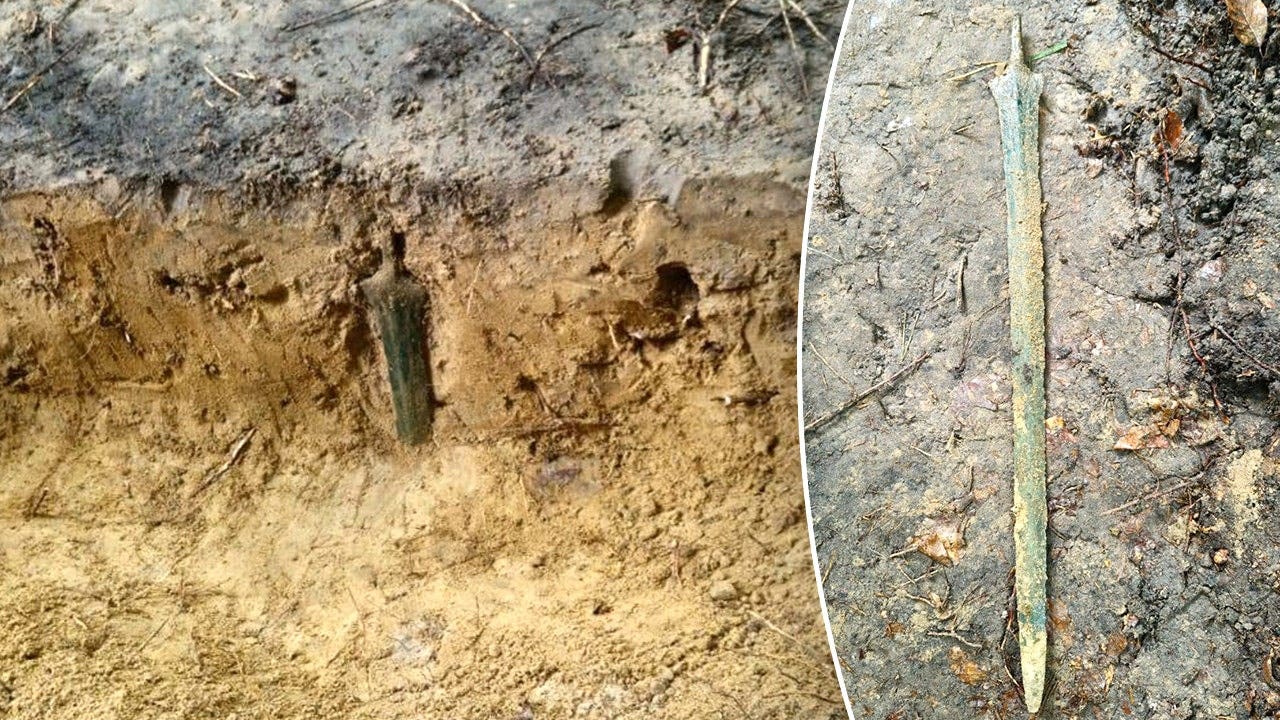
The useful question about the Gdańsk sword is not simply why it survived. It is why someone appears to have left it standing upright in the ground.
In June 2026, reports described a Bronze Age tang-hilted sword, about 60 cm long and dated to 900–700 BC, found by metal detectorist Marcin Wiśniewski in a forest near Gdańsk, Poland.[1][2] Its vertical position matters. A sword dropped in panic, lost during travel, or abandoned after a fight would not normally be expected to remain carefully upright. That does not prove a ritual on its own, but it gives a history student a strong starting point: begin with the observable detail before rushing toward belief.
A history lesson built around a Bronze Age ritual sword discovery has to resist two bad habits at once. One is treating the object as treasure, as if shine or age were the whole point. The other is leaping from “unusual” to “sacred” without showing the chain of reasoning. The better route is slower: ask what the object could do, what it cost, how it was handled, and where people chose to remove it from ordinary use.
Start With What The Sword Could Do
Bronze swords were not stage props. Experimental work led by Andrea Dolfini at Newcastle University has argued that bronze swords could function in combat, even while many surviving examples show no battle wear.[3] That combination is exactly what makes them historically interesting. If a sword can fight, but some examples seem barely used, the question changes from “Was this a weapon?” to “Was weaponhood its only role?”
Early Bronze Age rapiers, appearing around 1700–1600 BC, were built for thrusting. Later leaf-blade designs widened the blade and suited different styles of use. The long-lived Naue II, or Griffzungenschwert, spread across Europe and remained in production for roughly 700 years.[4] A form does not survive that long if it is merely decorative fashion. Continuity on that scale points to a working technological tradition, not a single odd custom.
| Life stage | What to observe | What it can support |
|---|---|---|
| Weapon | Blade form, durability, wear, repair, combat testing | Bronze swords could be practical instruments of violence |
| Prestige object | Casting skill, metal value, rarity, condition, ornate hilt | Some swords displayed rank, wealth, and specialist production |
| Offering | Upright placement, river or bog deposition, repeated finds, little use-wear | Deliberate removal from use can point toward ritual or social meaning |
That table is not a set of boxes to tick mechanically. It is a way of keeping inference honest. A blade shape tells us one thing. Wear marks tell us another. Deposition context tells us something else. Strong interpretation comes when those observations start pulling in the same direction.
Then Ask What Kind Of Society Could Make It
The Nördlingen sword, found in Bavaria and dated to around 1400 BC, changes the tone of the lesson. Reports described it as so well preserved that it “almost still shines,” with an octagonal bronze hilt cast over the blade.[5] That detail is not ornament for ornament’s sake. Casting a hilt over a blade without ruining the whole object required exceptional technical control.
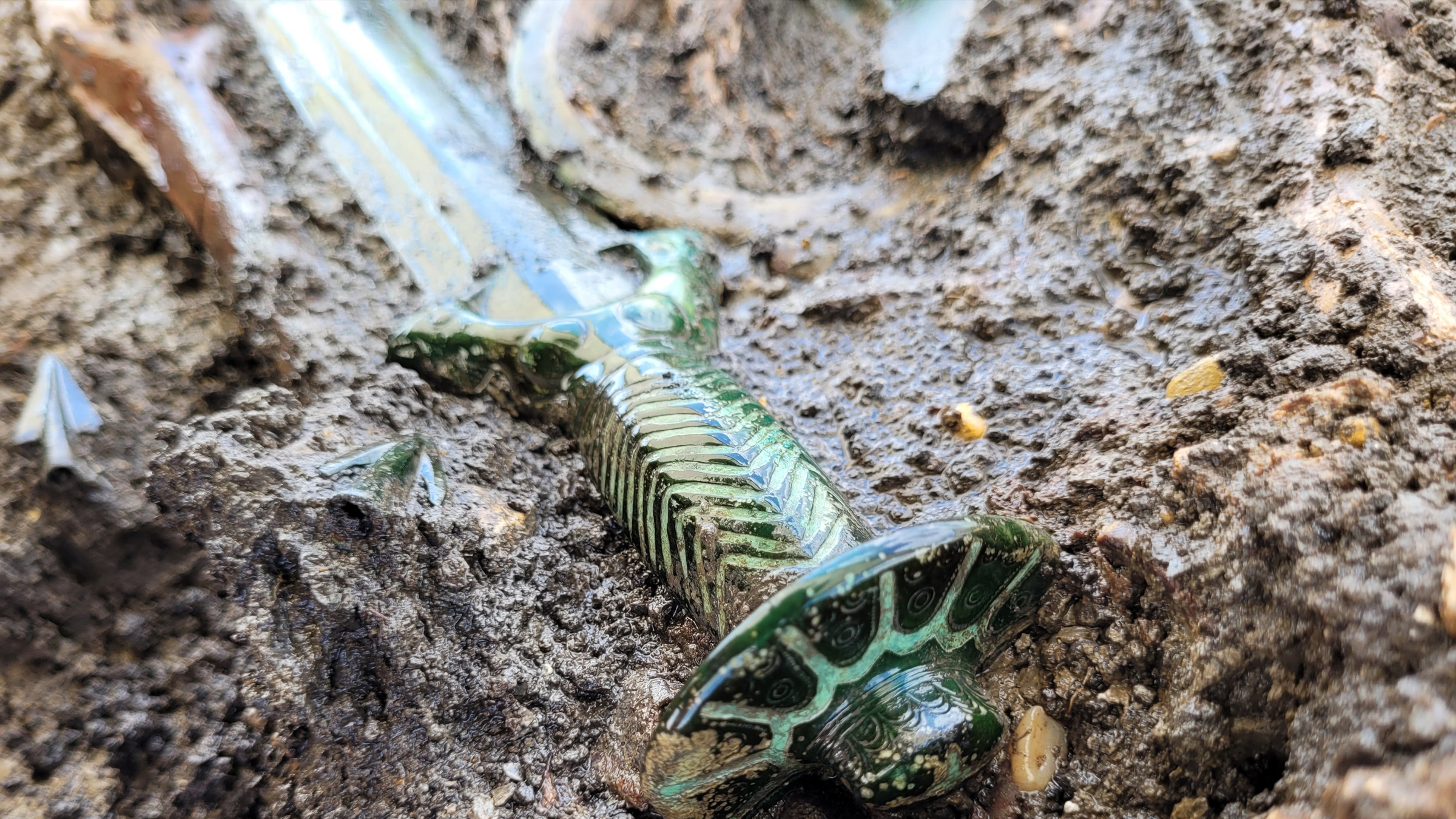
A student can use that sword to move from object description to social structure. Someone had to obtain the copper and tin. Someone had to know how to cast and finish the blade. Someone had to command enough surplus wealth to own an object that was not just useful, but impressive. The hilt type is associated with elite smiths from only two known regions, which makes the object evidence not only for fighting but for specialization and exchange.
Near-mint condition sharpens the point. If a sword built with such skill shows little sign of hard use, it becomes difficult to treat it as just another tool. It may still belong to the world of weapons, but it also belongs to the world of status: the visible claim that a person, household, or community could command rare materials and expert labor.
This is where value matters, though value has to be handled carefully. The Gdańsk sword has been described through Poland’s State Forests agency as worth a herd of cattle, but the available reports do not provide the calculation behind that comparison.[1] It is still useful as a scale marker, not as an exact price tag. The safe historical point is that bronze swords concentrated material value, specialist labor, and social display in one portable object.
Placement Turns Value Into Evidence
Once a sword is understood as valuable, its disappearance from everyday use becomes more significant. A poor object can be discarded casually. A costly weapon is different. If it is put upright in the ground, sunk in water, or placed in a bog, the historian has to ask why people gave up something worth retrieving.
The Gdańsk sword is especially useful here because the argument begins with a physical position. Reports emphasized that its upright placement made accidental loss unlikely.[1][2] That does not allow us to name the ceremony, identify the deity, or reconstruct a spoken prayer. It does allow a narrower and stronger conclusion: someone probably placed a high-value sword in a deliberate way, removing it from normal circulation.
That distinction is essential in exam writing. “This proves Bronze Age religion” is too large. “The vertical placement supports deliberate deposition, and when compared with repeated watery deposits of high-value metalwork it strengthens a ritual interpretation” is the kind of sentence that can carry evidence without pretending to know more than the evidence can tell us.
The River Trent Shows Why One Find Is Not Enough
A single upright sword is suggestive. A pattern of deposits is stronger. In one stretch of the River Trent, roughly 200 Bronze Age metalwork items, mostly weapons, were deposited over centuries.[6] That is a different kind of evidence from the Gdańsk find. It does not give us one dramatic pose in the soil; it gives us repetition.
Repetition matters because it reduces the chance that every object is best explained as a mistake. Rivers do claim lost things. People fall, boats overturn, floods move objects, and later disturbance complicates interpretation. But when high-value weapons and metalwork repeatedly appear in watery contexts over long periods, accidental loss becomes a less satisfying explanation for the whole pattern.
The River Trent material also reminds students not to make ritual mean vague or irrational. Depositing a weapon in water could be a public act, a memory act, a boundary act, a political act, or an offering; the surviving evidence may not let us choose cleanly between those possibilities. What it does show is that communities sometimes treated metalwork as something to be surrendered, not simply owned, traded, sharpened, or repaired.
Bog And Island Deposits Add Another Layer
The Isle of Shuna deposits belong in the same lesson because they place swords and metalwork within the wider habit of removing valued objects from everyday life.[7] Waterlogged and marginal places are not automatically sacred, but they often force a practical question: if an object was valuable and recoverable only with difficulty, why put it there at all?
Older finds near Gdańsk point in the same direction only cautiously. Antenna-hilt swords were reportedly found in a Gdańsk bog in the 1920s, but those objects were lost during World War II, limiting what can be checked now. They are suggestive background, not firm evidence on the same level as a recorded modern excavation or a surviving object available for analysis.
That caution does not weaken the lesson. It improves it. Historians do not give every clue equal weight. A lost object mentioned in older records can help frame a question; a surviving sword with documented position, typology, conservation record, and context can do more work.
How To Turn The Evidence Into An Essay Argument
A strong paragraph on Bronze Age swords should not begin and end with the word “ritual.” It should build the claim in layers. First, establish that bronze swords were functional weapons. Then show that they were expensive, technically demanding, and socially visible objects. Only after that should deposition become the center of the argument.
- Use combat capability to avoid the weak claim that ceremonial objects were never practical.
- Use elite manufacture and preservation to show that some swords carried status beyond utility.
- Use upright, river, bog, or island contexts to argue for deliberate removal from ordinary use.
- Use repeated deposits to make the ritual interpretation stronger than a single-find explanation.
- State uncertainty clearly when the evidence does not identify a specific belief or ceremony.
The Gdańsk sword’s future evidence is still partly waiting. As of July 2026, the available reports did not yet settle the conservation results or final museum destination.[1][2] Conservation may clarify corrosion, manufacture, damage, or traces of use. Until then, the best interpretation stays close to what is known: a late Bronze Age sword, found upright, valuable enough to matter, and unusual enough in position to make accidental loss unlikely.
The most persuasive history lesson, then, is cumulative. Bronze swords could fight. Some were made with extraordinary skill. Some remained almost unused. Some were placed where retrieval was unlikely or beside water where many other valued metal objects also appeared. Deliberate deposition is not a decorative footnote to Bronze Age warfare; it is evidence that technology, economy, status, violence, and belief could meet in one object.
References
- Bronze Age sword discovered near Gdańsk, Heritage Daily, June 2026, link
- Bronze Age Sword Found Standing Upright in Polish Forest, Archaeology Magazine, June 2026, link
- Bronze Age swords were used in combat, Newcastle University, link
- Bronze Age sword, Wikipedia, link
- A 3,000-Year-Old Bronze Sword So Well Preserved It ‘Almost Still Shines’ Has Been Unearthed in Germany, Smithsonian Magazine, June 2023, link
- Secrets of the Trent, The Past, link
- Isle of Shuna Bronze Age deposits, link
Comments
Join the discussion with an anonymous comment.