
What You Need to Know About Bacillus Cereus for Food Safety Exams
This study guide consolidates key facts about Bacillus cereus for food safety exams, from its two-syndrome presentation to its unique prevention challenges. Includes a side-by-side comparison table and exam-style review questions to help you distinguish emetic and diarrheal illness.
Updated:
For a food safety exam, the Bacillus cereus trap is usually not the word “bacteria.” It is the leftover rice, pasta, potato, or cooked vegetable that was heated once, cooled badly, and then treated as safe because someone plans to reheat it. B. cereus spores can survive cooking, and the emetic toxin cereulide is heat-stable, so the decisive control is time and temperature after cooking, especially during cooling and storage.[1]
That one sentence protects you from several wrong exam answers. “Cook it thoroughly” helps with many pathogens, but it does not finish the B. cereus problem. “Reheat leftovers” is also incomplete, because reheating may kill vegetative cells but cannot be relied on once cereulide has already formed in food.[1]
The organism itself is worth knowing, but it should sit behind the scenario. B. cereus is a gram-positive, spore-forming, facultative anaerobic rod. It can grow from 8–55°C, grows best around 25–37°C, tolerates pH 4.9–9.3, and can tolerate salt concentrations up to 7.5%.[1] In exam language, that means it is comfortable enough in ordinary cooked foods to become a problem when those foods spend too long in the temperature danger zone.
The Two Syndromes Are the Core Study Frame
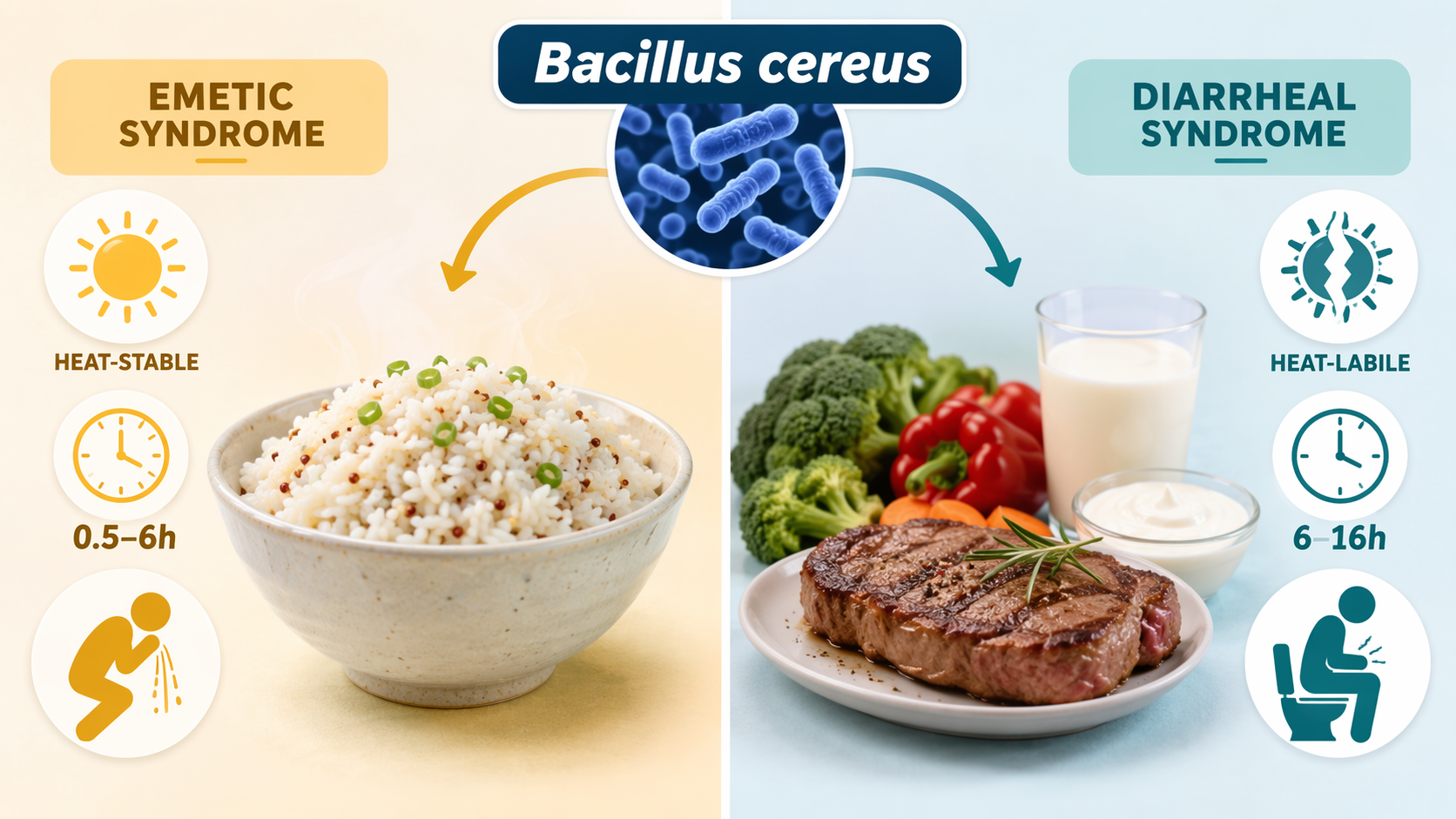
B. cereus causes two classic foodborne illness patterns: emetic illness and diarrheal illness. The difference is not just symptom wording. It changes the onset window, the likely food, the toxin location, and the prevention step that matters most.
| Exam point | Emetic syndrome | Diarrheal syndrome |
|---|---|---|
| Main toxin | Cereulide, a preformed toxin associated with vomiting illness.[1] | Enterotoxins such as Hbl, Nhe, and CytK produced after ingestion.[1] |
| Typical onset | Rapid: about 0.5–6 hours after eating contaminated food.[1] | Slower: about 6–16 hours after eating contaminated food.[1] |
| Common food clue | Rice and other starchy foods are the classic clue.[1] | Meats, vegetables, dairy products, and sauces are common clues.[1] |
| Heat stability | Cereulide is heat-stable, so reheating is not a dependable fix once toxin is present.[1] | The diarrheal enterotoxins are heat-labile.[1] |
| Where the toxin matters | Toxin is formed in the food before it is eaten.[1] | Toxin is produced in the small intestine after contaminated food is eaten.[1] |
| Main symptoms | Nausea and vomiting are the main exam clues.[1] | Watery diarrhea and abdominal cramps are the main exam clues.[1] |
| Practical prevention emphasis | Cool cooked starches quickly and store them cold before toxin forms. | Prevent growth by controlling time and temperature in cooked foods before serving. |
| Mimic organism | Can resemble Staphylococcus aureus food poisoning because both can cause rapid vomiting.[5] | Can resemble Clostridium perfringens because both can present with later diarrhea and cramps.[5] |
| Question stem language | “Fried rice,” “left at room temperature,” “vomiting within a few hours,” or “reheated leftovers.” | “Meat,” “gravy,” “vegetables,” “sauce,” “diarrhea later the same day,” or “held warm too long.” |
| Best memory hook | Preformed toxin in starchy food: fast vomiting, reheating is too late. | Cells enter the body and produce toxin: later diarrhea, time-temperature abuse is the setup. |
The emetic form is the one that catches students because it breaks the simple reheating habit. A pot of rice can be cooked properly, but spores may survive. If the rice then cools slowly or sits warm long enough, B. cereus can grow and produce cereulide. Once that heat-stable toxin is present, reheating the rice does not make the situation equivalent to safe, freshly cooked food.[1]
The diarrheal form is different. Here, the major problem is not a preformed vomiting toxin sitting in the food. The person eats food containing B. cereus, and enterotoxins are produced after ingestion. That is why the onset window is longer and why the symptom pattern points more toward diarrhea and cramping than sudden vomiting.[1]
There is one nuance worth keeping, but not letting it blur the main split: approximately 5% of strains have been described as producing both toxin types.[6] For most exam questions, however, the safest first move is still to sort the stem by onset, food, symptoms, and heat stability.
Why Cooked Starchy Foods Stay on the Watch List
Rice is the famous example, but exams may use pasta, noodles, potatoes, or cooked vegetables to test the same idea. The point is not that every serving is dangerous. The point is that cooking does not erase the spore problem, and starchy cooked foods can give surviving spores a chance to grow if cooling and storage are sloppy.
Canada’s pathogen safety data sheet gives a useful reason to take those foods seriously: B. cereus spores have been reported in 88–100% of sampled noodles, potatoes, and rice, and in 50–83% of cooked vegetable samples.[4] Those figures do not mean illness is inevitable. They mean the organism’s spores are common enough that time-temperature control has to be treated as routine practice, not as an extra precaution for unusual foods.
For emetic illness, the infective-dose range reported by BCCDC is 10^5–10^8 CFU/g.[2] A student does not need to calculate colony-forming units during a certification exam. The practical message is simpler: enough growth in the food before service is what turns a cooked starch into a B. cereus question.
Prevention: Follow the Food After Cooking
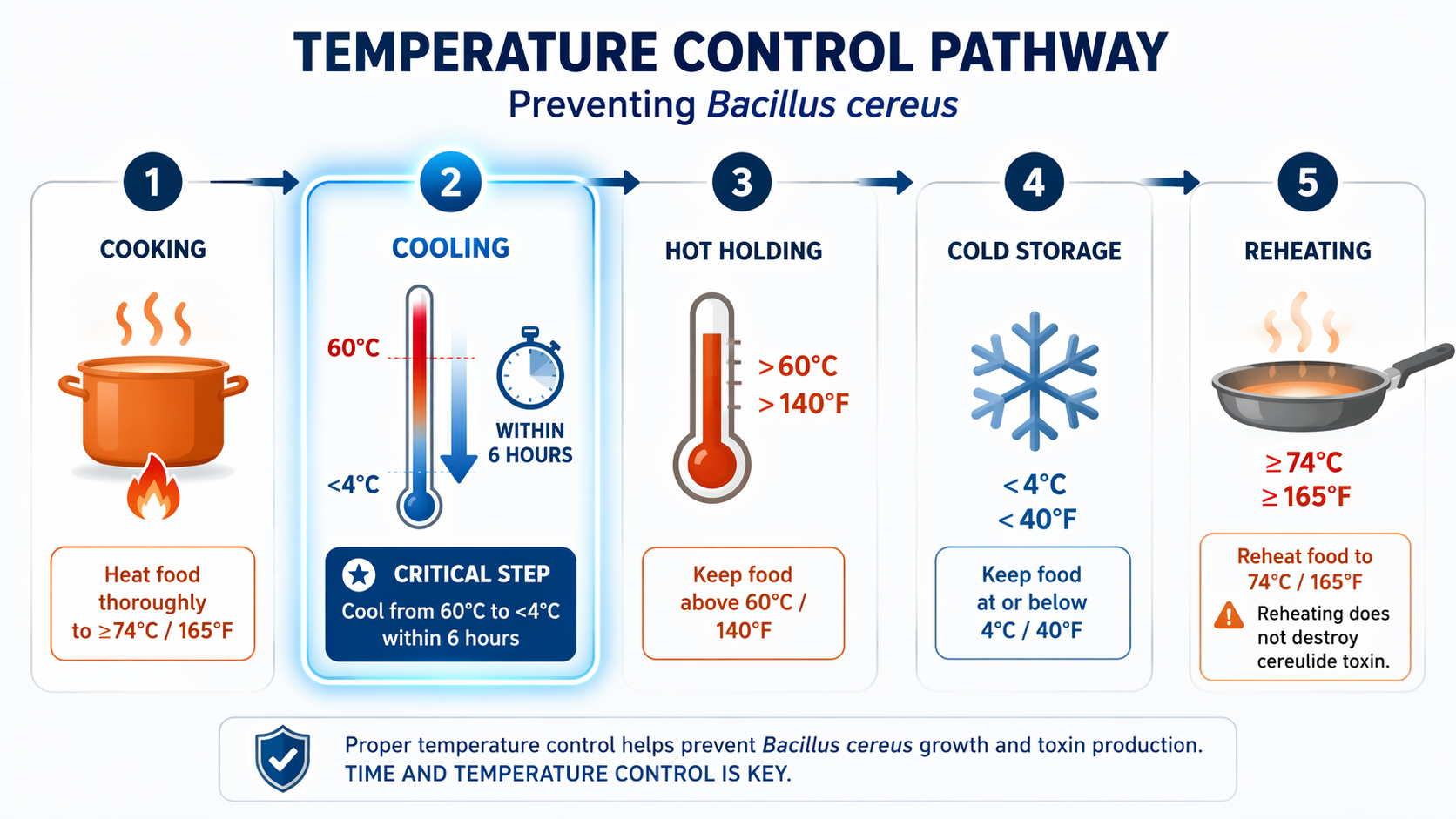
The workflow matters more than a single heroic final step. With B. cereus, the safe answer usually follows the food after cooking: cool it fast, hold it at the right temperature, store it cold, and reheat it properly only if it has already been handled safely.
| Control point | Exam-ready rule | Why it matters for B. cereus |
|---|---|---|
| Cooking | Cook food properly, but do not treat cooking as the final safeguard. | Spores can survive cooking.[1] |
| Cooling | Cool food from 60°C to below 4°C within 6 hours.[2] | Slow cooling gives surviving spores time to germinate and grow. |
| Hot holding | Hold hot food above 60°C/140°F.[3] | Hot holding prevents growth during service. |
| Cold holding | Hold cold food below 4°C/40°F.[3] | Cold storage slows or prevents growth before toxin becomes the issue. |
| Reheating | Reheat to at least 74°C/165°F when reheating is appropriate.[3] | This is not a rescue step for food that may already contain cereulide.[1] |
The cooling rule deserves special attention because it is where many scenario questions hide the mistake. A pan of cooked rice, pasta, or potatoes left deep, covered, and warm for too long is not just “waiting to be reheated.” It is spending time in the range where surviving spores may become a toxin problem.
ServSafe-style temperature choices often test whether the student can separate holding from reheating. Hot holding above 60°C/140°F and cold holding below 4°C/40°F are controls that prevent growth during storage or service. Reheating to at least 74°C/165°F is a required control in the right setting, but it does not undo earlier time-temperature abuse when heat-stable cereulide is the hazard.[1][3]
A good exam answer usually names the broken step. If cooked rice was left at room temperature for hours and then reheated, the failure is not “the cook forgot to reheat.” The failure is improper cooling and storage before reheating.
How to Tell B. cereus From Look-Alike Pathogens
B. cereus is often tested through mimicry. The emetic form can look like Staphylococcus aureus food poisoning because both are associated with rapid nausea and vomiting after a preformed toxin exposure. The diarrheal form can resemble Clostridium perfringens because both can produce later abdominal cramps and diarrhea.[5]
| If the stem says... | Think first about... | Do not miss... |
|---|---|---|
| Vomiting within a few hours after fried rice or another cooked starch | B. cereus emetic syndrome | Reheating is not reliable once cereulide has formed. |
| Rapid vomiting after food handled by a person and held improperly | Staphylococcus aureus as a close mimic | The food clue may push the answer away from B. cereus. |
| Diarrhea and cramps several hours after meat, sauce, vegetables, or gravy | B. cereus diarrheal syndrome or C. perfringens | Use the exact food, timing, and answer choices. |
| Cooked food held warm too long before service | A time-temperature control failure | The safest answer may be about holding, cooling, or discarding rather than cooking. |
How Common and How Serious Is It?
The numbers are useful for scale, not for pretending that every case is counted neatly. StatPearls reports CDC data showing 619 confirmed Bacillus-related outbreaks from 1998–2015, but that count covers Bacillus species as a group, not B. cereus alone.[1] The same review cites the FDA Bad Bug Book estimate of about 63,400 annual U.S. cases.[1]
Case estimates can differ because foodborne illness is underreported and because surveillance methods do not all measure the same thing. The right exam-level conclusion is that B. cereus is common enough to matter in food safety practice, especially in cooked foods that are cooled or held incorrectly.
Most study guides focus on short, self-limited illness because that is the usual exam pattern, but severe outcomes should not be erased. A 2025 global epidemiology study reported a 0.05% global mortality rate and noted severe cereulide-associated cases, including fulminant liver failure documented in children.[7] Because only abstract-level information was available from that study, those details are best used as a seriousness marker rather than as a full epidemiologic profile.
Exam-Style Review Questions
Use these as quick checks. The answer is included after each question so the point is hard to misremember.
- A customer vomits 2 hours after eating fried rice that was cooked earlier, left out, and reheated. Which B. cereus syndrome fits best? Answer: Emetic syndrome, because the rapid vomiting and cooked rice point to preformed cereulide.
- Why is reheating not enough in the fried-rice scenario? Answer: Cereulide is heat-stable, so reheating cannot be relied on once the toxin has formed.
- A tray of cooked pasta must be cooled safely. What cooling rule should you remember? Answer: Cool from 60°C to below 4°C within 6 hours.
- A patient develops diarrhea and abdominal cramps 10 hours after eating improperly held meat and vegetables. Which B. cereus pattern fits better? Answer: Diarrheal syndrome, because the onset is later and the food pattern is not the classic rapid-vomiting rice scenario.
- Which mimic should you compare with each syndrome? Answer: Emetic B. cereus can mimic Staphylococcus aureus; diarrheal B. cereus can mimic Clostridium perfringens.
For B. cereus, remember the exam rule this way: cooking starts the safety process, but it does not finish it. The decisive step is controlling time and temperature after cooking, especially during cooling and storage.
References
- Bacillus Cereus - StatPearls - NCBI Bookshelf.
- Bacillus cereus - BC Centre for Disease Control.
- Bacteria - ServSafe.
- Pathogen Safety Data Sheets: Infectious Substances - Bacillus cereus - Canada.ca.
- Bacillus Cereus - Cleveland Clinic.
- Bacillus cereus- An Overview - Microbe Notes.
- Global epidemiology of Bacillus cereus foodborne outbreaks and cereulide-producing strains - Food Research International - 2025.
Comments
Join the discussion with an anonymous comment.