
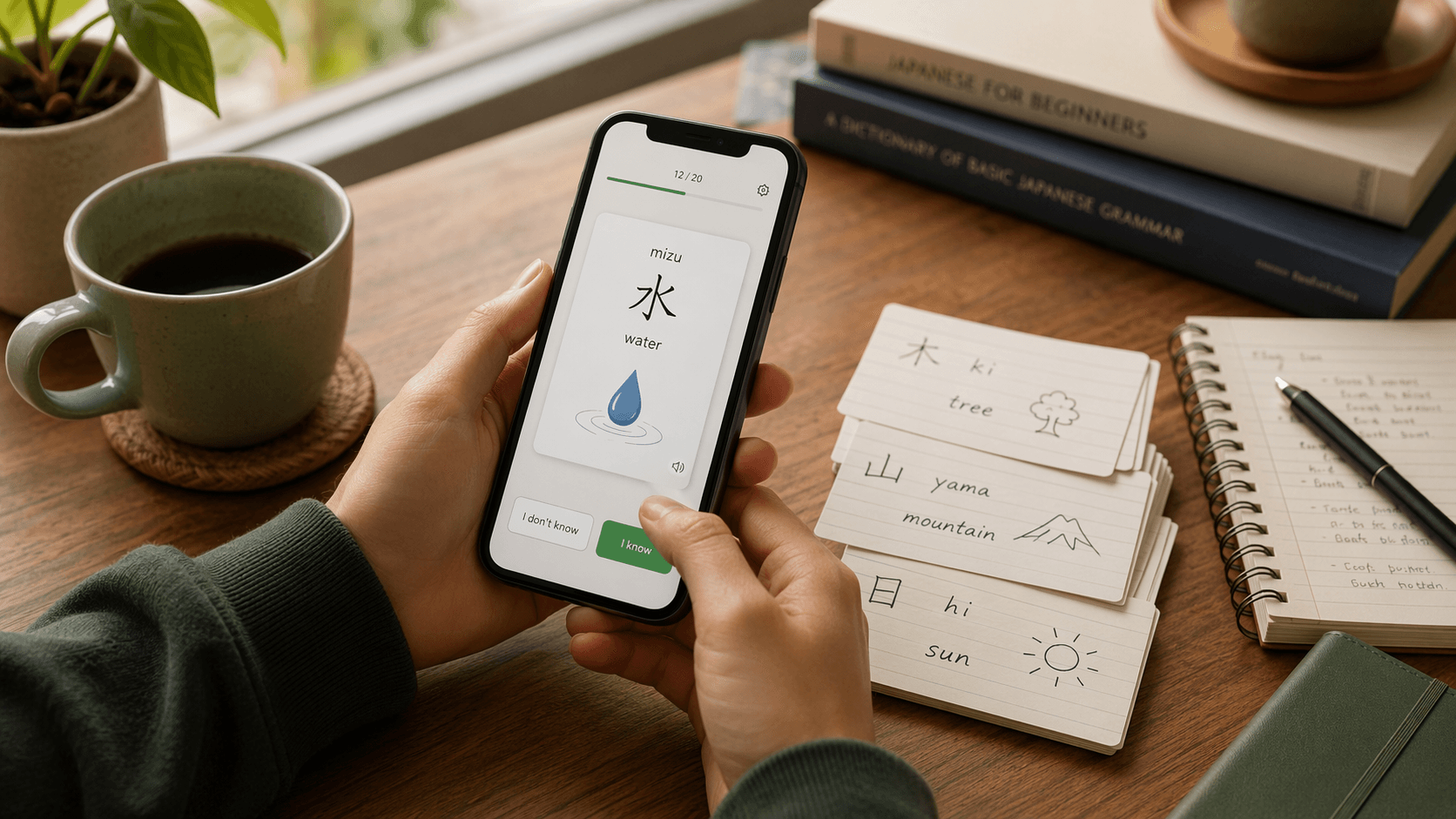
Are Flashcards Actually Effective for Language Learning? A Science-Backed Guide to How They Work and When They Don't
This guide examines the research behind flashcard-based vocabulary learning for intermediate language learners. It covers the cognitive science of why flashcards work (active recall, spaced repetition), their honest limitations (grammar, fluency, input substitution), and practical recommendations for using them effectively.
Updated:
The Problem: Why Most New Vocabulary Disappears Within a Day
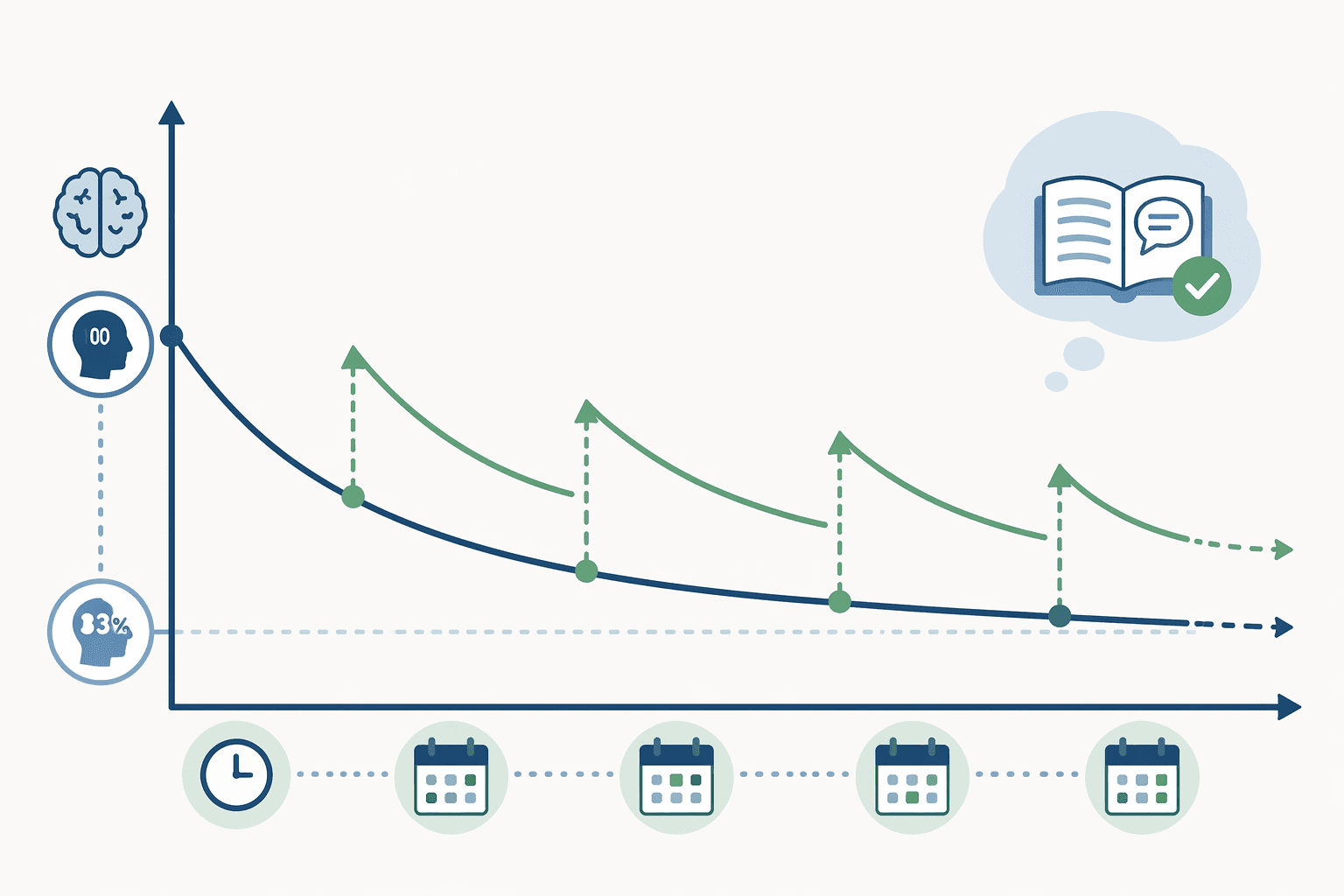
You learn a new word. You repeat it a few times. You feel confident. Then, the next day, it is gone. This experience is not a personal failing — it is a predictable feature of human memory first described by Hermann Ebbinghaus in the 1880s and replicated in modern research. The forgetting curve shows that without any reinforcement, memory retention drops to roughly 33 percent within just 24 hours of initial learning.
A 2015 study by Murre and Dros, published in PLOS ONE, replicated Ebbinghaus's original experiments and confirmed the same steep decline: participants forgot about two-thirds of the material they had learned within the first day. For language learners, this means that the 20 new words you studied this morning may be reduced to 7 by tomorrow afternoon unless you intervene.
This is the problem that flashcards, when used correctly, are designed to solve. But the solution is not simply making a stack of cards and flipping through them once. The science of why flashcards work — and when they fail — comes down to two mechanisms: active recall and spaced repetition.
What the Science Says: Active Recall and the 5:1 Benefit
The most important finding for anyone using flashcards is the testing effect. A landmark 2006 study by Roediger and Karpicke demonstrated that the act of retrieving information from memory — testing yourself — produces a 5:1 benefit over re-studying. In practical terms, five minutes of active recall practice is roughly equivalent to 25 minutes of re-reading or passive review.
This is not a marginal improvement. It is a fundamental shift in how you should approach vocabulary study. When you look at a flashcard and force your brain to retrieve the meaning of a word before flipping it over, you strengthen the neural pathway associated with that word far more than if you had simply read the word and its translation together. The effort of retrieval — even when you get it wrong — signals to your brain that this information is important and worth retaining.
A 2023 study by Le and Luong, published in the Vietnam Journal of Education, tested flashcard-based techniques with 18 language learners over four weeks. The results showed that flashcard-based techniques contributed significantly to vocabulary recall, and survey findings revealed that students had favorable perceptions and positive attitudes toward their vocabulary retention as a result of the teacher's use of these techniques. The study also identified challenges — primarily around consistency and motivation — which we will address later.
The Spaced Repetition Layer: Timing Your Reviews for Maximum Retention
Active recall tells you how to study. Spaced repetition tells you when. The two mechanisms work together: active recall strengthens the memory trace each time you retrieve a word, and spaced repetition ensures that you retrieve it at the moment it is about to fade.
The most comprehensive evidence for spaced repetition comes from a 2006 meta-analysis by Cepeda and colleagues, which examined 254 studies on the spacing effect. The conclusion: distributing practice over time produced 10 to 30 percent better retention than massed practice — the common approach of cramming all reviews into a single session. This is not a small effect. For a language learner studying 1,000 words over six months, a 20 percent improvement in retention means remembering 200 more words at the end of the period.
Modern flashcard apps implement spaced repetition through algorithms — SM-2 (used by Anki's legacy system), FSRS (the newer, more efficient algorithm adopted by Anki in 2023), and proprietary systems in apps like Brainscape and Quizlet. These algorithms calculate the optimal interval for each card based on your past performance. A card you answer correctly gets scheduled further into the future; a card you struggle with comes back sooner.
- Without spaced repetition, you waste time reviewing words you already know well and neglect words that are about to slip away.
- With spaced repetition, every review session targets the words at their optimal moment of forgetting — maximizing the impact of each minute spent.
- The Dunlosky et al. (2013) review of learning techniques ranked both practice testing (active recall) and distributed practice (spaced repetition) among the most effective learning strategies, with high utility across age groups and learning contexts.
For readers who want a deeper dive into the peer-reviewed research on spaced repetition and exam performance, our Science Behind Anki Flashcards article covers the specific studies on medical and graduate exam outcomes.
What Flashcards Cannot Do: The Honest Limitations
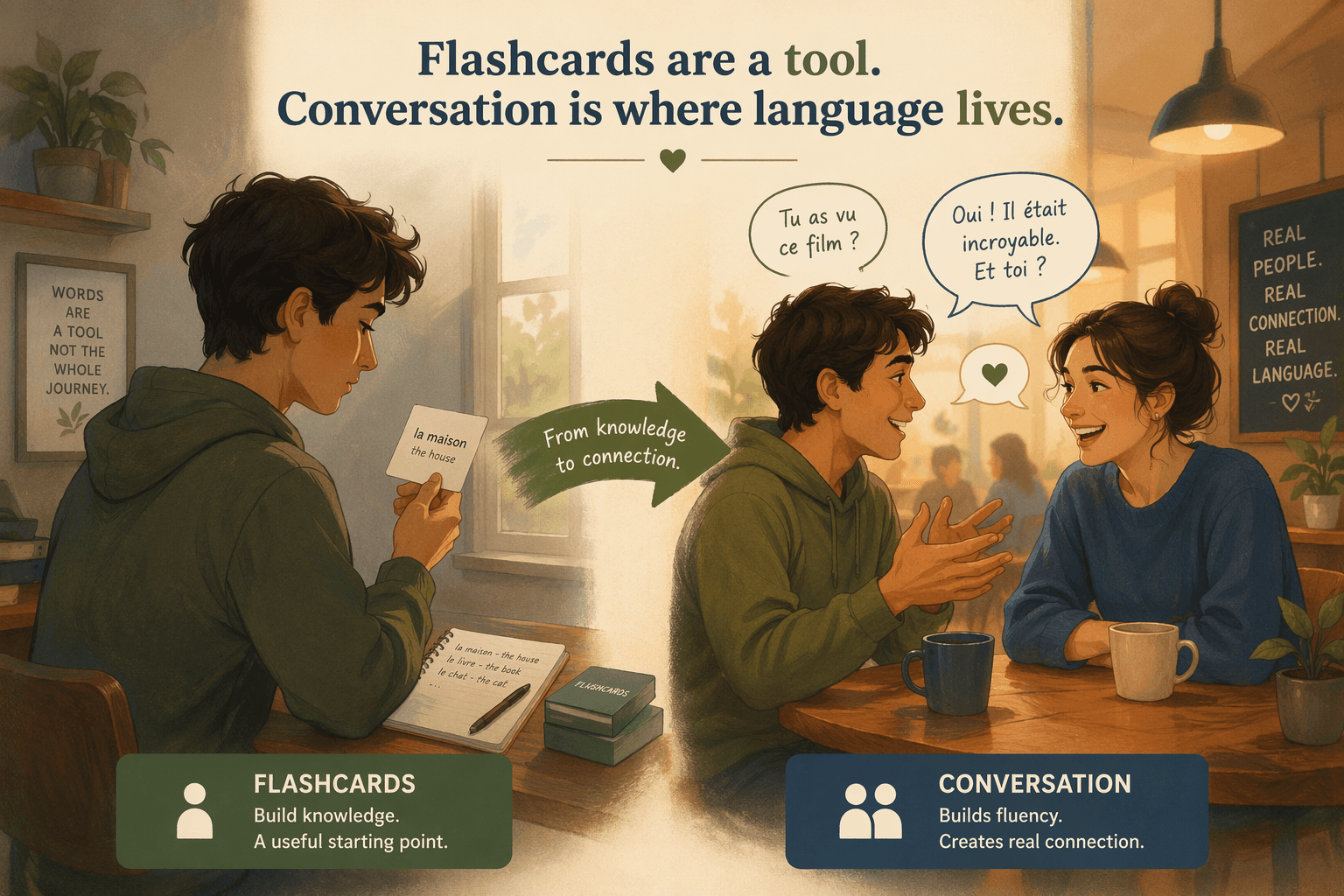
Here is the part of the article that most flashcard enthusiasts skip: flashcards are a tool for vocabulary retention, not a complete language learning method. They excel at building recognition and recall of isolated words and phrases, but they have clear boundaries that every learner should understand.
- Grammar: Flashcards do not teach grammatical structures naturally. You can memorize conjugations and case endings, but internalizing when and why to use them requires exposure to real sentences in context.
- Speaking fluency: Retrieving a word from a flashcard is not the same as producing it in a live conversation. The pressure, speed, and unpredictability of real speech cannot be replicated by a card flip.
- Comprehensible input: Research by Lichtman and VanPatten emphasizes that language acquisition depends heavily on exposure to meaningful, comprehensible input — reading and listening to content that is slightly above your current level. Flashcards can prepare you for that input, but they cannot replace it.
- Passive recognition trap: The most common failure mode is using flashcards for passive recognition — looking at a card and thinking "oh yes, I know that" without actually retrieving the word from memory. This feels productive but produces minimal learning.
This limitation is not a flaw in the flashcard method — it is a boundary of the tool. A hammer is excellent for driving nails but useless for sawing wood. The key is knowing when to use flashcards and when to put them down and pick up a book, a podcast, or a conversation partner.
How to Use Flashcards Effectively: Techniques That Work
Knowing the science is one thing. Applying it is another. Here are the evidence-backed techniques that separate effective flashcard use from the passive recognition trap.
- Use sentence-level cards instead of single words. A card that shows "Je voudrais un café, s'il vous plaît" is more useful than a card that shows "café = coffee." The sentence provides context, grammar, and natural usage patterns. When you retrieve the meaning of the sentence, you are practicing more than vocabulary — you are practicing comprehension.
- Prefer images over translations. The Picture Superiority Effect means that images are more memorable than words. A card with a picture of an apple on one side and "manzana" on the other creates a direct mental link between the concept and the target word, bypassing your native language entirely.
- Focus on high-frequency words. The Pareto principle applies to language: roughly 20 percent of the words in a language account for 80 percent of everyday speech. Start with the most common 1,000–2,000 words before moving to obscure vocabulary.
- Create your own cards. A 2025 study by Yasar and Kocoglu, published in the Australasian Journal of Educational Technology, found that self-created digital flashcards produced statistically significant vocabulary gains compared to no flashcards. The act of creating the card — deciding what to put on each side, finding an example sentence, choosing an image — is itself a learning event.
- Build a daily habit, not a weekly marathon. Five to ten minutes of daily review is far more effective than an hour-long session once a week. Short, frequent sessions align with the spaced repetition principle and reduce the cognitive load of each review.
For a language-specific example of these techniques in practice, see our guide on How to Make Mandarin Flashcards That Actually Stick, which applies sentence cards, image-based design, and the input loop to a specific language context.
Digital vs. Paper: Does the Format Matter?
A common debate among language learners is whether digital flashcards or paper flashcards produce better results. The research provides a clear answer: when used properly, there is no significant difference in vocabulary outcomes between the two formats.
A 2018 study by Ashcroft and colleagues compared Quizlet (digital) with paper flashcards among 139 Japanese college students. The results showed that using Quizlet caused a significant improvement in vocabulary scores for basic and intermediate groups in immediate recall. However, the advanced group showed significant improvements in delayed recall using print flashcards compared to digital. A separate 2018 study by Sanosi with 42 low-level male EFL learners at a Saudi Arabian college found that the Quizlet group showed a 23 percent improvement in vocabulary scores (from 6.8/15 to 10.2/15), while the control group improved only 1 percent (from 6.9 to 7/15).
| Study | Participants | Key Finding |
|---|---|---|
| Ashcroft et al. (2018) | 139 Japanese college students | Digital better for immediate recall (basic/intermediate); paper better for delayed recall (advanced) |
| Sanosi (2018) | 42 Saudi Arabian EFL learners | Digital group improved 23%; control group improved 1% |
A 2024 survey conducted at UCLA found that 77.8 percent of surveyed students reported using digital flashcards, and among those who had also used physical cards, 60.1 percent preferred digital. The practical advantages of digital — automated spaced repetition, easy editing, multimedia support, and cross-device sync — explain the preference. But the survey also confirms that a significant minority still prefers paper, particularly for non-Latin writing systems and complex diagrams where handwriting offers advantages.
The practical takeaway is not to choose one format and defend it. It is to choose the format that you will actually use consistently. If you enjoy the tactile experience of handwriting cards and the focused screen-free time, paper may work better for you. If you value automated scheduling and the ability to review on your phone during a commute, digital is the clear winner. Both work when you work.
Practical Recommendations: Building a Flashcard Habit That Lasts
The science is clear: flashcards work for vocabulary retention when paired with active recall and spaced repetition. But knowing the science does not automatically translate into a sustainable habit. Here is a practical framework for building a flashcard routine that actually lasts.
- Start with high-frequency words. Use a frequency list for your target language (the first 1,000 words cover roughly 80 percent of everyday speech). Do not waste early effort on obscure vocabulary.
- Create your own cards. The Yasar and Kocoglu (2025) study confirmed that self-created flashcards improve both vocabulary scores and self-regulated learning strategies. The act of creating a card — finding an example sentence, choosing an image, deciding what goes on each side — is a learning event in itself.
- Use an SRS app for automated scheduling. Apps like Anki, Brainscape, and Knowt handle the timing so you do not have to think about it. Set a daily new-card limit (10–20 new words per day is sustainable for most learners) and let the algorithm manage the reviews.
- Keep sessions short and daily. Five to ten minutes per day is more effective than one hour per week. The goal is consistency, not volume. A daily habit of 10 minutes will outperform a weekly cram session of 70 minutes.
- Always pair flashcards with real input. Read a short article, listen to a podcast, or have a conversation after your flashcard session. The flashcards prepare your brain to recognize the words; the input gives you the context and practice you need to internalize them.
For readers who want a broader planning framework that incorporates spaced repetition principles into a full study schedule, our Science-Backed Weekly Study Schedule Template provides a ready-to-use structure.
And for readers who are already using a specific tool and wondering why it is not working, our Anki vs. Quizlet failure modes article examines the specific pitfalls of each platform — the "Anki Trap" of over-customization and the "Quizlet Ceiling" of passive recognition — and how to avoid them.
Comments
Join the discussion with an anonymous comment.