
GRE, MCAT, SAT, ACT Planner
How DACA renewal delays should set your test date
Before you pay for the GRE, MCAT, SAT, or ACT, put one date on the calendar first: the expiration date on your current DACA and employment authorization document. In 2026, that date should set the testing plan. USCIS tells DACA renewal applicants to file 120 to 150 days before expiration, but current reporting shows that renewals can run close to that window, and sometimes beyond it.[1]
That is the practical impact of DACA renewal delays on studying: not just stress, and not just a vague interruption, but the possibility that a student who studied on schedule cannot sit for the exam because the renewal clock, ID rules, and test date were planned as separate timelines. WTTW reported in May 2026 that the median DACA renewal wait from October 2025 through February 2026 was about 70 days, compared with about 15 days in fiscal year 2025, and that by late April USCIS reported most renewals completed within about 122 days.[2] AP reporting in the same delay period described long waits leaving some recipients without status, jobs, and greater fear around enforcement.[3] Higher-education groups also warned that about 80% of renewals were taking up to four months, with some reaching six months.[4]
The official rule comes from USCIS’s I-821D guidance. The recent processing figures are drawn from secondary reporting and higher-education or advocacy sources because historical USCIS processing data was not directly available for review here. That difference matters: the official filing window tells you when USCIS says to file; the 2026 processing reports tell you how much calendar risk to protect against.

Choose the renewal timeline before the test date
A test date usually feels like the anchor. You see an MCAT date that leaves enough weeks for content review, or a SAT date that fits before application deadlines, and the study plan forms around it. For a DACA recipient in 2026, that order is too risky. The first anchor should be the renewal timeline, because an attractive test date inside a pending-renewal window may not be usable.
The reason is no longer only anecdotal. The National Immigration Forum reported that USCIS completed 56% of DACA renewals submitted in the first quarter of fiscal year 2026, compared with 96% a year earlier, and that completed renewals fell to 35,648 from about 70,000.[5] That does not predict what will happen in any one case. It does justify treating delay as a planning condition, not as an exception you can ignore until the final month.
This is scheduling guidance, not legal advice. For case-specific decisions, use the current USCIS page, NILC and ILRC resources, or an accredited immigration legal service provider. As of August 1, 2026, DACA policy and processing remain sensitive to litigation and agency practice, so do not let any exam-planning article substitute for a current legal check.
| Calendar item | What to do with it |
|---|---|
| DACA/EAD expiration date | Treat this as the fixed deadline that controls the rest of the plan. |
| 150-day filing point | Use the earliest edge of USCIS’s recommended 120–150-day renewal window as the planning target. |
| Estimated approval range | Plan around roughly 3.5–4 months in 2026, while recognizing that some cases may take longer. |
| Buffer after expected approval | Add time for mail, document updates, ID renewal, name corrections, and test-registration changes. |
| GRE/MCAT/SAT/ACT date | Choose the first date that sits after the pending-renewal window and after the ID check. |
A worked calendar example you can copy
Use this as a hypothetical planning model, not as a prediction for your case. Suppose your current DACA and EAD expire on December 15, 2026. USCIS’s recommended renewal window starts 150 days before expiration and runs to 120 days before expiration.[1] In this example, the 150-day filing point is July 18, 2026. The 120-day point is August 17, 2026.
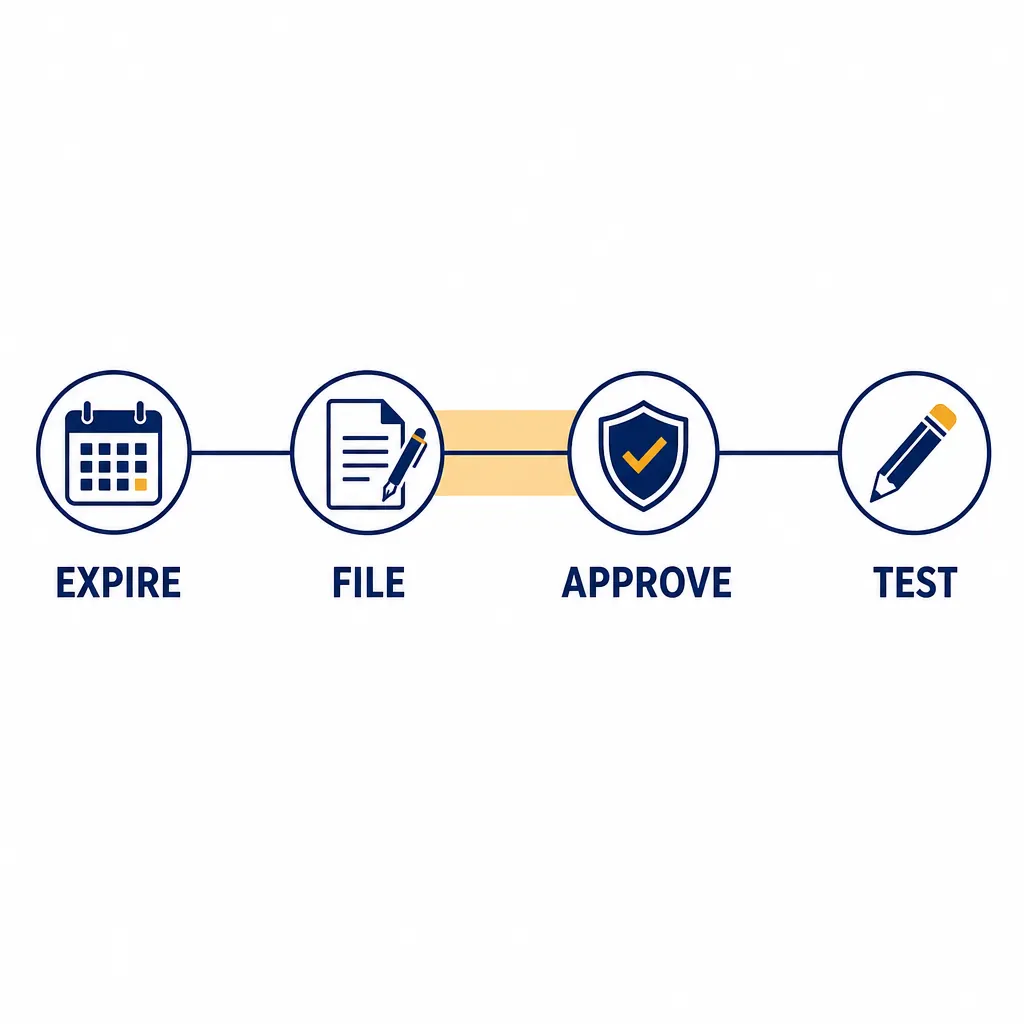
If you file on July 18 and plan for a 3.5- to 4-month renewal period, the estimated approval range lands roughly from early November to mid-November. That estimate is a planning assumption based on 2026 reporting, not a guarantee.[2][4] If you then add a buffer of several weeks for document arrival, driver’s license renewal if needed, name or ID problems, and test-registration cleanup, the safer testing window begins in early to mid-December, not in October.
Now compare the 120-day edge. If the same student waits until August 17 to file, a four-month processing period can run to about December 17, after the December 15 expiration date. If a six-month outlier occurs, the pending period reaches well into the next year. The problem is not that every renewal will take that long. The problem is that a test date chosen before this math may sit exactly where the calendar is least stable.
Reverse-schedule the exam from the renewal clock
The reverse schedule looks like this:
- Write down the DACA/EAD expiration date.
- Count back 150 days and mark that as the filing target.
- Estimate the approval range using current processing information, not last year’s faster timeline.
- Add a post-approval buffer for documents and ID logistics.
- Only then choose the GRE, MCAT, SAT, or ACT date.
- Attach the study plan to that test date.
For the December 15 expiration example, a student might reject an October GRE date even if the study plan looks ready by then. The issue is not academic readiness. The issue is that October sits inside the likely pending-renewal period. A December or January exam may feel slower, but it gives the renewal and ID process a chance to clear before test day.
The same method modifies longer study timelines. A student using a 12-week MCAT study plan should not simply count 12 weeks back from the earliest MCAT date that looks appealing. First find the first MCAT date that survives the renewal clock and ID buffer, then count the 12 weeks back from that safer date. A SAT student can do the same with a score-gap study method or a Khan Academy and Bluebook practice workflow. The exam plan is still rigorous; it is just anchored to the date you can actually attend.
If you already use a weekly planner, add a renewal lane beside the study lane. One row can track content review, practice tests, score targets, and registration deadlines. The second row should track filing, receipt notices, biometrics if applicable, case-status checks, approval, document arrival, ID renewal, and test-admission verification. Planner design matters here because the mistake is usually not forgetting to study; it is forgetting that another deadline can cancel the study plan. Students who need a more structured calendar can adapt a calendar-first study plan or the layout principles in an ADHD college study planner template to keep the renewal tasks visible.
What the delay changes inside the study plan
There is no 2026 study in the available materials that directly measures how current DACA renewal delays change GRE, MCAT, SAT, or ACT scores. So the strongest claim is narrower: documented renewal delays create scheduling and access risks that can disrupt studying and test attendance. The mental load is real, but the calendar risk is the part you can plan around.
A pending renewal can change which weeks are good for heavy review. If your estimated decision period falls during the same month as full-length practice tests, travel to a test center, application deadlines, or school finals, put lighter maintenance tasks in that part of the plan. Save the most expensive, least movable pieces — official practice exams, test-week tapering, travel, and final review — for the side of the calendar where the renewal and ID plan are more stable.
This is also where pre-exposure helps. If an exam section is likely to trigger anxiety, do not leave your first full encounter with it for the same month your renewal may be pending. Move early exposure to the front of the plan, the way a pre-exposure scheduling method would. The goal is not to pretend the renewal timeline is harmless; it is to keep the highest-friction academic tasks from stacking on the highest-friction immigration weeks.
Test-day ID is part of studying
A study plan is not complete until the test-day ID plan is checked. This is where a pending DACA renewal can turn into a no-test-day outcome even when the student is academically ready.
For the GRE, a 2016 My Undocumented Life guide documented ETS rules stating that non-U.S. citizens testing in the United States had to present a valid passport, that the registration name had to match the ID exactly, and that expired or unacceptable ID could mean no test and no refund.[6] Because that source is from 2016, do not rely on it alone. Re-check the current ETS identification requirements before registration and again before test day.
For the MCAT, SAT, and ACT, the same discipline applies: verify the current AAMC, College Board, and ACT ID rules before you pay. Older campus guidance from UC Merced noted exception channels for some graduate-admission exams, including the MCAT and GMAT, but that 2018 guidance should be treated as a prompt to verify current procedures, not as a current rule.[7]
The DACA-specific risk is the document cascade. WTTW reported that renewal delays have left recipients without work authorization, often along with their driver’s license.[2] If your driver’s license depends on your EAD, and your EAD renewal is pending near test day, the ID you planned to use may not remain valid. That is not a paperwork detail to check the night before. It belongs on the study calendar beside practice tests and registration deadlines.
| ID check | When to do it |
|---|---|
| Confirm the exact name on your test registration against the ID you will present. | Before paying for registration. |
| Check whether the test vendor accepts your planned ID for your citizenship and testing location. | Before choosing the test center or date. |
| Check the ID expiration date against the exam date and any expected renewal delay. | Before the registration deadline. |
| If using a passport, confirm it is valid and matches the registration name. | Before registration and again two weeks before test day. |
| If relying on a driver’s license tied to EAD validity, plan for the renewal and license timeline together. | At the same time you choose the exam date. |
If the renewal is still pending
Contingency steps are not a substitute for early filing and a safer test date. They are the backup plan when the calendar is already tight.
NILC has described several possible contributors to longer renewal processing, including biometrics-related issues, additional scrutiny, and country-of-origin holds.[8] Those are not factors a student can solve by studying harder. If the case remains pending and the exam is approaching, shift from passive waiting to documented follow-up.
- Check USCIS online case status and save screenshots or confirmations.
- If the case is outside normal processing time under current USCIS tools, submit an outside-normal-processing-time inquiry.
- If there is a serious, documented reason, review whether an expedite request is appropriate and gather supporting evidence.
- Contact an accredited immigration legal service provider before making case-specific decisions.
- Consider congressional casework if appropriate; NILC and ILRC list it among possible steps when a renewal is delayed.[9]
- Before the registration-change deadline, decide whether moving the exam is safer than hoping the ID issue resolves in time.
That last step is the one students often resist. It is painful to move a test after weeks of disciplined prep. It is worse to arrive ready and be turned away because the ID plan no longer works. If the renewal is still pending near the point where vendor deadlines become expensive or final, treat the exam date as movable until the ID check is secure.
The safest 2026 test date
The safest test date is not automatically the earliest date that fits your study calendar. It is the first date that survives three checks: the renewal was filed at the earliest recommended edge, the likely pending window plus buffer has passed, and the ID you will present on test day has been verified against current vendor rules.
Build the GRE, MCAT, SAT, or ACT plan from that date backward. Then study as aggressively as the exam requires. The calendar has already done its first job: keeping a delayed renewal from becoming the reason you never get to take the test.
References
- I-821D, Consideration of Deferred Action for Childhood Arrivals, USCIS
- DACA Recipients in Legal Limbo as Renewal Application Delays Mount, WTTW News, May 6, 2026
- Long DACA renewal wait times leave some Dreamers without status, a job and fearing detainment, AP News
- AAU, Associations Express Concerns Over Recent DACA Renewal Processing Delays, AAU
- Current Status of DACA: Explainer, National Immigration Forum, June 30, 2026
- UndocuGrad Tip: Taking the GRE as an undocumented student, My Undocumented Life, October 13, 2016
- Graduate Education | Services for Undocumented Students, UC Merced, 2018
- Why Some DACA Renewals Are Taking Longer — and What You Can Do, NILC
- Steps to Take if Your DACA Renewal Is Delayed, NILC/ILRC
Fill in this timeline
This is a skeleton schedule, not a performance claim — for section-by-section strategy to fill in each slot, read the exam hub. For evidence that a similar timeline worked, compare against real outcome logs.