
How to Use Retrieval Practice as a Study Method: A Weekly Schedule That Actually Works
The Gap Between Knowing These Strategies and Actually Using Them
Most students who have spent any time researching study techniques have come across retrieval practice and spaced repetition. They know that testing yourself beats re-reading, and that spreading study sessions out beats cramming. What they often lack is a concrete system that puts the two together — a weekly routine they can actually follow on a Tuesday night when they have two chapters to cover and an exam in ten days.
This guide is not an introduction to either strategy. If you need the foundation — what retrieval practice is, why it works cognitively, and which formats count as active recall — start with Active Recall: What It Is, Why It Works, and How to Use It. If you want to understand the science of spacing and the forgetting curve before building your schedule, read Spaced Repetition: How It Works and Why the Science Backs It first.
What this guide covers is the integration layer: which retrieval format to use for which type of content, how to build spaced intervals into the study time you already have, what a day-by-day weekly template looks like in practice, and which mistakes consistently break the system for students who try to implement it on their own.
Three Pillars of Effective Spaced Retrieval Practice
Before building the schedule, it helps to understand what actually makes spaced retrieval work — because each pillar directly shapes how you structure your sessions. Miss any one of the three and the system underperforms.
- Effortful recall. The struggle to retrieve information — before looking at your notes — is not a sign that something is wrong. It is the mechanism. Memory consolidation is driven by the effort of pulling information out, not by the ease of recognizing it when it is in front of you. If retrieval feels too easy, it is probably not doing much.
- Spaced intervals. There is no single optimal gap between sessions. What the research consistently shows is that any spacing beats massed study — even a 10-minute gap has value. The key principle, from Dr. Shana Carpenter's work on spacing flexibility, is simply to put enough time between sessions so the material is not still fresh in your mind when you return to it.
- Corrective feedback. After every retrieval attempt, you need to check your answer and correct any errors. Without this step, mistakes get encoded alongside correct information — and the more confident you are in a wrong answer, the more damage skipping feedback does. Retrieval without feedback is substantially less effective than retrieval with it.
"Research reveals that the key to successful learning is not the total time spent learning, but the way in which studying and teaching time is used." — Dr. Shana Carpenter, via RetrievalPractice.org
The corrective feedback requirement is especially important for students who tend to struggle with traditional study methods. Research on working memory capacity found that students with lower working memory capacity benefit more from retrieval practice paired with feedback than from restudying — not less. The combination is the equalizer, not a technique reserved for students who already perform well.
Choosing the Right Retrieval Format for Your Content Type
One of the most common implementation errors is defaulting to flashcards for everything. Flashcards are well-suited for isolated facts and definitions. They are a poor fit for understanding how a concept applies in a new context, for synthesizing a unit's worth of material, or for learning a multi-step procedure. The retrieval format should match both the content type and the way you will be tested on it.
Research on retrieval practice and transfer — the ability to apply knowledge in new situations — shows that benefits for transfer appear more reliably when a sufficient amount of retrieval practice is provided and when the retrieval format matches the demands of the eventual application. If your exam asks you to analyze, apply, or explain, your retrieval practice should too.
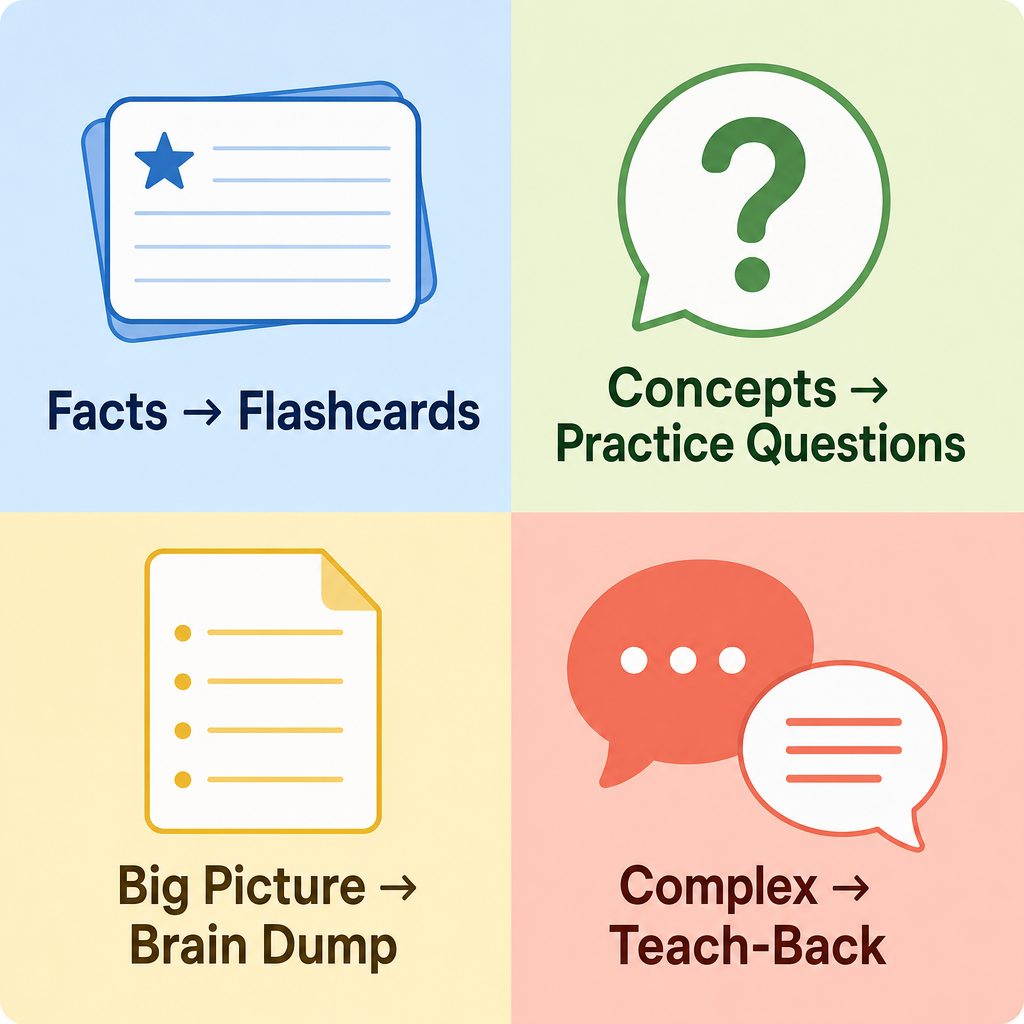
| Content Type | Retrieval Format | Why It Works |
|---|---|---|
| Isolated facts, definitions, vocabulary | Flashcard or cued recall | Direct question-answer format trains the exact retrieval cue you'll need on the exam |
| Concept application, cause-and-effect, analysis | Practice questions, short-answer prompts | Requires you to construct an explanation, not just recognize a term — builds transfer |
| Big-picture synthesis, unit overview, connections between topics | Brain dump or free recall | Forces you to self-organize and identify gaps in your mental model of the whole unit |
| Complex procedures, multi-step processes, systems | Teach-back or concept mapping from memory | Explaining or diagramming a process reveals where your understanding breaks down |
Building Your Weekly Spaced Retrieval Schedule
The logic of a spaced retrieval schedule is straightforward: study new material once, then retrieve it at growing intervals. Each retrieval attempt is brief and active. The gaps between sessions are where the memory consolidation actually happens.
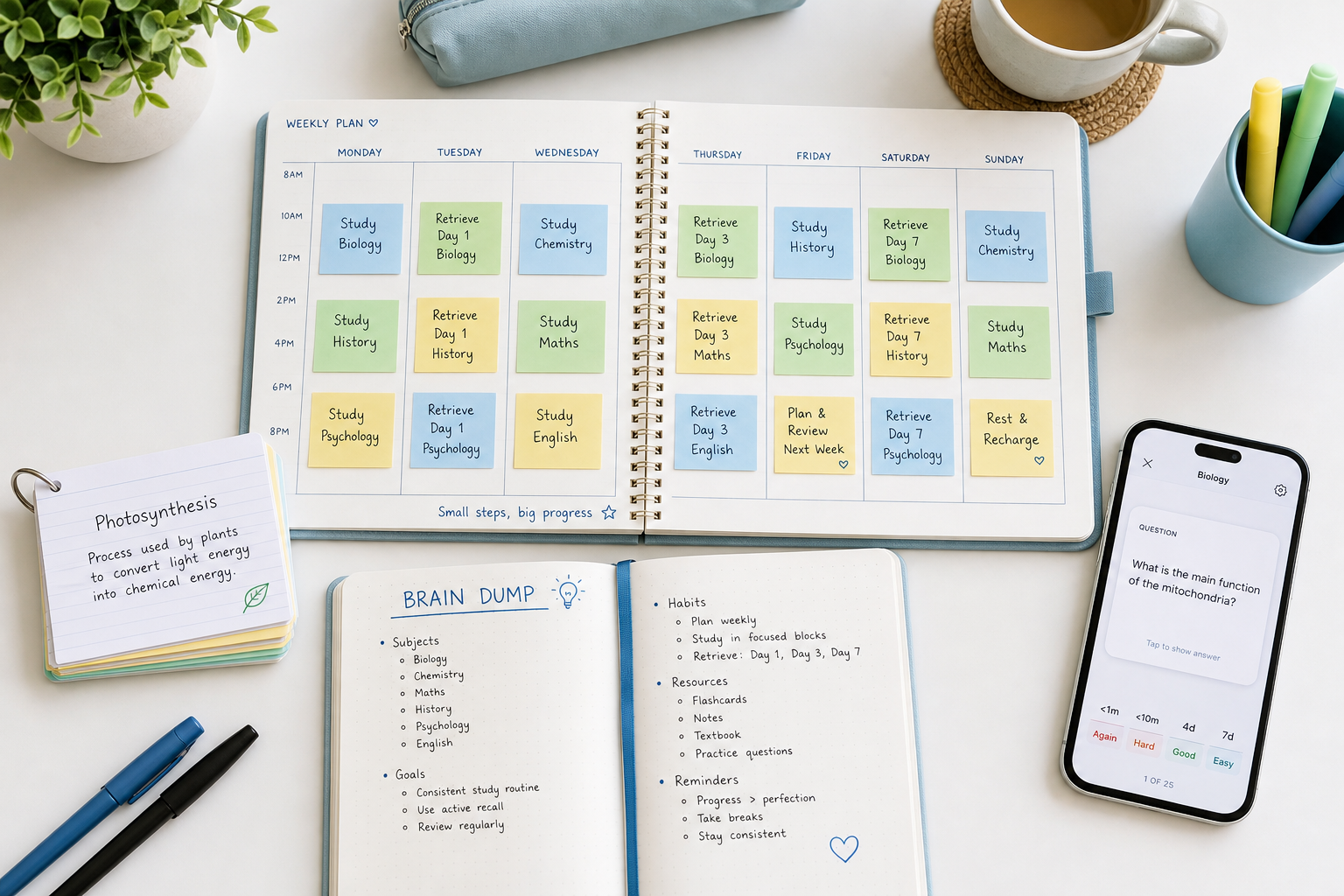
The expanding interval pattern — study, then retrieve at roughly 1 day, 3 days, 7 days, and 14 days — is a practical starting point. Research comparing uniform spacing (equal gaps) and expanding spacing (growing gaps) found no significant difference in outcomes overall, though expanding gaps may have a slight edge for harder material. The takeaway: do not over-engineer the intervals. Any consistent spacing pattern beats cramming.
| Day | Activity | Material in Play |
|---|---|---|
| Monday | Study new material (Chapter 4) | Chapter 4 — first exposure |
| Tuesday | Retrieve: Chapter 4 (Day 1 gap) | Chapter 4 — first retrieval |
| Wednesday | Study new material (Chapter 5) | Chapter 5 — first exposure |
| Thursday | Retrieve: Chapter 5 (Day 1 gap) + Chapter 4 (Day 3 gap) | Chapters 4 and 5 — retrieval |
| Friday | Study new material (Chapter 6) | Chapter 6 — first exposure |
| Saturday | Retrieve: Chapter 6 (Day 1 gap) + Chapter 5 (Day 3 gap) | Chapters 5 and 6 — retrieval |
| Sunday | Retrieve: Chapter 4 (Day 6 gap — approaching 7-day mark) | Chapter 4 — third retrieval |
The rolling carry-forward pattern — where each retrieval session includes both new material from the day before and older material at a longer gap — is the same logic used in structured classroom retrieval models. The key insight is that every concept gets multiple retrieval attempts across the week without requiring dedicated review blocks separate from your regular study sessions.
How Many Cards or Questions Per Session?
Keep individual retrieval sessions short and focused. A session covering 20–30 flashcards, 3–5 short-answer questions, or a 10-minute brain dump is more effective than a two-hour marathon review. The goal is effortful retrieval, not exhaustive coverage in one sitting. Shorter sessions spread across the week consistently outperform a single long block on the same material.
Fitting the Schedule Into Your Existing Study Time
The most common objection to a spaced retrieval schedule is time. Students assume that adding retrieval sessions means adding study hours. It does not. The schedule works by redistributing time you are already spending — replacing a two-hour re-reading block with several shorter, higher-yield sessions across the week.
- Replace one long re-reading block with three 15–20 minute retrieval sessions spread across the week. The total time is similar; the retention is substantially higher.
- Use transition time — commuting, waiting between classes, eating — for quick flashcard retrieval sessions. These short gaps count as spacing even if they are brief.
- Treat the retrieval session as the study session, not as something you do after studying. The retrieval attempt is where the learning happens, not the re-reading that precedes it.
- Use your Cornell Notes question column as a ready-made retrieval prompt list. Cover the note-taking column, work through the questions, then check your answers. No extra prep required — the retrieval prompts are already built into your notes.
Tool Options for Running Your Schedule
The schedule works with any tool that supports active retrieval — the format matters more than the platform. That said, some tools make the spacing logic easier to maintain.
- Anki (FSRS algorithm). Anki automates the spacing schedule — it calculates when to resurface each card based on your recall performance. This removes the need to manually track intervals. The important caveat: the algorithm only works as well as the cards you build. Poorly designed cards that can be answered by pattern recognition rather than genuine recall will inflate your performance metrics without building real memory. See the Anki flashcard app review for a full feature and pricing breakdown, or follow the beginner's setup guide if you are starting from scratch.
- Quizlet. Quizlet works well for collaborative study and shared deck workflows — useful when studying with classmates or using pre-made sets for standardized exams. Its spacing features are less sophisticated than Anki's FSRS, but the platform's Learn mode provides structured retrieval practice across multiple formats.
- Paper flashcards with the Leitner system. For students who prefer low-tech, the Leitner box system replicates spaced retrieval without any app. Cards move between boxes based on whether you recalled them correctly — correctly recalled cards move to a box reviewed less frequently; missed cards return to the daily review box. No device required.
- AI flashcard generators. If building a large card set from scratch is slowing you down, AI tools can generate flashcard drafts from your notes or PDFs. This is a time-saving option for the card-creation step, not the retrieval step. Review generated cards before using them — AI-generated content requires accuracy verification, especially for high-stakes exams. See the AI flashcard generator guide for an overview of how these tools work and where they fall short.
Adjusting the Schedule as Your Exam Approaches
As exam day gets closer, compress your spacing intervals. Instead of retrieving material at 7-day and 14-day gaps, shift to 2-day and 4-day gaps. This keeps retrieval active and frequent without reverting to cramming.
The distinction matters: compression means you are still retrieving from memory at every session, just more frequently. Cramming means you are re-reading or re-watching material in a single long block. The first approach maintains the effortful recall mechanism. The second largely bypasses it.
| Time to Exam | Suggested Spacing Approach |
|---|---|
| 4+ weeks out | Expanding intervals: 1 day, 3 days, 7 days, 14 days |
| 2–4 weeks out | Moderate intervals: 1 day, 3 days, 5 days |
| 1–2 weeks out | Compressed intervals: 1 day, 2 days, 4 days |
| Final 3–5 days | Daily retrieval of all high-priority material; no new content |
One common error during exam compression: dropping cards or topics after a single successful recall. Research on flashcard use shows students move on from material too quickly — a card should be recalled correctly four or five times before you deprioritize it. A single successful retrieval under pressure does not mean the memory is stable.
Five Mistakes That Break the System (and How to Fix Them)
Most students who try spaced retrieval practice and find it "not working" are running into one of these five problems. Each one is fixable.
- Peeking at the answer before fully attempting recall. Fix: cover the answer completely before attempting retrieval. If you cannot answer after a genuine attempt, mark it as missed — do not count a half-remembered answer as a success.
- Retrieving immediately after studying with no gap. Fix: wait until the material is no longer fresh before your first retrieval attempt. Even a few hours helps. Retrieving while the information is still in working memory does not produce the same consolidation benefit as retrieving after a genuine gap.
- Skipping the feedback step after retrieval. Fix: after every retrieval session, check your answers and correct any errors before moving on. Do not let a wrong answer sit uncorrected — it will be harder to unlearn later.
- Using only one retrieval format regardless of content type. Fix: match your format to what you are learning and how you will be tested. Flashcards for facts, practice questions for concepts, brain dumps for synthesis. A single format used for all content types will leave gaps.
- Dropping cards or topics too soon after one successful recall. Fix: keep a concept in active rotation until you have recalled it correctly four or five times across different sessions. One successful retrieval under low pressure does not mean the memory will hold under exam conditions.
Related case links
No matching exam hub found
Browse the exam hubs directory to find the study plan for this exam.
Did a similar plan work for you?
Share whether a comparable timeline and starting point produced a similar result — this is verification discussion, not general commentary.
Comments
Join the discussion with an anonymous comment.