
Pomodoro Done Right: 5 Critical Mistakes Students Make and How to Fix Them
Most students misuse the Pomodoro Technique by treating 25/5 as a rigid rule, scrolling on their phones during breaks, ignoring their energy cycles, studying without goals, and not pairing it with active learning. This guide explains each mistake and how to fix it.
Best for: all subjects, especially problem-solving and reading-heavy courses
Introduction – Why the Pomodoro Technique Fails for Most Students
You probably know the drill: set a timer for 25 minutes, work until it rings, take a 5‑minute break, and repeat four times before a longer rest. It sounds simple. Yet for many students, the Pomodoro Technique feels like a frustrating box — they end up more distracted, more tired, and no more productive than before. The problem isn’t the technique itself. It’s the way most people apply it.
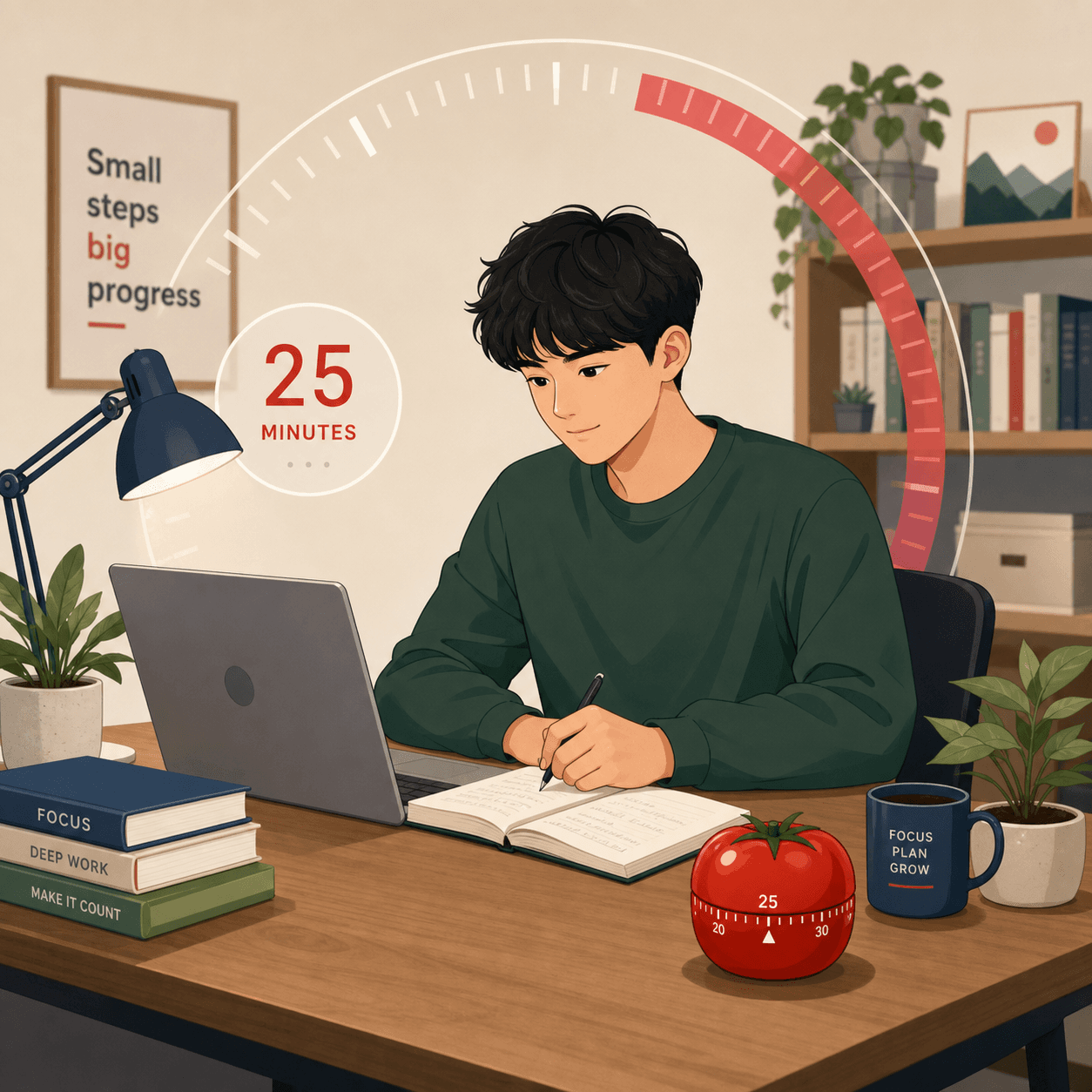
The core idea — timed work intervals separated by short breaks — is backed by real cognitive science. A 2025 scoping review of 32 studies (total N=5,270) found that structured Pomodoro intervals led to roughly 20% lower fatigue, a 0.5‑point improvement in distractibility, and a 0.4‑point increase in motivation compared to self‑paced breaks. 88% of the reviewed studies reported positive outcomes. But the catch is that those results come from students who adapted the method to their own needs, not from blindly following a fixed 25/5 rule.
Most students make the same five mistakes: they treat the 25‑minute interval as a sacred law, they scroll on their phones during breaks, they ignore when their brain is actually sharpest, they start a pomodoro without a clear goal, and they fill the time with passive reading instead of active learning. Each of these errors chips away at the technique’s effectiveness. Fix them, and the same timer that once felt like a productivity cage becomes a flexible, powerful study system.
Here’s how to do Pomodoro right — mistake by mistake.
The Pomodoro Technique in 60 Seconds (A Quick Refresher)
If you’re new or need a simple recap: the classic Pomodoro cycle has four steps:
- Choose a task you want to work on.
- Set a timer for 25 minutes and work without interruption.
- When the timer rings, take a 5‑minute break.
- After four pomodoros, take a longer break of 15–30 minutes.
That’s the template. But as you’re about to see, the template is a starting point — not a straitjacket.
Mistake #1 – Being Too Strict About the 25/5 Rule
Francesco Cirillo, the technique’s creator, originally used a 25‑minute work interval because that was the size of his kitchen timer. It wasn’t derived from neuroscience. Yet countless students treat the 25/5 split as a biologically determined optimum.
Research suggests that the ideal interval depends on the task and your personal focus capacity. The 2025 scoping review in anatomy education recommended schedules like 4×35 minutes with 10‑minute breaks or 4×40 minutes with 15‑minute breaks, depending on material complexity. A 1948 study by Mackworth, cited by Brown University assistant professor Apoorva Bhandari, found a 15–30% performance decrement after 20–30 minutes of continuous attention — meaning you do need a break around that window, but the exact number isn’t fixed at 25.
How to fix it: Experiment with different work lengths. Try 15 minutes for dense reading, 35 minutes for problem sets, and 50 minutes for creative work like essay drafting. Use the break to reset, not to keep working. The right interval is the one that lets you maintain focus without hitting a wall.
- Start with a range of 15–60 minutes.
- If you consistently lose focus before the timer ends, shorten the interval.
- If you’re in a flow state when the bell rings, finish the thought — then take your break.
Mistake #2 – Wasting Breaks on Your Phone
The five‑minute break is supposed to give your brain a rest, but scrolling through Instagram, TikTok, or your email does the opposite. Those feeds are designed to capture and hold attention, not to release it. As Brown University associate professor Matt Nassar explains, five‑minute breaks clear short‑term memory and force long‑term plasticity — but only when you disengage from active mental processing.

The Zeigarnik effect — the idea that interrupted tasks are easier to resume — works best when the break is a true pause, not a competing mental task. When you scroll on your phone, you’re not resting; you’re switching attention to another high‑engagement activity. That trains your brain for short attention spans and blocks the memory consolidation that happens during quiet moments.
Better break activities require zero screen time:
- Stand up and stretch for 2–3 minutes.
- Walk around your room or go outside — even a minute of nature exposure improves cognitive recovery.
- Do a few jumping jacks or bodyweight squats — a study cited by Med School Insiders shows that brief aerobic exercise increases memory and arousal.
- Sit quietly with your eyes closed, letting your mind wander.
Mistake #3 – Ignoring Your Natural Energy Rhythms
Most students start their study sessions with a random task — usually the easiest one — and save the heavy lifting for later when they’re already drained. This is the opposite of what cognitive science recommends. Your brain’s ability to focus fluctuates throughout the day according to your chronotype (whether you’re a morning lark or a night owl).
If you schedule demanding material during your natural low‑energy window, no timer structure will save you. The fix is simple: identify your peak focus period and reserve the first pomodoro of the day for your hardest subject. Three research‑backed adjustments:
- Morning types: Write or solve problems before lunch. Save reviewing or light reading for the afternoon.
- Night owls: Don’t try to force a 7 a.m. deep‑work session. Align your pomodoros with your actual alertness peaks, even if that means studying in the evening.
- Match interval length to energy: Use shorter pomodoros (20–30 minutes) in lower‑energy windows and longer ones (40–50 minutes) when you’re in the zone.
Mistake #4 – Studying Without a Clear Goal for Each Pomodoro
Parkinson’s Law states that work expands to fill the time allotted for its completion. If you sit down with a textbook and tell yourself “I’ll study for two pomodoros,” you’ll likely spend those 50 minutes flipping pages, highlighting random sentences, and mentally drifting. The timer becomes a countdown, not a focus tool.
The fix: define exactly one concrete task per pomodoro before you start the timer. A vague goal like “review Chapter 3” invites procrastination. A specific goal like “summarize the three main arguments of Chapter 3 in my own words” forces your brain to engage. The Med School Insiders guide explicitly recommends this: without a goal, the pomodoro is just a countdown; with a goal, it’s a focused sprint.
- Before each pomodoro, write down the one task you will complete. Keep it to a single sentence.
- If the task is too big (e.g., “write a 5‑page essay”), break it into pomodoro‑sized chunks: one pomodoro for the outline, one for the introduction, etc.
- At the end of the pomodoro, check whether you finished the task — if not, adjust the goal next time.
Mistake #5 – Not Combining Pomodoro with Active Learning Techniques
The Pomodoro Technique is a container — it tells you when to work and when to rest, but it doesn’t tell you what to do inside that container. Many students fill their pomodoros with passive re‑reading, re‑watching lectures, or copying notes. That’s the highest‑impact mistake of all.
The most effective study methods are active: they force your brain to retrieve information, solve problems, and explain concepts without looking at the source. When you pair pomodoros with active learning, you get both the timing benefit and a cognitive boost. A few proven strategies to drop into your pomodoro blocks:
- Active recall: Before you start a pomodoro, close your book or notes and try to list everything you remember from the previous session. Then work on filling the gaps. (Read our full guide: Active Recall: What It Is, Why It Works, and How to Use It)
- Practice problems: Twenty minutes of solving problems is worth more than an hour of re‑reading textbook explanations.
- The Feynman technique: Choose a concept, explain it in plain language as if teaching a beginner, and identify the parts you can’t explain clearly. That becomes your next pomodoro’s task.
- Flashcards: If you’re using pre‑made decks or creating your own, a pomodoro is the perfect time to run a batch. (Learn how to build effective flashcards: How to Make Effective Flashcards)
Once you start using active methods inside your pomodoros, you’ll notice that the timer no longer feels like something to endure — it becomes a structure that keeps you accountable to real learning. For a deeper look at common active‑recall errors, see 7 Active Recall Mistakes That Are Wasting Your Study Time (and How to Fix Them) and our weekly retrieval practice schedule for a ready‑made plan.
Cheat Sheet – The Fixed Pomodoro System (Quick Reference)
Here is a one‑page summary of every mistake and the fix. Use this table to diagnose your own study sessions and adjust immediately.
| Mistake | The Fix |
|---|---|
| Being too strict about 25/5 | Experiment with 15–60 min intervals. Shorten for dense material, lengthen for flow. Track what works. |
| Wasting breaks on your phone | No screens during breaks. Stand, walk, stretch, or sit quietly. Passive rest aids memory consolidation. |
| Ignoring natural energy rhythms | Schedule your hardest pomodoro during your peak alertness window. Use shorter intervals in low energy periods. |
| No clear goal per pomodoro | Write one concrete task before each interval. Break big tasks into pomodoro‑sized chunks. |
| Not combining with active learning | Fill each pomodoro with active recall, practice problems, Feynman technique, or flashcards. Skip passive re‑reading. |
Keep this system simple: decide your peak hours, set a task, pick an interval length that fits your current energy, work with an active method, and spend your break completely away from screens. Do that consistently, and the Pomodoro Technique will stop feeling like a productivity hack and start feeling like a natural part of how you learn.
Apply This Method
Related Methods
- How to Use Retrieval Practice as a Study Method: A Weekly Schedule That Actually Works
Knowing about retrieval practice and spaced repetition separately isn't enough — this guide shows high school and college students how to combine them into a concrete weekly schedule, including which retrieval format to use for each content type, how to build spaced intervals into existing study time, and how to avoid the common mistakes that break the system.
- Active Recall: What It Is, Why It Works, and How to Use It
Active recall — testing yourself to pull information from memory rather than passively reviewing it — is the most evidence-backed study technique available, yet most students avoid it because difficulty feels like inefficiency. This guide explains the science, walks through six practical techniques, and helps you understand why passive study methods like rereading and highlighting create a false sense of mastery.
- Cornell Notes Adaptation Guide: How to Make the Method Work for Any Subject
Struggling to make Cornell notes work for math, science, or language classes? This guide shows you how to adapt the cue and notes columns for any subject's unique demands, with concrete examples and a quick-reference table.
Comments
Join the discussion with an anonymous comment.