
Cornell Notes Adaptation Guide: How to Make the Method Work for Any Subject
Struggling to make Cornell notes work for math, science, or language classes? This guide shows you how to adapt the cue and notes columns for any subject's unique demands, with concrete examples and a quick-reference table.
Best for: humanities, STEM, biology, chemistry, languages, business meetings
Why Most Students Ditch Cornell Notes (and How to Fix It)
You probably tried the Cornell method once. You drew the vertical line, labeled the columns, and wrote your notes exactly like the template said. Then you looked at your math notes and realized the cue column was full of definitions you never revisited, and the notes column looked like a messy problem set. So you dropped it.
That experience is common, and it is not a failure of the method. The real failure is treating every subject like it has the same information structure. The Cornell system was originally designed for lecture-based, fact-heavy courses — history, psychology, introductory biology. For subjects that rely on problem-solving, visual diagrams, or procedural steps, the default setup needs to be rethought.
The core thesis of this guide is simple: Cornell notes work for every subject, but only if you adapt the roles of the cue column and the notes column to match how that subject presents information. Stop treating all classes the same, and the method stops feeling rigid.
If you need a refresher on the basic Cornell setup — the page layout, the four-phase workflow, and the 5 Rs — start with our complete Cornell notes method guide, then come back here for the subject-specific adaptations.
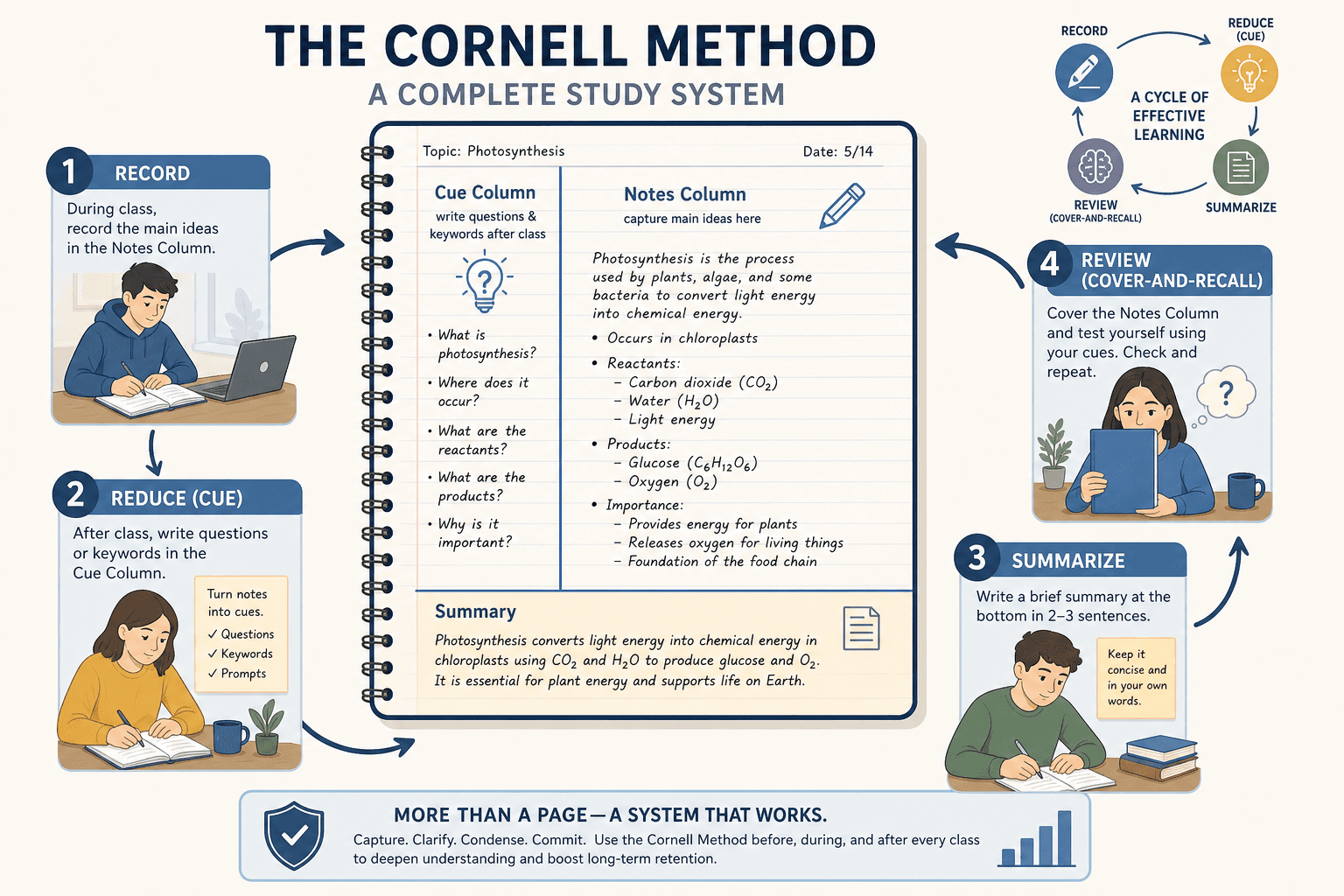
Humanities: Turn Your Cue Column into an Essay Prep Machine
For lecture-heavy courses like history, political science, and psychology, the cue column is your most powerful tool — but only if you stop writing single keywords and start writing open-ended questions. Instead of scrawling "Causes of WWI" in the cue, write "Why did the alliance system escalate a regional conflict into a world war?" That small change transforms your cue column from a vocab list into an essay question bank.
When you cover your notes and use only the cues to quiz yourself, you are effectively practicing short-answer and essay responses — exactly what humanities exams demand. The Athenify guide to Cornell notes recommends this strategy explicitly: for history, the cue column becomes a series of "why" and "how" questions that push you beyond surface recall.
| Element | Before (weak adaptation) | After (strong adaptation) |
|---|---|---|
| Cue column content | "WWII causes" | "Why did appeasement fail to prevent WWII?" |
| Notes column content | Bulleted list of causes with definitions | Key events (Munich Conference 1938, invasion of Poland 1939) and reasons for each |
| Study method | Read notes, try to recall definitions | Cover notes, answer the 'why' question aloud in 2-3 sentences |
| Exam prep value | Good for multiple-choice recall | Direct practice for essay prompts |
The summary strip also takes on a new role. Instead of a generic one-paragraph wrap-up, use it to write a thesis statement that synthesizes everything on the page. That thesis becomes a mini-essay outline you can chain together across pages for more complex arguments.
STEM: Use the Notes Column for Worked Examples, Not Concept Dumps
Math and physics students abandon Cornell earlier than anyone. The reason is obvious: writing down a theorem definition in the notes column and "Pythagorean Theorem" in the cue column does nothing to help you solve problems. The adaptation is straightforward — flip the purpose of each column.
- Use the notes column for worked examples and derivations. Write the problem statement at the top, then show every step of the solution with annotations.
- Use the cue column to write the problem type or theorem name — not the concept itself. For example, write "Chain rule — nested functions" instead of a definition of the chain rule.
- After class, cover the notes column and look at only the cue. Try to re-solve the example from scratch without looking at the steps.
The Athenify source explicitly recommends this approach: "Use the notes column for worked examples and derivations, not concept descriptions. Use the cue column to write the problem type or theorem name." This small shift turns each page into a practice exam — you cannot passively re-read your notes because you are forced to work through the chemistry.
| Traditional STEM Cornell | Adapted STEM Cornell |
|---|---|
| Notes column: definition of derivative, limit laws | Notes column: derivative of f(x)=3x²+2x from first principles, step by step |
| Cue column: "Derivative definition" | Cue column: "Limit definition of derivative — simple polynomial" |
| Summary: paraphrases definition | Summary: states the condition when to use limit definition vs. power rule |

Biology and Chemistry: Function Questions and Diagrams in the Notes Column
Biology and chemistry sit in a middle ground: the information includes both concepts and visual elements (diagrams, pathways, mechanisms). The adaptation for biology is to use the cue column for function questions — for each structure or process, ask "What does this do?" or "How does this relate to X?" — and use the notes column for the diagram plus a concise explanation.
For organic chemistry, the Athenify guide suggests a powerful trick: draw the starting material in the cue column and write the full mechanism with products in the notes column. When you review, you see only the starting material, and you must recall the steps and final product. This turns every page into a practice mechanism recall.
- Biology example: Cue column — "What is the function of the mitochondria?" Notes column — hand-drawn diagram of mitochondria with labels + one-line explanation ("cellular respiration, ATP production").
- Organic chemistry example: Cue column — draw the structure of 2-butanol. Notes column — mechanism of dehydration to 2-butene with all curved arrows, intermediates, and products.
The summary strip in these subjects should connect the function or mechanism to the bigger picture — for example, "Mitochondria are the powerhouses, but they also play a role in apoptosis." This bridges individual facts into integrated knowledge.
Language Learning: Translation Prompts and Grammar in the Notes Column
For language classes, the cue column becomes a translation prompt. Write the word or phrase in the target language (or in English, depending on your goal), and use the notes column for the definition, pronunciation hints, and one or two example sentences. The Athenify guide describes this as making the cue column a recall trigger — you see the prompt and must produce the full response.
Grammar rules also fit naturally. In the cue column, write the rule name (e.g., "Preterite vs. Imperfect"). In the notes column, write the conjugation pattern, when to use each tense, and three example sentences showing the contrast.
| Cue Column | Notes Column | Summary Strip |
|---|---|---|
| Spanish word: "hablar" | Definition: to speak; conjugation chart for present tense; example: "Yo hablo español" | Key rule: -ar verb endings; used for regular present tense |
| English prompt: "to go" | Translation: "ir"; irregular conjugation: voy, vas, va...; example: "Voy a la tienda" | Ir is highly irregular — memorize separately from -ar/-er/-ir patterns |
| Grammar cue: "Preterite vs. Imperfect" | Preterite: completed actions, specific time. Imperfect: ongoing actions, descriptions, habitual. Examples: "Ayer fui al cine" vs. "Cuando era niño, iba al cine cada sábado" | Use preterite for events with defined endpoints; imperfect for background and repetition |
The EC Tutoring article shares a similar approach: for Spanish, use the cue column for vocabulary words and the notes area for definitions. This turns review sessions into active recall drills — you see the word, try to recall its meaning and usage, then check the notes column.
Business Meetings: Turn Cornell into an Action-Item Tracker
The Cornell method also works outside the classroom. For students in group projects, internships, or professional meetings, the format adapts naturally to become an action-item tracker. The Canva Docs guide explains: "You can swap the quiz questions for action items in the cue column and you've got a running to-do list. After the meeting, one glance tells you who owns what, and the summary strip doubles as a ready-to-send recap announcement."
| Cue Column | Notes Column | Summary Strip |
|---|---|---|
| Action: Alicia — draft project timeline | Discussion: Client wants two-phase delivery. Phase 1: prototype by June 30. Phase 2: full launch by Sept 15. Budget cap $50k. | Two-phase delivery approved. Timeline by Friday from Alicia. Budget review next week. |
| Action: Marcus — research competitors | Identified three main competitors: ToolA (free tier limited), ToolB (strong analytics), ToolC (best for teams under 10). | Competitor landscape sent. Focus on ToolB for feature comparison. |
When NOT to Use Cornell Notes (And What to Use Instead)
Even with adaptation, the Cornell method has limits. It is a structured, linear layout, which means it struggles with certain learning contexts. Recognizing when to switch to another method is a sign of an effective student — not a weakness of Cornell.
- Fast-paced technical lectures (e.g., coding demos, advanced math proofs): The Cornell page takes too long to set up for a rapid-fire stream of code snippets or multi-step derivations. Use outline notes instead — a numbered list captures the sequence without the overhead of dividing columns.
- Discussion-based seminars: When the class is a conversation with no linear structure, the rigid Cornell layout forces your thoughts into boxes. Use free-form notes — a blank page with flexible spacing and arrows showing connections — to capture the flow of ideas.
- Highly visual subjects with many images (art history, architecture): Cornell's text-heavy format leaves little room for sketches, diagrams, or image descriptions. Try mind maps or the charting method — a table with rows for each artwork and columns for date, artist, style, and significance.

Quick-Reference Adaptation Table
Use the table below as a cheat sheet. Print it or bookmark it and revisit at the start of each semester to set up your note-taking strategy for every course.
| Subject Type | Cue Column | Notes Column | Summary Strip |
|---|---|---|---|
| Humanities (history, psychology, political science) | Open-ended 'why' and 'how' questions — essay prompts | Key events, arguments, dates, and supporting evidence | Thesis statement connecting the page's content |
| STEM (math, physics, engineering) | Problem type or theorem name (e.g., 'Chain rule — nested functions') | Worked example with full step-by-step solution and annotations | Condition or rule for when to apply this method vs. another |
| Biology / lab sciences | Function question (e.g., 'What does the mitochondria do?') or starting material for reactions | Diagram + concise explanation of process or mechanism | Bigger-picture connection (e.g., how function relates to system level) |
| Languages | Translation prompt (word or grammar rule name) | Definition, conjugation table, example sentences | Memory hook or exception to the rule |
| Business meetings / team projects | Action item: owner — task | Discussion points, decisions, deadlines | Ready-to-send recap of next steps |
The key takeaway is simple: the layout stays the same; the content of the columns changes. Once you understand how to shift the purpose of the cue and notes columns for each discipline, the Cornell method stops feeling like a rigid template and becomes a flexible system that actually supports how you learn.
Apply This Method
Related Methods
- 7 Active Recall Mistakes That Are Wasting Your Study Time (and How to Fix Them)
Struggling to see grade improvements despite using active recall? This troubleshooting guide identifies seven common execution errors—like passive flashcard flipping, testing too soon, and using the wrong technique for the subject—and provides practical fixes to make your study time count.
- How to Use Retrieval Practice as a Study Method: A Weekly Schedule That Actually Works
Knowing about retrieval practice and spaced repetition separately isn't enough — this guide shows high school and college students how to combine them into a concrete weekly schedule, including which retrieval format to use for each content type, how to build spaced intervals into existing study time, and how to avoid the common mistakes that break the system.
- Spaced Repetition: How It Works and Why the Science Backs It
A research-grounded explainer for high school and college students on how spaced repetition turns your brain's forgetting mechanism into a long-term retention tool — covering the cognitive science, optimal scheduling principles, and both app-based and manual implementation paths.
Comments
Join the discussion with an anonymous comment.