
Build Vocabulary with NYT Strands in 10 Minutes Daily
Yes, NYT Strands can help you learn new words — but only if you use deliberate strategies. This guide explains how the puzzle's thematic design and hint economy create a vocabulary reinforcement loop, and shares four post-puzzle practices that turn casual gameplay into consistent vocabulary growth in about 10–15 minutes a day.
Best for: language learning
The board is finished, the spangram suddenly seems obvious, and the last few theme words look less mysterious than they did ten minutes ago. That is the exact moment to ask whether the NYT Strands puzzle for vocabulary learning is doing anything useful.
The short answer is yes, but with a condition: Strands can be a strong daily trigger for vocabulary growth if the puzzle is treated as the first half of a 10- to 15-minute study routine. Finishing the grid is not the same as learning the words. The learning starts to become reliable when the player looks up missed words, records the theme, revisits old boards, and occasionally practices using the words outside the puzzle.
What Strands Makes You Do With Words
Strands gives players a letter grid, a daily theme, several hidden theme words, and one spangram that stretches across the board and names or clarifies the organizing idea. Non-theme words can earn hints, and a hint points the player toward a hidden theme word rather than simply turning the game into a vocabulary list.[1]
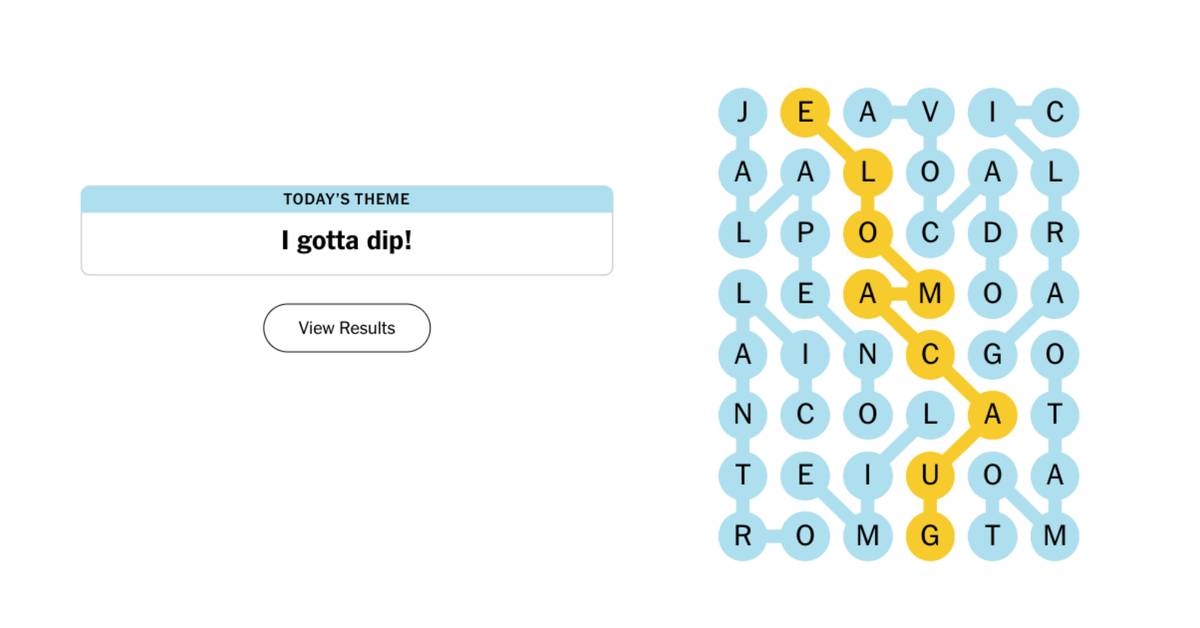
That structure matters because the player is not just recognizing isolated words. A normal solve requires a running question: what kind of word belongs to this theme? Once one answer appears, the next answer is no longer a random hunt. The category narrows the search.
For vocabulary learning, that is the useful part. A student who finds “bass,” “trout,” and “perch” under a fishing-related theme is doing more than tracing letters. The student is placing words into a semantic neighborhood. The spelling, category, and meaning are being handled together, which is far better than glancing at a list and hoping the words stick.
Why the Puzzle Has Real Learning Ingredients
A useful way to judge Strands is the Involvement Load Hypothesis, which argues that vocabulary retention improves when a task creates need, search, and evaluation. Strands creates need because the player wants to complete the theme, search because the player scans the grid for possible words, and evaluation because every promising word has to be judged against the daily category.[2]
The important detail is evaluation. A player may see a perfectly valid word in the grid and still reject it because it does not fit the theme. That little act of sorting is where vocabulary work becomes more active. The word is not only “seen”; it is tested against a meaning boundary.
Semantic clustering gives the puzzle another advantage. Vocabulary instruction research associated with Beck, McKeown, and Kucan emphasizes that related words can support one another as retrieval cues; in Strands, the daily theme automatically supplies that cluster.[3] One found word can prime another, and the spangram can become the label that holds the set together.
There is also a spelling benefit, especially for students who rush past word forms when reading. Orthographic mapping describes the process of connecting spelling, pronunciation, and meaning into a stable word memory; close attention to letter sequences supports that kind of mapping.[4] Strands is not a phonics lesson, but it does make the eye slow down over letter order, prefixes, suffixes, and unusual combinations.
That does not mean every completed board becomes permanent vocabulary. Paul Nation’s widely cited exposure threshold suggests learners often need roughly 10 to 20 encounters with a word in varied contexts before it is reliably stored for long-term use.[5] A single Strands appearance may be one encounter. The routine after the puzzle is what turns that encounter into part of a longer chain.
The 10- to 15-Minute Routine
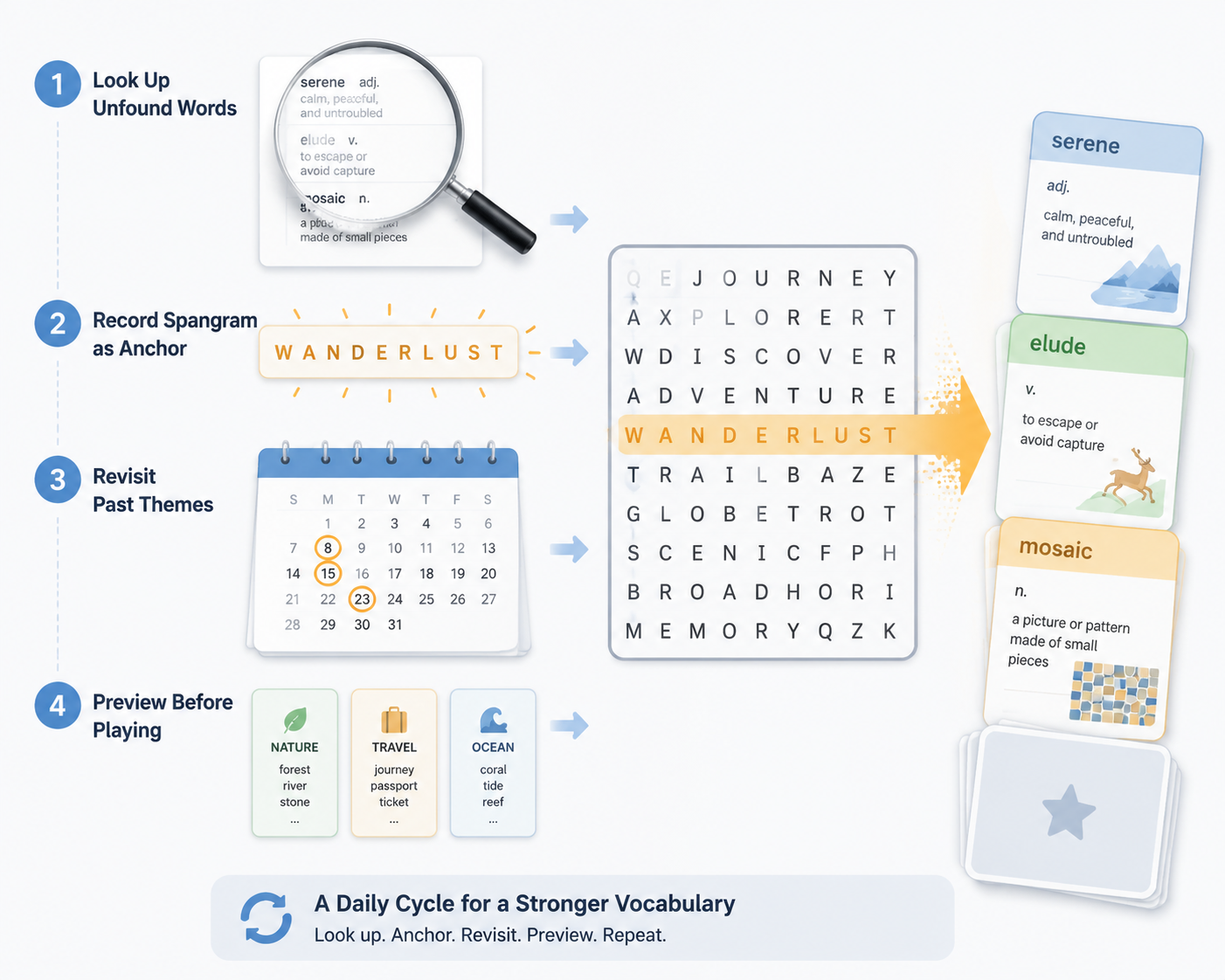
The simplest version is not complicated. Play the puzzle, then spend a few minutes making the words useful before closing the tab.
| When | Action | Why it helps |
|---|---|---|
| During the puzzle | Notice which words fit the theme and which almost fit | Builds category judgment instead of pure pattern matching |
| Right after solving | Look up every theme word you missed or guessed weakly | Adds meaning to words the grid only helped you recognize |
| Right after solving | Record the spangram as the category anchor | Gives the word set a retrieval cue |
| Later in the week | Revisit previous themes and recall words before checking | Turns exposure into spaced retrieval |
| Before a future puzzle | Preview old theme words for one minute | Warms up recognition without giving away the new board |
Look Up the Words the Puzzle Did Not Teach
Start with the words you did not find, the words revealed by hints, and the words you accepted only because the board accepted them. Those are the highest-value words because they mark the gap between solving and knowing.
For each one, write a plain definition and one short example sentence. Do not copy a dictionary entry so formal that you would never say it. If the word has several meanings, choose the meaning that fits the theme first, then add another meaning only if it is common enough to matter.
This is where Strands becomes better than a finished screenshot. The puzzle creates attention; the lookup gives that attention somewhere to go.
Use the Spangram as the Category Anchor
The spangram is worth recording because it names the relationship among the words. A vocabulary notebook entry can be very simple: date, spangram, theme words, missed words, and one sentence using the least familiar word.
A student does not need to make this beautiful. A messy note that can be reviewed tomorrow is more useful than a polished page made once and abandoned. The anchor is there so the next review begins with a category, not with a cold list.
Revisit Last Week’s Themes Before They Fade
Once a week, cover the theme words and look only at the spangrams or theme labels. Try to recall as many words as possible before checking the old list. This small retrieval step changes the task from “I recognize it when I see it” to “I can bring it back with a cue.”
That distinction matters for students. Recognition feels fluent earlier than production does. If a word looks familiar in the grid but cannot be explained, pronounced, or used in a sentence, it is not fully learned yet.
Preview Without Spoiling the Puzzle
Before opening a new Strands board, spend one minute reviewing two or three older theme sets. This is not about predicting the day’s answer. It is a warm-up for category thinking and spelling attention.
If the preview turns into a long study session, it will probably disappear from the morning routine. Keep it short enough that the puzzle still feels like a puzzle.
What the Evidence Can and Cannot Prove
Word-search research gives Strands a reasonable foundation, but it should not be oversold. A 2023 systematic review reported significant pretest-to-posttest vocabulary gains across multiple word-search studies, with experimental groups outperforming controls.[6] Another review of word games reported an 83% significant effect on vocabulary learning across formats including word search, word wall, crossword, and scramble activities.[7]
Those findings are encouraging, especially because they point in the same direction as the learning mechanisms above. Still, much of this evidence comes from classroom-heavy K-12 ESL settings rather than adult native-English players using NYT Strands at breakfast. It supports plausibility. It does not prove that every Strands player will gain the same amount of vocabulary from casual play.
A 2021 Journal of Cognitive Enhancement study, as reported in Pixelworks’ summary, found that adults who played word games for 15 minutes daily over 8 weeks improved on vocabulary tests, with larger gains among those who used word-finding tools alongside gameplay.[4] The useful takeaway is modest: pairing play with lookup and tools appears more promising than play alone.
The caution is just as important. Word searches can become rote pattern matching. A fast solver can skim for letter shapes, burn through hints, finish the grid, and leave with no usable meaning attached to the words. Strands resists that problem better than a plain word search because of its theme and spangram, but it does not eliminate it.
The Skill Strands Builds Best
Strands is strongest for recognition vocabulary: seeing a word, noticing its spelling, connecting it to a category, and understanding it when it appears again. That is a real skill. It helps with reading, test passages, and the quiet confidence of not skipping over unfamiliar words.
It is weaker for production. A comparison of Blossom and Strands makes this distinction directly: Strands leans toward recognition and thematic discovery, while production-heavy word games ask the player to generate more words from memory.[8] Because the source is from a Blossom-affiliated site, its comparison should be read with that context in mind, but the recognition-versus-production distinction is still useful.
That means students who want balanced vocabulary growth should add one production step. Write one sentence with a new word. Explain two theme words aloud. Make a flashcard that asks for the word from a definition, not only the definition from the word. These small additions ask the brain to retrieve, not merely recognize.
A Practical Verdict
NYT Strands can count as vocabulary practice when the player stays mentally active. The theme asks for category judgment, the spangram gives a retrieval anchor, and the grid rewards close attention to spelling. Those are good learning conditions.
The habit becomes much more defensible when it lasts a few minutes past the solved board. Look up the words you missed. Save the spangram. Revisit old themes. Use at least one new word outside the puzzle. That is enough to turn a pleasant daily game into a credible vocabulary supplement, especially for recognition, spelling attention, and thematic reinforcement.
References
- What Is Strands? (Today.com)
- Using Word Searches to Learn a New Language, Word Puzzle Hub
- Building Vocabulary Through Fun and Games, Edutopia
- Beyond Winning: How Word Games Improve Your Brain, Pixelworks
- Benefits of Word Puzzles for High School & Adult Learners, Life Beyond High School
- Effectiveness of Word Search Puzzles Game in Improving Student's Vocabulary, ResearchGate
- Effectiveness of Word Games in Teaching Students Vocabulary, Al-Kindi
- Blossom Word Game vs NYT Strands
Apply This Method
Related Methods
- Build Vocabulary With NYT Strands 'Big Talk' in 10 Minutes
Learn how a single daily NYT Strands puzzle can become a 10-minute vocabulary-building exercise, using the 'Big Talk' puzzle as a concrete example.
- Learn the Offside Rule in 20 Minutes with Self-Test Scenarios
This guide breaks down soccer's offside rule into four learnable conditions and tests your knowledge with real-match scenarios — helping you master Law 11 in about 20 minutes.
- Build One Statute of Limitations Chart for All 1L Exams
Law students often treat statute of limitations as four separate topics across Civil Procedure, Torts, Contracts, and Criminal Law. This guide shows how building a single cross-subject reference chart organized by cause of action replaces separate outlines and directly boosts exam performance.
Comments
Join the discussion with an anonymous comment.