
How to Use Past Papers for Exam Revision: A Phased Timeline Approach
Learn when to start using past papers during your revision and how to progress from open-book practice to full timed mocks. This phased approach transforms past papers from a final panic check into a structured learning tool throughout your study cycle.
Best for: General exam revision
Most students who misuse past papers do it in one of two ways. They either open a full timed paper before they have learned enough content to make the attempt meaningful, get crushed by the first unfamiliar prompt, and decide they are “bad at exams.” Or they protect every past paper like treasure until the final week, then try to sprint through years of material when there is no time left to fix what the papers reveal.
That is why the better question is not simply how to study with past papers. The better question is: what job should this paper be doing today? Early in revision, a past paper should teach you what the exam rewards. In the middle, it should force retrieval and pacing. Near the end, it should test stamina under realistic pressure.
This matters because practice testing is not just a way to measure learning after the fact. A Faculty Focus case study from Fall 2020 reported that students in government, economics, and law classes improved by about 15 percentage points, or 25 points on a 100-point scale, after using practice exams; nearly 90% performed better on the real exam after taking practice tests beforehand.[1] The same article cites a 2017 meta-analysis by Adesope, Trevisan, and Sundararajan covering 272 effects from 118 experiments, which found that practice testing significantly outperformed non-testing conditions.[1]
Past papers are one practical form of that testing effect. They are not magic documents. They work when they make you retrieve knowledge, notice the exact task being asked, compare your answer against a standard, and change what you study next. If you want the memory mechanism behind that process, the same logic sits inside active recall: you learn more when you have to pull an answer out of memory than when you only reread the explanation.
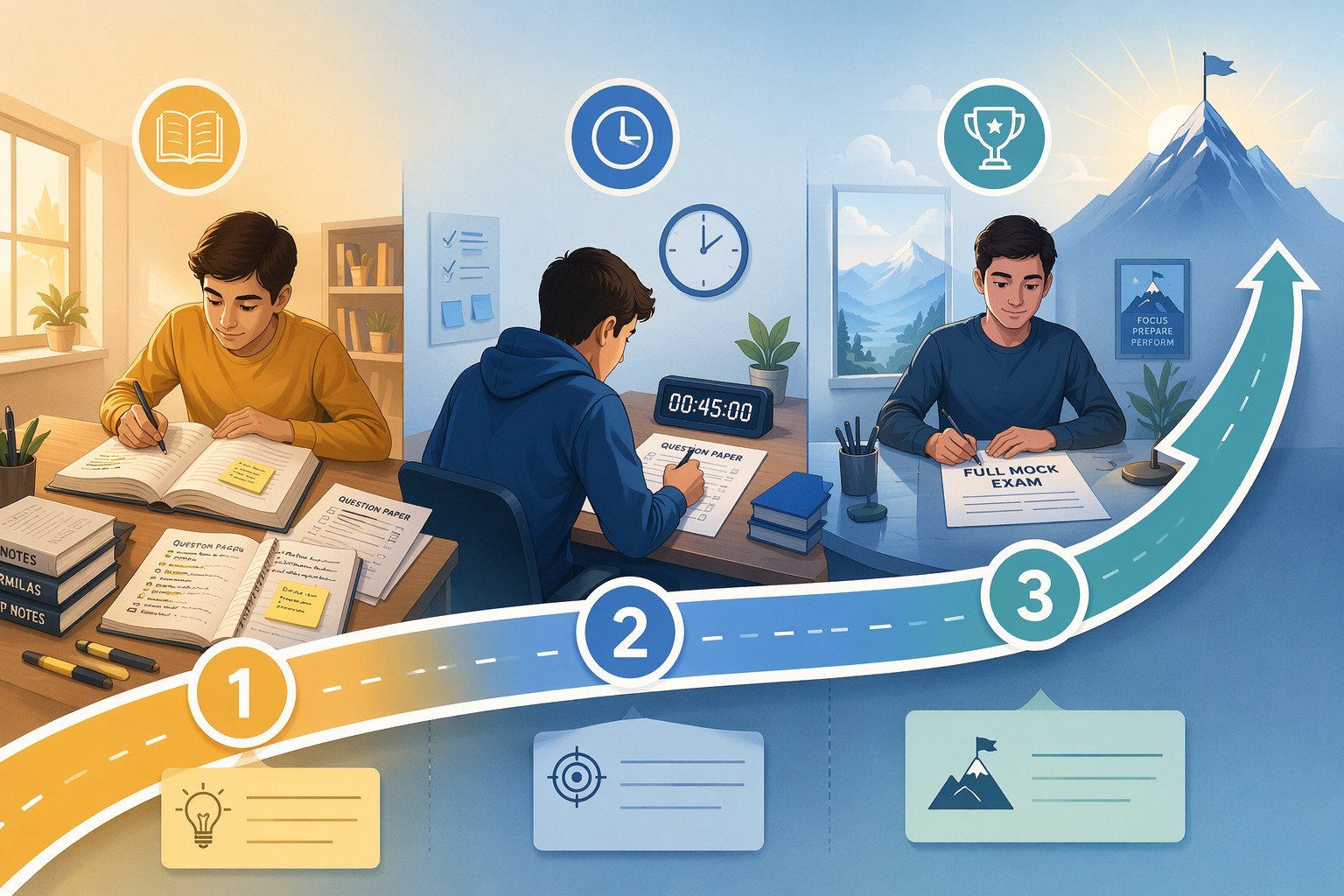
Use the Same Past Papers Differently as Revision Matures
A useful past-paper timeline has three phases: open-book practice, timed topic sections, and full mock exams. Save My Exams lays out this progression clearly: start by using past papers with notes and mark schemes to learn question styles, then move into timed sections, and only later attempt complete papers under exam conditions.[2]
| Revision stage | Main job of the past paper | What you should allow | What you should measure |
|---|---|---|---|
| Early | Learn question patterns and answer standards | Notes, textbook, worked examples, mark scheme after attempting | Do you understand what the prompt is asking? |
| Middle | Build retrieval and pacing by topic | Limited notes after the first attempt, timer, topic-focused sections | Can you produce the answer under partial pressure? |
| Final | Simulate the real exam | Exam conditions, full timing, minimal interruptions | Can you sustain accuracy, pacing, and stamina? |
The mistake is treating these stages as if they are interchangeable. A full mock in week one often measures panic more than knowledge. An open-book attempt two days before the exam may feel comforting, but it does not tell you whether you can perform without support. The paper is only useful if the pressure level matches the maturity of your revision.
Phase 1: Start Open-Book While You Are Still Learning
Early use of past papers should not look like an exam. This is the part students often resist because it feels less serious than closing the book, starting a timer, and suffering nobly for two hours. But if you have not learned the content yet, a full timed attempt can turn into a very elaborate way to discover that you have not learned the content yet.
In Phase 1, choose a small set of questions from a topic you are currently studying. Keep your notes, textbook, formula sheet, or class materials nearby. Read the prompt slowly. Circle the task verb: explain, compare, justify, evaluate, calculate, interpret, prove, discuss. In US classes, this might appear as an AP free-response command, a short-answer instruction on a final, or a standardized-test style prompt. The wording matters because it tells you the shape of the answer, not just the topic.
A student who knows the causes of an event may still lose points on a prompt that asks them to evaluate the most significant cause. A student who can perform a calculation may still drop points if the question asks them to interpret the result in context. Early past-paper work is where you learn that difference, before the timer makes every misunderstanding feel personal.
Try the answer first, even if you need support. Then check the mark scheme, scoring guide, rubric, or answer key. Do not use it as a pass-fail verdict yet. Use it as a model of what the exam rewards. Save My Exams specifically emphasizes using early past-paper practice to understand command words, answer structure, and mark schemes before moving into heavier timed work.[2]
Your notes after an early question should look more like exam-language translation than like a grade report. Write down what the prompt wanted, what a complete answer included, and what kind of evidence or working earned credit. If the scoring guide gives three points for a six-point answer, notice whether those points came from definitions, linked reasoning, examples, calculations, units, or evaluation. That is not administrative detail. That is the exam showing you how it thinks.
- If you cannot start the answer, look back at your notes and write a supported attempt instead of leaving the page blank.
- If you used the wrong structure, rewrite the first two or three sentences in the format the rubric expected.
- If you knew the content but missed the command, make a prompt-verb note such as “justify = give a choice plus reasons,” or “compare = discuss both similarities and differences.”
- If the scoring guide rewards a phrase you never use, add that phrase to your topic notes and practice using it in a fresh sentence.
This phase also protects confidence. A hard question in Phase 1 is not evidence that you are doomed. It is evidence that you have found a format, wording pattern, or content gap while there is still room to deal with it. That is exactly when past papers are supposed to be uncomfortable.
Do Not Use Early Scores as a Diagnosis of Your Final Ability
Cambridge Assessment offers a useful warning here: past-paper questions can be excellent for revision, but they can be problematic when used out of context as formative diagnosis, especially before students have been taught the material the question assumes.[3] That is the guardrail. A past paper cannot fairly diagnose your exam readiness if it is testing material you have not covered or a style you have not yet learned.
So in the early phase, do not turn every mark into a prediction. The useful question is not “What score would I get today?” The useful question is “What does this question require that my current notes or habits do not yet produce?”
This is also where a study plan often fails if it only says “do past paper” on Thursday. That task is too vague. A better plan specifies the phase: “Open-book practice: photosynthesis short-answer questions; mark for command words and missing reasoning.” The calendar matters, but the execution detail matters more. If your planner looks organized while your sessions stay vague, that is the same planning-versus-doing problem described in the planning vs. execution gap.
Phase 2: Move to Timed Topic Sections
Phase 2 begins when you have covered enough content that retrieval is a fair demand. You do not need to be perfect. You do need enough foundation that the main challenge has shifted from “I have never learned this” to “Can I produce it without help, fast enough, in the right format?”
This is the hinge of the whole method. Students often jump from comfortable notes straight into full mocks, then wonder why timing collapses. Timed topic sections give you a middle step. They keep the workload small enough to review properly, but they add enough pressure to expose whether understanding survives the exam format.
Choose a cluster of questions from one topic or one question type. Set a timer. If your exam uses marks or points, estimate time from the weight of the section. GCSE Online Tutoring gives a simple pacing guide of about one minute per mark, and Save My Exams also recommends using mark values to build timing awareness.[2][4] US exams will not always map perfectly onto that rule, but the principle transfers: heavier questions deserve more time, and small questions should not quietly eat half the session.
At this stage, do the first attempt closed-book. If you get stuck, mark the point where you got stuck, then continue as far as you can. After the timer ends, you can use notes in a different color to complete or repair the answer before marking. That small distinction is important. It separates what you could retrieve under pressure from what you could recognize once support returned.
A useful Phase 2 session might look like this:
- Pick one topic or question type, not an entire paper.
- Set a realistic timer based on points, marks, or the exam’s normal pace.
- Attempt the section closed-book.
- After time ends, add corrections or missing steps with notes in a different color.
- Mark the answer and label each lost point by cause: content gap, prompt misunderstanding, timing, careless error, weak explanation, or incomplete working.
- Choose one repair task before the next session.
The “different color” part may sound fussy until you have seen ten students insist they “basically knew it” after reading the answer key. Maybe they did. Maybe they recognized it after the pressure was gone. Phase 2 is where you learn the difference. Recognition feels smooth; retrieval is the real exam skill.
This phase should also make your pacing visible. If you spend twelve minutes on a low-value question because you are trying to make it perfect, the issue is not just content. It is decision-making under pressure. If you rush a longer response and leave out the explanation that earns most of the credit, the issue may be answer planning. Those are fixable problems, but only if your review names them accurately.
The Review Routine Matters More Than the Attempt
Doing a past paper and then glancing at the score is not review. It is receipt-keeping. The learning happens in the loop after the attempt: mark, diagnose, repair, and retest.
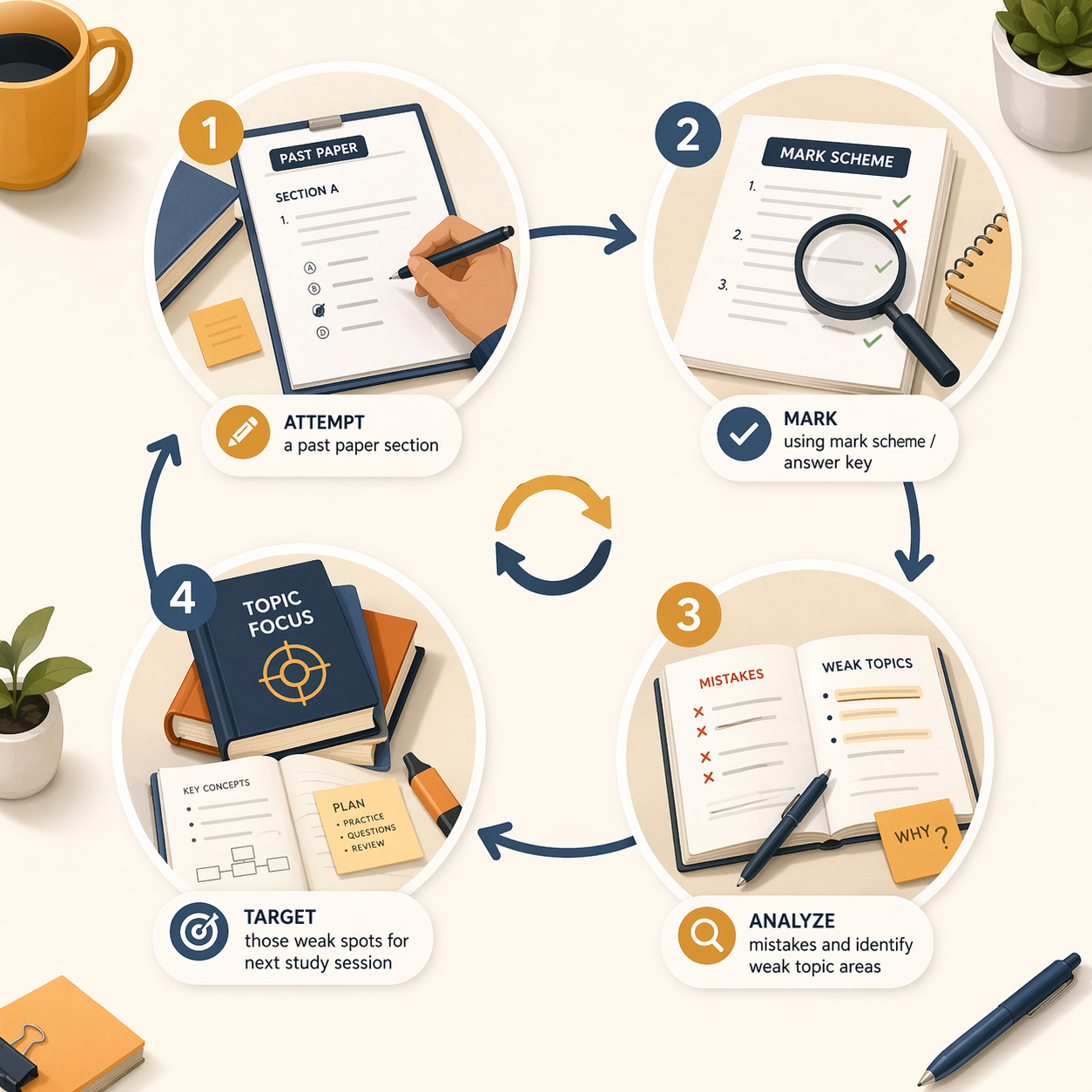
After every serious attempt, create a short error log. Keep it boring and specific. You are not writing a diary entry about being disappointed. You are building instructions for your next study session.
| What went wrong | What it usually means | Next repair task |
|---|---|---|
| I did not know the fact, formula, case, term, or method. | Content gap | Restudy the topic, then answer two similar questions without notes. |
| I knew the topic but answered the wrong task. | Prompt or command-word problem | Rewrite the answer opening using the exact task verb. |
| I ran out of time. | Pacing problem | Redo a smaller timed set and set a checkpoint halfway through. |
| My answer was vague or unsupported. | Explanation problem | Add evidence, working, examples, or reasoning links to a model answer. |
| I made small avoidable mistakes. | Accuracy or checking problem | Create a final two-minute checking routine for that question type. |
The repair task should be close to the mistake. If you lost points because you misread “compare,” rereading the whole chapter is a poor fix. Practice two comparison prompts. If you lost points because you forgot a formula, rewriting a beautiful set of notes on the entire unit is probably avoidance. Learn the formula, use it, and then test it in a fresh problem.
This is where past papers become a study tool rather than a score generator. One attempt tells you where the leak is. The next session should plug that leak. If the next session ignores the error log, the paper has done the emotional damage of testing without giving you the learning benefit of feedback.
Phase 3: Save Full Mock Exams for the Final Stretch
Full mocks belong near the end of revision, when most content has been covered and you have already practiced the main question types. This does not mean the night before. It means late enough that the score is meaningful and early enough that the weaknesses it exposes can still be repaired.
Now the rules change. Put away notes. Use the allowed calculator, formula sheet, scrap paper, or reference materials only if the real exam allows them. Sit for the full time. Keep your phone away. If the test has sections, breaks, or a required order, follow that structure. GCSE Online Tutoring recommends simulating exam conditions and aiming for several complete papers per subject; it suggests 3–5 full papers as a practical target.[4]
For AP exams, finals, ACT-style practice, or other standardized tests, adapt the same idea: use official or teacher-approved materials where possible, follow the real timing, and mark with the closest available scoring guide. The point is not to cosplay stress. The point is to find out whether your knowledge still works when the paper is long, the clock keeps moving, and your concentration has to last.
Full mocks reveal problems that smaller sections cannot. A student may pace individual questions well but fade in the final third. Another may know every topic separately but lose time deciding which method applies. Someone else may score well until a difficult question appears early and rattles the next page of answers. These are not moral failures. They are performance conditions, and they need practice under conditions that resemble the real thing.
The review after a full mock should be stricter but not endless. Mark the whole paper, identify the few losses that cost the most, and separate them into two groups: quick repairs and deeper weaknesses. A quick repair might be a formula, definition, unit conversion, citation format, or prompt habit. A deeper weakness might be an entire topic, a recurring reasoning problem, or a timing collapse across a section. In the final stretch, you do not have time to treat every lost point equally.
How Many Past Papers Should You Do?
There is no universal number that works for every subject, course, or exam. The practical target from GCSE Online Tutoring is 3–5 full papers per subject, but that advice is best treated as a final-stage benchmark rather than a rule for every week of revision.[4] A student preparing for one cumulative final with limited official materials may need to preserve complete papers carefully. A student with many released AP free-response questions can afford more topic-based practice earlier.
Quality also changes the number. One full paper with a serious review log, targeted repair, and a retest of weak areas is worth more than three papers scored, sighed over, and forgotten. If you have limited past papers, use partial questions for Phase 1 and Phase 2, then reserve at least one or two complete papers for Phase 3 conditions. If you have plenty, still resist burning through them without review. More attempts do not automatically mean more learning.
A Simple Calendar Rule
Place your next past-paper session by asking what your revision is ready to handle.
- If you are still learning the topic, use open-book questions to learn prompt patterns, answer structure, and marking standards.
- If you mostly understand the topic, use timed sections to practice retrieval, pacing, and question selection.
- If the exam is approaching and content coverage is mostly complete, use full mocks to test stamina, timing, and remaining weak spots.
That rule is usually enough to stop the two worst habits: panicking through full papers too early or saving every paper until it is too late to learn from them. Past papers work best when their role changes as your revision matures. Early on, they teach you what a good answer looks like. In the middle, they make you produce that answer under pressure. Near the end, they show whether you can sustain the whole performance.
References
- Practice Exams for Improved Learning, Faculty Focus, 2021.
- How to Use Past Papers Effectively, Save My Exams, March 2026.
- Are past paper questions always useful?, Cambridge Assessment.
- How to Use Past Papers for GCSE Revision, GCSE Online Tutoring, 2026.
Apply This Method
Related Methods
- Adapting the Pomodoro Technique for an ADHD Brain
The classic 25/5 Pomodoro model often falls short for students with ADHD. This guide explains how to adjust intervals, breaks, and reward timing so the technique supports your natural attention patterns instead of fighting against them.
- 3 Math Note-Taking Methods That Actually Work (3-Column, Cornell, and Scaffolded Notes)
Most note-taking advice treats all subjects the same, but math requires a different structure. This guide compares three proven methods — the 3-Column Method, Cornell adapted for math, and Scaffolded Notes — with examples, a decision guide, and templates to help you choose the right one.
- Focused Notes vs. Cornell Notes vs. Other Methods: Which Note-Taking System Is Best for You?
AVID Focused Notes and Cornell Notes share the same roots but serve different purposes. This guide compares the two systems head-to-head, evaluates other popular methods like Charting and Flow Notes, and helps you choose the right approach based on your learning style and course load — backed by fresh 2026 research.
Comments
Join the discussion with an anonymous comment.