
Which Bryan Johnson Daily Habits Help Students Focus?
If you came looking for Bryan Johnson daily routine habits for student focus and discipline, the usable answer is smaller than the spectacle. Copy the parts that make sleep and study blocks more predictable. Do not copy the expensive protocol stack as if red-light panels, sauna time, testing, or supplements have been shown to raise a GRE, MCAT, SAT, ACT, or ASVAB score.
Johnson’s 2026 morning routine is self-reported and unusually elaborate: he says he is in bed around 8:30 p.m., wakes around 5 a.m., uses 10,000-lux light for 6 minutes, does breathwork, exercises for 90 minutes, uses sauna and red-light therapy, and completes a morning routine that totals 4 hours and 46 minutes.[1] That is interesting as an n=1 discipline project. It is not an exam-prep study.

The useful wrinkle is that Johnson himself does not frame the protocol as something everyone should clone. His protocol materials tell readers to start small and not simply copy his routine wholesale.[2] For students, that is the correct entry point. The question is not whether a billionaire biohacker can run a 4-hour-plus morning. The question is what survives a week with class, work, homework, commuting, family obligations, and a test date that will not move because your sleep schedule fell apart.
The student audit: keep the structure, skip the theater
Before borrowing anything from the routine, label it. Some parts are Johnson’s self-reported habits. Some have independent support for student-relevant outcomes. Some are expensive or biologically interesting but not worth building an exam plan around.
| Routine element | Evidence label | Student verdict |
|---|---|---|
| Consistent bedtime and wake time | Johnson self-reports an early bedtime and wake time; sleep consistency has the strongest student-facing evidence in this audit.[1][3][4] | Keep. Make it the anchor of the plan, especially in the final weeks before the test. |
| Morning light | Johnson reports 10,000-lux light for 6 minutes.[1] The student case is mainly practical: light early in the day helps make the wake time feel real. | Keep, cheaply. Use outdoor morning light when possible; do not treat a premium lamp as mandatory. |
| Daily movement | Johnson reports 90 minutes of exercise.[1] That dose is not realistic for many students. | Keep the habit, shrink the dose. A short walk, easy run, gym session, or bodyweight routine is enough to protect the pattern. |
| Breathwork and a calmer start | Johnson self-reports breathwork.[1] The exam-prep value is not a guaranteed cognitive boost; it is a low-friction transition from bed to the first planned action. | Optional. Use it if it helps you begin; skip it if it becomes another performance ritual. |
| Screens-off wind-down | Not the glamorous part, but it directly protects the sleep window the evidence cares about. | Keep. The last hour before bed should have rules decided before you are tired. |
| Pre-committed rules | Johnson’s larger protocol is built around decisions made in advance rather than nightly negotiation.[2] | Keep. Students need rules for bedtime, phone placement, caffeine cutoff, and first study block. |
| Sauna, red-light therapy, extensive testing, devices, supplement stacks | Self-reported or commercially presented protocol layers; not shown here to improve student test scores. | Skip for exam prep unless independently prescribed or needed for another reason. |
That table is not a moral judgment about Johnson’s project. A fixed bedtime and a repeated morning are plain, stubborn, useful things. The problem starts when discipline content turns those basics into a shopping list.
Sleep is the part worth taking seriously
If a student can only copy one category from Johnson’s routine, it should be the sleep structure: a bedtime that does not require nightly negotiation, a wake time that stays stable enough to make mornings usable, and a wind-down that protects both.

A Stanford Lifestyle Medicine recap of an MIT study reported that sleep quality, duration, and consistency together accounted for about 25% of the variance in academic performance among the students studied.[3] That does not mean sleep explains every grade, and it certainly does not mean an 8:30 p.m. bedtime is magic. It means sleep regularity is too large a factor to treat as a soft lifestyle preference while obsessing over flashcards, practice passages, or another productivity app.
A 2026 Scientific Reports actigraphy study gives the same idea a more concrete student shape. In a small sample of 33 students, higher sleep efficiency, shorter sleep onset latency, and lower night-to-night variability, especially on weekdays, were associated with higher exam scores.[4] The limitations matter: the study was correlational, and N=33 is not a foundation for sweeping claims. It does not prove that if you fall asleep faster next Tuesday, your score rises next Wednesday. It does make a strong practical case for reducing chaos in the sleep window.
The evidence is not unanimous. Jalali et al. found no significant sleep-quality difference between high- and low-GPA medical students in a 2020 study.[5] That counterpoint is useful because it keeps the recommendation honest. Sleep consistency is not a score hack. It is a condition that makes studying less brittle: fewer mornings lost, fewer practice sets done half-awake, fewer late-night rescue missions that create the next day’s problem.
What sleep consistency means in practice
For a student, “sleep like Bryan Johnson” should not mean adopting his exact bedtime. It means choosing a sleep window that can survive your actual schedule. If work ends at 9 p.m., an 8:30 p.m. bedtime is fantasy. If school starts early, a midnight bedtime may be the reason every morning study block fails.
- Set a target wake time first, because classes, work, commute, and practice exams usually decide the morning.
- Count backward to a bedtime you can repeat most nights.
- Protect the same final hour before bed, not just the moment you get into bed.
- Track variability, not perfection. A routine that is stable five or six nights a week is more useful than a heroic schedule that collapses every third day.
This is where the famous routine becomes refreshingly ordinary. The valuable part is not waking up at 5 a.m. because Johnson does. The valuable part is removing the nightly argument about when the day ends.
Morning light and movement: useful, but do not let them eat the morning
Johnson’s morning includes 10,000-lux light exposure and 90 minutes of exercise.[1] A student does not need to turn that into a premium ritual. The transfer is simpler: after waking, get light, move your body, and begin the first planned study action before the phone turns the morning into someone else’s agenda.
Morning light can be free. Open the blinds. Step outside for a few minutes. Walk to class without headphones for the first block if that helps you wake up. A light box may be appropriate for some people and climates, but it should not become the price of admission to discipline.
Movement deserves the same treatment. Johnson’s 90-minute exercise block may fit his life; it will not fit every student’s. For exam prep, the useful version is a minimum dose you will repeat: a 10-minute walk after waking, a short lift after class, a jog on non-practice-test days, or a bodyweight circuit before dinner. The goal is not to become a miniature endurance project. It is to make your body less stagnant and your day less likely to begin in a scroll.
The expensive layer belongs on the skip-list
The HealthRX evidence audit is useful mainly as a caution sign, not as final authority. It is a commercial telemedicine source, so it should not be treated like an independent systematic review. Still, its framing matches the sensible student verdict: Johnson’s project is an n-of-1 protocol with a high-cost aura, often described around a roughly $2 million-per-year spend, while the strongest transferable layer is lifestyle rather than supplements or devices.[6]
For exam prep, that means supplements, red-light therapy, sauna, extensive testing, and hardware should not compete with sleep, practice questions, review blocks, and a realistic calendar. If you want to audit nutrition claims around scores, use a clinical-trial standard rather than influencer logic; this site’s nutrition and test scores clinical-trial audit is the right kind of filter. The same goes for focus claims that sound edgy or shortcut-like; compare them against the microdosing, test anxiety, and focus myth-bust before adding risk to an already stressful season.
The skip-list is not glamorous, but it saves attention. A student with a fixed test date does not need a longevity lab. They need enough energy tomorrow to do the work they planned today.
Turn the keep-list into a budget routine until test day
The student version of the routine should fit on one page. It should not require expensive equipment, a 4-hour morning, or a personality transplant.
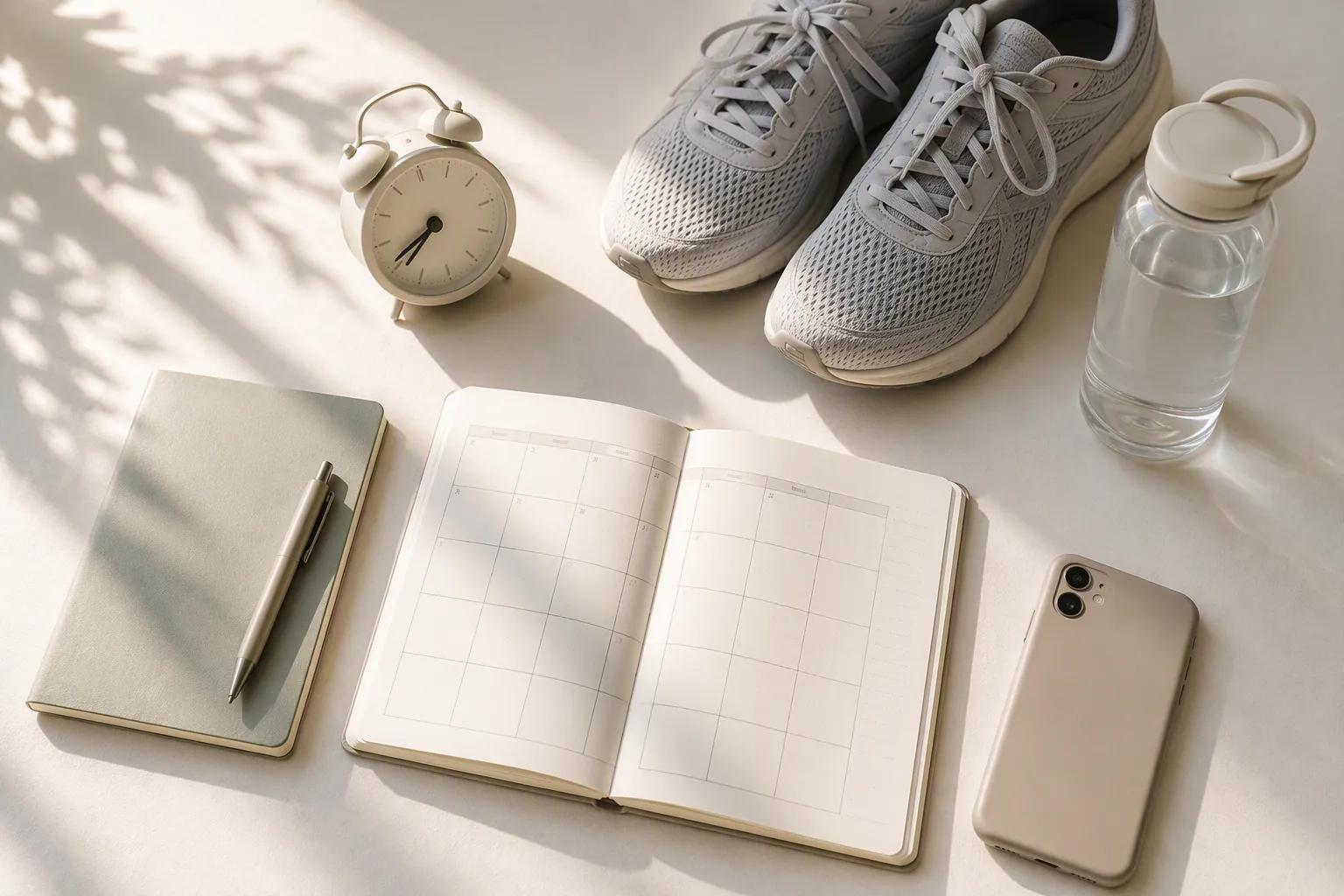
| Time | Action | Why it stays |
|---|---|---|
| Night before: final hour | Phone away from bed, materials set out, no new heavy planning unless it is already scheduled. | Protects the sleep window and prevents the last hour from becoming a negotiation. |
| Bedtime | Use the same target bedtime most nights. | Sleep consistency is the strongest student-relevant part of the audit. |
| Wake time | Wake within the same general window, including weekends when possible. | Reduces night-to-night variability and makes morning study blocks more reliable. |
| First 10 minutes | Get light: window, outdoor walk, or a basic lamp if appropriate. | Turns waking up into an action instead of a debate. |
| Next 10–30 minutes | Move: walk, stretch, lift, run, or bodyweight work. | Keeps the routine physical without demanding Johnson’s 90-minute block. |
| First study block | Begin the highest-value planned task before opening feeds, messages, or entertainment. | Converts discipline into sequence: wake, light, move, start. |
| End of day | Write the next day’s first task and stop. | Pre-commits the morning before willpower is tired. |
The first study block should be tied to your exam, not to a vague identity project. An MCAT student in a 12-week runway can attach the routine to the daily work in a 12-week MCAT study plan. An SAT student should connect it to a score-gap plan, not just “study more”; the SAT score-gap method is built for that. Once the gap is clear, practice has to become specific, which is where a guide to using SAT practice questions matters more than another morning-routine video.
How to run it across weeks, not one heroic morning
The routine should change shape as the test gets closer, but the anchors should stay boring.
- Weeks to months out: stabilize bedtime and wake time first. Do not add five new habits while sleep is still chaotic.
- Once sleep is stable: attach light and movement to the wake time. Keep both short enough that you can still study before obligations begin.
- During heavy practice weeks: make the first study block concrete before bed. “Review yesterday’s missed algebra questions” beats “be productive.”
- During the final week: protect sleep variability. Do not trade a stable routine for late-night panic review unless there is a truly exceptional reason.
- After a bad night: resume the routine the next night instead of trying to punish yourself into perfection.
If the system keeps falling apart, the problem may be planning load, not motivation. Use a weekly assignment planner routine that sticks to decide what goes where. If money is tight, fold the study plan into a broader budget instead of buying another tool; the new-grad budget study plan is a useful frame. If the planner itself becomes friction, choose the format you will actually open; this paper planner vs. digital app comparison can help settle that without turning it into a lifestyle debate.
A realistic student version
Here is the whole thing in its least theatrical form:
- Pick a wake time that matches your real obligations.
- Set a bedtime that makes that wake time repeatable.
- Put the phone away during the last hour before bed.
- Get light soon after waking.
- Move for a short, repeatable block.
- Start the first planned study task before optional media.
- Write tomorrow’s first task before the day ends.
Nothing in that list requires becoming Bryan Johnson. That is the point. The useful lesson is not the $2 million aura or the 4-hour-plus morning. It is making a few evidence-supported behaviors non-negotiable long enough that your study consistency has a chance to improve.
References
- My Morning Routine (2026), Blueprint, 2026.
- Bryan Johnson's Protocol, Blueprint, 2026.
- Sleep and Academic Excellence: A Deeper Look, Stanford Lifestyle Medicine.
- Scientific Reports actigraphy study on sleep and exam scores, Scientific Reports, 2026.
- Sleep quality and academic performance in medical students, 2020.
- Evidence Base, HealthRX.
Related case links
No matching exam hub found
Browse the exam hubs directory to find the study plan for this exam.
Did a similar plan work for you?
Share whether a comparable timeline and starting point produced a similar result — this is verification discussion, not general commentary.
Comments
Join the discussion with an anonymous comment.