
Method
Physical Symptoms of Dementia Follow Predictable Stage Patterns
This study guide organizes the physical and motor symptoms of dementia by disease stage and subtype, helping nursing and pre-med students distinguish between Alzheimer's, vascular, Lewy body, and frontotemporal dementias for exam success.
Evidence panel
- Evidence level
- Moderate
- Primary citation
- Andrade-Guerrero et al. (2024) Motor impairments in Alzheimer's disease. PMC.
For a physical symptoms of dementia study guide, the first exam mistake is treating dementia as if it lives only in memory questions. Dementia does affect thinking, judgment, language, and personality, but nursing and pre-med stems often move through the body: a patient starts wandering at night, falls repeatedly, develops a shuffling gait, loses continence, coughs with meals, or can no longer sit upright safely. In the United States, CDC estimates that 6.9 million people age 65 and older live with dementia, about 1 in 9 people in that age group, so these details are not rare bedside trivia.[1]
Use this as a dated Q3 2026 study framework, not as a promise that every patient follows the same script. Alzheimer’s disease gives the cleanest stage ladder for exams: early or mild, middle or moderate, late or severe. Vascular dementia and Lewy body dementia are better learned as subtype clues that can interrupt or redirect that ladder. Frontotemporal dementia belongs in the differential too, but the strongest testable contrast is usually behavioral or language-first rather than a distinctive late swallowing-and-walking sequence.
If you want to turn this into cards later, the useful question is not simply “What are dementia symptoms?” It is “Which physical clue tells me the stage, and which physical clue tells me the subtype?” That is the same kind of symptom-sorting habit used in other exam guides, such as How to Master Legionnaires’ Disease Symptoms for the USMLE.
The Alzheimer’s Stage Ladder
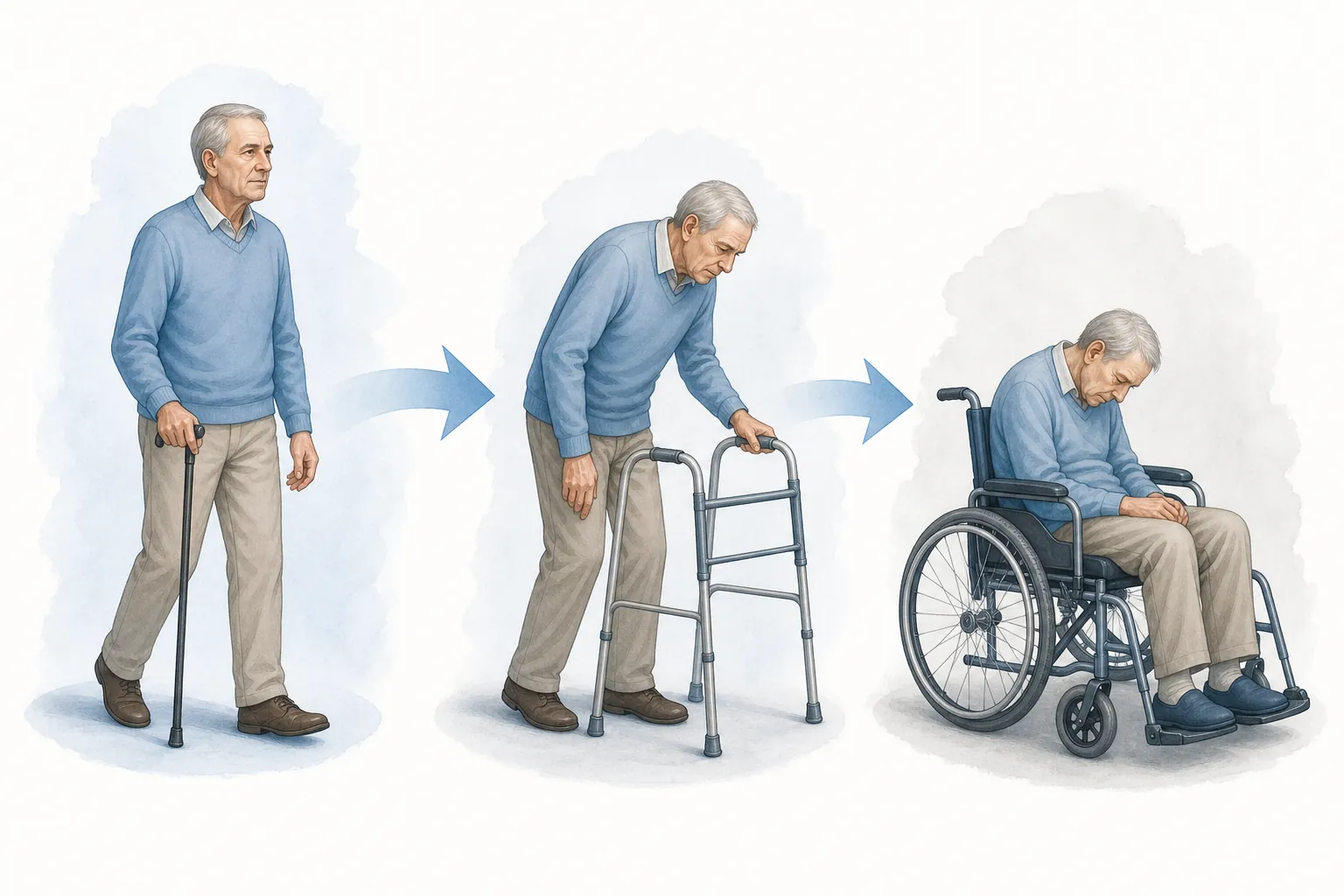
Alzheimer’s disease is the default stage framework because major patient-facing and clinical education sources describe it in early, middle, and late phases. The Alzheimer’s Association notes that the middle stage is typically the longest stage, while late-stage disease brings major loss of physical function, including walking, sitting, and swallowing abilities.[2] For exams, that gives you a memorization spine before you add subtype-specific motor clues.
| Alzheimer’s stage | Physical symptoms to recognize | Exam translation |
|---|---|---|
| Early / mild | Subtle gait or balance changes may appear, but independence is often partly preserved. | Do not expect total immobility. A mild stem can still focus mainly on memory, judgment, or getting lost. |
| Middle / moderate | Wandering, restlessness, sleep-wake agitation, toileting problems, incontinence, and higher fall risk become more visible. | This is where safety planning becomes testable: fall precautions, supervision, toileting routines, and wandering prevention. |
| Late / severe | Loss of walking, sitting without support, swallowing, and eventually safe oral intake may occur. | Think immobility, aspiration risk, pressure injury risk, feeding support, contractures, and total care needs. |
Early or Mild Alzheimer’s: Small Physical Clues, Big Distractors
Early Alzheimer’s questions usually lead with short-term memory loss, misplacing objects, poor judgment, or trouble completing familiar tasks. The physical part is quieter. A patient may still walk into clinic independently, dress with minimal help, and pass casual conversation well enough that the motor decline is easy to miss. That is why an early-stage answer choice describing bedbound status, dysphagia, or total incontinence is usually too advanced for the stem.
Do not overlearn early Alzheimer’s as “normal body, abnormal memory,” though. Motor change can begin before obvious severe disability. The safer exam wording is: early disease may include subtle gait or balance changes, but the dominant tested impairments are still cognitive and functional rather than total physical dependence.[2]
A clean card would read: early Alzheimer’s equals mild cognitive decline plus preserved basic mobility, with possible subtle gait changes. If you are building a spaced-repetition deck, keep that card separate from late-stage dysphagia. Mixing them makes the disease feel like a random symptom pile. For spaced repetition, StudyMethod’s Anki evidence review for the MCAT is more useful here than rereading the same symptom list five times.
Middle or Moderate Alzheimer’s: The Safety Stage
Middle-stage Alzheimer’s is where physical symptoms become hard to ignore because cognition now creates bodily risk. The patient who cannot remember where the bathroom is may have toileting accidents. The patient who misjudges distance or forgets to use an assistive device may fall. The patient who becomes restless near evening may wander into a hallway, stairwell, or street.
The Alzheimer’s Association places wandering and bladder or bowel control problems in the middle stage and identifies this as the stage that can last for many years.[2] For nursing-style questions, that matters because the correct answer is often an environmental or safety intervention rather than an explanation of amyloid, tau, or cortical atrophy.
Sundowning belongs here as a practical clue. RegisteredNurseRN’s NCLEX review describes sundowning as increased confusion, agitation, and restlessness as evening approaches.[3] On a stem, that may look like a patient pacing, trying to leave, pulling at lines, or becoming more difficult to redirect late in the day. The physical symptom is not just “confusion”; it is movement plus unsafe timing.
- Wandering: test as elopement risk, supervision need, door alarms, safe walking paths, and identification.
- Incontinence: test as toileting schedule, skin protection, dignity, infection monitoring, and fall risk during urgent bathroom trips.
- Restlessness or sundowning: test as evening agitation with pacing, unsafe ambulation, and need for calm redirection.
- Gait or balance decline: test as fall precautions, assistive devices, footwear, clutter removal, and medication review.
This is also the stage where “pleasantly confused” can be a dangerous phrase if it hides the work being done around the patient: keeping them from sliding out of bed, getting them to the toilet before they rush, watching swallowing, and preventing a nighttime walk from becoming an injury. Exams compress that labor into answer choices, but the pattern is the same.
Late or Severe Alzheimer’s: Walking, Sitting, Swallowing
Late-stage Alzheimer’s is where the physical exam clues become the most decisive. The Alzheimer’s Association describes late-stage disease as involving loss of the ability to respond to the environment, carry on conversation, and eventually control movement; it specifically notes that people may lose the ability to walk, sit, and swallow.[4] That is a stronger clinical teaching point than a pooled estimate from heterogeneous motor studies, and it deserves to sit near the top of your exam deck.
The National Institute on Aging likewise emphasizes that in the last stages of Alzheimer’s disease, people may need help with all daily activities and personal care, have trouble eating and swallowing, and become unable to walk without assistance.[5] For NCLEX-style thinking, the risk stack changes: aspiration, dehydration, malnutrition, pressure injury, contractures, pneumonia, constipation, and caregiver strain become much more relevant than cueing someone to use a calendar.
Dysphagia is especially high-yield because it converts a neurocognitive diagnosis into an airway and nutrition problem. If a late-stage dementia patient coughs during meals, pockets food, has a wet voice after swallowing, or develops recurrent respiratory infections, the question is no longer testing whether dementia causes memory loss. It is testing whether you recognize aspiration risk and the need for swallowing assessment, positioning, texture modification when ordered, oral care, and feeding support.
| Late-stage clue | What it means at bedside | Likely exam priority |
|---|---|---|
| Cannot walk safely | Transfers, falls, immobility, wheelchair or bed care | Prevent falls and pressure injuries |
| Cannot sit upright without support | Poor trunk control and unsafe feeding posture | Positioning before meals and during care |
| Trouble swallowing | Aspiration, dehydration, malnutrition | Swallow evaluation and aspiration precautions |
| Total care needs | Dependence for hygiene, toileting, turning, feeding | Skin integrity, dignity, caregiver education |
Subtype Clues That Change the Stem
Once the Alzheimer’s ladder is in place, subtype clues become easier to hold. The point is not to memorize four separate full disease timelines. The point is to notice when a motor feature is too asymmetric, too parkinsonian, or too behavior-first to be ordinary staged Alzheimer’s.
Vascular Dementia: Think Stroke-Like Physical Findings
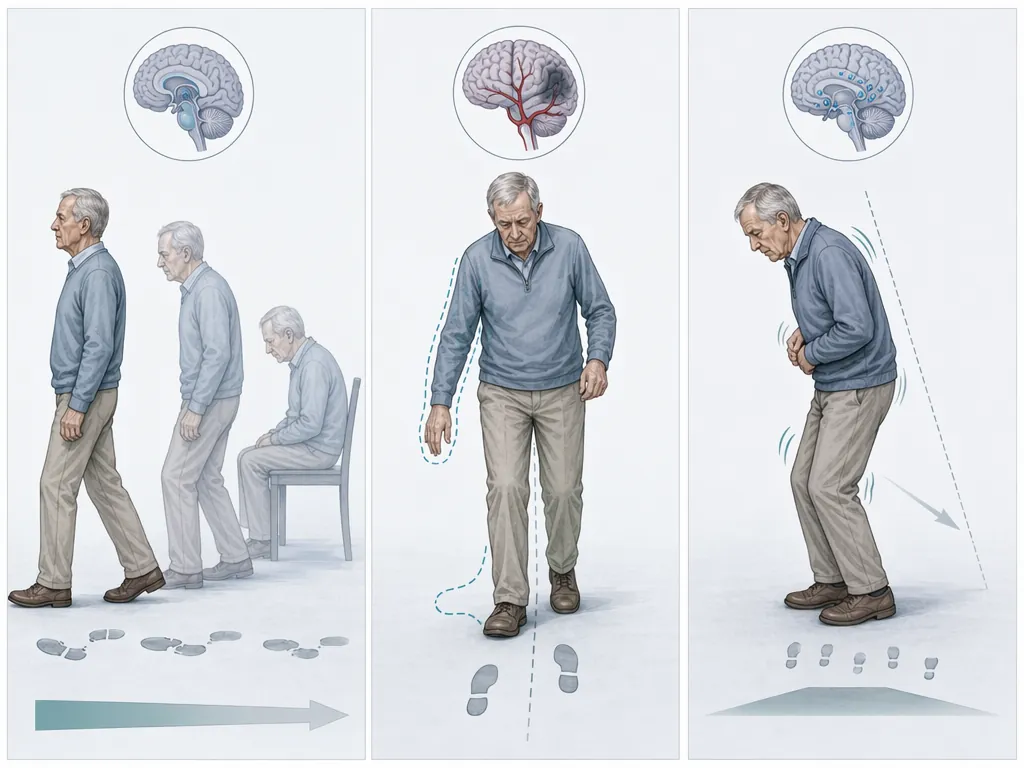
Vascular dementia is the subtype where unilateral body findings should make you slow down. NHS lists movement problems in vascular dementia, including weakness or paralysis on one side of the body, as well as difficulty walking.[6] That is different from the gradual, symmetric functional decline students often attach to Alzheimer’s.
In exam language, vascular dementia may come with a history of stroke or stepwise decline. The physical clue might be one arm hanging lower, one leg dragging, a new gait change after a cerebrovascular event, or focal weakness. The answer is not “all dementia causes unilateral paralysis.” It is “unilateral weakness is a vascular clue until proven otherwise.”
Lewy Body Dementia: Parkinsonian Signs Plus Falls
Lewy body dementia is the subtype where parkinsonian motor language matters. NHS identifies Lewy body dementia as causing problems with movement, including stiffness and slowness, and Mayo Clinic lists movement disorders such as rigid muscles, slow movement, tremors, and trouble walking among dementia-related symptoms.[6][7] For an exam, translate that into bradykinesia, rigidity, postural instability, shuffling gait, and repeated falls.
Repeated falls are not just a caregiver complaint in this subtype; they are often the clue that the stem is not asking for ordinary Alzheimer’s staging. A patient with cognitive fluctuation, visual hallucinations, rigidity, and postural instability should pull you toward Lewy body dementia rather than a generic “late dementia” answer, even though advanced dementia of many types can eventually produce immobility.
Frontotemporal Dementia: Do Not Force a Motor Pattern
Frontotemporal dementia is important, but for this article’s physical-symptom purpose it should stay narrow. Mayo Clinic describes frontotemporal dementia as a group of disorders associated with personality, behavior, and language changes.[7] That contrast is testable because an early disinhibition or language-predominant stem points away from classic Alzheimer’s memory-first framing.
Do not invent a single bedside motor signature for frontotemporal dementia unless the stem gives one. Some neurodegenerative syndromes can overlap with movement findings, but the provided high-yield distinction here is behavioral or language presentation, not a predictable swallowing-walking-sitting sequence like late Alzheimer’s.
Why Physical Symptoms Are Not Peripheral
The bedside reason is obvious: falls, aspiration, immobility, and incontinence are the events that hurt patients and exhaust caregivers. The evidence reason is more careful. Motor findings are common and clinically meaningful in dementia, but pooled research numbers should be read with labels because study designs, dementia subtypes, and measurement methods differ.
| Evidence point | What the number says | How to use it for exams |
|---|---|---|
| Fall risk | A 2024 review reports a meta-analysis finding that dementia patients have a 44% higher fall risk than controls. | Moderate evidence label: memorize that dementia increases fall risk; do not treat 44% as a bedside rule for every patient. |
| Sarcopenia | The same review reports meta-analysis evidence that sarcopenia is 3-5 times more frequent in dementia patients than in adults without dementia. | Moderate evidence label: connect dementia with frailty, weakness, mobility loss, and care dependence. |
| Gait as predictor | Older adults with gait disorders were reported to have a 1.2-2.5 times higher risk of developing Alzheimer’s disease. | Use as association/prediction language, not as proof that gait disorder causes Alzheimer’s. |
| Cardiorespiratory fitness | A cited study reported cardiorespiratory fitness about 20% lower in Alzheimer’s patients than in age-matched healthy individuals. | Use to remember lower exercise tolerance and physical reserve, not as a diagnostic cutoff. |
These figures come from Andrade-Guerrero and colleagues’ 2024 review of motor impairments in Alzheimer’s disease, which summarizes meta-analyses and related studies rather than functioning as an exam manual.[8] The translation for students is straightforward: physical impairment is not an afterthought, but the exact number belongs in the “supporting evidence” bucket, not the “must apply universally” bucket.
Exam-Ready Distinctions
The fastest way to miss these questions is to memorize every symptom under one heading called dementia. The safer method is to sort by stage first, then subtype. If the patient is mildly forgetful but mobile, do not jump to aspiration precautions. If the patient has late-stage Alzheimer’s and coughs with meals, do not answer with memory aids. If the patient has one-sided weakness, do not bury that finding under generic decline.
| Stem wording | Best interpretation | Do not confuse with |
|---|---|---|
| Mild memory loss, still independent, possible subtle balance issue | Early / mild Alzheimer’s pattern | Late-stage immobility |
| Wandering, nighttime pacing, toileting accidents, increasing supervision needs | Middle / moderate Alzheimer’s pattern | Purely psychiatric agitation |
| Cannot walk, cannot sit unsupported, difficulty swallowing | Late / severe Alzheimer’s pattern | Early dementia |
| Unilateral weakness, paralysis, leg dragging, stroke history | Vascular dementia clue | Typical symmetric Alzheimer’s progression |
| Rigidity, bradykinesia, postural instability, repeated falls | Lewy body dementia clue | Generic aging or ordinary forgetfulness |
| Early disinhibition, personality change, or language-predominant symptoms | Frontotemporal dementia clue | Memory-first Alzheimer’s framing |
For MCAT students, the symptom framework can sit beside mechanism study rather than replacing it. If you are reviewing research design, the Alzheimer’s material in Learn MCAT Research Design from the CO₂-Alzheimer’s Study and SORLA Blocks Tau Tangles Through Three Protective Mechanisms belongs in a different mental drawer: biology and study interpretation. This guide is the clinical-recognition drawer.
How to Turn the Framework Into Cards
Make cards that force discrimination, not cards that ask you to recite a paragraph. A weak card asks, “What are physical symptoms of dementia?” A better card asks, “Dementia patient with wandering, evening restlessness, and new incontinence: which Alzheimer’s stage is most likely?” Another asks, “Dementia patient with rigidity, bradykinesia, postural instability, and repeated falls: which subtype is suggested?”
- Stage card: early Alzheimer’s → mild cognitive decline, preserved basic mobility, possible subtle gait change.
- Stage card: middle Alzheimer’s → wandering, sundowning/restlessness, incontinence, fall-risk planning.
- Stage card: late Alzheimer’s → loss of walking, sitting, swallowing, total care, aspiration precautions.
- Subtype card: vascular dementia → stroke-like unilateral weakness, paralysis, gait change, stepwise clue if provided.
- Subtype card: Lewy body dementia → bradykinesia, rigidity, postural instability, repeated falls.
- Subtype card: frontotemporal dementia → behavior or language-first clue rather than a forced motor signature.
If you compare platforms before building the deck, the Anki vs. Knowt vs. RemNote vs. Brainscape spaced-repetition comparison can help you choose a tool. The content choice matters more than the app: physical symptoms of dementia are best learned as staged functional decline plus subtype-specific motor clues.
References
- Signs and Symptoms of Dementia — CDC
- Alzheimer's Stages - Early, Middle, Late — Alzheimer's Association
- Alzheimer's Disease (Dementia) NCLEX Nursing Review — RegisteredNurseRN
- Late-Stage Alzheimer's & Dementia Caregiving — Alzheimer's Association
- Care in the Last Stages of Alzheimer's Disease — NIA
- Symptoms of dementia — NHS
- Dementia - Symptoms and causes — Mayo Clinic
- Alzheimer's Disease: Understanding Motor Impairments - PMC — PMC, 2024
Comments
Join the discussion with an anonymous comment.