
Method
Learn MCAT Research Design from the CO₂-Alzheimer's Study
Learn to evaluate research design, identify confounding variables, and assess evidence quality using the 2025–2026 CO₂-Alzheimer's study as a real MCAT case study. This guide helps you distinguish study designs, effect sizes, and clinical significance—skills directly tested in the MCAT's Scientific Inquiry and Reasoning section.
Evidence panel
- Evidence level
- Limited
- Primary citation
- Ryman, S. G., et al. (2025). The influence of intermittent hypercapnia on cerebrospinal fluid flow and clearance in Parkinson's disease and healthy older adults. npj Parkinson's Disease.
A reader searching for a carbon dioxide alzheimers research study is probably expecting one clean question: did inhaling CO2 help clear Alzheimer's proteins from the brain? The more useful MCAT version starts one step earlier: what study are we actually looking at?
The strongest peer-reviewed source here is not an Alzheimer's clinical trial. It is a 2025 npj Parkinson's Disease paper on intermittent hypercapnia, cerebrospinal fluid flow, and clearance in people with Parkinson's disease and healthy older adults.[1] The Alzheimer's-specific result comes from AAIC 2026 conference coverage: in a small group of 12 people, blood beta-amyloid rose after CO2 exposure and returned to baseline within about an hour.[2] That is interesting. It is also limited evidence, and the limitation is not a footnote. It is the main thing an MCAT passage would expect you to notice.
This is why the study works so well for Skill 3, the AAMC category that asks students to reason about how research is designed and executed.[3] The passage trap is not amyloid. It is the quiet slide from biomarker movement to treatment implication.

Strip the headline down to the actual claim
The narrow supported claim is not that CO2 treats Alzheimer's disease. The better-supported claim is that controlled intermittent hypercapnia can alter physiological measures related to CSF movement and plasma biomarkers in early-stage mechanistic research. In the conference-reported Alzheimer's component, the measured effect was transient: beta-amyloid increased in blood after CO2 exposure, then returned to baseline within about one hour.[2]
That timing matters. A short-lived blood biomarker change can fit a plausible clearance mechanism, but it does not by itself show durable brain clearance, symptom improvement, slowed cognitive decline, or clinical safety for patient use. On the MCAT, that distinction often separates a tempting answer from the answer that actually follows from the data.
| Question | What the evidence supports | What it does not support |
|---|---|---|
| Did researchers manipulate CO2 exposure? | Yes, in controlled experimental hypercapnia protocols. | Not unsupervised or home use. |
| Was there an Alzheimer's-specific signal? | A conference-reported n=12 result showed transient blood beta-amyloid movement. | Not proof of an Alzheimer's treatment. |
| Was the main peer-reviewed paper an Alzheimer's trial? | No, it focused on Parkinson's disease and healthy older adults. | Not a randomized Alzheimer's efficacy trial. |
| Is this useful MCAT material? | Yes, because it forces design, variable, and inference checks. | Not because it gives a simple clinical conclusion. |
Name the design before you trust the conclusion
The primary Ryman et al. paper described a prospective cross-sectional design with an experimental hypercapnia intervention.[1] That wording is not decorative. Prospective means the investigators collected data forward from the study protocol. Cross-sectional means the groups were compared at a particular study window rather than followed for long-term disease outcomes. Experimental hypercapnia means CO2 exposure was manipulated under study conditions.
It is not an RCT showing that CO2 prevents Alzheimer's disease. It is not a longitudinal dementia-outcome study. It is also not merely observational, because the CO2 exposure was experimentally introduced. For MCAT purposes, that mixed structure is the point: one paper can contain both group comparison logic and intervention logic, and each supports a different kind of inference.
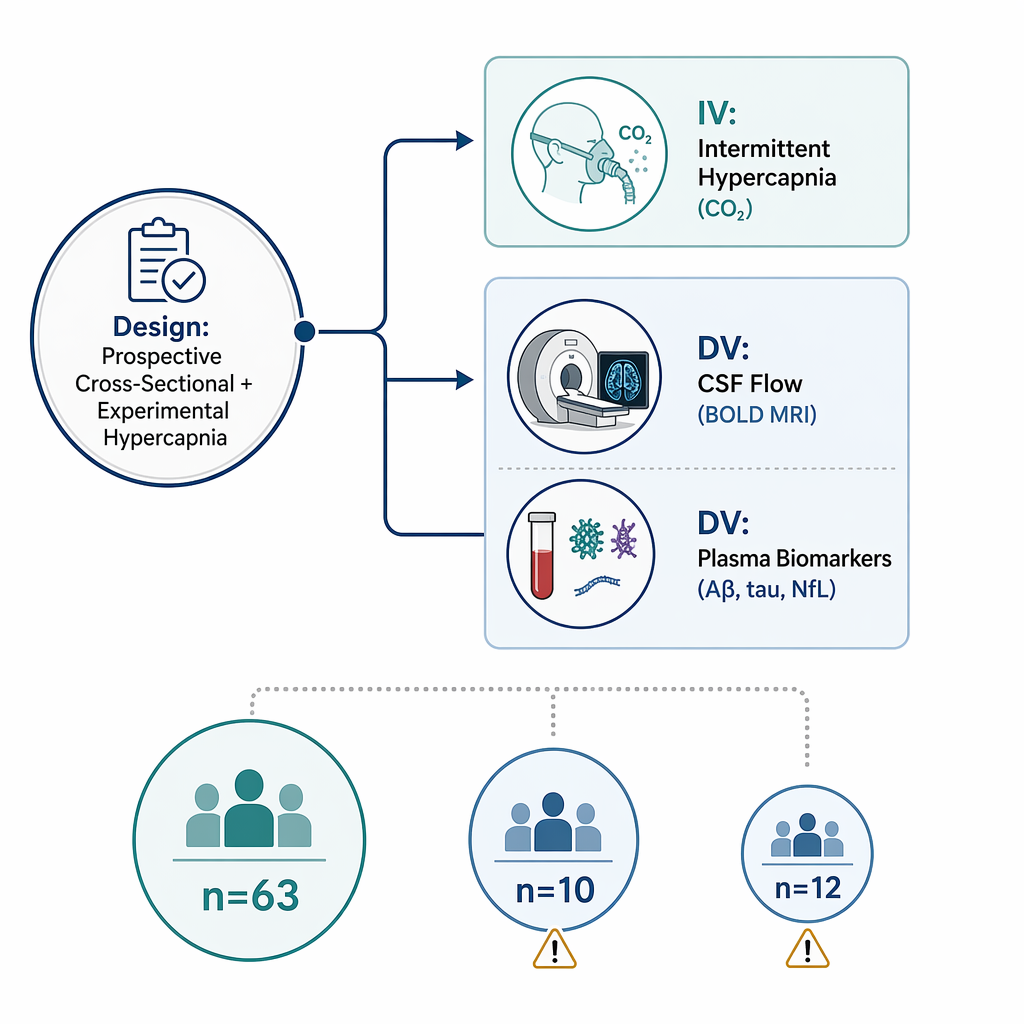
The peer-reviewed paper included 63 participants in its broader study context, with a smaller experimental biomarker sub-study of 10 participants.[1] The conference-reported Alzheimer's component involved 12 participants.[2] Those sample sizes do not make the work useless. They make the strength of the inference narrower. A small study can be valuable for detecting a biological signal worth testing again; it cannot carry the evidentiary burden of broad clinical guidance.
Independent variable, dependent variables, and the easy wrong answer
If this appeared as an MCAT passage, the independent variable would be the manipulated CO2 condition: intermittent hypercapnia. More specifically, the protocol varied exposure to elevated carbon dioxide, either through an individually calibrated end-tidal CO2 increase or through a fixed CO2 gas mixture, depending on the sub-study.[1]
The dependent variables were not memory scores or dementia diagnoses. They were physiological and biochemical readouts: CSF inflow measured with BOLD MRI at the fourth ventricle and central canal, and plasma biomarkers including amyloid-beta, tau species, alpha-synuclein, neurofilament light chain, and GFAP measured with ELISA or Simoa methods.[1]
| Study element | In this research | MCAT move |
|---|---|---|
| Independent variable | Intermittent hypercapnia / CO2 exposure | Identify what the investigators manipulated. |
| Dependent variables | CSF inflow and plasma biomarker levels | Avoid substituting clinical outcomes that were not measured. |
| Population | Parkinson's disease and healthy older adults in the main paper; small Alzheimer's group in conference coverage | Do not generalize beyond the actual sample. |
| Main inference | Mechanistic biomarker and flow changes | Separate mechanism from clinical utility. |
The easy wrong answer is to treat amyloid or tau as if their presence automatically turns the study into an Alzheimer's treatment study. Biomarkers can overlap across neurodegenerative research questions. A dependent variable related to Alzheimer's biology is not the same thing as an Alzheimer's clinical endpoint.
Two CO2 delivery methods create a comparability problem
The study becomes more exam-like when the methods stop being perfectly tidy. In Study 1, investigators used the RespirAct system to produce an individually calibrated 10 mmHg increase in end-tidal CO2.[1] In Study 2, they used a Douglas bag with a fixed 5% CO2 mixture.[1] Both are hypercapnia protocols, but they are not identical exposures.
That difference matters because a calibrated change in end-tidal CO2 and a fixed inspired gas concentration may not impose the same physiological dose across participants. If one sub-study shows a stronger biomarker response than another, a careful reader has to ask whether the difference reflects biology, measurement, sample composition, or delivery method.
A passage question might phrase this as a threat to internal validity or as a limitation on comparing the two sub-studies. The answer should not be that the research is invalid. The answer should be that method variation reduces how confidently you can attribute differences across sub-studies to the biological mechanism alone.
Small samples can produce real signals and unstable estimates
Study 2 is the sample-size lesson in miniature. With n=10, the reported Cohen's d values ranged from 0.44 for pTau217 to 1.84 for GFAP.[1] Those numbers are not a scoreboard where the largest effect automatically wins. They are a reminder that effect-size estimates from very small samples can move dramatically when one participant's value changes.
A large Cohen's d in a small mechanistic study can be scientifically interesting because it suggests the intervention may be producing a measurable physiological response. At the same time, it is unstable because the estimate has limited protection against sampling noise, outliers, and baseline imbalance. MCAT answer choices often hide this distinction by making students choose between two exaggerated interpretations: either the finding proves clinical significance, or the small n means the data are meaningless. Neither is the disciplined answer.
Statistical significance, effect size, and clinical significance answer different questions. Statistical significance asks whether the observed pattern is unlikely under a null model, given the analysis. Effect size asks how large the observed difference appears to be. Clinical significance asks whether the change matters for patient health. In this research, the strongest claims stay closer to biological response than to patient benefit.
The transient amyloid result is a duration problem, not just an Alzheimer's hook
The AAIC 2026 Alzheimer's component deserves attention because it is the part most closely aligned with the headline. In that small n=12 report, beta-amyloid increased in blood after CO2 exposure and returned to baseline within about an hour.[2] A plausible interpretation is that CO2 may temporarily increase movement of Alzheimer's-related proteins out of the brain and into circulation. A stronger interpretation would require more evidence than the report provides.
Duration changes the inference. If a biomarker returns to baseline quickly, then the study is not showing a sustained reduction in pathological burden. It is showing a temporary measurable shift. That can still matter in early mechanistic science. It just should not be rewritten as evidence that patients experienced lasting clinical improvement.
The safety caveat also belongs in the evidence discussion, not at the end as a legal disclaimer. University of New Mexico coverage of the research explicitly warned people not to attempt CO2 inhalation at home.[4] On an exam, that warning would sit under ethical execution of research: controlled exposure, participant monitoring, and avoiding unsupported self-experimentation.
Confounding shows up in the baseline pathology
One detail that looks small but tests beautifully is co-occurring pathology. The primary paper reported that about 10% of participants with Parkinson's disease had co-occurring Alzheimer's disease pathology; one such individual showed a 30.4% increase in Aβ1-40.[1] That is exactly the kind of baseline difference a passage might use to ask whether all participants are equally comparable before the intervention.
If a participant already has Alzheimer's-related pathology, that person's amyloid response may not represent the response of the broader Parkinson's group or the healthy older adult group. The confound is not mysterious. Baseline disease biology may affect the dependent variable. When a study measures amyloid response, preexisting amyloid pathology is not background noise; it may be part of the mechanism producing the observed value.
The correct MCAT move is not to delete that participant in your head. It is to recognize that subgroup composition can change interpretation, especially when the sample is small enough that one person can visibly affect the estimate.
Mechanism is not the same as treatment
The mechanism proposed in coverage of the research is not random. CO2 can influence blood vessel behavior and may increase vasomotion, which in turn could affect glymphatic clearance of proteins from the brain.[5] That gives the study a biologically plausible reason to exist. It also makes the design more tempting to overread, because a plausible mechanism can make a weak clinical claim sound stronger than it is.
Mechanistic evidence asks whether a pathway can be moved. Clinical efficacy asks whether moving that pathway improves outcomes that matter to patients. This study is much closer to the first question. It measures CSF flow and plasma biomarkers under controlled conditions. It does not establish dosing, durability, long-term safety, cognitive benefit, or comparative effectiveness against existing interventions.
That boundary is especially important because the intervention itself sounds simple. Breathing a gas mixture can feel less like a drug than a procedure, but the ethical issue is the same: physiological manipulation without evidence of clinical benefit can still carry risk. The study's own safety framing keeps the finding in the research setting.[4]
Do not mix up this experiment with air-pollution dementia evidence
A useful contrast comes from the Cambridge coverage of a Lancet Planetary Health systematic review published in July 2025. That review included 51 studies and about 29 million participants, and it reported that long-term PM2.5 exposure was associated with a 17% higher relative risk of dementia per 10 micrograms per cubic meter.[6]
That sounds much larger and more definitive than n=10 or n=12, but it answers a different question. The air-pollution review is observational risk evidence. It can synthesize associations across very large populations, but it still has to handle exposure measurement, confounding, and the limits of nonrandomized environmental data. The CO2 hypercapnia research is experimental mechanistic evidence. It can manipulate a physiological exposure under controlled conditions, but it uses small samples and surrogate outcomes.
Both bodies of evidence also carry generalizability cautions. The CO2 work came from a single New Mexico research setting, while the Cambridge summary noted that many included studies came from predominantly white populations in high-income countries.[4][6] The MCAT lesson is not that one design is always better. It is that different designs trade off control, scale, causality, and external validity.
How an MCAT passage could test this study
If this research appeared in a passage, the questions would probably not ask you to recite the glymphatic system. They would ask you to evaluate whether the conclusion follows from the design. A strong reader would slow down at the same few points every time.
- Design: prospective cross-sectional study with an experimental hypercapnia component, not an Alzheimer's RCT.
- Variables: CO2 exposure is the independent variable; CSF flow and plasma biomarkers are dependent variables.
- Sample size: n=10 and n=12 results can suggest mechanisms but cannot support broad treatment claims.
- Methods: calibrated end-tidal CO2 and fixed 5% CO2 delivery are not interchangeable protocols.
- Inference: transient biomarker changes are not the same as durable clinical benefit.
- Confounding: baseline neurodegenerative pathology can affect biomarker response.
A polished wrong answer would say the study demonstrates that CO2 clears Alzheimer's proteins and therefore may be used therapeutically. A lazy skeptical answer would say the sample is too small to learn anything. The better answer is narrower: the study provides early mechanistic evidence that controlled hypercapnia can move CSF-flow and biomarker measures, while the Alzheimer's-specific evidence remains conference-reported, small, transient, and not clinically decisive.
That is the practical value of the case. It forces the reader to hold two thoughts at once: the research question is scientifically reasonable, and the headline version outruns the design. Skill 3 lives in that gap.
References
- The influence of intermittent hypercapnia on cerebrospinal fluid flow and clearance in Parkinson's disease and healthy older adults, npj Parkinson's Disease, 2025
- Inhaling high-dose CO2 clears Alzheimer's proteins from the brain, New Scientist
- Scientific Inquiry and Reasoning Skills: Skill 3: Reasoning about the Design and Execution of Research, AAMC
- Researchers Study Whether Intentionally Manipulating Blood Carbon Dioxide Levels Might Enhance Brain Health, UNM Health Sciences Newsroom
- Breathing CO2 May Help the Brain Clear Toxic Proteins in Parkinson's Disease, Touro University
- Long-term exposure to outdoor air pollution linked to increased risk of dementia, University of Cambridge, July 2025
Comments
Join the discussion with an anonymous comment.