
Comparison
How to Master Legionnaires' Disease Symptoms for the USMLE
Learn how to efficiently memorize Legionnaires' disease symptoms for USMLE and NCLEX using mnemonics, spaced repetition, and the best study tools — from Anki decks to Sketchy Medical scenes.
Verdict panel
- Compared
- not specified
- Target exam
- not specified
- Best for
- not specified
- Pricing last reviewed
- pricing currency unconfirmed
If you keep missing Legionella questions, the problem usually is not that you forgot the organism exists. It is that the clue is scattered across the vignette: an older patient with pneumonia, sodium that quietly dropped, diarrhea or confusion several lines away, and maybe a pulse that feels too slow for the fever. Under exam pressure, those details have to collapse into one object: Legionnaires' disease symptoms.
The high-yield study target is the classic exam heuristic: pneumonia plus hyponatremia plus neurologic and/or GI symptoms. Medbullets, Oncourse, and Osmosis all teach that cluster as a board-relevant Legionella pattern, although the exact wording varies by source and it should not be treated as a validated diagnostic rule.[1][2][3]
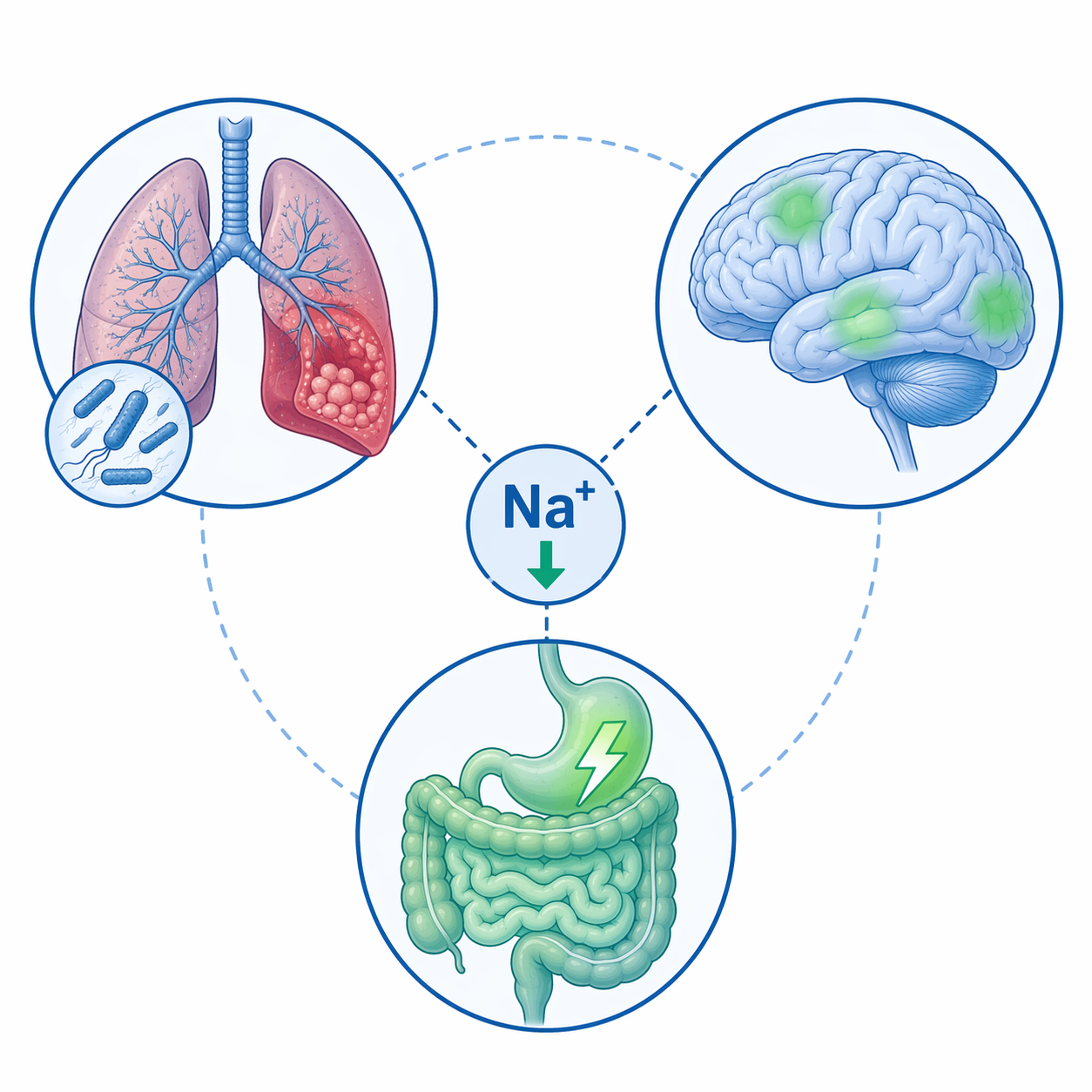
Clinically, Legionella matters because it is not a rare board-writer invention. StatPearls describes Legionella as one of the top four causes of community-acquired pneumonia and reports that it accounts for about 2–15% of community-acquired pneumonia cases.[4] Mortality numbers need context: StatPearls gives a broad 4–40% range across settings, while the CDC says about 1 in 10 people with Legionnaires' disease die, rising to about 1 in 4 when the illness is acquired in a healthcare facility.[4][5]
For studying, that context is enough. You do not need to reread an entire clinical reference every time. You need a retrieval system that makes the vignette clue obvious before your brain files it under generic atypical pneumonia.
Start With the Board Pattern, Not the Organism Biography
The first pass should be brutally practical. When a question stem gives you pneumonia, scan for sodium, mental status, diarrhea, exposure to water systems, and pulse-temperature mismatch. Relative bradycardia in a febrile pneumonia patient is a supportive diagnostic clue in Legionella discussions, but it is not the whole diagnosis by itself.[1][2][4]
| Vignette clue | What it should trigger |
|---|---|
| Pneumonia | Lungs are the anchor; do not leave Legionella floating as a microbiology fact |
| Low sodium | Hyponatremia is the exam clue that separates this from many bland pneumonia stems |
| Confusion, headache, or altered mental status | Neurologic involvement belongs in the same memory object as the pneumonia |
| Diarrhea, nausea, or abdominal symptoms | GI symptoms are not a side note; they are part of the board pattern |
| Fever with relative bradycardia | Supportive clue, especially when paired with the symptom cluster |
| Urine antigen positive or BCYE culture | Diagnostic/lab facts that should be attached after the symptom pattern is stable |
A common trap is making one card that says, “What are symptoms of Legionella?” and then congratulating yourself when you can recite pneumonia, diarrhea, confusion, and hyponatremia in order. That card tests list recall. The exam tests recognition across distance. Your study system has to practice the distance.
That is the same reason symptom-recognition topics, whether infectious disease or neurology, need more than passive notes. If you have studied a pattern like FAST or focal deficits for stroke, the logic is similar: turn scattered clinical details into a retrievable diagnostic frame. The same approach is useful for stroke symptom recognition study methods, but Legionella has its own unusually convenient memory hooks.
Use LEGIONella as the Symptom Skeleton
The cleanest starting mnemonic is the LEGIONella wordplay from Medicowesome: L for lungs, E for encephalon, G for GI symptoms, and ION for hyponatremia.[6] It works because it does not ask you to memorize a random sentence. It puts the categories inside the organism's name.
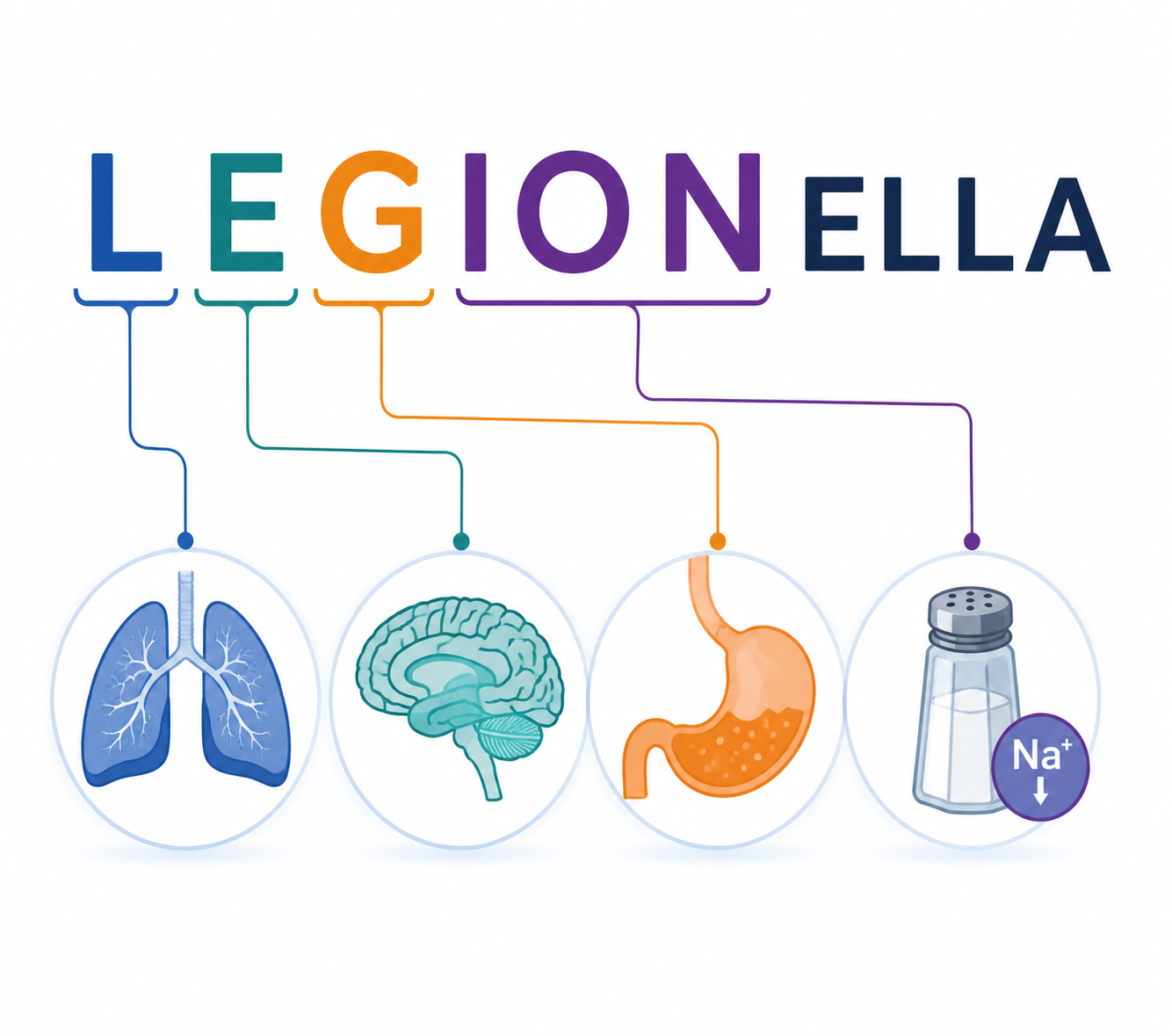
That structure matters. Lungs, encephalon, GI, and ION are not four equally random facts; they map directly onto the board-style cluster. If you can rebuild the word under stress, you can rebuild the symptom pattern.
- L = lungs: pneumonia is the clinical anchor.
- E = encephalon: confusion, headache, or neurologic symptoms belong with the pneumonia.
- G = GI: diarrhea and abdominal symptoms should raise suspicion instead of feeling incidental.
- ION = sodium problem: hyponatremia is the lab clue you want to notice fast.
This is also where overconfident “classic triad” studying can go wrong. If you memorize only pneumonia plus hyponatremia plus confusion, you may miss a version that emphasizes diarrhea. If you memorize only pneumonia plus diarrhea, you may ignore the sodium. LEGIONella gives you categories, not one fragile sentence.
Attach the Weird Lab and Habitat Facts to a Scene
Once the symptom skeleton is stable, add the organism facts that exam stems like to hide in the answer explanation: water habitat, special culture requirements, and urine antigen limitations. These do not fit as neatly into LEGIONella, so forcing them into the same word mnemonic usually makes the whole thing messier.
The French Legionnaire narrative used by Oncourse is useful here because it ties several isolated facts into one scene: a legionnaire, water exposure, silver stain, and the iron plus cysteine requirement for buffered charcoal yeast extract agar.[2] The point is not to admire the story. The point is to stop relearning “BCYE needs iron and cysteine” as a loose trivia card every week.
Diagnostic details should stay precise. The CDC notes that urine antigen testing is rapid but detects only Legionella pneumophila serogroup 1, while culture can detect other species and serogroups.[5] StatPearls describes culture on BCYE agar as the gold standard.[4] A board question may hand you the urine antigen; a real diagnostic discussion is broader than that.
Do not turn this into ten equal cards on every environmental and microbiology detail. The sequence should be: recognize the symptom pattern first, then attach the lab confirmation facts that make the answer choice feel inevitable.
Sketchy, Picmonic, Oncourse, Anki, and Quizlet Do Different Jobs
The worst way to compare study tools is to ask which one is “best for Legionella” in the abstract. They encode different things. Some are good at building a scene, some are good at discrete associations, and some are only good if you force yourself to retrieve.
| Tool or mnemonic | Best use for Legionella | Main trade-off |
|---|---|---|
| LEGIONella word mnemonic | Fast symptom-category recall: lungs, encephalon, GI, hyponatremia | Does not carry the lab and habitat facts well |
| French Legionnaire story | Water habitat, silver stain, iron and cysteine, BCYE-style details | Less direct for recognizing the symptom cluster |
| Sketchy Medical | Integrated visual context around Legionella pneumophila and related microbiology | Can become passive if you only rewatch the scene |
| Picmonic | Discrete visual hooks for individual findings such as fever, hyponatremia, and type IV RTA | Too many associations can become a second list to memorize |
| Anki | Spaced retrieval, cloze deletion, image occlusion, and missed-question repair | Bad cards can create false fluency |
| Quizlet | Lightweight review and quick matching practice | Less powerful for long-term spaced medical review than a well-built Anki workflow |
Sketchy Medical's Legionella pneumophila lesson places the organism in a broader visual scene, which can be helpful when the problem is not one missing fact but a blurred microbiology shelf in your head.[7] Use it to create context, then test yourself away from the video. Rewatching the scene until it feels familiar is not the same as recognizing Legionella in a new pneumonia stem.
Picmonic takes a more atomized approach, using character-based visual associations for Legionella disease, including separate hooks such as a hippo-salt-shaker for hyponatremia and a kidney-tuba for type IV renal tubular acidosis.[8] That can be great for rescuing a detail you keep dropping. It can also become too much if you try to memorize every character as its own dictionary entry.
Oncourse-style narrative is strongest when you need the lab and habitat facts to sit together. Sketchy is strongest when you want integrated visual context. Picmonic is strongest when one specific symptom or lab association refuses to stick. None of those replaces spaced retrieval.
For the retrieval layer, Anki is usually the serious medical-student option because cloze deletion, image occlusion, shared decks, and spaced repetition fit this exact kind of pattern learning. The AMA's overview of Anki notes its role as a flashcard app widely used by medical students and built around spaced repetition.[9] If you want a fuller tool-level breakdown, start with an Anki review for medical students rather than treating Legionella as a one-off memorization project.
Quizlet can still be reasonable for a lighter pass, especially if you want quick matching or you are not maintaining a full medical-school spaced-repetition system. The trade-off is durability and control. A direct Anki vs Quizlet comparison for medical students is more useful than pretending both tools serve the same cognitive job.
Turn the Mnemonic Into Retrieval, Not Decoration
A mnemonic earns its keep only after it becomes a prompt you can answer cold. For Legionella, build cards that force you to reconstruct the pattern from partial clues, not just define the organism.
Card Type 1: Symptom Cluster Cloze
Use one card to make the core board pattern automatic:
Legionnaires' disease classically points to pneumonia + {{c1::hyponatremia}} + {{c2::neurologic and/or GI symptoms}}.That card is basic, but it gives the triad a stable home. The wording “and/or” matters because sources vary in whether they emphasize confusion, diarrhea, or both.[1][2][3]
Card Type 2: Vignette Recognition
Then make the card look more like the exam:
A patient has atypical pneumonia, diarrhea, confusion, and Na+ 128. Most likely organism? {{c1::Legionella pneumophila}}This is still a simplified card, but it trains the right direction: symptoms and labs to organism. If all your cards go organism to symptom list, you are studying backward for vignette recognition.
Card Type 3: Differential Split
Add a card that keeps Legionella from blending into the rest of atypical pneumonia:
Atypical pneumonia + prominent hyponatremia + GI/neuro symptoms should make you think {{c1::Legionella}}, not just "atypical pneumonia."That phrasing is deliberately annoying. It interrupts the lazy category your brain wants to use when several organisms feel similar.
Card Type 4: Lab Confirmation
After the symptom card is working, add a lab card:
Legionella culture requires {{c1::BCYE agar}} enriched with {{c2::iron and cysteine}}.And a diagnostic limitation card:
Legionella urine antigen testing is rapid but mainly detects {{c1::L. pneumophila serogroup 1}}.Those two cards should not be the first thing you build. They are support beams, not the front door.
Card Type 5: Missed-Question Repair
When you miss a question, do not write a card that copies the explanation. Identify the clue you ignored. If you saw pneumonia and diarrhea but skipped the sodium, make the card about sodium. If you saw low sodium but forgot GI symptoms, make the card bridge those details.
- Bad repair card: “Legionella causes pneumonia, diarrhea, confusion, hyponatremia, and requires BCYE agar.”
- Better repair card: “In a pneumonia vignette, hyponatremia plus diarrhea/confusion should trigger which organism?”
- Best repair card if you missed the lab clue: “Which pneumonia organism grows on BCYE agar with iron and cysteine?”
This is where many students fall into the Anki trap of memorizing cards instead of understanding. If your card can be answered by rhythm alone, rewrite it so the clue has to be interpreted.
A Practical One-Week Review Loop
You do not need an elaborate Legionella curriculum. You need a loop that exposes the pattern, forces recall, and catches the exact clue you keep dropping.
- Day 1: Learn the LEGIONella mnemonic and write the symptom-cluster cloze card.
- Day 1: Watch or review one visual/narrative aid for the lab and habitat facts, such as Sketchy, Picmonic, or an Oncourse-style lesson.
- Day 2: Add vignette-direction cards that go from pneumonia clues to Legionella.
- Day 3 or 4: Do practice questions and tag any missed Legionella item by the clue missed: sodium, GI, neuro, relative bradycardia, urine antigen, or BCYE.
- Day 7: Review only the cards and missed-question notes; do not reread the full disease page unless a concept is still unclear.
The review loop should feel slightly uncomfortable because recognition is harder than rereading. That discomfort is the point. A familiar paragraph about Legionnaires' disease can make you feel prepared while leaving the board-style clue untrained.
If you are choosing a flashcard setup from scratch, a broader flashcard app comparison for 2026 can help. For this specific topic, the tool matters less than whether it supports spaced retrieval and missed-question repair.
What to Memorize Cold
By the end, your Legionella file should be small and sharp:
- Pneumonia plus hyponatremia plus neurologic and/or GI symptoms is the main board-recognition pattern.
- LEGIONella gives the symptom structure: lungs, encephalon, GI, ION.
- Relative bradycardia supports the diagnosis when the pneumonia pattern is already suggestive.
- Urine antigen is rapid but limited mainly to L. pneumophila serogroup 1.
- Culture on BCYE agar with iron and cysteine is the lab fact to attach to the narrative scene.
- Visual tools are allowed to help, but spaced retrieval is what keeps the pattern available a week later.
Use one structural mnemonic for the symptom cluster, one visual or narrative aid for the organism's odd lab and habitat facts, and a small set of spaced-repetition prompts that test recognition from the stem. That is enough. The goal is not to become emotionally attached to a cartoon, a deck, or a perfect disease summary. The goal is to see pneumonia, low sodium, and neuro/GI symptoms and stop treating them as separate facts.
References
- Legionnaires Disease — Medbullets
- Legionella pneumophila — USMLE Step 1 Lesson — Oncourse AI
- Legionella pneumophila — Osmosis
- Legionnaires' Disease — StatPearls
- About Legionnaires' Disease — CDC
- Symptoms of Legionella pneumonia mnemonic — Medicowesome
- Legionella pneumophila — Sketchy Medical
- Legionella Disease - Microbiology — Picmonic
- What is Anki? — AMA
Back to the exam this applies to
Target exam not specified — see all exam hubs.
Comments
Join the discussion with an anonymous comment.