
What Hong Wang's Fields Medal Win Reveals About Math Study
Hong Wang won the Fields Medal on July 23, 2026, at ICM Philadelphia, becoming the third woman ever to receive the prize, after Maryam Mirzakhani in 2014 and Maryna Viazovska in 2022. Last reviewed July 2026, that fact is current enough to feel like news and large enough to attract the usual bad study advice within hours: turn a mathematician’s life into a poster, extract a few heroic habits, and pretend they transfer neatly to SAT algebra, ACT functions, GRE quant, or MCAT data interpretation. They do not transfer neatly. Wang has not published a standardized-test study system, and she has not endorsed the learning-science review used here.[1]
The narrower claim is more useful. Wang’s documented work patterns and academic path can be read beside Dunlosky et al.’s 2013 review of learning techniques, which rated practice testing and distributed practice as high utility, and interleaved practice, elaborative interrogation, and concrete examples as moderate utility.[2] That does not mean her Fields Medal explains those techniques. It means a search for study lessons from Wang’s achievement only becomes honest when inspiration is routed through evidence that already exists.

The human bridge matters, though. Wang was not always moving through a clean, preordained math corridor. She skipped two grades in primary school, took China’s Gaokao at 16, and scored 653. She began at Peking University in earth sciences before switching to mathematics after one year, then continued through École polytechnique, a 2019 MIT PhD, the Institute for Advanced Study from 2019 to 2021, and later positions connected with NYU Courant and IHES.[3] That is an elite path, but it is not a fairy tale about already knowing the field on day one.
The achievement that brought the current attention is the three-dimensional Kakeya conjecture, a problem open since 1917, which Wang solved with Joshua Zahl in a 127-page proof.[4] Terence Tao called the work “spectacular progress” in a February 2025 post, and Nets Katz described the result as a “once-in-a-century” achievement.[5][6] For exam prep, the proof itself is mostly context. The useful question is smaller: which parts of Wang’s documented way of working resemble study behaviors that an ordinary test-taker can schedule this week?
A Five-Habit Crosswalk, With the Evidence Labels Left On
The evidence labels matter because they keep the article from pretending that a Fields Medalist’s biography is a controlled experiment. Dunlosky et al. reviewed 10 learning techniques, not Hong Wang’s notebooks. So each habit below has two separate parts: what is documented about Wang, and what the learning evidence says students can actually use.[2]
| Technique | Dunlosky rating | Exam-prep translation |
|---|---|---|
| Practice testing | High utility | Turn review into retrieval before looking at notes or solutions. |
| Distributed practice | High utility | Spread quant work across days instead of compressing it into long, late blocks. |
| Interleaved practice | Moderate utility | Mix problem types once fundamentals are stable enough to compare methods. |
| Elaborative interrogation | Moderate utility | Ask why a step, theorem, formula, or trap works before moving on. |
| Concrete examples | Moderate utility | Tie abstract rules to worked problems, graphs, units, or passages. |
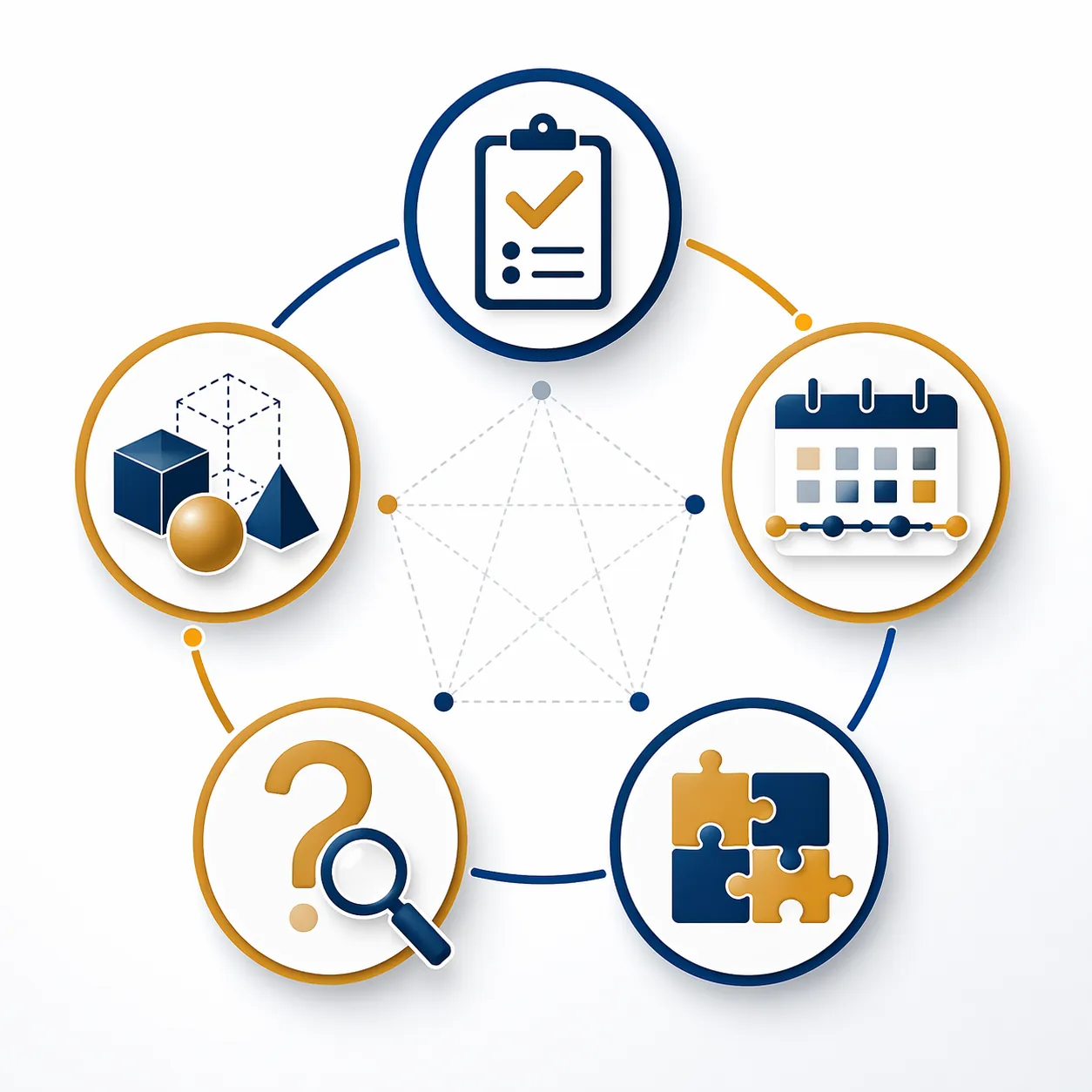
Practice Testing — High Utility
Practice testing is not “do more problems” in the vague way students say it after a bad diagnostic. In Dunlosky et al., it means using retrieval itself as a learning event: trying to produce an answer, solution path, definition, or explanation before the material is restudied. The review rated it high utility.[2]
Wang’s own language points toward a related discipline: “You have to be honest with yourself. Not too optimistic, not too pessimistic.”[4] In advanced mathematics, that honesty is not a bubble sheet. It is knowing whether a line of argument really works. In standardized-test prep, the equivalent is more mechanical and less glamorous: close the solution, set a timer, and see whether you can still produce the move.
For SAT, ACT, GRE, or MCAT math-heavy work, the clean version is a two-pass block. First, attempt a set under conditions close enough to test day to expose hesitation. Second, review every miss and every lucky correct answer without changing the score in your head. A student who says “I knew that” after reading a solution has not tested retrieval; they have recognized someone else’s completed path.
The practical move tonight is simple: take 20 to 40 minutes of closed-book quant work, then spend almost as long writing why errors happened. Use three labels only: content gap, method choice, or execution error. Content gap means you did not know the underlying rule. Method choice means you knew several tools but selected poorly. Execution error means arithmetic, sign handling, graph reading, unit conversion, or timing broke the attempt. That classification is dull, which is part of why it works.
MCAT students can apply the same idea to passage-based quantitative reasoning: cover the explanation, reconstruct the calculation, and then explain which passage sentence supplied the needed value. A related application appears in active recall for MCAT drug classifications, where the point is again retrieval before comfort.
Distributed Practice — High Utility
Distributed practice, also rated high utility by Dunlosky et al., is the case where exam-prep students should pay closest attention.[2] It is the opposite of the heroic cram block. It asks students to revisit material across time, so forgetting has a chance to appear while there is still time to repair it.
Wang’s career is not evidence for spacing, but her remarks make the long arc easier to respect. In a CRM interview, she said, “Sometimes you work for years and don’t solve the problem. But the tools, the intuition, what you build along the way, it all ends up useful.”[4] A test-taker does not have years, and should not pretend to. But the exam version of that sentence is recognizable: a ratio setup you struggled with in week one may become the exact tool that saves a data interpretation question in week six.
The mistake is treating spacing as a calendar decoration instead of a decision about when struggle should happen. If your SAT is in eight weeks, algebra cannot live only in week one and full tests cannot live only in week eight. If your GRE is in one month, quantitative comparison needs repeated contact. If your MCAT is later this quarter, units, logarithms, proportional reasoning, graph slopes, and experimental data should recur in small doses while science content is also moving.
A workable distributed schedule has three layers. New work introduces a topic. Return work revisits it before it feels fully fresh. Mixed review tests whether it survives next to other topics. The spacing does not need to be mathematically perfect. It does need to be visible on a calendar, because “I’ll review later” is not a plan; it is usually a confession made too early.
- For the SAT: place linear equations, quadratics, functions, and data analysis on recurring days rather than finishing one unit permanently.
- For the ACT: rotate fast arithmetic, geometry, function notation, and word-problem translation because speed weaknesses decay quickly when ignored.
- For the GRE: revisit quantitative comparison and data interpretation every few days, even while studying geometry or number properties.
- For the MCAT: keep short quantitative drills attached to chemistry, physics, and research-design review instead of isolating math as a one-time prerequisite.
Students using an exam hub can turn this into a weekly grid rather than a vague resolution: SAT prep, ACT prep, GRE prep, and MCAT prep all benefit when topics are scheduled to return before test week panic starts.
Interleaved Practice — Moderate Utility
Interleaved practice received a moderate-utility rating in Dunlosky et al.[2] It means mixing related problem types so the student must choose a method, not merely execute the method announced by the chapter title. That choice is where many test errors live.
Here the Wang connection is intellectually vivid but must be handled carefully. Tao’s discussion of the Wang-Zahl proof describes a layered strategy for the three-dimensional Kakeya problem, not a worksheet trick.[5] Proof architecture and exam problem sets are not the same thing. Still, the resemblance worth keeping is the movement across structures: instead of staying inside one comfortable representation, the work depends on seeing how different tools constrain the same object.
For exam prep, interleaving should usually come after a short blocked introduction. If you have never learned exponent rules, mixing exponent questions with logarithms, functions, and probability may produce noise rather than learning. But once the basic rule is available, mixed sets force the more valuable question: what kind of problem is this?
- After learning linear equations, mix slope, systems, word translations, and graph interpretation.
- After learning geometry formulas, mix area, similarity, coordinate geometry, and unit conversion.
- After learning MCAT physics equations, mix plug-in calculation, proportional reasoning, graph slope, and passage-based variable identification.
- After learning GRE number properties, mix divisibility, remainders, inequalities, and quantitative comparison.
The review step matters more in interleaving than students expect. Do not only ask whether the answer was right. Ask what cue should have told you which method to use. That is the part a blocked set often hides.
Elaborative Interrogation — Moderate Utility
Elaborative interrogation was also rated moderate utility.[2] The phrase sounds heavier than the action. It means asking why a fact is true, why a step is allowed, or why a condition matters, then producing an explanation rather than merely rereading the line.
Wang’s CRM interview gives a natural bridge because she talks about connecting areas rather than collecting isolated tricks. She described the importance of “connecting disparate fields,” and said, “You can find fractal structure in any set if you look at the right scales.”[4] A standardized exam is not asking for fractal geometry, but it often rewards the same smaller habit: change scale, restate the object, and explain why the chosen view helps.
A student reviewing a missed function question might ask: why did the graph representation make the intercept obvious when the equation felt messy? A GRE student might ask: why does testing values expose a quantitative comparison faster than algebra here? An MCAT student might ask: why does the unit cancel in this direction and not the other? These are not diary prompts. They are pressure tests for understanding.
Keep the prompt short enough that you will actually use it: “Why this method?” “Why this condition?” “Why did the wrong answer look tempting?” For memory-heavy parts of science and medicine, the same evidence-graded caution applies to mnemonic work; this mnemonic study method for early dementia signs is a useful comparison because it treats explanation as part of recall, not as decoration after recall.
Concrete Examples — Moderate Utility
Concrete examples received a moderate-utility rating in Dunlosky et al.[2] For math-heavy exams, this is the technique that protects students from the illusion of knowing a rule because the rule sounds familiar. “Slope is rise over run” is not yet useful until it can survive a graph, a table, a word problem, and a rate in a passage.
Wang’s work sits at the other end of abstraction, but her own comment about finding structure “at the right scales” is a good warning for students.[4] Too abstract, and the rule floats. Too concrete, and the student memorizes one surface pattern. The study task is to move between them: formula, worked example, altered example, and then a fresh problem.
A concrete-example routine can be brief. After reviewing a rule, write one clean worked example and one near-miss example where the same rule does not apply. For probability, that might mean one independent-events problem and one dependent-events problem. For coordinate geometry, one slope question and one distance question using the same two points. For MCAT science, one equation used with direct substitution and one passage item where the variable must be inferred first.
Science-prep students can also borrow from worked examples outside pure math. A resource like Google Earth science discovery for SAT and MCAT prep is useful when it turns an abstract data or earth-science idea into a visible case. The example is doing its job only if the student can later handle a changed version, not merely admire the original.
What Not to Steal From a Fields Medalist
Do not steal the timeline. Wang’s path includes a decade-long movement from PhD to breakthrough-level work, and the Kakeya result itself belongs to a research world where years of partial tools may matter later.[3][4] A student with a test date does not need to imitate that scale. They need to decide what happens at 7 p.m. on Tuesday when a mixed set exposes a weakness.
Do not steal the prestige sequence either. Peking University, École polytechnique, MIT, IAS, NYU Courant, and IHES explain part of Wang’s academic environment, not a universal recipe.[3] For a test-taker, the more portable part is the behavior underneath: attempt, space, mix, explain, instantiate.
And do not turn “third woman ever” into either a study method or a footnote. It is historically significant, and it is not an algebra strategy.[1] The better use of the milestone is to let it draw attention to work that was patient, technical, and resistant to easy translation.
Turn the Five Habits Into This Week’s Prep
A disciplined study plan can use Wang’s story without pretending Wang handed it down. Put practice testing and distributed practice at the center because Dunlosky et al. rated them high utility. Add interleaving, elaborative interrogation, and concrete examples because they help with method selection, explanation, and transfer when used carefully.[2]
- Schedule retrieval first: start several sessions with closed-book problems before notes or videos.
- Space topics deliberately: make weak areas return on the calendar before they feel fully comfortable.
- Mix problem types after initial learning: force yourself to choose the method, not just execute it.
- Write short why-prompts during review: explain the condition, cue, trap, or unit conversion.
- Pair rules with examples and near-misses: make the abstract rule prove that it can travel.
If you like role-model study methods, read them with the same skepticism. A related format appears in the Denzel Washington study method, and Dunlosky-style evidence grading also appears in NYT Connections vocabulary study and CA DMV written test study methods. The standard is the same: admiration may get you to the desk, but the method still has to survive evidence and scheduling.
Hong Wang’s Fields Medal does not reveal a secret shortcut for standardized-test math. It makes five unglamorous habits easier to respect: scheduled practice blocks, mixed problem sets, self-testing, explanation prompts, and concrete worked examples. That is enough to be useful, and it is about as much as the evidence allows.
References
- Hong Wang, Permanent Professor at IHES, awarded the 2026 Fields Medal — IHES
- Improving Students’ Learning With Effective Learning Techniques — Dunlosky et al., 2013
- Hong Wang — Wikipedia
- Hong Wang: On Solving Kakeya and Rethinking Restriction — CRM, July 2025
- The three-dimensional Kakeya conjecture, after Wang and Zahl — Terence Tao’s blog, February 2025
- ‘Once in a Century’ Proof Settles Math’s Kakeya Conjecture — IAS/Quanta Magazine
Related case links
No matching exam hub found
Browse the exam hubs directory to find the study plan for this exam.
Did a similar plan work for you?
Share whether a comparable timeline and starting point produced a similar result — this is verification discussion, not general commentary.
Comments
Join the discussion with an anonymous comment.