
Method
Denzel Washington's Failure Quotes Become a Study Method
Bombing a practice test feels like a setback, but Denzel Washington's "fall forward" philosophy shows that every wrong answer is diagnostic data. This article presents a three-step mistake-audit protocol that helps students classify errors, assign targeted fixes, and build a recovery plan.
Evidence panel
- Evidence level
- Moderate
- Primary citation
- Dunlosky et al. (2013) Improving Students’ Learning With Effective Learning Techniques, Psychological Science in the Public Interest
You bombed a practice test. The score report is ugly, the timing felt worse than you expected, and one section may have made you wonder whether you have been lying to yourself about your progress.
The next move is not to take another full-length exam tomorrow just to prove the first one was a fluke. That usually turns one bad data point into two exhausted data points. The next move is to audit the damage while it is still fresh enough to be useful.

That is where Denzel Washington’s failure quotes become more than commencement-speech decoration. In his 2011 University of Pennsylvania address, Washington told graduates to “fall forward,” adding, “Every failed experiment is one step closer to success” and “If you don’t fail, you’re not even trying.” He also used the Thomas Edison example: Edison did not simply fail at making a light bulb; he found thousands of ways not to make one.[1]
For students, that only matters if it changes what you do with the wrong answers. A missed SAT math question, a misread MCAT passage, or an ASVAB arithmetic-reasoning error is not automatically evidence that you are bad at the exam. It is evidence that one part of the system broke. The work is to find which part.
The GPA Story Matters, But Not as a Fairy Tale
Washington’s own academic story gives the “fall forward” line some weight. In different public tellings, his Fordham GPA is reported as either 1.7 or 1.8, and the practical point does not depend on choosing one decimal as sacred. The story is that he struggled badly enough at Fordham to be asked to leave, then later found theater and built the career people now associate with discipline and excellence.[1][2]
That is not a claim that Washington invented a study system. He did not publish a test-prep protocol. His UPenn speech also has a clear faith dimension, including the instruction to “put God first,” which belongs to the source material and should not be erased.[1] This article is doing something narrower: applying the “fall forward” idea to what happens after a mock exam goes badly.
The difference matters. Motivation can get you back to the desk. It cannot tell you whether you missed the question because you lacked the formula, misread the word “except,” ran out of time, or changed a correct answer for no reason. A usable method has to separate those failures.
The Fall Forward Study Method
The Fall Forward Study Method is a three-step mistake audit for the hours after a practice test. It treats every wrong answer as diagnostic data, then forces that data into a repair plan before you spend time on another full practice test.
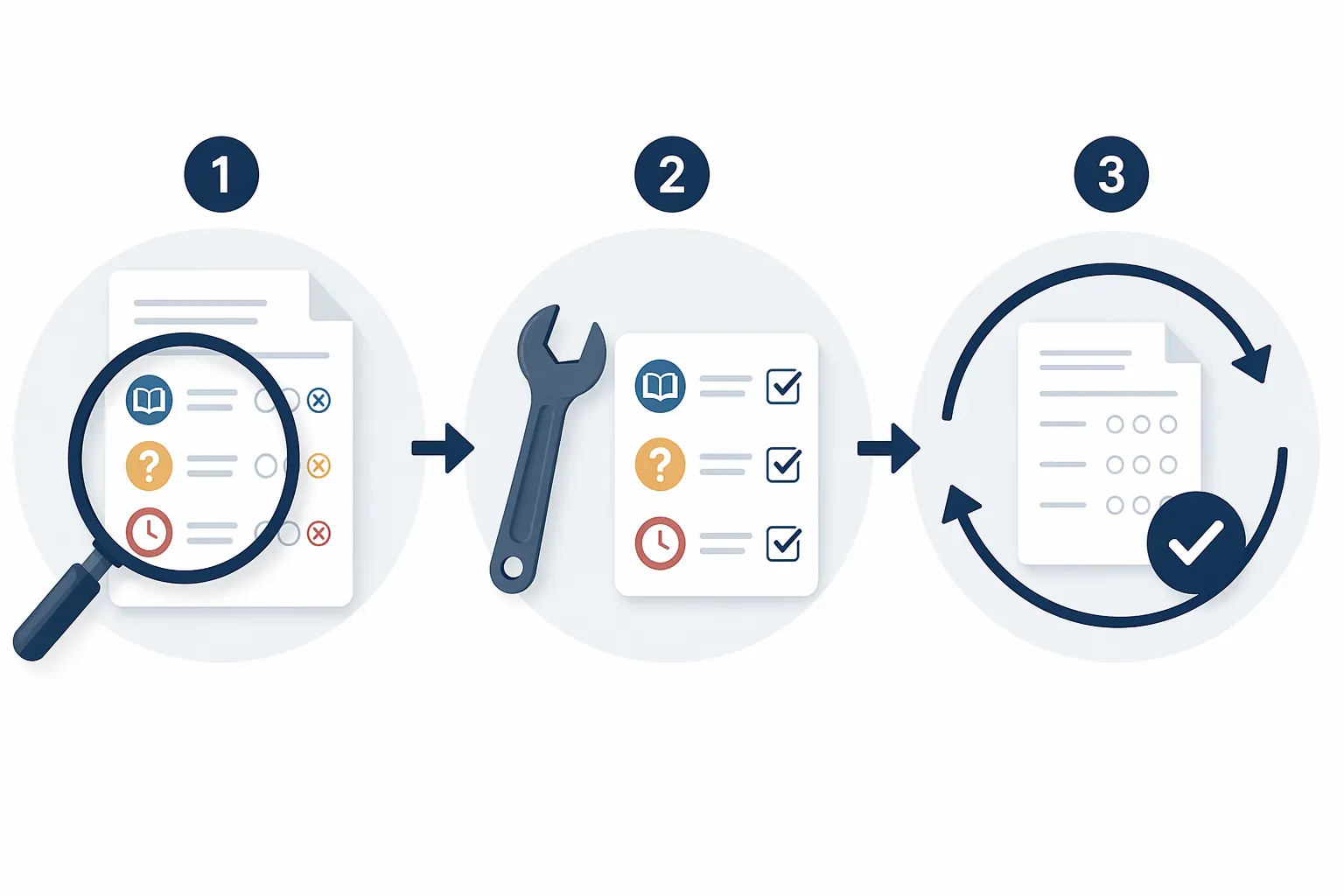
| Step | What You Do | What You Avoid |
|---|---|---|
| 1. Classify the miss | Label each wrong answer by failure type. | Calling every mistake “careless” or “I didn’t know it.” |
| 2. Assign one fix | Choose one targeted repair for that failure type. | Writing vague notes like “study harder.” |
| 3. Re-test the repaired category | Check the fixed skill before another full exam. | Using full-length tests as emotional reassurance. |
There is a learning-science reason to make practice tests part of the recovery plan rather than treating them as punishment. Dunlosky and colleagues classified practice testing as a high-utility learning technique in their 2013 review of effective study methods.[3] That does not mean every practice test automatically helps. It means retrieval practice becomes powerful when the student uses the result to change the next round of study.
Step 1: Classify Each Wrong Answer by Failure Type
Start with the questions you missed, guessed correctly, or barely survived. A correct answer that came from a lucky guess still belongs in the audit. You are not building a shame file. You are building a map of where the test found weakness.
Use four labels first. They are plain enough to work across the SAT, ACT, GRE, MCAT, ASVAB, and most school exams.
- Knowledge gap: You did not know the concept, formula, vocabulary, rule, or content being tested.
- Misinterpretation: You knew the underlying material but misunderstood the question, passage, graph, wording, or answer choice.
- Test-taking error: You made an avoidable execution mistake, such as bubbling the wrong line, skipping a negative sign, choosing too quickly, or changing an answer without evidence.
- Time-pressure mistake: You might have solved it under normal conditions, but pacing pushed you into rushing, guessing, or freezing.
Most students want to write “careless” beside half the page and move on. That label feels merciful because it suggests you really knew the material. It is also usually too blurry to fix. If you dropped a negative sign because you were rushing through the last five SAT math questions, that is not the same problem as forgetting how exponent rules work. One needs pacing control; the other needs content review.
A student using the SAT Score-Gap Method already has a reason to think this way: the gap between the current score and the target score is not one giant weakness. It is a set of smaller score leaks. The mistake audit makes those leaks visible.
Here is the test I used to give students who insisted they “just blanked.” If I covered the answer choices and gave you the same question untimed, could you explain the path to the answer? If yes, time pressure or test execution may be the main issue. If no, the miss probably belongs under knowledge gap or misinterpretation. That one distinction can save a week of studying the wrong thing.
How the Labels Look in Real Test Prep
| What Happened | Likely Label | Why It Matters |
|---|---|---|
| You missed a geometry question because you did not remember the circle theorem. | Knowledge gap | Reviewing strategy will not replace missing content. |
| You knew the science concept but answered the opposite of what the passage asked. | Misinterpretation | More content review may not fix a reading-control problem. |
| You solved correctly on paper but bubbled the neighboring answer. | Test-taking error | The repair is procedural, not conceptual. |
| You guessed on the last several arithmetic-reasoning questions because the clock collapsed. | Time-pressure mistake | The fix has to include pacing practice, not just more drills. |
This is the point where discouragement usually argues for a dramatic conclusion: “I’m not good at math,” “I can’t read passages fast enough,” “I’m not built for standardized tests.” Those may feel honest in the moment, but they are too large to act on. A useful label has to be small enough that tomorrow’s study session can attack it.
Step 2: Assign One Targeted Fix Per Error Type
After classification, do not write a heroic study plan. Write one repair action for each error type that actually appeared. If the mock exam exposed three time-pressure misses and one content gap, the next study block should not look like a generic review of the whole exam.
| Failure Type | Targeted Fix | What Counts as Evidence of Repair |
|---|---|---|
| Knowledge gap | Relearn the rule, concept, or formula; then solve a small set of related questions without notes. | You can explain why the right answer works before checking the key. |
| Misinterpretation | Rewrite the question task in your own words before solving similar items. | Your written task matches what the question actually asked. |
| Test-taking error | Add a repeatable check, such as underlining the requested value or verifying signs before choosing. | The same procedural slip stops appearing in the next drill. |
| Time-pressure mistake | Practice a shorter timed set with a pacing rule, such as when to skip and return. | You finish the set with fewer rushed guesses, not just faster guesses. |
For SAT math, this might mean taking five missed linear-equation questions and rebuilding the skill before touching a new full test. The SAT math practice guide is a better next stop for that student than another four-hour exam. For a student still deciding how to structure the whole prep cycle, the broader SAT exam prep guide can hold the full plan while the mistake audit handles the immediate repair.
For an ASVAB student, a time-pressure pattern in arithmetic reasoning deserves a different fix from a content gap in mechanical comprehension. For an MCAT student, misreading a dense passage is not repaired by memorizing more terms if the real problem is that the student keeps answering from outside knowledge instead of from the passage. The label chooses the tool.
This is also where Washington’s Edison analogy earns its place. A wrong answer should eliminate one wrong approach. If the audit only produces “review chapter” or “do more questions,” the failed experiment has not taught you much. If it produces “I misread comparison questions when the answer choices are long,” now the next session has a target.
A Simple Mistake Log That Does Not Waste Your Evening
| Question | Failure Type | One-Sentence Cause | Targeted Fix | Re-Test Item |
|---|---|---|---|---|
| Practice Test 2, Math Q14 | Knowledge gap | Forgot how to handle negative exponents. | Review exponent rules, then solve related items without notes. | Untimed exponent mini-set |
| Practice Test 2, Reading Q27 | Misinterpretation | Answered the author’s general point instead of the specific line reference. | Paraphrase the task before reading answer choices. | Line-reference question set |
| Practice Test 2, Math Q31 | Time-pressure mistake | Started a long solution with too little time left. | Practice skip-and-return decisions in a timed set. | Ten-question timed drill |
The log does not need to be pretty. It needs to prevent the same mistake from hiding under a new question number next week.
Step 3: Re-Test the Fixed Categories Before the Next Full Practice Test
Once you have classified and repaired the main error types, re-test only those categories. This is the part many students skip because a full practice test feels more serious. It is also the part that tells you whether the repair worked.
If your audit found knowledge gaps in ratios, do a focused ratio set. If your audit found misinterpretation in paired passages, do a small passage set where the only goal is task accuracy. If your audit found timing breakdowns, run a shorter timed drill with a planned skip point. Do not wait for a full exam to discover that yesterday’s fix was only a good intention.
Students preparing for military entrance testing can use the same structure alongside an ASVAB prep plan. Pre-med students can connect the same practice-testing logic to MCAT review, including content-heavy areas such as MCAT drug classifications. The exam changes, but the audit question stays stable: what failed, what did you repair, and what evidence shows it is less likely to fail again?
What to Do in the First Hour After a Bad Mock Exam
There is a practical reason not to jump straight into another test. Right after a bad score, your judgment is noisy. You are tempted to punish yourself with volume or soothe yourself by hunting for an easier score. Neither one is an audit.
- Take a short break before reviewing. Not a week. Long enough that you can look at the score report without turning every question into a verdict.
- Mark every wrong, guessed, or unstable question. Do not review only the wrong ones if several correct answers were lucky.
- Assign one failure-type label to each marked question. If two labels seem possible, choose the one that explains the first thing that went wrong.
- Write one targeted fix for the most common labels. Stop before the plan becomes a fantasy schedule.
- Schedule a focused re-test before the next full-length practice test.
If the test was the SAT and the pattern is mostly math execution, a focused resource like How to Make SAT Math Practice Questions Actually Work belongs before another full diagnostic. If the pattern is broader, use the audit to decide which section deserves the next study block instead of letting the lowest scaled score bully the whole week.
The Score Is Not the Repair Plan
A practice-test score measures the performance you produced under that set of conditions. It does not automatically tell you what to do next. That is why two students with the same score may need different repairs. One may have missed content across the section. Another may have lost points to timing, misreading, and answer-choice traps. Same score, different prescription.
Washington’s “fall forward” line is useful for students only if “forward” becomes concrete. Not “feel inspired.” Not “pretend the score did not hurt.” Forward means the score turns into a short list: knowledge gaps to relearn, misinterpretations to control, test-taking errors to proceduralize, and timing mistakes to drill under pressure.
After the audit, you should be able to say: these are my two most common error types, these are the fixes I will apply this week, and this is the small re-test that will show whether the fixes worked. That is falling forward. The bad score stops being a verdict and becomes the next thing to fix.
References
- Denzel Washington Fall Forward Commencement Speech Transcript, Rev
- Denzel Washington’s Life Advice Will Leave You SPEECHLESS, Goalcast
- Improving Students’ Learning With Effective Learning Techniques: Promising Directions From Cognitive and Educational Psychology, Psychological Science in the Public Interest, 2013
Comments
Join the discussion with an anonymous comment.