Method
Can Your Daily NYT Connections Count as Exam Vocabulary Study?
Wondering if your daily NYT Connections habit helps with GRE, SAT, or ACT vocabulary? This article explains why the game already uses evidence-backed strategies like distributed practice and retrieval, and how a simple 5-minute follow-up can turn it into a targeted vocab warm-up.
Evidence panel
- Evidence level
- Limited
- Primary citation
- Dunlosky, J. et al. (2013). Strengthening the Student Toolbox. American Educator.
If you play NYT Connections every morning and want to count it as vocabulary study, the honest answer is: partly. It can be a useful, low-stakes warm-up for GRE, SAT, or ACT vocabulary because it makes you retrieve meanings and revisit word relationships day after day. That lines up with the two learning techniques Dunlosky and colleagues rated highest for utility: practice testing and distributed practice.[1] It does not, by itself, replace a targeted exam vocabulary list.
That distinction matters because a pleasant habit is easy to over-credit. Connections drew 2.3 billion plays in 2023, according to a TechCrunch report on New York Times game data, which says plenty about how sticky the puzzle became.[2] It does not prove that the puzzle teaches test vocabulary. Popularity is not pedagogy.

What Connections Actually Gives You
The useful part of Connections is not that it exposes you to a magical set of exam words. The useful part is the mental move it asks for: look at a word, test possible meanings, compare it with neighboring words, reject a tempting but wrong category, and try again.
That is closer to retrieval than to rereading. You are not staring at a definition and nodding along. You are asking your memory what a word can mean, what it can sound like, what phrases it appears in, and which associations are strong enough to group it with three others. Dunlosky’s review gives practice testing high utility because the learner has to bring information back from memory, not merely encounter it again on the page.[1]
The daily rhythm matters too. A puzzle once in a while is just a puzzle. A puzzle most mornings turns into a small spaced routine, and distributed practice is the other technique Dunlosky and colleagues rated as high utility.[1] The spacing is not customized to your personal weak words, which is why this still cannot be your whole vocabulary plan. But the habit has the shape of something learning science tends to respect.
Why the Game Feels Vocabulary-Relevant
Connections is built around semantic pressure. A word may belong with synonyms, with items in a phrase, with a spelling pattern, with pop-culture references, or with a category that only becomes visible after you stop using the first meaning that came to mind. Muraki and Pexman, writing as cognitive science researchers, describe the game as requiring flexible access to semantic memory, including word meaning, grammar, spelling, and remote associations.[3] That is expert commentary on the game, not a direct experiment showing that Connections improves exam scores.
Still, the explanation matches what test-takers need from vocabulary study. Exam vocabulary is rarely just “know the definition.” A strong reader notices connotation, contrast, category, tone, and context. McKeown’s discussion of effective vocabulary instruction emphasizes knowing words, using words, and understanding how words work, with students actively processing words across contexts rather than only memorizing definitions.[4]
That is why a Connections grid can be a decent first five minutes before real studying. It wakes up the habit of asking, “What else can this word do?” If you want a fuller explanation of the cognitive mechanics inside the puzzle, the related guide on solving Connections puzzles using semantic memory goes deeper without pretending the game is a full vocabulary curriculum.
The Five-Minute Add-On That Makes It Count More
The puzzle becomes much more defensible as exam prep when you add a short conversion routine after you finish. Not an hour. Not a color-coded notebook system. Five minutes is enough to separate “I played a game” from “I caught vocabulary I was uncertain about and moved it into a study system.”
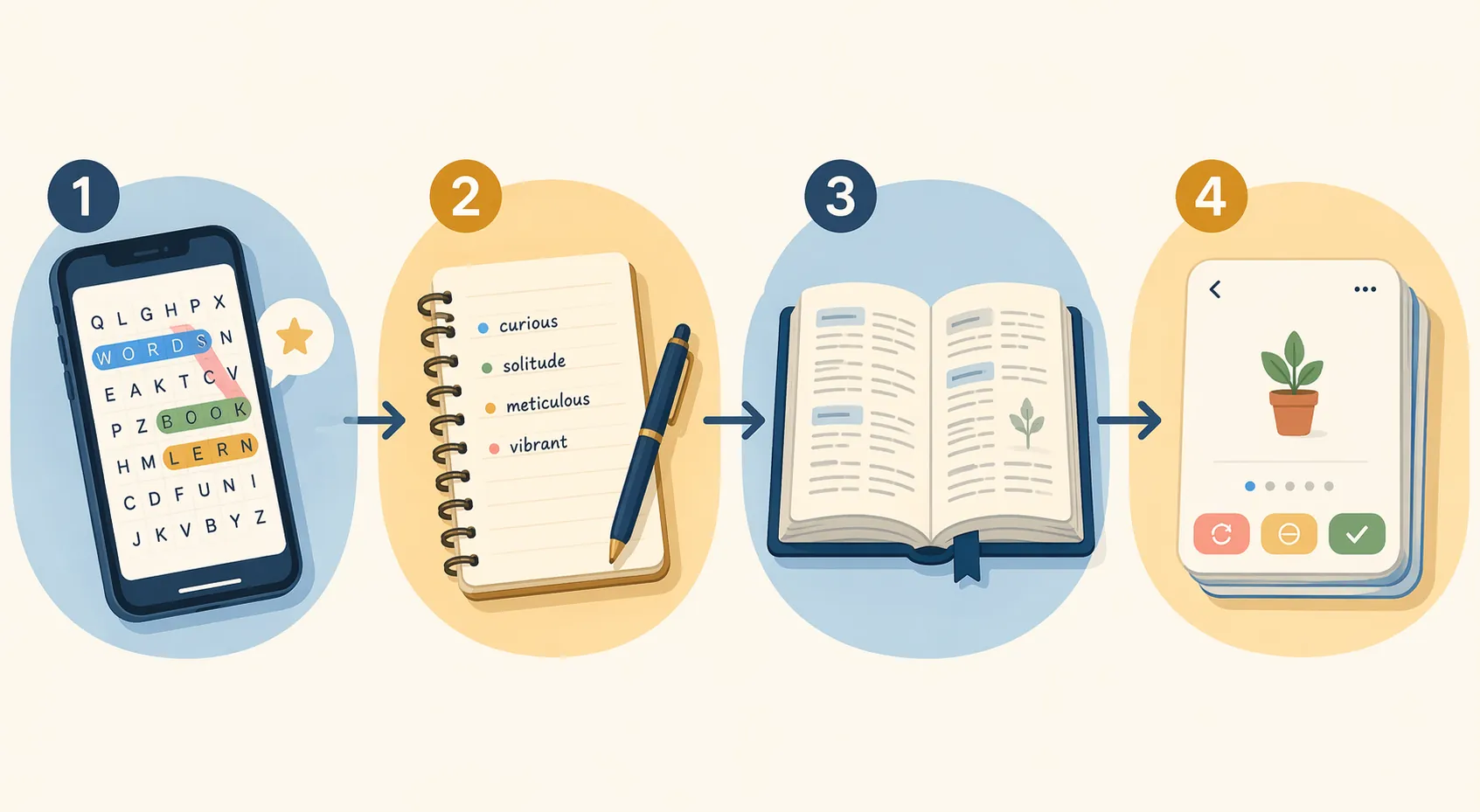
- Play the daily Connections puzzle as usual, ideally before your main vocabulary or reading session.
- Write down every word that made you hesitate, every word you guessed from vibe rather than meaning, and every word whose category surprised you.
- Look up the uncertain words and write a usable definition, not a dictionary copy you would never say aloud.
- Add only the worthwhile words to a spaced-repetition deck or your existing exam vocabulary system.
- During your next review, test yourself on the word’s meaning, usage, and one relationship it has to another word.
The second step is the one students skip because it feels too small to matter. It is also the step that changes the value of the habit. Hesitation is useful diagnostic data. If you pause over a word, misread its sense, or solve the group only after revealing the answer, that word has just identified itself as a candidate for study.
This is where semantic mapping becomes relevant without needing a full classroom activity. Reading Rockets describes semantic mapping as a way to help students identify, understand, and recall word meanings by organizing relationships among words; Keys to Literacy similarly presents semantic mapping as a vocabulary tool built around word relationships.[5][6] Connections already hands you a rough, game-shaped semantic map. Your job is to rescue the useful pieces before tomorrow’s puzzle replaces them.
| During the puzzle | After the puzzle | Why it helps exam prep |
|---|---|---|
| You hesitate on a word | Log it before checking out mentally | Hesitation marks a weak or unstable meaning |
| You group by a wrong meaning | Write the meaning you used and the meaning the puzzle required | Contrast makes the correction easier to remember |
| You recognize a word but cannot define it | Add a plain-language definition and one example phrase | Recognition alone is too weak for test-day use |
| You learn a category after solving | Record one relationship among the words | Relationships support recall better than isolated labels |
Where It Fits in GRE, SAT, or ACT Prep
For GRE students, the daily puzzle belongs before the serious flashcard work, not instead of it. If a Connections word is useful, feed it into the same system you use for high-frequency GRE vocabulary. The guide to using GRE vocabulary flashcards the right way is the better place for the review mechanics; Connections is just the warm-up layer.
For SAT and ACT students, the value is often less about obscure words and more about flexible reading. You are practicing the habit of checking whether a familiar word is being used in an unfamiliar way. That is relevant to reading and vocabulary-in-context work, but it still needs to sit beside passage practice and exam-specific review. SAT readers who need the broader structure can use the SAT exam prep guide rather than trying to make one daily puzzle carry the whole plan.
The cleanest setup is simple: Connections first, targeted vocabulary second. If you are building a GRE timeline from scratch, place the puzzle as a daily opener inside a larger plan like a step-by-step GRE study plan with free tools. If your missing piece is the review app, compare spaced repetition apps for GRE vocabulary and choose one you will actually open.
What the Puzzle Cannot Promise
No peer-reviewed study has directly tested NYT Connections as a GRE, SAT, or ACT vocabulary intervention. The case for using it rests on transfer from better-established learning principles: retrieval, distributed practice, active processing, and word relationships. That is enough to justify a small warm-up. It is not enough to claim score improvement.
The game also chooses the words. Your exam does not care whether today’s puzzle happened to include a word you need. A daily grid may give you useful exposure, but it will also spend time on proper nouns, phrases, jokes, and categories that have little to do with your test. That is fine for a game. It is a problem only if you pretend the game is a syllabus.
There is also a broader “brain game” caution. Northeastern’s discussion of Connections and Wordle notes that such games engage executive functions but are not specifically designed for cognitive improvement.[7] So the safer claim is narrower: Connections can support vocabulary study when paired with deliberate follow-up. It should not be sold to yourself as general brain training.
A Practical Verdict
Keep the daily puzzle if it helps you start. Treat it as a semantic warm-up: a few minutes of retrieval, association, and flexible word thinking. Then spend five more minutes capturing the words that exposed uncertainty and moving the useful ones into spaced repetition or your exam-specific vocabulary list.
References
- Strengthening the Student Toolbox, American Educator / AFT, 2013
- Connections is the New York Times’ most-played game after Wordle, TechCrunch, August 2023
- NYT Connections: Tips to improve your game through the science of semantic memory, The Conversation, 2024
- Effective Vocabulary Instruction Fosters Knowing Words, Using Words, and Understanding How Words Work, Language, Speech, and Hearing Services in Schools / PMC, 2019
- Connecting Word Meanings Through Semantic Mapping, Reading Rockets
- Semantic Mapping to Grow Vocabulary, Keys to Literacy
- Are the NYT’s Connections and Wordle Good For Your Brain?, Northeastern University, 2024
Comments
Join the discussion with an anonymous comment.