
Which Language Learning App Has the Best SRS Algorithm?
Not all language learning flashcard apps use the same spaced repetition algorithm. This guide compares FSRS, SM-2, Leitner, half-life regression, and proprietary systems to help you choose the app that delivers the best long-term memory outcomes for your language studies.
A language learning flashcard app can say it uses spaced repetition and still mean several very different things. It might move cards through fixed boxes. It might use the older SM-2 style of interval growth. It might estimate the probability that you will remember a word tomorrow. Or it might use the phrase “adaptive learning” while giving you almost no way to inspect what is actually being adapted.
For serious language study, that distinction is not cosmetic. A learner maintaining hundreds of Spanish collocation cards, Japanese kanji readings, Mandarin listening cards, or French sentence cards is not asking for prettier reminders. The question is whether the app can schedule each item close to the point where recall is becoming fragile, without burying the learner in unnecessary reviews or letting difficult items disappear too long.
| Algorithm family | Practical seriousness for language learning | Typical app examples from the available evidence |
|---|---|---|
| FSRS and related adaptive memory-curve models | Strongest transparent choice for high-volume learners because they model memory more precisely and can be inspected | Anki 23.10+, MintDeck, RemNote 1.16+, FluentCards |
| Half-life regression | Strong published evidence in Duolingo’s own learning context, especially for recall prediction | Duolingo |
| SM-2 style scheduling | Proven and still usable, but older and cruder about failures and individual item behavior | Older Anki scheduling and apps modeled on classic SuperMemo-style repetition |
| Proprietary adaptive systems | Potentially good, but harder to judge when the model and validation are not public | Memrise |
| Leitner or fixed-box systems | Acceptable for lighter use, but limited once item difficulty varies widely | Word+/WordPlus, Lexilize |
| Flashcards without current true SRS | Useful for drilling, weak for long-term scheduling | Quizlet, based on current user and third-party reports |
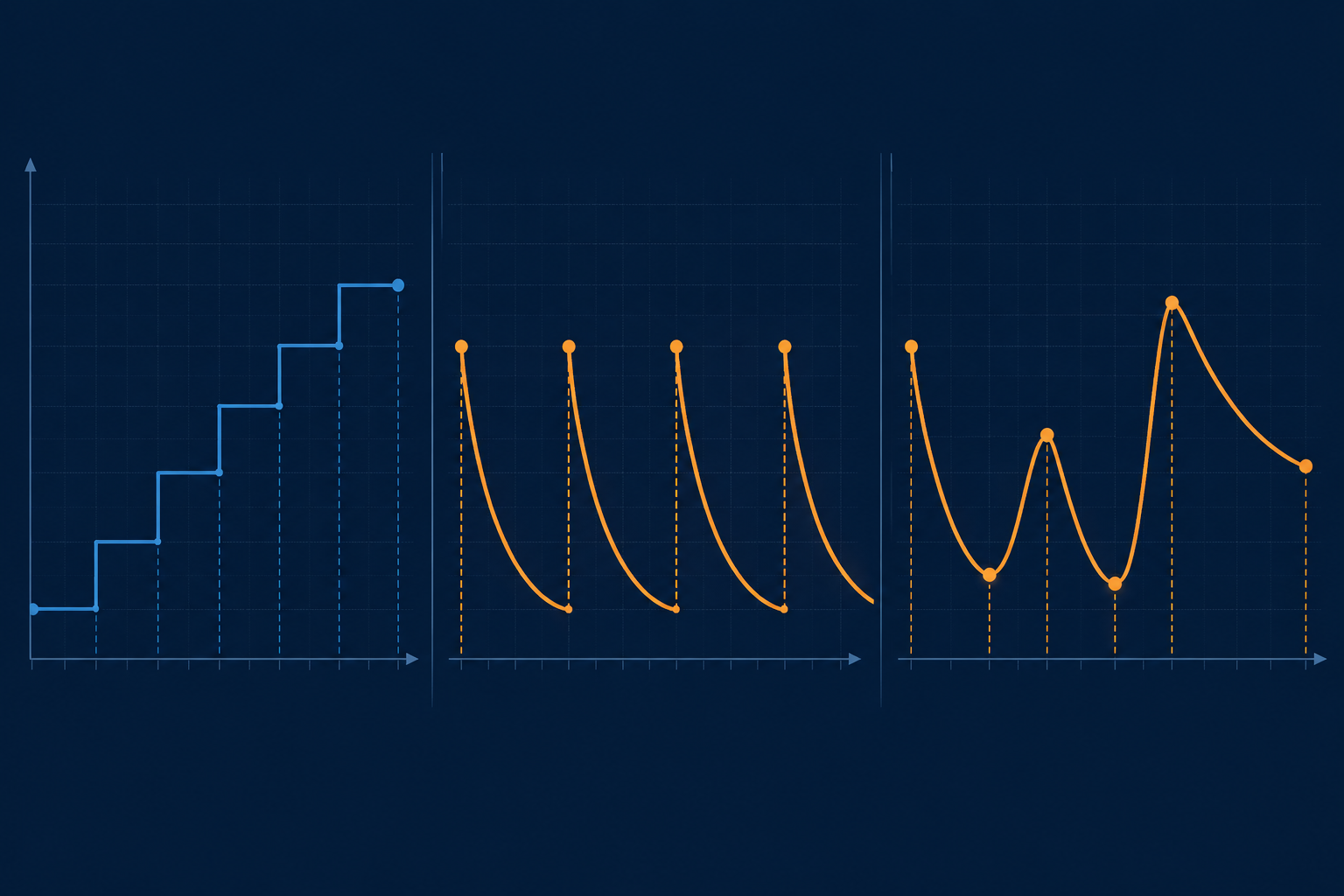
The best SRS algorithm is the one that models forgetting, not just time
The main split is between systems that count boxes or intervals and systems that estimate memory. Box systems ask, in effect, “How many times has this card succeeded?” Adaptive memory models ask a better question: “Given this item, this learner, this difficulty, and this review history, how likely is recall at a future moment?”
FSRS, the Free Spaced Repetition Scheduler, is the clearest example of the stronger approach among transparent tools. Its documentation describes separate modeling of stability, difficulty, and retrievability: how long the memory lasts, how hard the item is, and how likely the learner is to recall it at review time. It has been adopted by Anki 23.10+, MintDeck, RemNote 1.16+, and FluentCards according to the available implementation notes and app documentation.[1]
That separation matters for language cards because not all failures mean the same thing. Forgetting a transparent cognate after a long gap is not the same as missing an abstract verb pattern that has failed three times already. A scheduler that treats both failures mainly as a reset is leaving useful information on the floor.
SM-2, the classic SuperMemo-derived algorithm family that shaped older Anki scheduling, is still respectable. It helped make computer-based spaced repetition practical. But in its traditional form, it relies on an ease factor and interval growth that act more like a general approximation than a personalized memory model; older Anki-style behavior is commonly described as using a 2.5x ease factor and sending failed review cards back to a short interval such as one day.[2]
That is not disastrous. Many learners have built large vocabularies with SM-2-like scheduling. The weakness shows up as the deck grows uneven. Easy concrete nouns start wasting review slots because they are shown too conservatively. Stubborn grammar cards keep coming back, but the algorithm may not distinguish a genuinely difficult item from a temporary lapse as elegantly as a model built around stability and retrievability.
FSRS vs. SM-2 vs. HLR: what actually changes in the review queue
The easiest way to compare algorithms is to ignore the marketing vocabulary and watch what happens after three ordinary events: a successful recall, a repeated easy recall, and a failure.
| Review event | Leitner or fixed boxes | SM-2 style scheduling | FSRS-style scheduling |
|---|---|---|---|
| You remember the card | The card moves to the next box or fixed interval | The interval grows according to the card’s ease and review grade | The next interval is based on estimated stability, difficulty, and target retrievability |
| You keep remembering the card easily | The card keeps moving outward in pre-set steps | The interval expands faster if ease remains high | The model can stretch the interval because the item appears stable for this learner |
| You fail the card | The card usually drops to an earlier box | The card is often pushed back to a short relearning interval | The model updates its estimate rather than treating every lapse as the same kind of collapse |
| Two cards have very different difficulty | The box position may hide that difference | Ease can reflect some difference, but the model is still coarse | Difficulty and stability are treated as separate signals |
Half-life regression, Duolingo’s published approach, belongs in the adaptive camp, though it lives inside a very different product. In the 2016 ACL paper by Settles and Meeder, Duolingo described a model that estimated the half-life of a learner’s memory for a skill or item. In their reported experiments, the model reduced recall prediction error by more than 45% and increased daily engagement by 12%.[3]
The important phrase is “recall prediction.” Duolingo’s result does not prove that HLR is better than FSRS for a self-managed Anki deck, and it does not prove that any app using the word adaptive has comparable performance. It does show that predicting when someone is likely to forget can improve a real language-learning product at scale.
FSRS is attractive for a different reason: it is open enough for serious learners and developers to inspect, tune, and argue with. That does not automatically make every FSRS implementation excellent. Defaults, review buttons, learning steps, burying behavior, and user settings still matter. But when the choice is between an inspectable memory model and a friendly animation labeled “smart review,” the transparent model deserves more trust.
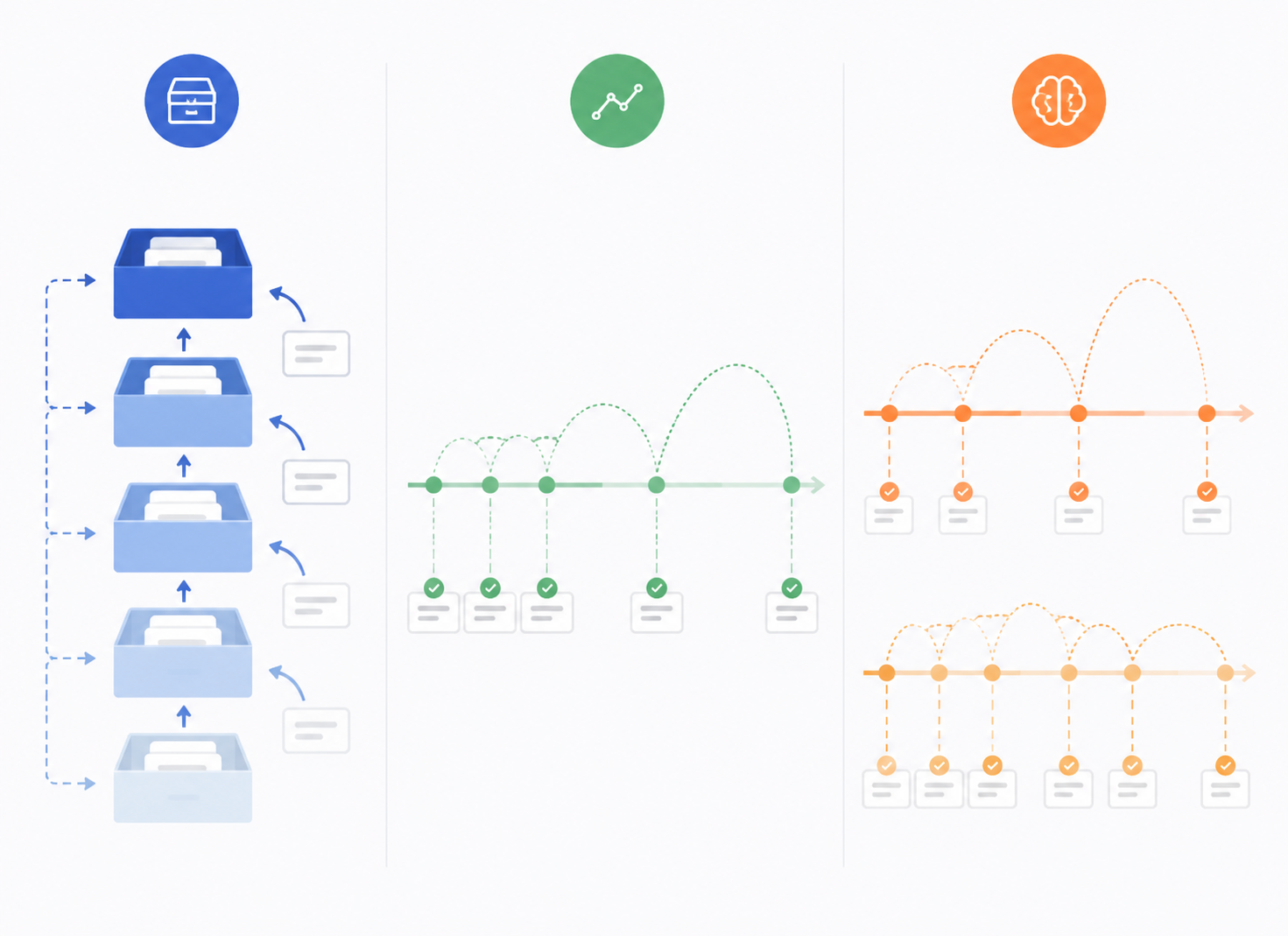
Why Leitner feels fine at first and then starts to creak
The Leitner system is beautifully simple: cards move between boxes depending on whether the learner remembers them, and each box is reviewed at a different frequency. It is also old, explainable, and easy to implement, which is why it still appears in language flashcard tools such as Word+/WordPlus and Lexilize according to the available app descriptions.[2]
For a casual traveler learning a few hundred phrases, Leitner can be enough. The learner mostly needs repeated exposure and a routine. The problem appears when the deck contains radically different memory burdens: kana recognition, kanji production, gendered nouns, prepositions, minimal-pair listening cards, and full sentence cards all competing for the same daily review window.
A box number is a blunt summary of that history. It knows that a card has succeeded or failed enough times to move. It does not really know whether the card is intrinsically hard, newly unstable, easy but neglected, or temporarily missed because the learner was tired. In small decks, that crudeness is tolerable. In large language decks, it becomes expensive.
Proprietary systems deserve interest, not blind faith
Memrise is the awkward case. It has long been associated with memory-based language learning and presents its system as more than a plain flashcard box. The available 2026 Skillademia compilation, drawing on Sensor Tower and Memrise-related data, reports claims of 2.2x better retention than traditional study and an average of 44 words learned per hour, while also citing estimates such as 65 million registered users and $35 million in revenue.[4]
Those numbers are worth noticing, but they are not the same kind of evidence as an open scheduler or a peer-reviewed algorithm paper. The user and revenue figures are extrapolated rather than official disclosures, and the retention claim does not let an outside learner inspect the model, compare parameters, or separate the effect of scheduling from content, interface, reminders, and user selection.
A proprietary algorithm can be excellent. It can also be a fairly ordinary interval system wrapped in confident language. The problem for an intermediate learner choosing a language learning flashcard app is not that proprietary systems are automatically weak. It is that the learner has less evidence when the app refuses to show the machinery.
Quizlet is a warning about assuming flashcards mean SRS
Quizlet remains useful for making and sharing study sets, but current user and third-party reports say it no longer offers true spaced repetition as of 2024. The evidence here is not an official Quizlet technical notice; it comes from community reports and comments collected in places such as FLTMAG and Reddit, so the claim should be treated as reported rather than formally confirmed by Quizlet.[5]
Still, the caution is practical. Many learners hear “flashcard app” and assume “long-term review scheduler.” Those are different products. A tool can be excellent for classroom sets, cramming, matching games, or quick self-tests and still be the wrong home for a multi-year vocabulary deck.
How much does the algorithm actually matter?
Timed retrieval itself has strong support beyond language learning. A 2024 PubMed-indexed study of 26,258 physicians reported that a spaced repetition group scored 58% correct after six months, compared with 43% in the control group.[6]
That finding should not be stretched into a claim that FSRS specifically beats SM-2 for Japanese particles or French verb forms. It does support the broader point: scheduling recall over time is not a decorative feature. If an app treats review timing casually, it is weakening one of the main mechanisms that makes flashcards useful.
Algorithm quality matters most when three conditions are present. The learner has a large deck. The items vary widely in difficulty. The learner reviews consistently enough for the model to collect meaningful history. That describes many intermediate and advanced language learners more than beginners.
- A beginner learning 200 survival phrases may not notice much difference between Leitner, SM-2, and FSRS if the cards are simple and review sessions are short.
- An intermediate learner with 3,000 mixed vocabulary, sentence, and listening cards is much more likely to benefit from adaptive scheduling.
- A kanji or character learner faces unusually uneven item difficulty, making crude interval growth more painful.
- A learner who misses reviews for weeks at a time will reduce the advantage of any algorithm because the schedule no longer reflects normal behavior.
There is a less flattering version of the same point: advanced scheduling rewards boring consistency. If the learner keeps changing apps, deleting review histories, suspending half the deck, or reviewing only during bursts of guilt, the model has less useful data. The math is better, but the input is noisy.
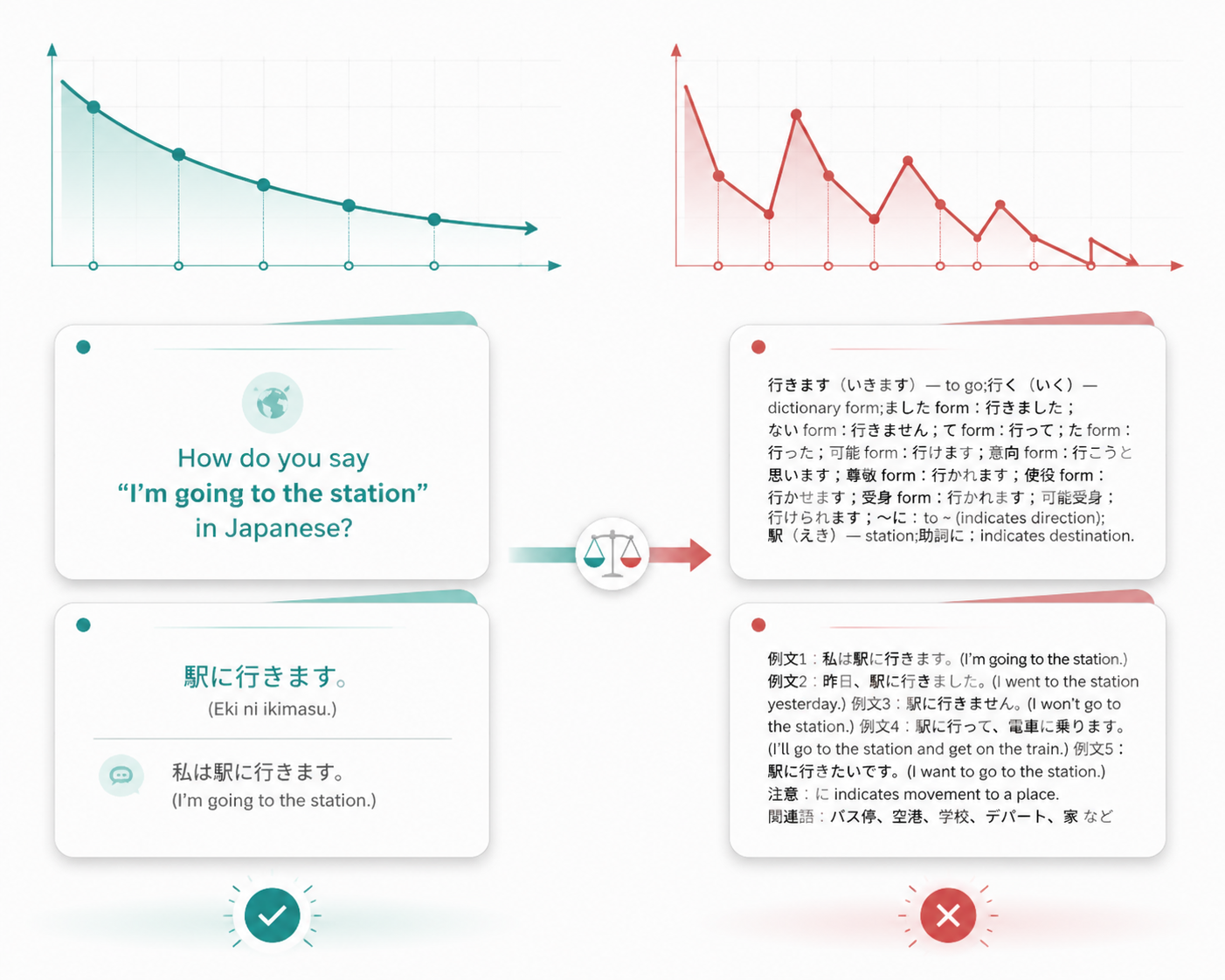
The best scheduler cannot repair bad cards
A strong SRS algorithm can decide when to show a card. It cannot decide whether the card deserved to exist in its current form. That is where many language decks quietly fail.
If one card asks for a word, its pronunciation, two example sentences, a grammar note, three synonyms, and a cultural aside, the algorithm receives a muddy signal. Did the learner forget the word? Misread the sentence? Fail to produce the gender? Miss the pitch accent? The review button records one grade, but the mental event was several failures tangled together.
This is why sentence cards, audio cards, and cloze deletions are not automatically better than basic word cards. They are better when they isolate the skill being trained. A listening card that asks the learner to recognize one phrase from audio gives the scheduler a cleaner memory signal. A cloze card that hides the exact grammar pattern under study can work well. A beautiful card that tests five things at once makes even a good scheduler look worse than it is.
The classroom evidence is a useful corrective here. Seibert Hanson and Brown’s 2019 peer-reviewed study of Anki use in second-language Spanish found that most students did not sustain SRS use even when it was graded. The important lesson is not that Anki failed as software. It is that better scheduling did not automatically create durable study behavior.[7]
Which app should a serious language learner choose?
If the priority is the strongest transparent SRS algorithm for a serious self-managed language deck, choose an FSRS-based app first. Anki with FSRS is the obvious power-user answer because it combines an open scheduler with mature card types, audio support, add-ons, and long-term deck ownership. MintDeck, RemNote, and FluentCards are also relevant if their surrounding study setup fits the learner better.
If the learner wants a guided course more than a personal flashcard system, Duolingo’s HLR research deserves respect. It is one of the rare cases where a major language app has published measurable recall-prediction and engagement results. But Duolingo is not simply a flashcard deck with an exportable scheduler; it is a full product environment, and that limits how directly its algorithm can be compared with Anki-style self-study.
If the learner wants polished prepared content and does not need algorithm transparency, Memrise can be considered, with the caveat that its strongest claims are harder to independently verify from the outside. It may be a good product choice without being the cleanest answer to the algorithm question.
If the learner is using Quizlet, the decision depends on the goal. For shared classroom lists, quick practice, or short-term review, it may still be convenient. For long-term language retention, current reports that true SRS is no longer available make it a poor default home for a serious deck.
| Learner type | Best algorithm fit | Reason |
|---|---|---|
| Large self-built deck, consistent daily review | FSRS | The learner can benefit from adaptive modeling and transparent long-term scheduling |
| Guided app learner who wants a course environment | HLR-backed product scheduling | Published Duolingo evidence supports recall prediction inside that context |
| Casual phrase learner | Leitner or simple SRS | The deck is small enough that crude scheduling may be adequate |
| Learner using polished proprietary content | Proprietary adaptive system, with caution | Product quality may be high, but the algorithm is harder to inspect |
| Cramming or classroom set sharing | Non-SRS flashcard tools can be acceptable | Long-term memory scheduling is not the main job |
A conditional verdict
For serious language learners who review consistently and make reasonably clean cards, FSRS-based apps are the strongest transparent choice. They model more of what matters: item difficulty, memory stability, and the probability of recall at a chosen time. That is closer to the real problem than moving a card through boxes or multiplying intervals by a mostly fixed factor.
HLR deserves respect because Duolingo published evidence that better recall prediction improved measurable outcomes in its own system. SM-2 remains usable, especially for learners with established decks and stable habits. Leitner is fine for lighter use. Proprietary systems may be strong, but they ask for more trust.
The best language learning flashcard app is not the one with the most cheerful review screen. It is the one whose scheduling model matches the scale of the learner’s memory problem—and whose review routine the learner will actually keep using.
References
- Free Spaced Repetition Scheduler documentation. Open Spaced Repetition.
- Spaced repetition. Wikipedia.
- A Trainable Spaced Repetition Model for Language Learning. Association for Computational Linguistics. 2016.
- Memrise Statistics: Revenue, Users and Growth. Skillademia. 2026.
- Quizlet spaced repetition user reports and comment discussion. FLTMAG and Reddit r/quizlet. 2024.
- Spaced repetition study of 26,258 physicians. PubMed. 2024.
- Anki: A study of spaced repetition software in a beginning L2 Spanish class. Computer Assisted Language Learning. 2019.
Related Resources
- 8 Anki MCAT Mistakes That Keep Your Score in the Low 500s (And How to Fix Them) →
If you've done thousands of Anki cards but your MCAT score is stuck in the low 500s, you're likely making one of these eight common mistakes. This guide breaks down each error, explains why it hurts your score, and gives you a concrete fix — plus a 3-step plan to turn things around today.
- Are Flashcards Actually Effective for Language Learning? A Science-Backed Guide to How They Work and When They Don't →
This guide examines the research behind flashcard-based vocabulary learning for intermediate language learners. It covers the cognitive science of why flashcards work (active recall, spaced repetition), their honest limitations (grammar, fluency, input substitution), and practical recommendations for using them effectively.
- How to Make Mandarin Flashcards That Actually Stick: Card Design, Pacing, and the Input Loop →
Most Mandarin learners struggle with flashcards not because they lack discipline, but because their card design is wrong. This guide prescribes a complete system for Chinese-specific card types, research-backed daily pacing, leech card triage, and the input loop that connects flashcard study to real-world fluency.
Comments
Join the discussion with an anonymous comment.