
The Best Japanese Kanji Flashcard Decks in 2026: A Complete Guide by Level and Platform
Overwhelmed by the hundreds of Japanese kanji decks on AnkiWeb? This guide cuts through the noise, comparing the top pre-made decks and platforms for every learner level — from absolute beginner to upper-intermediate — so you can pick the right deck and start learning kanji effectively.
Deck Sources
Why Kanji Flashcards and SRS Are Essential for Japanese Learners
Japanese presents a memorization challenge that most other languages simply do not. To reach functional literacy, you need to recognize roughly 2,000 to 2,500 kanji characters — each of which can have multiple readings depending on context. A single character like 生, for example, has over a dozen possible pronunciations. Relying on rote repetition or passive exposure alone is a recipe for burnout.
This is where spaced repetition systems (SRS) change the game. Instead of reviewing every character at the same frequency, an SRS algorithm schedules each card for review just as you are about to forget it. Anki, the most popular flashcard platform for Japanese learners, uses customizable intervals — the default settings schedule a card at 1 day, then 10 days, then multiplies the interval by 2.5x after each successful review. The result: you spend your study time on the characters you actually struggle with, not the ones you already know.
The problem is that AnkiWeb hosts nearly 1,000 shared Japanese decks, and the vast majority are poorly structured, outdated, or riddled with errors. Picking the wrong deck can waste weeks of study time. This guide exists to cut through that noise — not by declaring a single winner, but by matching the right deck categories to your specific level, learning style, and goals.
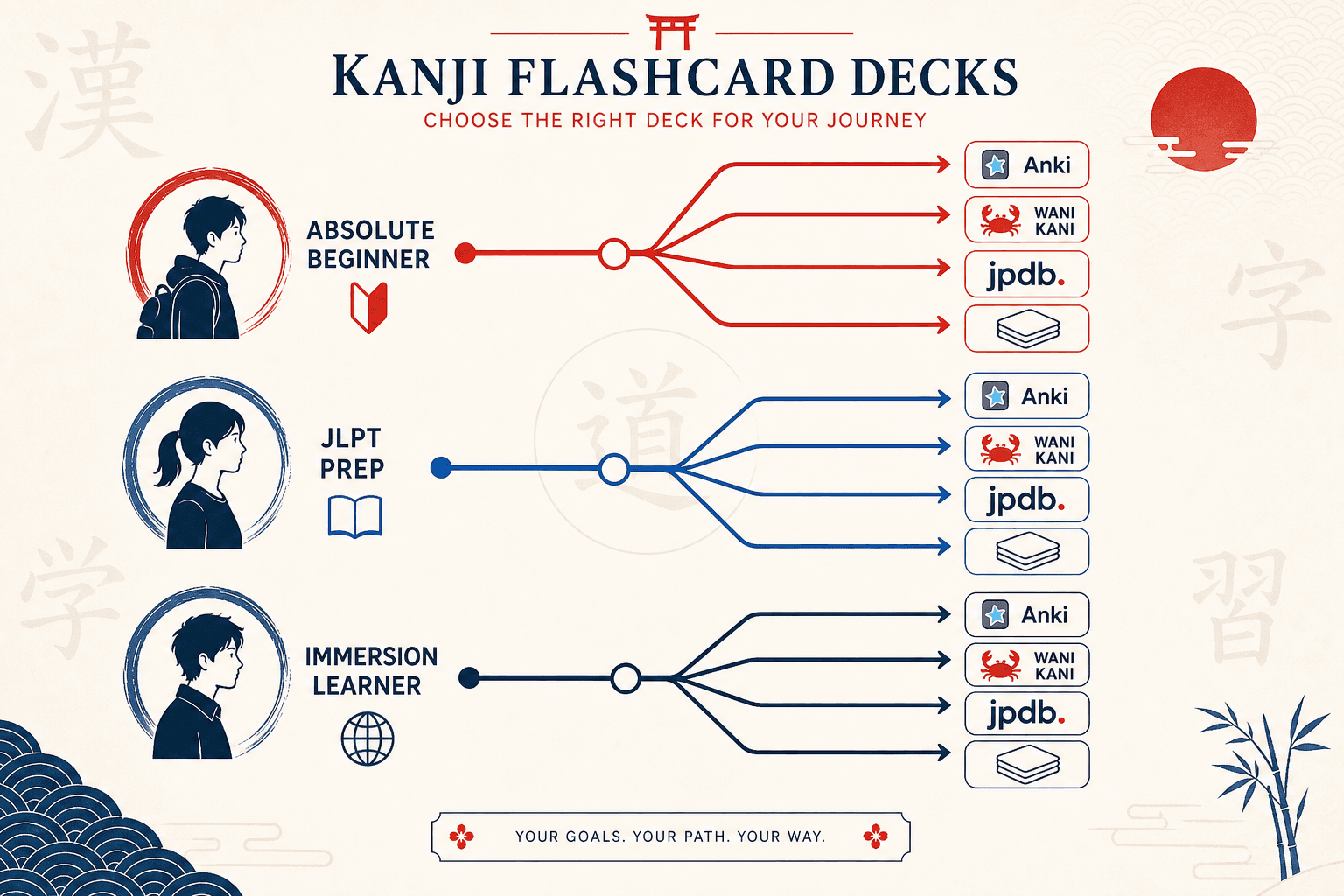
Quick Decision Framework: Which Deck Path Is Right for You?
Before we dive into detailed profiles, use this decision guide to identify which deck category matches your current situation. Each path leads to a different combination of decks and platforms.
| Your Profile | Primary Goal | Recommended Deck Path | Platform |
|---|---|---|---|
| Absolute beginner (knows kana, zero kanji) | Learn to recognize 2,000+ kanji meanings quickly | Recognition RTK (Heisig method) + Kaishi 1.5k vocabulary deck | Anki (free desktop/Android, $24.99 iOS) |
| JLPT N5 or N4 candidate | Pass a specific exam with known kanji lists | Tango N5 or N4 deck + JLPT-specific vocabulary deck | Anki or Kanjideck physical cards |
| Intermediate immersion learner (N3 or above) | Build vocabulary from native media | Core 2K/6K series or jpdb anime decks | Anki or jpdb (web-based) |
| Learner who wants structure and hates configuring Anki | Guided progression with built-in mnemonics | WaniKani (60 levels, ~2,000 kanji, ~6,000 vocab) | WaniKani ($9/month, $89/year, $299 lifetime) |
| Budget-conscious student who prefers physical cards | Offline study with tactile feedback | Kanjideck JLPT-level decks or Tuttle/White Rabbit sets | Physical cards ($35–$100 per level) |
Major Kanji Deck Categories: Detailed Profiles
Each deck category below represents a different learning philosophy. Some prioritize rapid recognition of kanji meanings; others focus on vocabulary in context; a few use humor or mnemonics to make characters stick. Understanding these differences is the key to building a deck stack that works for you.
Recognition RTK (Remembering the Kanji — Recognition Deck)
The Recognition RTK deck is a modern adaptation of James Heisig's classic method. Unlike the original Heisig approach, which required you to produce kanji from memory (writing them), this deck only asks you to recognize the kanji and recall its English keyword. It covers all 2,136 jouyou kanji (the characters required for everyday literacy in Japan) and can be completed in a few months if you maintain a consistent review pace.
The strength of this deck is speed. Because you are only learning one direction (kanji → English meaning), you can move through characters rapidly — 20 to 30 new cards per day is feasible for many learners. The trade-off is that you learn no readings, no vocabulary, and no writing. This deck must be paired with a separate vocabulary deck to be useful for actual reading.
All-in-One Kanji Deck
As its name suggests, the All-in-One Kanji Deck attempts to be the only kanji deck you will ever need. It includes 2,136 Jouyou kanji, 861 Jinmeiyou kanji (used in names), 2,500 of the most frequent kanji, and 3,007 Heisig kanji — a total that far exceeds what even advanced learners need. Each card typically includes the kanji, its readings, stroke order, and example words.
The density of this deck is both its selling point and its weakness. With thousands of cards covering overlapping kanji sets, the deck can feel overwhelming. Most learners who try to use it as their primary deck end up setting a daily limit of 5 to 10 new cards and still struggle to keep up with reviews. It is better suited as a reference deck — something you dip into when you encounter an unfamiliar kanji — than as a daily study driver.
KanjiDamage
KanjiDamage takes a deliberately irreverent approach. It covers 1,700 kanji using crude, memorable mnemonics — often built around "Yo Mama" jokes and pop culture references. Every kanji is broken into components with a math-style notation, and the deck includes over 800 hints to help you distinguish look-alike characters. It also cuts over 100 bogus jouyou kanji that appear in official lists but are rarely used.
The official Anki deck includes stroke order diagrams and ranks all words by usefulness. The mnemonics are not for everyone — some learners find them distracting or juvenile — but for those who respond well to humor and absurdity, KanjiDamage can make the early stages of kanji learning genuinely entertaining. It covers fewer characters than Recognition RTK or the All-in-One deck, so you will eventually need to supplement it.
Core 2K / 6K / 10K Vocabulary Decks
The Core series is one of the oldest and most established deck families for Japanese learners. Core 2000 Step 01 teaches 2,000 of the most common words using sentence cards with audio. It includes 405 audio files and 235 images, and most learners complete it in 2 to 3 months. Core 2000 Step 02 adds another 2,000 words, and the Core 6000 and Core 10000 extensions push into intermediate and advanced vocabulary.
The Core decks are sentence-based: each card shows a Japanese sentence with one target word highlighted, the reading, and an English translation. This approach teaches vocabulary in context, which is far more effective for retention than isolated word lists. The downside is that the decks are older and the audio quality varies. Some community-maintained versions have updated the audio and fixed errors.
Kaishi 1.5k
Kaishi 1.5k is the newcomer that has rapidly become the most recommended starting vocabulary deck in 2026. It covers 1,500 common words with pitch accent graphs, cleaner card design, and better mobile optimization than the older Core decks. The pitch accent graphs are a standout feature — they visually show the rising and falling pitch pattern of each word, which is critical for speaking and listening comprehension but missing from most other beginner decks.
The deck is designed to be used immediately after learning kana, making it an excellent companion to a kanji recognition deck like Recognition RTK. Its vocabulary selection focuses on high-frequency words that appear in everyday conversation and beginner-level media. The mobile-friendly formatting means the cards display properly on phone screens, which is not true of many older Anki decks.
Tango N5 and N4 Decks
The Tango decks are built around the principle of i+1 sentences — each card introduces exactly one new vocabulary item or grammar point, using only words and kanji that have appeared in previous cards. This creates a carefully scaffolded learning progression where nothing feels random or out of reach.
The Tango N5 deck covers the vocabulary and kanji needed for the JLPT N5 exam (roughly 100 kanji and 800 words), and the Tango N4 deck extends to the N4 level (approximately 300 total kanji). The sentence ordering is deliberate and effective — you never encounter a card that requires knowledge you have not yet learned. This makes the Tango decks ideal for JLPT candidates who want a structured, exam-aligned path.
JLPT-Specific and Themed Decks
Beyond the major categories, several specialized decks serve niche needs. The Japanese Visual Novel, Anime, Manga, LN Vocab – V2K deck contains over 2,000 words commonly found in Japanese media, making it a strong choice for learners who want to understand anime and manga without constant dictionary lookups. The JLPT Grammar from Jtest4you deck divides grammar points by JLPT level, which pairs well with vocabulary decks for exam preparation.
For learners using the Genki textbook series, the Genki 1 & 2 Kanji deck covers lessons 3 through 23 and aligns directly with the textbook's kanji introduction order. This is a practical choice for classroom students or self-learners following the Genki curriculum.
| Deck Name | Kanji / Word Count | Learning Approach | Mnemonic Support | Audio | JLPT Alignment | Best For |
|---|---|---|---|---|---|---|
| Recognition RTK | 2,136 jouyou kanji | Kanji → English meaning only | Heisig keywords | None | None (general literacy) | Absolute beginners who want rapid kanji recognition |
| All-in-One Kanji Deck | 2,136 Jouyou + 861 Jinmeiyou + 2,500 frequent | Kanji + readings + examples | Heisig keywords included | None | N5–N1 | Reference deck; not recommended as primary daily driver |
| KanjiDamage | 1,700 kanji | Kanji + components + crude mnemonics | Yo Mama jokes, 800+ hints | None | None | Learners who enjoy humor-based mnemonics |
| Core 2K Step 01 | 2,000 words | Sentence-based vocabulary | None | 405 audio files | N5–N4 | Learners who want vocabulary in context |
| Kaishi 1.5k | 1,500 words | Vocabulary with pitch accent graphs | None | Yes (pitch accent graphs) | N5–N4 | Beginners who want modern, mobile-friendly design |
| Tango N5 | ~800 words, ~100 kanji | i+1 sentence progression | None | Yes | N5 | JLPT N5 candidates who want structured progression |
| Tango N4 | ~1,500 words, ~300 kanji | i+1 sentence progression | None | Yes | N4 | JLPT N4 candidates continuing from Tango N5 |
Platform Comparison: Anki vs. WaniKani vs. jpdb vs. Brainscape vs. Physical Decks
The deck is only half the equation. The platform you use to study it determines your daily experience — how much control you have, how much you pay, and how much structure is provided. Here is how the major platforms stack up for kanji learning.
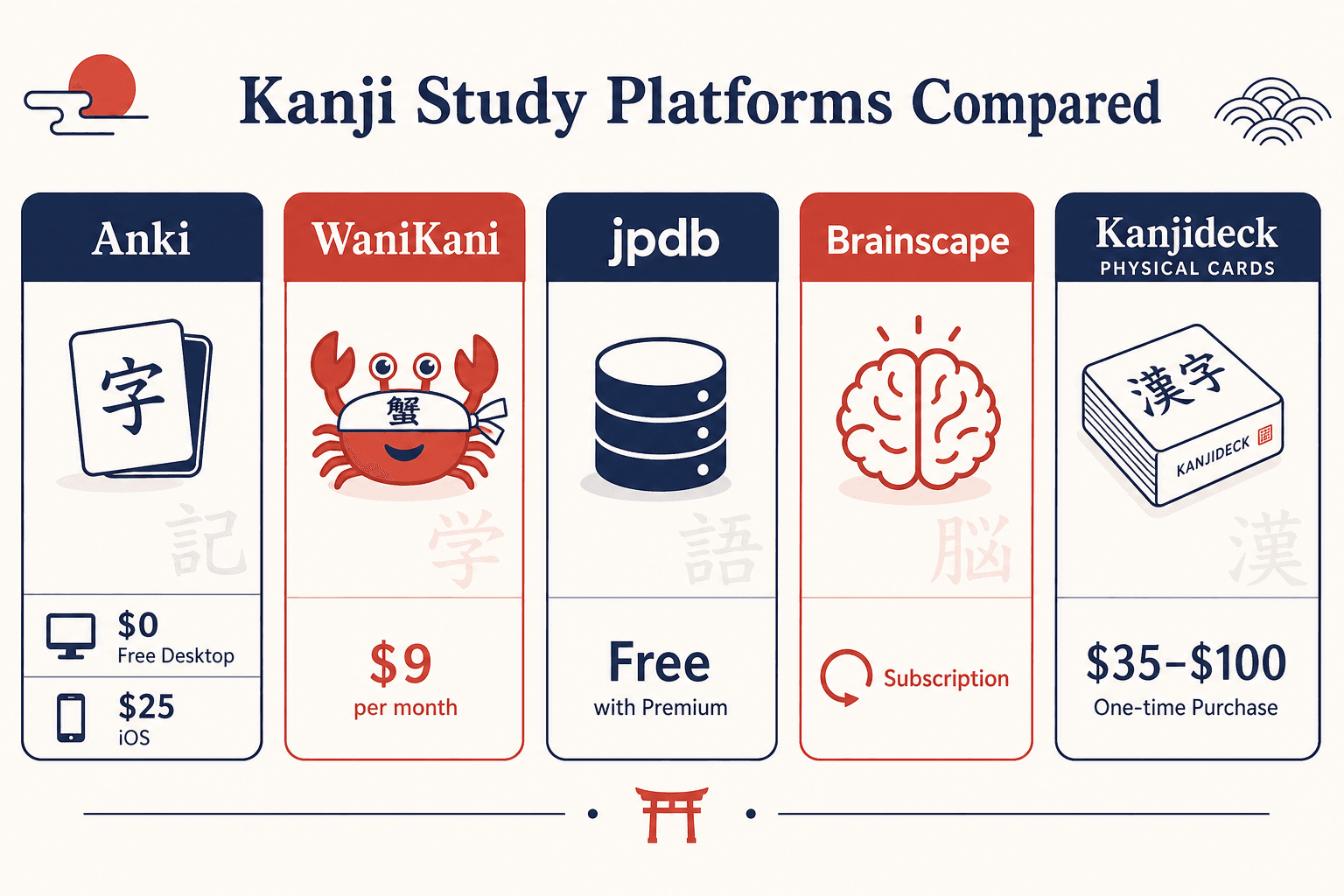
| Platform | Pricing | SRS Algorithm | Kanji Coverage | Customization | Best For |
|---|---|---|---|---|---|
| Anki | Free (desktop/Android); $24.99 (iOS) | SM-2 (default) or FSRS (optional) | Any — depends on deck chosen | Full control over cards, intervals, and add-ons | Learners who want complete control and are willing to configure |
| WaniKani | $9/month, $89/year, or $299 lifetime | Proprietary (5 stages, 8 levels) | ~2,000 kanji + ~6,000 vocab | Minimal — built-in mnemonics, no card editing | Beginners who want a structured, guided path |
| jpdb | Free tier; paid tier available | Machine-learning-based (handles lapses better than SM-2) | 21,434 prebuilt decks from 1,399 anime | Moderate — can extract vocab from any text | Intermediate learners who want to study from anime and media |
| Brainscape | Free tier; paid subscription for full access | Proprietary adaptive system | User-created decks; limited Japanese-specific content | Limited compared to Anki | Learners who prefer a simple, mobile-first interface |
| Kanjideck (Physical) | $35 (JLPT-5), $55 (JLPT-4), $100 (JLPT-3) | Manual spaced repetition (user-managed) | 80 (N5), 167 (N4), 380 (N3) kanji per deck | None — fixed card set | Learners who prefer tactile, offline study |
Anki: The Power User's Choice
Anki remains the dominant platform for serious Japanese learners because it offers complete control. You can customize every aspect of your cards, choose from hundreds of community decks, install add-ons like the Japanese Support add-on for furigana and pitch accent, and switch between the default SM-2 algorithm and the newer FSRS algorithm. The trade-off is a steep learning curve — configuring Anki for Japanese requires several setup steps that many beginners find frustrating.
For readers who want a detailed walkthrough of Anki's features and pricing, see our Anki Flashcard App Review. If you need help with the initial setup, our beginner's guide to setting up Anki walks through the process step by step.
WaniKani: Structure Over Flexibility
WaniKani takes the opposite approach. It teaches approximately 2,000 kanji and 6,000 vocabulary words across 60 levels with built-in mnemonics for every character and word. You cannot edit cards, change the order, or skip ahead — the system dictates your progression. Learners must type their answers; there is no multiple choice. This rigidity is a feature for beginners who want a clear path and a bug for advanced learners who want to move faster.
WaniKani's SRS has five stages (Apprentice with 4 sub-levels, Guru, Master, Enlightened, and Burned). Completion typically takes about 1.5 years with consistent daily reviews. The first 3 levels are free, after which it costs $9 per month, $89 per year, or a $299 lifetime subscription.
jpdb: The Media-Focused Alternative
jpdb is a web-based platform that combines a Japanese dictionary with a machine-learning SRS algorithm. It offers 21,434 prebuilt decks drawn from 1,399 different anime. You can paste any Japanese text into the platform, and it will extract the vocabulary and sequence it chronologically for study. It can also suggest media where you already know 90% or more of the vocabulary, which is a powerful feature for learners transitioning from textbook study to native content.
jpdb's SRS algorithm is more sophisticated than Anki's default SM-2 — it handles lapses and irregular reviews better, and it automatically teaches the kanji needed for each vocabulary item. The platform can also partially import existing Anki databases, making it a viable migration path for learners who want to switch.
Physical Decks: Kanjideck, Tuttle, and White Rabbit
Physical flashcard decks remain a viable option for learners who want to reduce screen time or prefer tactile learning. Kanjideck offers JLPT-level physical decks with colored radicals, etymology notes, and example compounds that use only previously seen kanji. The JLPT-5 deck (80 kanji) costs $35, the JLPT-4 deck (167 kanji) costs $55, and the JLPT-3 deck (380 kanji) costs $100. All three are currently listed as pre-order with a November 2026 shipping date. Kanjideck also offers a digital Anki deck covering all 2,136 Jōyō kanji for a one-time payment of $19.
Other physical options include Tuttle Kanji Flash Cards (covering the first 200 JLPT kanji), Dr. Moku's mnemonic-illustrated cards, and White Rabbit's beginner and intermediate decks (1,000+ Joyo kanji). These lack the SRS scheduling of digital platforms, so you will need to manage your own review intervals or use a Leitner box system.
How to Combine Decks for Maximum Efficiency
The most effective Japanese learners do not rely on a single deck. They combine a kanji recognition deck with a vocabulary deck, creating a system where each reinforces the other. Here is the most common and recommended combination.
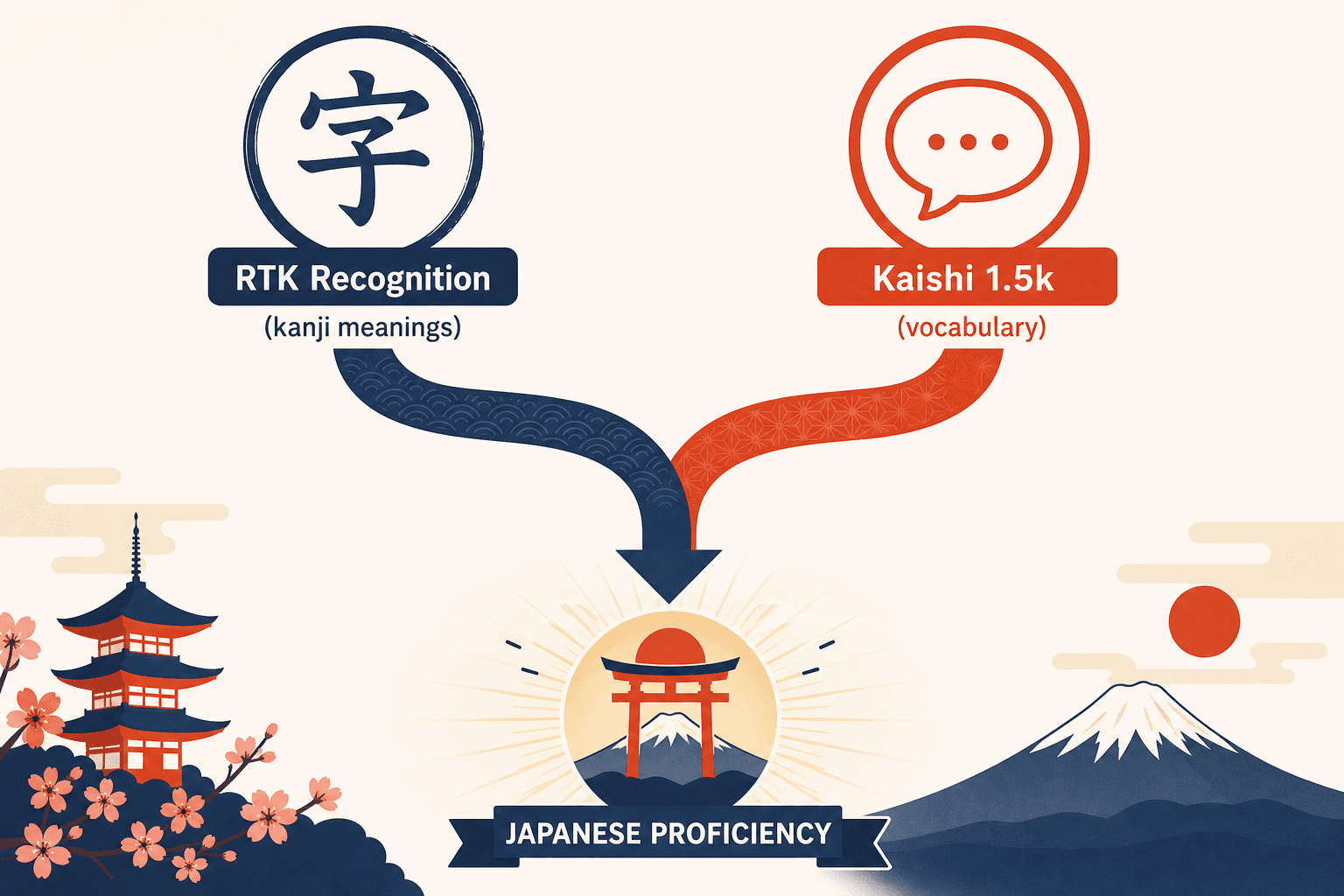
Start with a kanji recognition deck — Recognition RTK is the strongest choice for this role. Study 15 to 20 new kanji per day, focusing only on the kanji-to-English meaning direction. After two to three months, you will have seen all 2,136 jouyou kanji at least once. You will not know their readings or any vocabulary, but each character will look familiar rather than alien.
Simultaneously (or after a short delay), begin a vocabulary deck. Kaishi 1.5k is the best current option for this role because its pitch accent graphs and mobile-friendly design make it easy to maintain alongside a kanji deck. Set a daily limit of 10 to 15 new vocabulary cards. As you encounter kanji in the vocabulary deck that you have already seen in the recognition deck, the connection between meaning and reading will strengthen naturally.
Here is a sample weekly schedule for this combined approach:
- Daily: 15–20 new Recognition RTK cards + reviews
- Daily: 10–15 new Kaishi 1.5k vocabulary cards + reviews
- Total daily study time: 30–45 minutes
- Weekly: One day of catch-up reviews if backlog builds
- Monthly: Review retention rate — if below 85%, reduce new card count
Common Pitfalls and How to Avoid Them
Even with the right deck and platform, several common mistakes can derail your progress. Here are the ones we see most frequently — and how to sidestep them.
- Learning kanji in isolation without vocabulary context. Knowing that 食 means "eat" is useless if you cannot read 食堂 (cafeteria) or 食欲 (appetite). Always pair a kanji deck with a vocabulary deck.
- Ignoring readings entirely. The Recognition RTK approach is fast, but if you never learn the on'yomi and kun'yomi readings, you will not be able to read real Japanese. Transition to a vocabulary deck within a few months of starting kanji study.
- Setting too many new cards per day. Starting with 50 new cards feels productive for the first week, but the review burden doubles every few days. Within two weeks, you will be drowning in reviews. Start at 10 to 15 new cards per day and increase only if your retention rate stays above 85%.
- Inconsistent review habits. SRS works best when you review every day. Missing three days creates a backlog that can take an hour to clear, which makes you more likely to miss another day. Set a minimum daily commitment — even 10 minutes of reviews is better than skipping entirely.
- Using multiple kanji decks simultaneously. Studying Recognition RTK, KanjiDamage, and the All-in-One deck at the same time creates confusion because each deck uses different mnemonics and ordering. Pick one kanji deck and one vocabulary deck, and stick with them for at least three months.
Final Recommendations by Learner Profile
There is no single best kanji deck. The right choice depends on who you are, where you are in your learning journey, and how much structure you want. Here is a summary of our recommendations for the most common learner profiles.
| Learner Profile | Recommended Deck(s) | Platform | Estimated Monthly Cost | Daily Time Commitment |
|---|---|---|---|---|
| Absolute beginner (knows kana, zero kanji) | Recognition RTK + Kaishi 1.5k | Anki (free desktop/Android, $24.99 iOS) | $0 (desktop) or $24.99 one-time (iOS) | 30–45 minutes |
| JLPT N5 or N4 candidate | Tango N5 or N4 deck + JLPT Grammar deck | Anki | $0 (desktop) or $24.99 one-time (iOS) | 30–40 minutes |
| Intermediate immersion learner (N3+) | Core 6K or jpdb anime decks | Anki or jpdb (free tier available) | $0–$10/month | 20–30 minutes |
| Learner who wants structure (no Anki setup) | WaniKani (all-in-one system) | WaniKani | $9/month or $89/year | 20–30 minutes |
| Budget-conscious student who prefers physical cards | Kanjideck JLPT-5 ($35) or Tuttle Kanji Flash Cards | Physical cards (Leitner box for SRS) | $35 one-time (per level) | 15–20 minutes |
Whichever path you choose, the most important factor is consistency. A decent deck studied every day for 20 minutes will take you further than a perfect deck studied sporadically. Start with one combination, commit to it for 90 days, and adjust based on what you learn about your own study habits. The kanji will not learn themselves — but with the right deck and a steady routine, 2,000 characters is an achievable goal, not an impossible mountain.
Related Resources
- GRE Vocabulary Flashcard Decks Compared: Magoosh, Anki, Brainscape, and Quizlet →
A deck-by-deck evaluation of the most-used GRE vocabulary flashcard options — comparing word count, SRS support, cost, and post-2023 test alignment — so you can choose the right deck for your timeline and learning style before committing study time.
- GRE Vocabulary Flashcards: How to Choose the Right Tool and Use It Effectively →
A practical guide for GRE test-takers who feel overwhelmed by flashcard options — covering how the post-2023 GRE actually tests vocabulary, how to evaluate and choose between Anki, Magoosh, Brainscape, Quizlet, and paper cards, and how to build a daily study routine that turns flashcard drilling into real Verbal score gains.
- How Many GRE Vocabulary Words Do You Actually Need? A Data-Backed Guide to Deck Size and Retention →
Feeling overwhelmed by 3,500-word lists? This guide uses expert consensus and data to show that 800–1,200 high-frequency words studied deeply are the real target for a competitive GRE Verbal score. Learn why smaller, focused decks win, how the shorter GRE changes the math, and how to build a practical study plan.
Comments
Join the discussion with an anonymous comment.