ASVAB, SAT, ACT, GRE Exam Hub
What Exams Actually Test About the 2026 Total Solar Eclipse
Solar eclipses show up on the ASVAB, SAT, ACT, and GRE in different test modes — definition recall, in-passage reasoning, or chart reading. This study guide shows which 2026 eclipse concepts are actually worth your time, anchored to the August 12, 2026 total eclipse.
- gre
- mcat
- asvab
- sat
- act
- digital-adaptive
- official-material
- section-strategy
- test-date-timeline
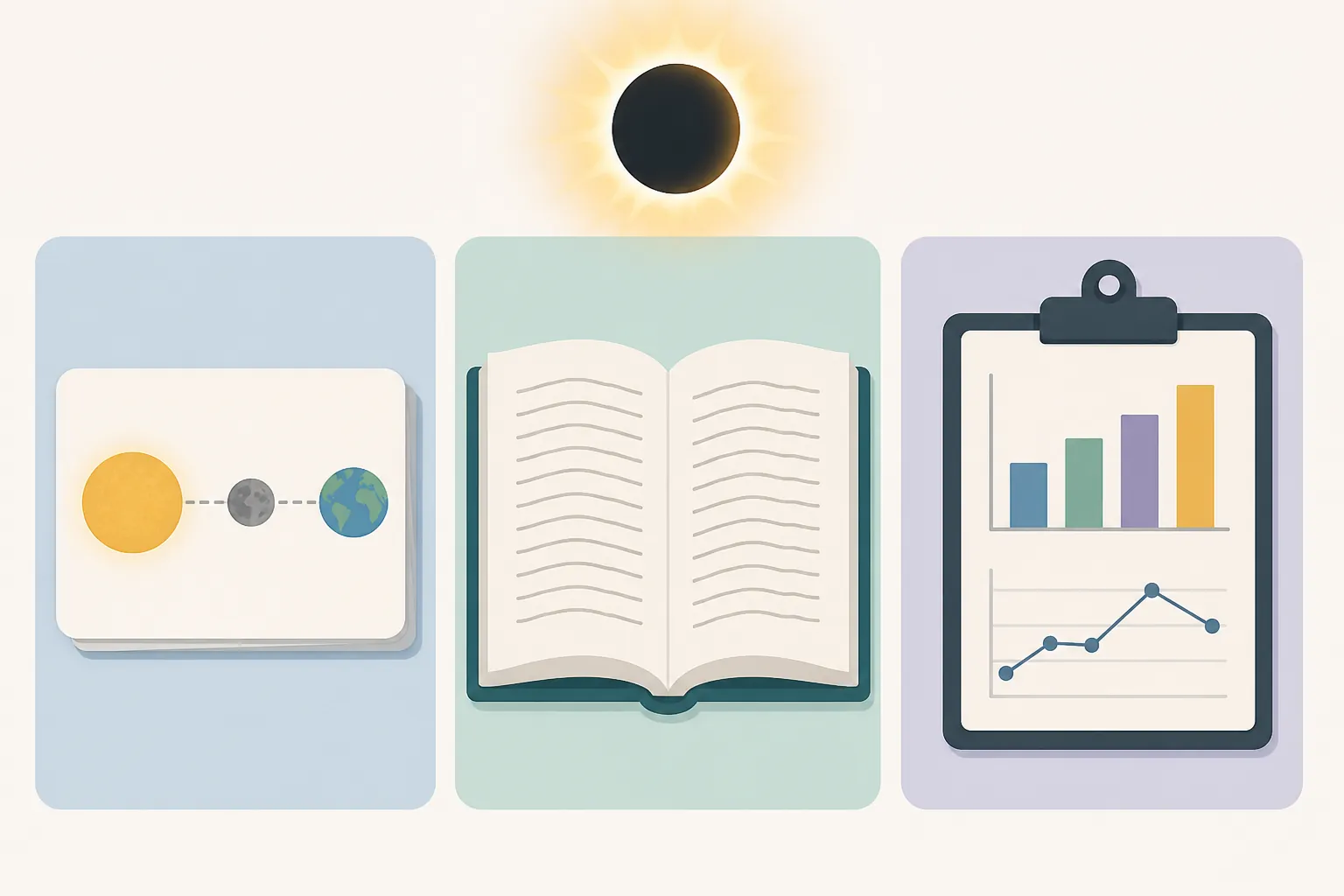
If a solar eclipse appears on your ASVAB, SAT, ACT, or GRE prep, the first question is not “How much astronomy can I learn?” It is “What is this exam using the eclipse to test?” The answer changes by exam. ASVAB-style General Science practice asks for basic Earth-Moon-Sun arrangement recall. Digital SAT Reading and Writing practice can place eclipse facts inside a transition or reasoning question. GRE Verbal practice can use a total eclipse passage to test purpose, tone, or inference. ACT Science is the one most likely to make eclipse information behave like data: durations, coverage, paths, tables, and graphs.
That is why an exam study guide for the 2026 total solar eclipse should not turn into a viewing guide or a history lesson. The August 12, 2026 eclipse is useful because it gives you concrete numbers to read and compare: date, path, duration, magnitude, city coverage, and total versus partial conditions. It is not useful because your exam is likely to ask whether you memorized Saros 126.
Start with the exam mode, not the eclipse
The cleanest way to keep this topic under control is to separate four testing modes before you study any details.
| Exam | What the eclipse topic usually becomes in practice | What to study first | What not to over-study |
|---|---|---|---|
| ASVAB General Science | Definition and arrangement recall | Sun-Moon-Earth alignment, umbra, penumbra, new moon connection | Named historical eclipses, Saros cycle labels |
| Digital SAT Reading and Writing | Passage-based reasoning, transitions, evidence, purpose | How to use supplied facts inside the sentence or paragraph | Outside astronomy facts that the question does not ask for |
| ACT Science | Chart, table, map, and variable interpretation | Duration, magnitude, path width, city coverage, total versus partial data | Narrative eclipse history |
| GRE Verbal | Reading comprehension, author purpose, inference, language | How the passage frames the eclipse, not how eclipses mechanically work | Astronomy recall unless the passage itself requires it |
The evidence for those modes is format evidence, not a complete map of every official item pool. A CrackASVAB General Science practice item asks directly which arrangement causes a solar eclipse, with the Moon between the Sun and Earth as the tested idea.[1] A SATPanda digital SAT Reading and Writing practice item uses eclipse facts inside a transition question, including a 762 BCE total eclipse lasting 7 minutes 25 seconds and a 424 BCE annular eclipse, but the work is choosing the logical connection between sentences.[2] A Graduate’s Hotline GRE reading comprehension set uses Annie Dillard’s “Total Eclipse” as literary nonfiction, where the task is verbal analysis rather than astronomy recall.[3]
Third-party practice banks are not the same as official College Board, ACT, ETS, or DoD releases. Still, they are useful warnings. The same sky event can become a definition question, a transition question, a chart-reading question, or a prose-analysis question. Studying one way for all four is how students lose evenings.
The small mechanics set worth knowing
For exams, the core mechanics set is small. A solar eclipse happens when the Moon passes between the Sun and Earth and blocks sunlight from reaching part of Earth. The darkest central shadow is the umbra; the lighter outer shadow is the penumbra. A total solar eclipse is seen from inside the Moon’s umbra, while a partial eclipse is seen from the penumbra. Solar eclipses occur at new moon, but not at every new moon because the Moon’s orbit is tilted about 5 degrees relative to Earth’s orbit around the Sun.[4][5]
That paragraph is close to the ceiling for most non-specialist exam prep. If you need the concept lesson itself, use StudyMethod’s 2026 solar eclipse astronomy guide and the related moon phases astronomy study guide. This article is doing a different job: deciding how much of that mechanics background each exam actually rewards.
Related exhibits & inventory
Verified outcomes
No verified outcomes on file for this exam yet
See Methodology for how outcome evidence is disclosed once logged.
Planners
No planner filed for this exam yet
A downloadable timeline template for this exam hasn't been published yet.
Tool verdicts
AI-tool cautions
No AI tools tested for this exam yet
No hands-on AI-accuracy logs have been filed for this exam.
Questions about this plan
Ask a question about a specific section, timeline, or citation in this plan — or flag something that needs correcting.
Comments
Join the discussion with an anonymous comment.