
SAT, ACT Exam Hub
Free SAT and ACT Support Programs for Rural Students
This guide explains how rural students can access free SAT and ACT fee waivers, official prep courses from College Board and ACT, and school-run programs like TRIO and GEAR UP, with step-by-step instructions for getting each one.
- gre
- mcat
- asvab
- sat
- act
- digital-adaptive
- official-material
- section-strategy
- test-date-timeline
A rural student can be ready to study for the SAT or ACT and still be stopped by the first page of the process: the test costs money, the official prep account is somewhere else, the home internet cuts out, and the one adult at school who knows the waiver rules is booked through next week. That is why the useful version of “rural children education support programs” starts with a practical question: which free programs can remove the registration fee, unlock official prep, and give the family a named school contact before anyone pays for commercial tutoring?
The access problem is not imagined. In 2019 NCES data, 76% of rural students had fixed home broadband, compared with 87% of suburban students; 663,000 rural students, or 7%, had no home internet at all. NCES also found that the poverty gap in no-internet access was largest in rural areas, at 14 percentage points. Those figures are from 2019 and should not be treated as a perfect picture of 2026, but they explain why test prep is often logistical before it is motivational.[1]

The good news is that the free official stack is more concrete than many families realize. It is not just a motivational website or a PDF of tips. For eligible students, the SAT and ACT pathways can combine fee waivers, official practice, full-length timed tests, score reports, and school-side programs that may cover preparation or registration barriers. The catch is that the pieces live in different places.
Start with the free official stack, not a paid prep cart
Before comparing paid courses, a rural family should try to unlock the official resources attached to the test itself. That order matters because the waiver is often the key that opens the rest of the package.
| Step | What to do | Who usually helps | What it can unlock |
|---|---|---|---|
| 1. Check waiver eligibility | Ask whether the student qualifies for an SAT or ACT fee waiver and what documentation the school needs. | School counselor, testing coordinator, college access adviser | Free or reduced test registration costs and related benefits |
| 2. Choose the test path | Decide whether the student is registering for SAT, ACT, or both based on school requirements, nearby test centers, and deadlines. | Student and parent, with counselor support | A clear registration plan instead of duplicate accounts and missed deadlines |
| 3. Activate official prep | Use the free prep tied to that exam: Khan Academy and Bluebook for SAT, ACT’s Kaplan-powered self-paced course for ACT waiver users. | Student, parent, counselor, or teacher | Official-style questions, lessons, timed practice, and full-length tests |
| 4. Ask about school-side support | Request information on TRIO, GEAR UP, Title I/IV-A-funded prep, after-school labs, transportation, or registration help. | Counselor, principal, district federal programs office, college access program staff | Prep materials, supervised internet access, fee support, advising, and deadline help |
StudyMethod’s practical view is that this free stack covers most commercial prep functions for many rural families: official content review, practice questions, full-length tests, account-based progress, and registration-cost relief. That is a prioritization judgment, not a verified promise that a student’s score will rise by a specific number of points.
SAT support: the waiver, Khan Academy, and Bluebook
The SAT side begins with the fee waiver. College Board says SAT fee waivers are for eligible low-income 11th- and 12th-grade students in the United States and U.S. territories, and students get access through their school counselor or another authorized school representative.[2]
Eligibility can be shown several ways. College Board lists routes such as enrollment in or eligibility for the National School Lunch Program, meeting USDA income eligibility guidelines, participation in a federal, state, or local program that aids low-income students such as TRIO, being enrolled in a program for students from low-income families, living in federally subsidized public housing, being in foster care, being homeless, or being a ward of the state or an orphan.[2]
The family-facing instruction is simple, but it needs to be said plainly: do not start by asking, “Is the SAT free?” Ask, “Can you check whether I qualify for a College Board SAT fee waiver, and what record do you need from me?” If the counselor says the school uses meal forms, income surveys, or another student-support record, ask when that record must be completed for the current testing year.
That wording matters because school-meal status and fee-waiver eligibility are related, but they are not always the same administrative record sitting in the same office. If your household income form was never submitted, or if a deadline passed, the student may look ineligible in one system even when the family would qualify under the rules. We cover that documentation trap in more detail in the fee-waiver eligibility and income-survey guide.
Once the SAT path is open, the prep side should use two official pieces together. Official Digital SAT Prep on Khan Academy is free and built in partnership with College Board; College Board also points students toward timed full-length practice tests in the Bluebook app.[3]
- Use Khan Academy for skill practice, explanations, and targeted lessons.
- Use Bluebook for the timed full-length testing experience, because the Digital SAT is not just a paper worksheet moved online.
- If home internet is unreliable, ask the school whether the student can reserve a library computer, supervised lab period, advisory block, or after-school time for Bluebook practice.
For a fuller SAT sequence, the SAT exam prep guide lays out a free-first plan around Bluebook and Khan Academy. Students who are worried about the adaptive math section can also use the Digital SAT Math practice guide to focus on official-format math work and calculator strategy.
ACT support: the waiver package is unusually concrete
The ACT waiver is worth checking even for families who assume a waiver only covers the registration fee. ACT says its fee waiver covers up to two ACT tests, including optional science and writing fees. It also includes free access to the Official ACT Self-Paced Course Powered by Kaplan, a free answer-key service, free score reports, and college application fee waivers.[4]
The prep course is a real piece of the package, not a small add-on. ACT describes the free Official ACT Self-Paced Course Powered by Kaplan as including 30 video lessons, more than 2,000 questions, 5 full-length practice tests, and 1 year of access for eligible fee-waiver students.[4]
The access question for the ACT is therefore not only, “Can I take the test without paying?” It is also, “Can the school help me activate the ACT fee waiver benefits so I can use the Kaplan-powered course and practice tests?” A student who gets a waiver code but never activates the prep course has left one of the most useful parts of the waiver untouched.
- Ask the counselor or testing coordinator whether the student qualifies for an ACT fee waiver.
- Confirm how many ACT attempts the student can use under the waiver and which test dates are realistic based on transportation and school calendars.
- After receiving waiver access, ask how to activate the Official ACT Self-Paced Course Powered by Kaplan.
- Schedule practice time somewhere with stable internet if home access is weak: school library, public library, community center, or a supervised school lab.
- Use the included full-length practice tests before buying any paid ACT prep.
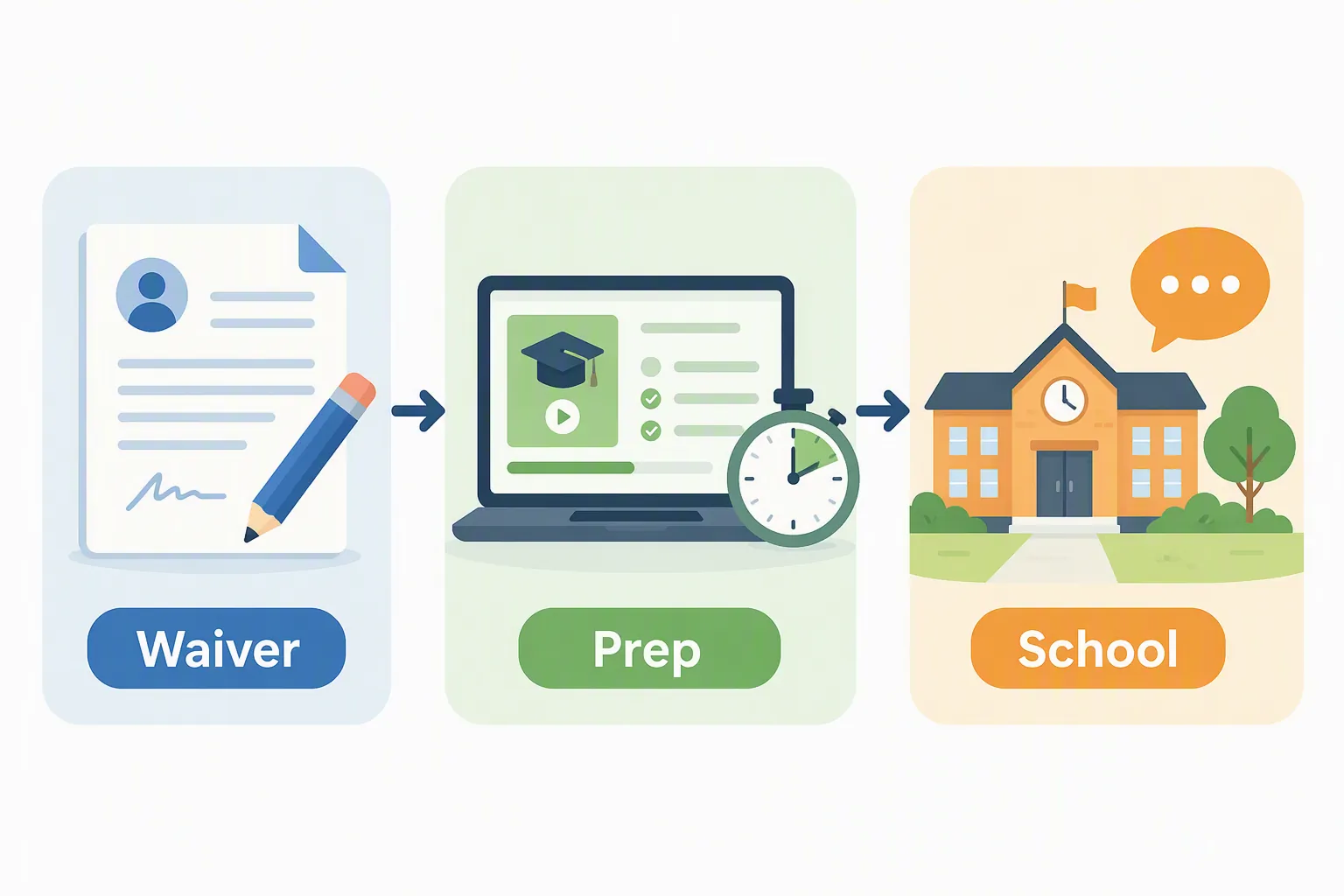
When the school answer is unclear, ask for the program layer
In many rural schools, the counselor is not just a counselor. That person may also be the testing coordinator, scholarship adviser, schedule fixer, and the adult expected to know every outside program. If the first answer is “I’m not sure,” the next move is not to give up. Ask which program office handles college access funds.
TRIO and GEAR UP are especially relevant in rural communities. American Progress reported in 2025 that about 55% of TRIO-served students come from rural areas, even though rural areas hold roughly 20% of the U.S. population.[5]
The family does not need to become a federal-program expert. The useful question is whether the school, district, nearby college, or regional education agency has a program that can pay for or provide SAT/ACT preparation, registration help, advising, transportation, or supervised online practice time. A school funding guide from Progress Learning lists Title I, Title IV-A, GEAR UP, and TRIO as possible funding sources schools may use for ACT/SAT prep materials and registration-related support.[6]
| If you hear this term | Ask this practical question |
|---|---|
| TRIO | Does our school or a nearby college have a TRIO program that helps eligible students with test registration, prep, advising, or college applications? |
| GEAR UP | Is our grade level or school part of a GEAR UP cohort, and does it include SAT/ACT prep or college-entrance testing support? |
| Title I | Can Title I funds support test-prep materials, after-school prep, or internet access for eligible students? |
| Title IV-A | Are there student-support or well-rounded-education funds that cover college-readiness testing or prep? |
| Local foundation or college-access grant | Is there a regional program that pays registration fees, transportation, or prep access for rural students? |
Funding can change from year to year, and 2026 budget debates have made some college-access pipelines feel less secure. That is another reason to ask early in the semester, not the week registration closes. If your school had a prep program last year, ask whether it still exists this year, who runs it now, and whether current juniors and seniors are eligible. For more on how funding cuts can affect test-prep access, see our guide to DEI funding cuts and test-prep pipelines.
The paperwork is part of the access problem
Families often treat paperwork as a side errand. For SAT and ACT support, it can be the gate. A missing income survey, an outdated household-size record, or a student-support program that was never linked to the testing account can turn a free official resource into something the student never sees.
A parent can make the counselor’s job easier by bringing or asking about the records that match the eligibility routes: school meal eligibility, household income information, participation in TRIO or another low-income student program, foster-care documentation, homelessness liaison confirmation, or other records the school already uses. The point is not to overshare personal information with every office. It is to find the one authorized school contact who can verify eligibility for the testing program.
Students in mixed-status or protected-status households should also be careful not to assume immigration category is the deciding factor. Fee waivers are generally tied to income or qualifying support status, not a family’s immigration label. We explain that distinction in the testing guide for students with Temporary Protected Status.
What free official prep can and cannot promise
Free official prep is the right first stop because it removes cost and uses official test-aligned materials. That is different from saying it guarantees a score jump. Brookings cautioned in July 2025 that the well-known “20 hours” SAT-prep claim did not account for natural retest growth; it also noted that a 2020 follow-up placed the benefit for six or more hours of practice at about 21 points, that only about 10% of students practiced six or more hours, and that an ACT-sponsored randomized trial of ACT Online Prep found no score difference partly because more than half of users never started.[7]
That evidence does not make official prep useless. It makes the promise more modest and more honest. A student still has to log in, practice, review mistakes, and sit for timed tests. A family still has to solve the internet problem if the house cannot support an online practice session. A counselor still has to help unlock the waiver or point the student to the person who can.
Paid courses can be useful for some students, especially when they provide scheduled accountability or specialized tutoring. But rural families should read guarantees carefully before spending money. If a paid program promises a score increase, check the fine print on attendance, baseline testing, refund rules, and whether the student can realistically meet every condition. Our guide to SAT prep score guarantees walks through those conditions.
A practical order before paying for prep
For most rural SAT and ACT families, the cleanest order is this:
- Ask the school counselor or testing coordinator to check SAT and ACT fee-waiver eligibility.
- Bring or complete the documentation the school uses for income, school-meal, TRIO, foster, homeless, or related eligibility records.
- If taking the SAT, use Official Digital SAT Prep on Khan Academy and timed full-length practice in Bluebook.
- If taking the ACT with a fee waiver, activate the Official ACT Self-Paced Course Powered by Kaplan and use the included full-length practice tests.
- Ask whether the school, district, nearby college, or regional program has TRIO, GEAR UP, Title I, Title IV-A, or grant-funded support for prep, registration, transportation, or internet access.
- Only then compare paid prep, and compare it against what the free official stack already provides.
The free stack does not remove every rural barrier, and it does not promise a particular score increase. It does remove enough cost and official-material uncertainty that it should be the first path rural SAT and ACT families try.
References
- Internet Access of Students in Rural Areas, NCES Condition of Education.
- SAT Fee Waiver Student Eligibility, College Board.
- College Board + Khan Academy for Better SAT Prep, College Board Blog.
- ACT Fee Waiver Program, ACT.
- Preparing Rural Students for College and Beyond by Improving Access to Coursework, American Progress, 2025.
- Funding Sources for ACT/SAT Prep, Progress Learning.
- Exam ready? Who uses college admissions test prep, and does it work?, Brookings, July 2025.
Related exhibits & inventory
Verified outcomes
No verified outcomes on file for this exam yet
See Methodology for how outcome evidence is disclosed once logged.
Planners
No planner filed for this exam yet
A downloadable timeline template for this exam hasn't been published yet.
Tool verdicts
AI-tool cautions
No AI tools tested for this exam yet
No hands-on AI-accuracy logs have been filed for this exam.
Questions about this plan
Ask a question about a specific section, timeline, or citation in this plan — or flag something that needs correcting.
Comments
Join the discussion with an anonymous comment.