
SAT Exam Hub
Miami-Dade Lunch Change Puts SAT and ACT Fee Waivers at Risk
Miami-Dade ended universal free meals, putting SAT and ACT fee waivers at risk for thousands of students. Learn what families must do now to keep fee waivers and college application fee waivers through the 2026-2027 school year.
- gre
- mcat
- asvab
- sat
- act
- digital-adaptive
- official-material
- section-strategy
- test-date-timeline
Miami-Dade families who need SAT, ACT, or college application fee waivers for 2026-2027 should treat the school-meal change as a paperwork deadline, not just a lunch issue. The district says the 2026-2027 Income Survey opens Aug. 10, 2026, at incomesurvey.dadeschools.net and mdcpsnutrition.net; that survey is now the safest first step for families who need documented eligibility before test registration or application season begins.[1]
The confusing part is that free food at school and fee-waiver eligibility are related, but they are not the same administrative record. Miami-Dade says 121 schools will continue serving free meals automatically under the Community Eligibility Provision, while other families must apply for meal benefits.[2] A student at one of those 121 schools may still eat free every day and still need the Income Survey so the district can document eligibility for SAT, ACT, and college application fee waivers.

What changed in Miami-Dade
For the past four years, Miami-Dade operated with districtwide universal free meals. That meant many families never had to think about whether a lunch-benefit record had been individually created for their child. The districtwide system ended after Miami-Dade’s direct certification rate fell from 64% in 2022 to 45.1% in 2026, below the 62.5% threshold needed for districtwide Community Eligibility Provision coverage.[3]
That number explains why the old automatic setup disappeared. It does not tell a parent whether a junior can register for the SAT with a fee waiver in September, whether a senior can get ACT waivers, or whether college application fee waivers will be available later. For that, the family needs a current eligibility record the testing and application systems can recognize.
District officials attributed the drop in direct certification to several factors, including SNAP cuts, out-migration connected to cost of living, and changes in immigrant student enrollment; the available reporting does not support reducing the change to one single cause.[3] For families, the more urgent point is simpler: the previous assumption that eligibility was already handled may no longer be safe.
The three situations families should sort out first
Before anyone starts a test-registration form, figure out which of these situations fits the student. The answer changes the meal experience at school, but in all three cases the fee-waiver question still depends on documented eligibility.
| Student situation | Meal situation | Fee-waiver action |
|---|---|---|
| Student attends one of the 121 remaining CEP schools | Meals continue to be free automatically | Complete the Income Survey anyway if the student needs SAT, ACT, or college application fee waivers |
| Student attends a non-CEP school and the family may qualify by income or other eligibility | Family must apply or complete the district process for benefits | Complete the Income Survey and make sure eligibility is recorded before requesting test waivers |
| Family is unsure whether the school is CEP or whether the student is already documented | Do not rely on the lunch line as proof | Complete the Income Survey and ask the school to confirm the eligibility record |
The district’s 121-school CEP list should be checked against the current MDCPS posting before families make decisions from memory or screenshots. Schools can sound familiar, programs can move, and a student’s campus assignment may not be the same as a sibling’s.
Why lunch eligibility matters for SAT and ACT waivers
College Board’s SAT fee-waiver eligibility rules include students who are enrolled in or eligible to participate in the National School Lunch Program. College Board also allows eligible students to request a fee waiver through the student’s College Board account, but the qualification still depends on the eligibility information available to verify the request.[4]
That is where the Miami-Dade change matters. A student may have been eating free under a districtwide meal program without the family ever having to submit income information. Once universal districtwide coverage ends, the testing system may not have a current NSLP eligibility record unless the family completes the survey or is otherwise directly certified.
The same documentation can matter beyond the test date. A local Miami-Dade school CAP page describes eligible students receiving up to two SAT fee waivers and two ACT fee waivers total, along with college application fee waivers through Common App and Coalition App.[5] That school page is useful for students, but families should still follow their own school’s counselor instructions because processing steps can vary by campus.
For families with immigration-status questions layered on top of income questions, the same practical rule still applies: testing fee waivers are generally tied to income-based eligibility, not to a student’s ambitions, grades, or how badly the fee waiver is needed. StudyMethod’s guide to Temporary Protected Status and testing covers related exam-access questions for immigrant families.
The 2026-2027 steps: from Income Survey to fee waivers
The cleanest way to handle this is to work backward from the moment the student needs the waiver. SAT and ACT registration do not wait for a family to discover that a lunch record is missing. College application fee waivers can also become urgent when a senior is trying to submit before a deadline.
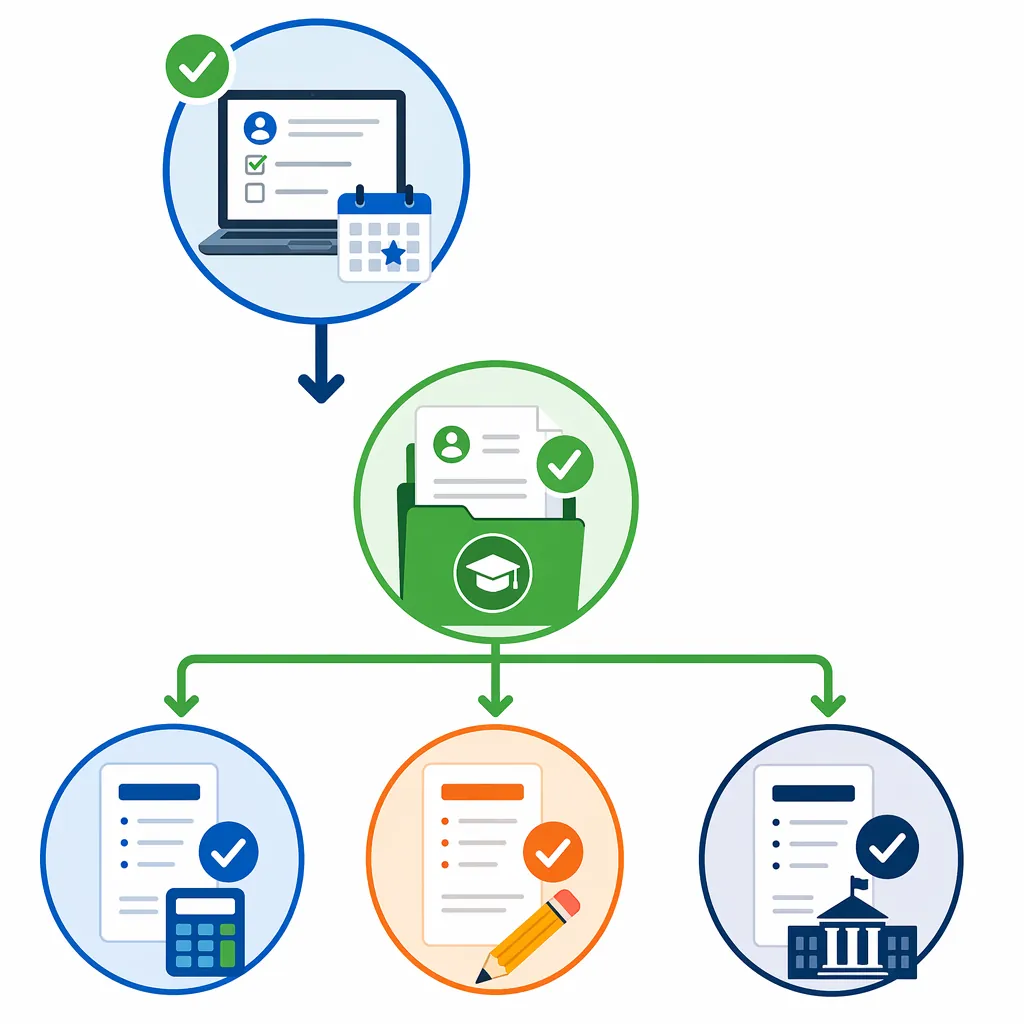
1. Complete the Income Survey when it opens
The district says the Income Survey opens Aug. 10, 2026, at incomesurvey.dadeschools.net or mdcpsnutrition.net.[1] Families should complete it before they need a test waiver, not after the student is already inside the SAT or ACT registration screen.
Do this even if the student’s school continues free meals under CEP and even if the student ate free last year. The meal line is not the record a testing organization reviews. The record has to exist in a form the school or district can use when the student asks for a waiver.
2. Keep proof that the survey was submitted
After submitting the survey, save the confirmation screen or email if one is provided. If the parent portal or school nutrition system shows a status, take a screenshot. This is not because screenshots replace official eligibility. It is because screenshots help a counselor or school staff member find the record faster if something does not match later.
The family should use the same student name, ID information, and household details the district uses. A small mismatch can turn into a delay at exactly the wrong time, especially for seniors who are managing counselor forms, application deadlines, and test registration at the same time.
3. Confirm the eligibility record before registering for SAT or ACT
Once the survey has been processed, students should ask the school counselor, CAP advisor, or the staff member handling testing waivers whether the eligibility record is active. The question should be direct: “Does my record show that I qualify for SAT or ACT fee waivers?”
Families should be careful with summer timing. One Miami-Dade school CAP page notes that fee waiver requests may not be processed over the summer, but that note should not be treated as a districtwide rule unless the student’s own school confirms it.[5] The safer assumption is that school-year processing takes time and that waiting until the week of a deadline creates avoidable risk.
4. Request SAT waivers through the proper channel
College Board says eligible students can request SAT fee-waiver benefits directly through their College Board account, and students may also work with their school counselor depending on the school’s process.[4] A student should not assume the waiver will appear automatically just because the family completed the Income Survey. The survey supports eligibility; the student still has to get the waiver applied to the test registration.
If the College Board account does not show the expected benefit, the student should contact the school counselor or testing office with the survey confirmation and ask whether the district record has been transmitted or verified. The important thing is to solve the record problem before choosing a test date that requires immediate payment.
5. Request ACT waivers through the school process
ACT fee waivers are usually handled through the school. The Miami-Dade school CAP page cited here describes eligible students receiving up to two ACT waivers total.[5] Students should ask the counselor or CAP advisor how their school distributes ACT waivers and what documentation the school needs to see.
This is where the Income Survey matters again. A counselor may know a student personally and still need the official eligibility record before releasing a waiver. The family’s job is not to argue poverty at the counter; it is to make sure the record exists before the request lands on the counselor’s desk.
6. Preserve eligibility for college application fee waivers
Fee waivers do not stop with the SAT or ACT. The same local CAP page connects test-fee waiver eligibility with college application fee waivers through Common App and Coalition App.[5] Seniors should ask about application fee waivers early in the fall, before they are sitting with a completed application and a payment screen.
A student applying to several colleges can feel the difference quickly. One missing eligibility record can mean not only paying for a test, but also pausing applications while the school tries to confirm whether the student qualifies for application fee waivers. That delay is avoidable if the Income Survey is completed and checked before application season is moving at full speed.
Income limits are the guide, but check the current-year numbers
The most recently available Florida school-meal income figures in the research brief list free meals at or below 130% of the federal poverty level and reduced-price meals from 130% to 185%. For a family of four, that source lists $40,560 per year for free-meal eligibility and $57,720 per year for reduced-price eligibility, using 2025-2026 figures.[6] FRAC’s school-meal eligibility guidance also identifies the 130% and 185% thresholds.[7]
Those dollar amounts should be checked against the 2026-2027 guidelines before a family makes a final decision. Federal income guidelines often update by school year. The practical advice does not change: if the family might qualify, complete the Income Survey and let the district make the eligibility determination.
Families should also remember that direct certification can happen through programs such as SNAP, but not every eligible household will appear automatically in the school system. If the student needs a test waiver and the family has not confirmed the record, relying on automatic matching is a gamble.
A short checklist before test season
- On or after Aug. 10, 2026, complete the MDCPS Income Survey at the district site listed by MDCPS.
- Do not skip the survey just because the student attends a CEP school and still receives free meals.
- Save any confirmation or status screen connected to the survey.
- Ask the counselor, CAP advisor, or testing office whether the student’s eligibility record is active for SAT and ACT fee waivers.
- Check the student’s College Board account and the school’s ACT waiver process before choosing a test date.
- For seniors, ask early about Common App and Coalition App fee waivers, not after applications are ready to submit.
The Miami-Dade meal-policy change does not automatically take away SAT, ACT, or college application fee waivers. It does remove the old assumption that eligibility is already documented. Families who want those waivers for 2026-2027 should complete the Income Survey and verify the record before the student needs to register for a test or submit applications.
References
- Miami-Dade County Public Schools News Release, Miami-Dade County Public Schools.
- Miami-Dade County Public Schools to continue free meals at 121 campuses; other families must apply for benefits, Local10, July 24, 2026.
- Miami-Dade ends universal free school lunch after four years, Miami Herald.
- Fee Waiver Eligibility, College Board.
- CAP, Terra Environmental Research Institute.
- Florida School Meal Eligibility Calculator, DaycareCalc.
- School Meal Eligibility and Reimbursements, Food Research & Action Center.
Related exhibits & inventory
Verified outcomes
No verified outcomes on file for this exam yet
See Methodology for how outcome evidence is disclosed once logged.
Planners
No planner filed for this exam yet
A downloadable timeline template for this exam hasn't been published yet.
Tool verdicts
AI-tool cautions
No AI tools tested for this exam yet
No hands-on AI-accuracy logs have been filed for this exam.
Questions about this plan
Ask a question about a specific section, timeline, or citation in this plan — or flag something that needs correcting.
Comments
Join the discussion with an anonymous comment.