
SAT Exam Hub
What Temporary Protected Status Means for Your SAT, ACT, and GRE
This article explains whether Temporary Protected Status affects your ability to register for the SAT, ACT, GRE, MCAT, or ASVAB, and what documentation you need on test day. TPS does not restrict test access, but fee waivers are income-based and keeping your status current is your responsibility.
- SAT
- ACT
- GRE
- MCAT
- ASVAB
- digital-sat
- adaptive-testing
- registration-fee
- content-outline
- score-target
Last reviewed: July 21, 2026. For students searching for temporary protected status explained for students, the testing answer is simpler than the immigration landscape around it: TPS does not, by itself, block you from registering for the SAT, ACT, GRE, MCAT, or ASVAB. The part that can cost you a seat is usually not the word “TPS.” It is a name mismatch, an ID problem, an expired Employment Authorization Document, or a missed re-registration deadline. That warning matters in Q3 2026 because TPS policy is moving quickly after the Supreme Court’s June 25, 2026 decision in Mullin v. Doe, and the National Immigration Forum estimated that about 1.3 million people had TPS protections in its July 2026 fact sheet.[1]
| Exam | Does TPS block registration? | What usually matters on test day | Special caution |
|---|---|---|---|
| SAT | No. TPS is not a registration bar. | The name on your admission ticket and acceptable photo ID must match closely enough for check-in. | SAT fee waivers are income-based on College Board’s published criteria; College Board does not make a TPS-specific promise on the cited page.[4] |
| ACT | No. TPS is not a registration bar. | Use the official ACT ID rules for your test date and make sure your account name matches your ID. | Treat ACT fee waivers as income/school-eligibility questions, not immigration-status guarantees, unless ACT or your school confirms your case. |
| GRE | No. TPS is not a registration bar. | Follow the exam owner’s ID policy exactly; immigration status is not the usual gatekeeping issue. | Graduate programs may have separate admissions, residency, or funding rules. |
| MCAT | No. TPS is not a registration bar. | Follow the AAMC ID rules for the MCAT; do not assume one exam’s ID rule applies to another. | Medical school admissions and aid rules are separate from test registration. |
| ASVAB | TPS does not block using the ASVAB for high school career exploration. | Use the school or program’s required identification process. | Do not confuse taking the ASVAB with enlistment eligibility; TPS alone is not a green card.[7] |

The test center is checking identity, not deciding your immigration case
A standardized test registration system is not the same thing as USCIS, a financial aid office, or a state residency office. For testing purposes, the first question is usually ordinary and unforgiving: does the person standing at the door match the person registered for the exam?
Temple University’s international student guidance is useful because it says the student-facing part plainly: people with TPS may study, take exams, and use documents such as an EAD or state ID in school-related processes.[3] That does not mean every testing company has identical ID rules. It means TPS is not the reason you are barred from the exam. The practical work is matching your test account, admission ticket, and identity document before test day.
If your school record says “Maria Jose Rivera,” your state ID says “María J. Rivera,” your EAD says “Maria Rivera,” and your testing account says “MJ Rivera,” do not wait until Friday afternoon before a Saturday exam. Fix the testing account early, ask the testing agency what documentation it will accept, and keep a screenshot or email of any official answer you receive. The student who prepared well should not lose a test date because four systems stored the same name four different ways.
Separate four questions before you make a plan
Most bad advice in this area comes from mixing different rules together. A student asks, “Can I take the SAT with TPS?” and gets an answer about federal student aid. Or a student asks about an ACT fee waiver and gets warned about immigration status. Those are not the same question.
- Registration: TPS does not block ordinary registration for the SAT, ACT, GRE, MCAT, or ASVAB.
- Fee waivers: SAT and ACT access is usually handled through income-based or school-based waiver rules, not through a TPS category.
- Test-day ID: your acceptable photo ID, name match, and expiration date matter.
- Immigration maintenance: TPS re-registration and EAD renewal are your responsibility, not the testing agency’s responsibility.
Once those questions are separated, the path gets less scary. You can choose the exam you need, then solve the documentation and payment questions in the right order.
SAT and ACT: registration is open, fee waivers need careful wording
For the SAT, the best-supported statement is this: College Board publishes fee-waiver eligibility around income-linked criteria such as participation in certain assistance programs, family income, homelessness, foster care, or being an orphan or ward of the state. The cited College Board page does not say “TPS holders qualify,” so it is safer to say that a TPS student may qualify if they meet the listed fee-waiver criteria.[4]
That distinction is not hair-splitting. If a student hears “TPS gets a fee waiver,” they may stop checking the actual requirements and miss the step where a counselor has to issue or confirm the waiver. If a student hears “TPS students never get fee waivers,” they may pay money they did not have to pay. The usable answer is narrower: ask your school counselor early, bring documentation of the income-based category if the school requests it, and do not assume immigration status alone decides the fee.
ACT fee waivers should be handled with the same caution. The access route is generally through school-based eligibility and financial need, but the sources cited here do not include an ACT page that explicitly addresses TPS. So the responsible move is to ask the high school counselor or ACT directly, using your income or program eligibility facts rather than asking for a TPS exception.
A separate financial-aid rule does not control the fee-waiver answer. Federal Student Aid explains that TPS holders are not eligible noncitizens for Title IV federal student aid.[5] That is important for college-cost planning, but it does not mean a student is automatically blocked from an SAT or ACT fee waiver. Different program, different rulebook.
After you confirm you can test, choose the exam on academic grounds. If you are still deciding between the SAT and ACT, use a score-fit and timing comparison rather than making the decision around TPS. A practical starting point is this SAT vs. ACT prep guide for 2026. If you already know you are taking the SAT and need a prep program, compare the major prep paths in Kaplan, Princeton Review, and PrepScholar options.
GRE and MCAT: treat them as exam registrations, then read the ID page line by line
For graduate and professional exams, TPS still is not the registration barrier. The GRE and MCAT are not immigration-status screenings. The risk is more ordinary: the name in the account, the form of ID, the test center’s refusal rules, and the fact that graduate admissions offices may ask separate questions later.
Do not carry over an SAT habit into the MCAT. Do not assume a state ID that worked for one exam will satisfy another exam owner’s current policy. Before paying a registration fee, open the official ID requirements for that exact exam and check three details: acceptable document type, expiration rule, and name-match rule.
Admissions classification can also be messy. NILC notes that tuition and access rules for immigrant students vary by state, and recent state policy changes make broad statements risky.[6] For testing, many TPS students will move through domestic-style school counseling and admissions workflows, especially if they are enrolled in U.S. schools, but an individual college can still have its own residency, tuition, and documentation process. That comes after the test-registration question; it should not be allowed to confuse the test-registration answer.
ASVAB: career exploration is not the same as enlistment
High school students may encounter the ASVAB as part of career exploration. A TPS student can use the ASVAB that way, but that sentence needs a hard stop before anyone turns it into a military eligibility promise. Military enlistment generally requires U.S. citizenship or lawful permanent residence, and TPS alone is not lawful permanent residence.[7]
So the ASVAB plan depends on the purpose. If the school is offering it to explore strengths and career clusters, prepare for it like an assessment. If the question is enlistment, do not rely on a testing article, a recruiter’s quick comment, or a school rumor. Get qualified immigration and military-accession guidance before making decisions.
For career-exploration preparation, you can compare ASVAB study apps that boost AFQT score or build a routine with this ASVAB study-plan framework. Keep that preparation separate from enlistment eligibility.
The document checklist that prevents most test-day problems
The safest testing plan is boring on purpose. It starts before registration and ends only after your score is released.
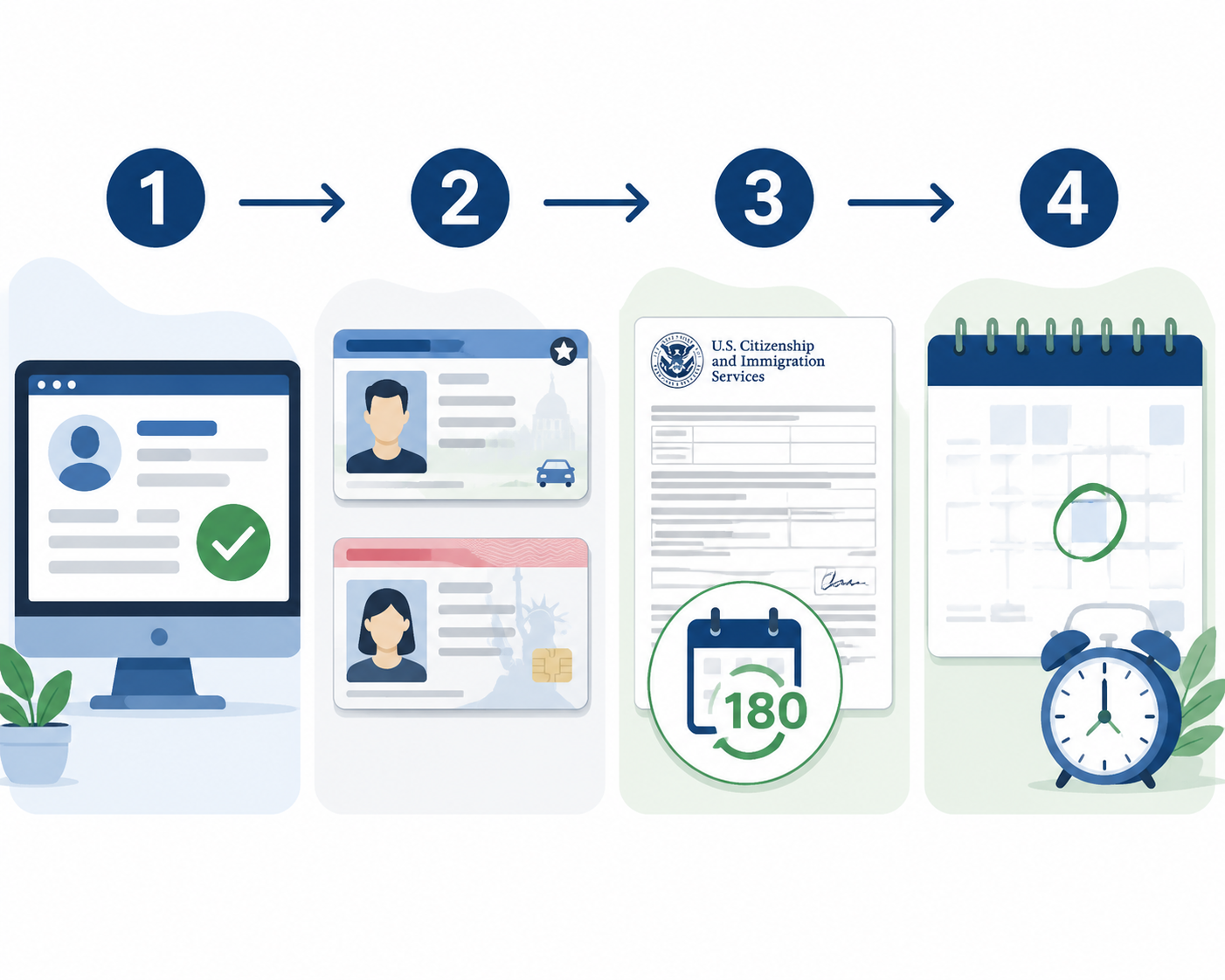
- Create the exam account using the name that appears on the ID you plan to bring.
- Choose the ID before you register, not the night before the exam.
- Check the ID expiration date against the test date.
- If your EAD is expiring, read the USCIS automatic-extension and receipt-notice language that applies to your TPS category.
- Calendar TPS re-registration and EAD renewal deadlines separately from school deadlines.
USCIS is the source for TPS rules, current country designations, re-registration periods, and EAD renewal procedures.[2] A school counselor can remind you to register for the SAT. A testing agency can tell you whether a document is acceptable at check-in. Neither one is responsible for monitoring whether your TPS re-registration window is open or closing.
If your unexpired state ID is accepted by the exam owner and matches your account, it may be cleaner than using an EAD that is close to expiration. If your EAD is the document you have, use it carefully: check whether it will be unexpired on test day, whether your category has an automatic extension, and whether you have the USCIS I-797 receipt notice or other documentation described by USCIS for that extension.[2]
Do not assume that a proctor will understand TPS automatic extensions from memory. If an expired EAD plus an I-797 receipt notice is part of your plan, contact the testing agency before test day and ask whether that combination will be accepted under its ID policy. Save the answer. Bring the documents in the order the agency tells you to bring them.
Name mismatches deserve their own check
Name problems are not dramatic until they are. A student may use one surname at school, two surnames on an immigration document, and a shortened name in a testing account. Testing companies do not need to understand the whole family naming history at the door. They need enough match to admit the student under their rule.
Before the registration deadline, compare the exact spelling, spacing, hyphens, accents, middle initials, and surname order across your school record, test account, admission ticket, EAD, state ID, and passport if you have one. If something does not match, ask the testing agency how to correct it. Do not create a second account unless the agency tells you to; duplicate accounts can create score-reporting problems later.
Pending TPS applications need the same testing discipline
A pending TPS application does not turn a standardized test into an immigration-status exam. But it can affect what document you actually have in your wallet on test day. If you do not yet have an EAD, plan around another acceptable ID if you have one. If you are waiting for a receipt notice or renewal document, do not build your whole test plan on a paper you may not receive before the exam date.
That may mean choosing a later test date, using a state ID, or asking the agency in writing about alternatives. It is better to move a test date while registration options still exist than to discover the problem at check-in.
What TPS does and does not explain
TPS is a temporary immigration protection for people from designated countries who meet the program requirements; USCIS maintains the official list of designations and procedures.[2] For this article, the important testing consequence is limited: TPS can give a student an EAD and a lawful basis to remain during the protected period, but it does not make a testing company responsible for tracking the student’s immigration deadlines.
It also does not answer every education question. State tuition classification, institutional aid, professional-school admissions, and F-1 strategy can all involve separate rules. The NILC overview of in-state tuition access shows why state policy cannot be reduced to one national answer, and the recent volatility in state tuition-equity laws makes old advice especially risky.[6]
If your question is “Can I register for the exam?” you can usually solve that through the exam owner’s registration and ID rules. If your question is “What happens if TPS for my country is terminated?” or “Should I change to F-1?” that is not an exam-prep question. Bring those facts to an immigration attorney or a qualified legal services provider.
A practical testing calendar for a TPS student
Put the exam plan and the TPS plan on the same calendar, but do not let them blur together. The exam side should show registration deadlines, fee-waiver request dates, accommodation deadlines if applicable, test date, score-release date, and college or program application deadlines. The TPS side should show re-registration windows, EAD expiration, receipt-notice tracking, and any USCIS announcement that affects your country designation.[2]
For the testing side, start with the exam you actually need. If you are applying to undergraduate programs, decide whether SAT or ACT scores help your application. If you are applying to graduate or professional school, confirm whether the GRE or MCAT is required, optional, or not accepted. If you are taking the ASVAB through school, write down whether the purpose is career exploration, not enlistment.
Then verify the official ID rule for that exam, apply for any income-based waiver early, and make the name on the account match the ID you will bring. Keep TPS re-registration and EAD renewal dates somewhere more reliable than a counselor’s memory: a phone calendar with alerts, a paper calendar at home, and a shared reminder with a trusted adult if you have one. That is the part that keeps an immigration deadline from becoming a testing emergency.
References
- Temporary Protected Status Fact Sheet, National Immigration Forum, July 2026
- Temporary Protected Status, USCIS
- Studying in Temporary Protected Status (TPS): When & Why to Apply for F-1 Status, Temple University ISSS
- SAT Fee Waivers, College Board
- Eligible Noncitizens, Federal Student Aid
- Basic Facts About In-State Tuition for Undocumented Immigrant Students, NILC
- Military Green Card, Yolanda Mendoza Law
Related exhibits & inventory
Verified outcomes
No verified outcomes on file for this exam yet
See Methodology for how outcome evidence is disclosed once logged.
Planners
No planner filed for this exam yet
A downloadable timeline template for this exam hasn't been published yet.
Tool verdicts
AI-tool cautions
No AI tools tested for this exam yet
No hands-on AI-accuracy logs have been filed for this exam.
Questions about this plan
Ask a question about a specific section, timeline, or citation in this plan — or flag something that needs correcting.
Comments
Join the discussion with an anonymous comment.