GRE, MCAT, SAT, ACT, ASVAB Exam Hub
Do Mindfulness Exercises Actually Improve Study Focus?
Mindfulness can help exam focus in specific doses, but most popular claims outrun the evidence. This review grades the strongest studies and exercises High, Moderate, or Limited so deadline-driven test-takers can decide whether the practice is worth their scarce study time.
- gre
- mcat
- asvab
- sat
- act
- digital-adaptive
- official-material
- section-strategy
- test-date-timeline
For a test-taker asking whether mindfulness exercises to improve study focus are worth the time, the answer is a narrow yes. The best-supported uses are reducing mind-wandering during cognitively demanding work and lowering test anxiety enough that studying or test-taking can proceed. That is different from saying mindfulness is a score strategy by itself.
If your exam date is fixed, mindfulness should not displace practice tests, review of missed questions, spaced repetition, pacing work, section strategy, or content repair. It earns a place only when anxiety, intrusive thoughts, or drifting attention are actively interfering with those higher-yield tasks.
The evidence grades, before the exercise list
The strongest study in this pile is not an app testimonial or a generic stress survey. Mrazek and colleagues ran a two-week randomized study with 48 undergraduates assigned either to mindfulness training or to a nutrition class. The nutrition class matters because it functioned as an active control: the comparison was not simply “do something” versus “do nothing.” The mindfulness group received 45-minute sessions four times per week for two weeks, then improved on a modified GRE verbal reasoning task, working memory capacity, and mind-wandering measures; the researchers estimated an average GRE-equivalent gain of about 16 percentile points.[1][2]
That earns a High label for one specific claim: a short, structured mindfulness course can improve GRE-relevant verbal-task performance in a student sample, with reduced mind-wandering and improved working memory as plausible mechanisms. It does not earn a blank-check claim that any breathing exercise will raise any student’s score. The task was GRE-relevant, not an official test administration. The sample was undergraduates, not every exam population. The dose was not tiny: 45 minutes, four times a week, for two weeks.
The most practical study is Sun and colleagues’ 2025 trial with 61 high-school students during a real exam window. The intervention was small enough to fit into an overloaded week: five consecutive days of an 8-minute prerecorded mindfulness session combining mindful breathing and a body scan between two real exams. State anxiety dropped from 45.31 to 38.28, the anxiety reduction appeared after even one 8-minute session, and exam performance held in the mindfulness group while the control group declined.[3]
That result is useful, but it should be labeled Moderate/Limited rather than High. The authors reported no active control group, baseline group differences that required ANCOVA adjustment, and no medium- or long-term follow-up.[3] In plain exam-prep language: this is a realistic protocol for a stressful test week, but it is not strong enough to support confident score-improvement promises.
| Claim | Evidence grade | What the evidence actually supports |
|---|---|---|
| A structured two-week mindfulness course can improve GRE-relevant focus outcomes. | High, narrowly | Supported by a randomized active-control study showing improved modified GRE verbal reasoning, working memory, and reduced mind-wandering in undergraduates.[1][2] |
| An 8-minute breath-plus-body-scan routine can reduce test anxiety during an exam week. | Moderate/Limited | Supported by a small real-exam-window high-school study, but without an active control or follow-up.[3] |
| Brief mindful breathing can help highly test-anxious students. | Limited | Supported by a small study of highly test-anxious university students, with n=12 per group and no real exam context.[7] |
| Mindfulness generally improves academic achievement. | Limited | Trait mindfulness explained under 1% of university GPA variance in one study; that is not enough to treat mindfulness as a general achievement lever.[5] |
| Any mindfulness activity is better than normal prep. | Unsupported | Mindfulness often performs poorly when compared with active controls, so some apparent benefits may reflect doing any structured activity rather than mindfulness specifically.[4] |
Why the strongest finding still needs a leash
The Mrazek study deserves attention because it uses the kinds of controls that many wellness claims avoid. It randomized students. It used an active comparison. It measured outcomes that matter for studying: working memory, mind-wandering, and performance on a GRE-style verbal task.[1] If a student keeps rereading a dense passage while thinking about the score report, this is exactly the kind of attentional bottleneck that could matter.
The number that will travel fastest is the estimated 16 percentile-point GRE-equivalent gain.[2] It is also the number most likely to be abused. A percentile estimate from a modified GRE task after a two-week intervention is not a promise that a student with three weeks until the MCAT, SAT, ACT, ASVAB, or official GRE can add 16 percentile points by meditating. It is a signal that attention training can affect exam-relevant cognitive performance under certain conditions.
The time cost matters. Four 45-minute sessions per week for two weeks is six hours of scheduled training, not counting transition time. For a student who already knows the content and loses points because attention collapses, that may be a reasonable two-week intervention. For a student missing algebra, physics, grammar, vocabulary, or reading strategy, those same six hours may be better spent repairing the exam plan.
The counter-evidence is not a footnote
There is a reason the final recommendation stays narrow. McGill’s Office for Science and Society warns that mindfulness meditation is “rarely shown to be better than an active control,” which means many studies may be detecting the benefit of doing something structured, quiet, and expectant rather than the unique benefit of mindfulness itself.[4]
Academic-performance claims also shrink when measured broadly. Alomari’s 2023 study in Frontiers in Education found that mindfulness explained under 1% of the variance in university GPA, with a reported correlation of r=0.133.[5] GPA is not the same as a timed standardized test, but the finding is a useful brake on vague claims that “more mindfulness” generally means better grades.
Safety claims need the same restraint. NCCIH describes much meditation and mindfulness research as preliminary or not scientifically rigorous, and notes that a 2020 review found about 8% of participants reported negative effects, most commonly anxiety and depression.[6] Most students will not have that reaction, but a test-taker who becomes more anxious, detached, or depressed during practice should not push through because an article promised calm.
The exercises worth trying
The exercise should match the evidence. A long menu of “21 mindfulness techniques” creates the comforting illusion of choice, but a deadline-driven student needs fewer decisions, not more. These are the only options worth considering here.
Best practical dose: 8-minute mindful breathing plus body scan
Use this when test anxiety is interfering with study sessions, practice exams, or the days leading into a real exam. The tested version in Sun’s study was five consecutive days, 8 minutes per day, using prerecorded mindful breathing plus a body scan.[3]
- Set a timer for 8 minutes before a study block, practice test, or exam-week review session.
- Spend the first part noticing the breath without trying to make it impressive: inhale, exhale, return when attention wanders.
- Move attention through the body in a simple scan: face, shoulders, chest, abdomen, hands, legs, feet.
- When anxious thoughts appear, label them as thoughts and return to the next breath or body area.
- When the timer ends, start the planned study task immediately; do not turn the session into a longer avoidance ritual.
Grade: Moderate/Limited. It is the best fit for students with scarce time because the dose is small and was tested around real exams. The weakness is design, not practicality: without an active control, we cannot know how much of the effect came from mindfulness specifically rather than quiet breathing, expectation, teacher attention, or simply pausing before the exam.
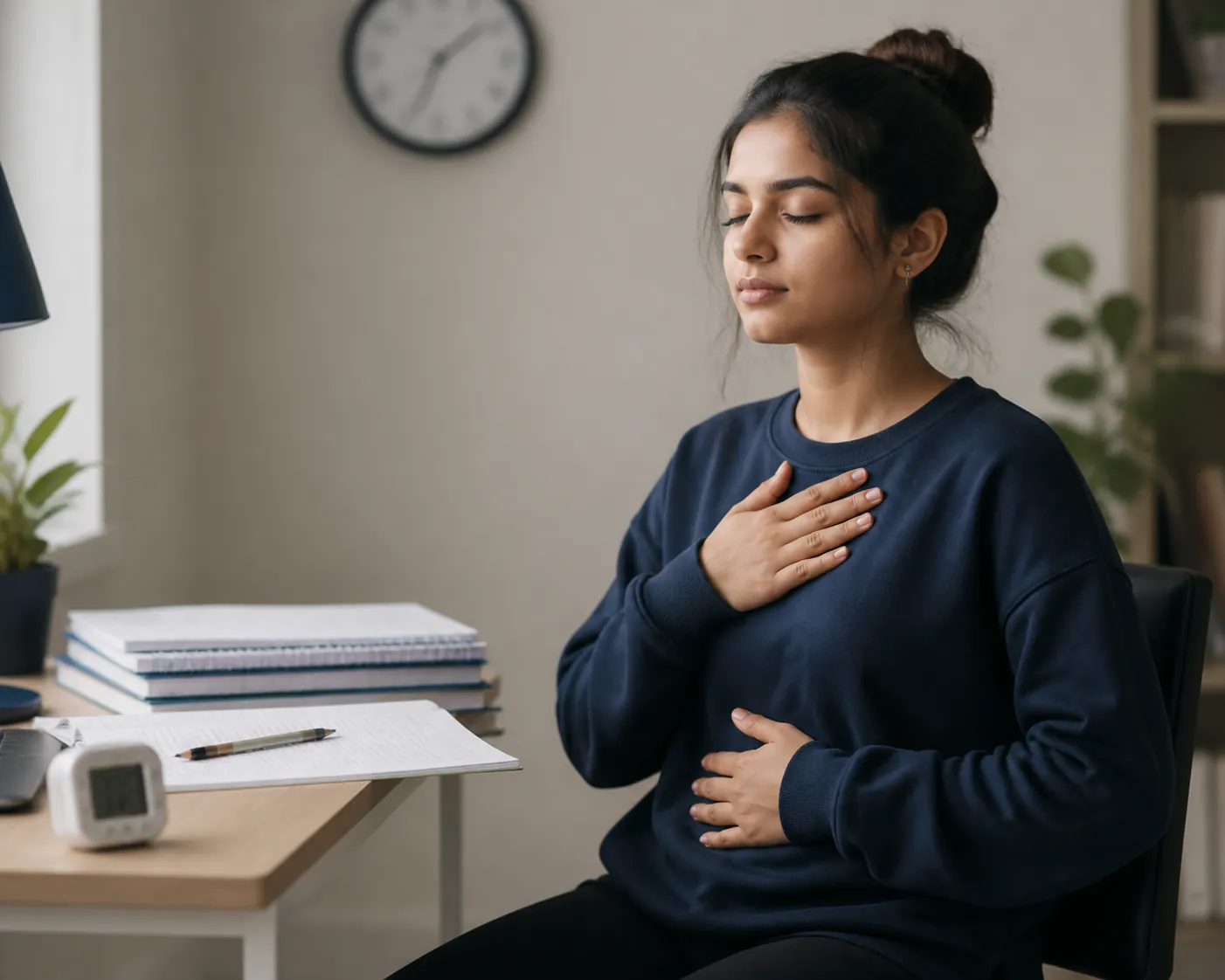
Lowest-friction reset: 1–2 minutes of focused breathing
Use this when the alternative is losing the next 20 minutes to panic, phone checking, or rereading without comprehension. Mayo Clinic describes focused breathing as a mindfulness exercise that can be practiced even for a minute, and Harvard Health distinguishes focused-attention practice from open-monitoring practice when discussing mindfulness for focus.[8][9]
- Look away from the screen or page.
- Put both feet on the floor.
- Follow 6–12 slow breaths.
- On each exhale, relax the jaw, shoulders, or hands.
- Return to one concrete task: one passage, one problem set, one missed-question review.
Grade: Limited-to-Moderate. This is a reasonable reset because the cost is tiny and the mechanism is plausible. It should not be advertised as exam-proven at this exact dose. Its job is to interrupt a spiral, not to replace the next timed section.
Strongest research benchmark: 45 minutes, four times per week, for two weeks
This is the closest protocol to the strongest exam-relevant evidence. If you have two weeks, a stable content base, and a recurring attention problem, you could treat the Mrazek-style schedule as a short focus intervention: four 45-minute sessions per week for two weeks.[2]
Grade: High for the underlying study, conditional for your calendar. The dose is serious enough that it competes with study time. It makes the most sense when mind-wandering is a primary bottleneck and your plan already includes practice tests, review cycles, and section-specific work.
Supporting signal: six days of mindful breathing for test-anxious students
Cho and colleagues studied 36 highly test-anxious university students and found that six days of daily mindful breathing produced larger reductions in test anxiety than the control condition, with reported effect sizes of d=1.42 versus d=0.56, and increased positive automatic thoughts more than cognitive reappraisal.[7]
Grade: Limited. The direction is encouraging for anxious students, but the groups were very small, with 12 students per group, and the study did not occur inside a real exam administration.[7] Treat it as support for trying a brief breathing routine, not as proof that breathing practice will change an official score.
When to skip it
Skip mindfulness, or keep it to a one-minute reset, if the main problem is not anxiety or mind-wandering. If your diagnostic test shows content gaps, timing errors, or repeated missed question types, the fix is exam work. Breathing calmly before guessing on the same algebra setup is still guessing.
Also skip or modify the practice if it worsens symptoms. NCCIH’s safety summary is a useful reminder that meditation is not universally pleasant or neutral; a minority of participants in reviewed studies reported negative effects such as anxiety and depression.[6] For a student already under pressure, “this makes me feel worse” is enough data to stop and choose another reset.
Be especially careful when mindfulness becomes polished procrastination. A five-minute reset before missed-question review is different from a 40-minute session that quietly replaces the missed-question review. The exam does not score how centered the study plan looked. It scores the answers.
How to keep the exam plan in charge
Use a small test before making mindfulness part of the schedule. For five study days, place the 8-minute breath-plus-body-scan before the session where anxiety or drifting is most likely. Track only two outcomes: whether you started the planned task on time, and whether mind-wandering or anxiety interrupted the first 30 minutes less than usual. If it helps, keep it. If it does not, remove it.
Do not track whether the practice felt profound. Track whether it protects the work that actually moves scores: timed sets, review logs, spaced recall, passage accuracy, pacing decisions, and full-length exam debriefs.
If your focus problem is mostly environmental or behavioral, a mindfulness routine may be the wrong first lever. Phone distraction belongs closer to screen-time and grades evidence. If you are comparing wellness-style resets, it may help to read the same evidence-labeled treatment of hot flow yoga for study focus or coloring for study stress relief. If the problem is consistency, the better frame may be willpower as a study system.
For GRE, MCAT, SAT, ACT, and ASVAB prep, the practical rule is simple: choose the smallest evidence-backed mindfulness dose that fits the study calendar, check whether it reduces anxiety or mind-wandering, and then return to the study plan. Most of the score movement still has to come from exam-specific work.
References
- Mindfulness training improves working memory capacity and GRE performance while reducing mind wandering. PubMed. 2013.
- Brief Mindfulness Training May Boost Test Scores, Working Memory. Association for Psychological Science.
- Effects of brief mindfulness training on test anxiety and exam performance in high school students. BMC Psychology. 2025.
- Mindfulness meditation often fails the scientific test. McGill Office for Science and Society.
- Mindfulness and academic achievement among university students. Frontiers in Education. 2023.
- Meditation and Mindfulness: Effectiveness and Safety. National Center for Complementary and Integrative Health.
- The Effectiveness of Daily Mindful Breathing Practices on Test Anxiety of Students. PLOS ONE. 2016.
- Mindfulness exercises. Mayo Clinic.
- Mindfulness practice for focus. Harvard Health.
Related exhibits & inventory
Verified outcomes
No verified outcomes on file for this exam yet
See Methodology for how outcome evidence is disclosed once logged.
Planners
No planner filed for this exam yet
A downloadable timeline template for this exam hasn't been published yet.
Tool verdicts
AI-tool cautions
No AI tools tested for this exam yet
No hands-on AI-accuracy logs have been filed for this exam.
Questions about this plan
Ask a question about a specific section, timeline, or citation in this plan — or flag something that needs correcting.
Comments
Join the discussion with an anonymous comment.