
Former OpenAI Intern's Learning Strategy for Exam Prep
Accuracy Warning — AI Study Tools (general)
AI summaries can create an illusion of mastery if used before active retrieval; risk of passive consumption without performance evidence.
- Accuracy:
- Limited
- Tested:
- Generating practice prompts and concept checks
- Last tested:
- 2026-07-28
At first, advice from a former OpenAI intern sounds like the wrong shelf for someone trying to raise a GRE quant score, survive MCAT CARS, or stop running out of time on ACT science. Tech career essays usually drift toward biography, brand names, and lucky breaks. Timed exams do not care about any of that. They care whether you can retrieve the right rule, choose between two tempting answers, and keep doing it after your concentration starts to thin.
Hamza Mostafa’s framework is useful only because it can be stripped of the career glamour. In his The Next Web essay, he describes a three-part learning path: “go broad on AI,” then “specialize in agents,” then “build projects.” He also writes, “the best way I learn is by doing and by building.” [1] That was advice for becoming an AI-native engineer, not for taking the MCAT, GRE, SAT, ACT, or ASVAB. The transfer is analogical. But the structure is familiar to anyone who has watched real score improvement happen: survey the field, find the constraint, drill under conditions that expose whether learning has actually landed.
Mostafa’s own path gives the idea weight without making it a promise. Business Insider frames his career story as a move from an unpaid internship to OpenAI’s first intern cohort, and highlights his advice to focus on what you can control. [2] That is not evidence that a student can copy his route and get the same outcome. It is evidence of a learning loop with visible pressure: he started broad, narrowed toward a hard subproblem, and proved skill by making things rather than merely reading about them.
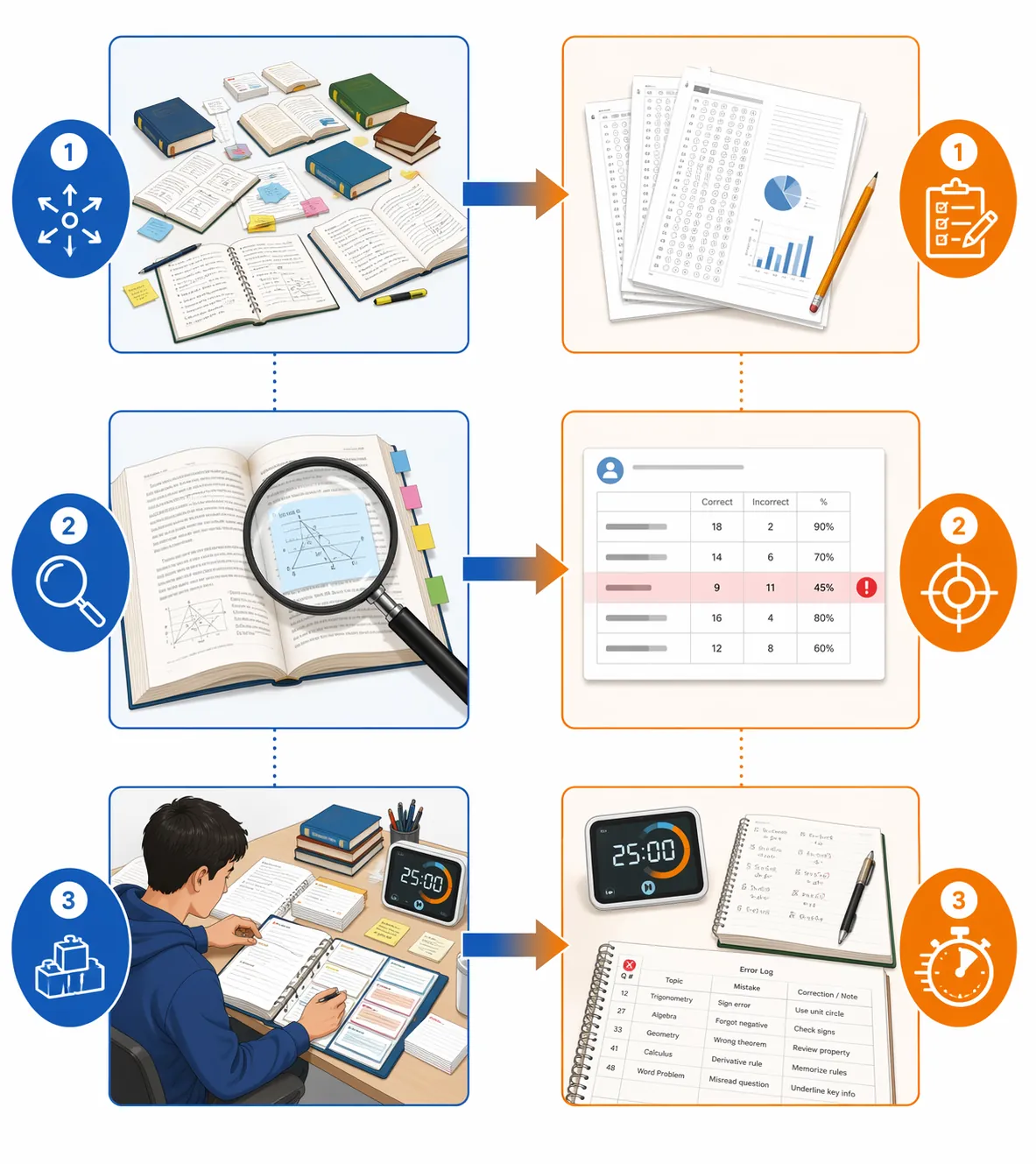
The exam version: survey, identify, drill, verify
The translation is not complicated. It is just less comfortable than rereading notes.
| Mostafa’s AI-learning step | Exam-prep translation | What counts as proof |
|---|---|---|
| Go broad | Survey the exam content, format, timing, and question types | You can name what is tested and where you are losing points |
| Specialize | Choose the section, passage type, content domain, or timing problem suppressing the score | Your study plan stops treating all weaknesses as equally urgent |
| Build | Do timed retrieval, official-style practice, full sections, full-length exams, and error-log review | Performance changes under test constraints, not just during review |
“Go broad” is not permission to wander through every topic until confidence improves. For an exam, it means building a working map. What sections exist? What skills are actually measured? Which question types punish slow reading, weak recall, careless arithmetic, or brittle content knowledge? A broad survey should end with a diagnostic picture, not a prettier notebook.
That diagnostic picture can be ugly. Good. If a GRE student discovers that geometry is fine but rate problems collapse under time pressure, the next study block has a target. If an SAT student keeps missing punctuation questions because the rules blur together, more general grammar review is inefficient. If an ASVAB student understands mechanical concepts while reading explanations but cannot select the correct relationship in a timed item, the weakness is not “mechanical comprehension” in the abstract. It is retrieval and selection under pressure.
“Specialize” is where many students resist the evidence. They keep rotating through all subjects because it feels responsible. A full-coverage plan looks mature on paper, especially when anxiety is high. But if one section is doing most of the score damage, equal time is not fairness; it is avoidance with a calendar.
The specialization step should be narrow enough to change tomorrow’s work. “Get better at reading” is too large. “Practice main-idea and author-attitude questions in dense passages under a clock, then log why the wrong answer was attractive” is usable. “Review math” is too large. “Drill translating word problems into equations before doing computation” gives the student a behavior to rehearse.
“Build” is the point at which the method stops sounding like advice and starts behaving like preparation. Building, in an exam context, means producing answers before looking at explanations. It means working inside the time limit. It means writing down the reason for an error while the mistake is still fresh. It means checking whether the next attempt changes, rather than collecting another explanation that feels clear for ten minutes.
MCAT: the clearest case for the loop
Take a hypothetical MCAT student with three weeks left and a diagnostic result that hurts to look at. The wrong move is to respond with panic-rereading: biochemistry Monday, physics Tuesday, psychology Wednesday, then a weekend spent highlighting CARS strategy notes. That student may feel busy and still be no closer to choosing the right answer under the clock.
The broad phase starts differently. The student reviews the exam as an object: content areas, passage demands, discrete questions, timing, and the way answer choices are written. Broad content review still has a place, especially if foundational knowledge is missing. But it has to answer a diagnostic question: which part of the exam is currently limiting performance?
Suppose that review shows the largest recurring breakdown in CARS. The student understands passages after reading explanations, but during timed work the same pattern repeats: slow first read, overattachment to a plausible phrase, and missed author stance. Specialization now means CARS gets privileged attention. Not because the other sections do not matter, but because this is the bottleneck the evidence has exposed.
The build phase is not another stack of CARS tips. It is timed passage sets, review of why each wrong answer survived initial elimination, and periodic full-length timed sections to test stamina. The student is building the ability to read, decide, and recover. That last verb matters. CARS does not merely test comprehension; it tests whether a student can keep making disciplined choices after one passage feels bad.
This is where Mostafa’s “doing and building” line has real exam value. A completed timed section is a built artifact. So is an error log that separates content gaps from timing failures and answer-choice traps. So is a retake plan that changes because the last practice block produced evidence. The product is not a project demo; it is a more reliable test-day behavior.

Why passive review feels good and still fails you
Passive review creates familiarity. Familiarity is seductive because it resembles learning from the inside. You reread a concept, recognize the terms, nod at the explanation, and feel the pressure drop. Then a timed question asks for the concept in a disguised form, and recognition does not become retrieval quickly enough.
The build phase forces four things passive review can hide: retrieval, decision-making, timing, and feedback. Retrieval asks whether the idea can be produced without the answer sitting in front of you. Decision-making asks whether you can choose between close options. Timing asks whether the skill survives the actual pace of the exam. Feedback asks whether you can classify the miss accurately enough to prevent a repeat.
This is also the boundary for AI study tools. An AI summary can make a dense topic feel less threatening, and that can help a student get started. But summaries are not retrieval. More explanation is not the same as more performance. If a tool keeps you in consumption mode, it has become part of the problem.
That risk shows up whenever students use AI to smooth away friction instead of testing themselves. The warning in AI Replacing Teachers: What 2025 Research Says About Student Learning is relevant here: if the tool gives a clean explanation before the student has struggled to produce an answer, it can feed an illusion of mastery. The same caution applies to Why Tokenmaxxing Backfires When You're Studying for an Exam. Longer prompts, larger context windows, and more detailed answer dumps do not automatically create better recall.
A better use of AI is narrower: generate a practice prompt, ask for a concept check, compare your explanation against a standard explanation, or help categorize errors after you have already attempted the question. Judgment stays with the student. That boundary matters for the same reason discussed in What Sam Altman's AI Authoritarianism Warning Means for Students: delegating judgment is different from using a tool to support judgment.
What “focus on what you can control” means in test prep
Mostafa’s Business Insider interview includes the mindset advice to focus on what you can control. [2] In exam prep, that phrase is only useful if it becomes operational. You cannot control the exact passage topic, the curve, the testing room, or whether the first section feels friendly. You can control the next diagnostic review, the next timed set, and whether your plan changes when the evidence changes.
- Review misses by cause, not by embarrassment: content gap, misread question, trap answer, timing collapse, or careless execution.
- Stop rereading material you already retrieve correctly under time.
- Use official-style practice when you need score-relevant evidence, not just confidence.
- Schedule full sections or full-length exams when stamina is part of the weakness.
- Let the error log decide the next study block more often than your mood does.
This does not erase anxiety. A student with a deadline and a disappointing diagnostic is not a machine waiting for an optimized workflow. But anxiety often pushes students toward the safest-feeling activity: rereading, reorganizing, watching another explainer, or making a new plan. The controllable action is usually less soothing and more useful: attempt the set, score it, inspect the misses, adjust the next set.
Short versions for GRE, SAT, ACT, and ASVAB
The MCAT example is the cleanest because content, passage skill, timing, and stamina all collide. The same loop still applies elsewhere, with less ceremony.
| Exam | Go broad | Specialize | Build |
|---|---|---|---|
| GRE | Map quant, verbal, writing, timing, and question formats | Identify whether the main limiter is vocabulary, text logic, arithmetic, algebra setup, geometry, or pacing | Drill timed sets, then review whether misses came from knowledge, setup, or decision errors |
| SAT | Survey reading, writing, and math question types | Target the recurring suppressor, such as punctuation, function questions, algebra translation, or data interpretation | Use timed modules or section-style practice and track repeat error patterns |
| ACT | Map the pace and question demands across English, math, reading, and science | Choose the section where speed and accuracy are most out of balance | Practice under tight timing and review skipped, rushed, and misread questions separately |
| ASVAB | Survey the tested academic and vocational areas | Find whether the weakness is knowledge, vocabulary, mechanical reasoning, arithmetic setup, or pacing | Drill targeted item types, then verify improvement with mixed timed practice |
The mixed timed practice at the end matters. Specialization can raise a skill in isolation, but standardized exams do not politely announce, “Here comes the kind of problem you studied yesterday.” The final check is whether the skill appears when surrounded by other demands.
Where the OpenAI story stops helping
Mostafa’s path is extraordinary. The unpaid-internship-to-OpenAI sequence is not a template a test-taker can reproduce by following three steps harder than everyone else. [2] It would be lazy to turn that story into a score guarantee. It would also be wasteful to ignore the learning pattern underneath it.
The useful part is the loop: start wide enough to understand the landscape, narrow enough to attack a real constraint, then build something that proves competence. In AI engineering, that proof might be a project. In exam prep, it is a timed section, a cleaner error log, a full-length exam completed with steadier pacing, or a repeated question type finally handled without prompting.
The limits are clear. This framework was created for AI career entry, not standardized testing. It does not replace official practice material. It does not guarantee a particular score increase. It does not mean every student should mimic an AI-career path. It transfers because both domains punish passive familiarity and reward produced evidence.
Use the framework if it changes your behavior. Survey the exam. Locate the highest-leverage weakness. Build proof through timed work. Review the evidence and repeat. The reason the method belongs in exam prep is not that OpenAI advice is magically superior. It is that, under pressure, consuming more material stops being the same thing as getting better.
References
- I was in OpenAI's first intern cohort. Here's what it taught me about becoming an AI-native engineer, The Next Web.
- Former OpenAI Intern Shares 3 Tips for Breaking Into AI, Business Insider, July 2026.
Authoritative source
For the authoritative version of this contentHow to Read the '1 in 4 NFL Players CTE' Study
Report an error in this tool's output
Found something this tool got wrong beyond what's documented above? Report it so the accuracy log stays current.
Comments
Join the discussion with an anonymous comment.