
MCAT Exam Hub
Which cancer symptoms mnemonics belong on the MCAT?
CAUTION, CAUTION UP, and tumor-marker lists are nursing or USMLE content, not MCAT material. This guide maps each cancer symptom mnemonic to the exam that would actually test it and lists the mechanism-based concepts — oncogenes, tumor suppressors, p53, Myc — that earn MCAT points.
- gre
- mcat
- asvab
- sat
- act
- digital-adaptive
- official-material
- section-strategy
- test-date-timeline
If you searched for cancer symptoms mnemonics for med school exams and you are taking the MCAT, split the material before you memorize anything. CAUTION and CAUTION UP are symptom-recognition tools. Tumor-marker tables are much closer to pathology-board territory. The MCAT’s usable cancer content is molecular: cancer as a failure of normal cellular controls, proto-oncogene activation, tumor-suppressor loss, p53, Myc, and the two-hit logic behind many tumor suppressors [1].

That distinction is not a purity test. Clinical mnemonics can be useful in the right setting. They are just poor tenants in an MCAT core deck when the same minutes could be spent learning what a gene product normally does and what happens when that control fails.
| Mnemonic or content type | Where it belongs | MCAT decision |
|---|---|---|
| CAUTION / CAUTION UP cancer warning signs | Patient education, nursing-style recognition, general clinical awareness | Do not keep in the MCAT core deck. Osmosis presents CAUTION UP as warning signs that may warrant investigation, while also noting they do not necessarily indicate cancer [2]. |
| Tumor-marker tables | USMLE-style pathology and clinical oncology review | Skip as a memorized table for the MCAT. Medbullets frames tumor markers as helping confirm diagnosis, monitor response, and track recurrence, not as stand-alone diagnosis without tissue examination [3]. |
| Paraneoplastic syndrome lists | Clinical pathology / board-style medicine | Usually outside MCAT core unless a passage teaches the mechanism inside the stem. |
| Oncogene vs. tumor suppressor logic | MCAT biology | Keep. This is the exam-relevant cancer framework: gain-of-function in proto-oncogenes versus loss-of-function in tumor suppressors [1]. |
| p53, Myc, two-hit hypothesis | MCAT biology when tied to cell-cycle control and gene regulation | Keep, but learn by function rather than as an isolated name pile [1]. |
Why CAUTION UP is not an MCAT biology target
CAUTION UP is built to make a person notice possible warning signs: change in bowel or bladder habits, a sore that does not heal, unusual bleeding or discharge, thickening or lump, indigestion or difficulty swallowing, obvious change in a wart or mole, nagging cough or hoarseness, unexplained weight loss, pernicious anemia, and persistent fever [2]. The important part for an MCAT student is not the ten-item expansion. It is the caveat attached to the tool: these signs may warrant investigation, but they do not necessarily indicate cancer [2].
That makes CAUTION UP a recognition mnemonic, not a mechanism mnemonic. It helps someone decide that a symptom should not be ignored. It does not help a pre-med answer why a gain-of-function mutation in a proto-oncogene can increase proliferation, why loss of a tumor suppressor removes a checkpoint, or why a passage cares about DNA damage response.
The older public-health trail is real, but it should not be overread. The American Cancer Society’s history notes a 1947 “Cancer Signals” public education campaign [4]. Its current signs-and-symptoms page discusses possible cancer symptoms, but it does not present the CAUTION acronym as the organizing device [5]. So the clean attribution is: ACS history supports the public-education background; Osmosis-style teaching supplies the CAUTION UP mnemonic used in many clinical-learning feeds.
For MCAT prep, that is enough. You do not need to punish the mnemonic, and you do not need to learn it. Put it outside the core deck unless your separate nursing, EMT, clinical volunteering, or patient-education context gives it a job.
Tumor markers are a different exam’s problem
Tumor-marker mnemonics look more “medical” than CAUTION, which is why they waste more MCAT time. A table that asks you to pair markers with cancers is usually training a clinical-pathology reflex: this marker can support a diagnosis, this one can be followed during treatment, this one may help detect recurrence. Medbullets’ Step 1 review frames tumor markers in that clinical way and explicitly notes that tissue examination is still needed for diagnosis [3].
That is not the MCAT’s usual angle. An MCAT passage can absolutely mention a biomarker, a mutation, a receptor, or a cancer drug. But when it does, the test normally gives you enough information to reason from the passage. The payoff is in interpreting the experiment, the signaling pathway, the gene-expression change, or the cell-cycle consequence—not in recalling a clinical marker atlas cold.
If your study source drops a tumor-marker mnemonic into a generic “med school exams” bucket, label the bucket yourself. USMLE-style? Maybe. MCAT core? No, not without practice-question evidence from your own prep.
The MCAT cancer framework is smaller, but it has to be functional
The MCAT version of cancer starts with normal control. A proto-oncogene is not “a cancer gene” by default; it is a normal gene involved in growth signaling or proliferation control. When a mutation or regulatory change makes that gene product overactive, the resulting oncogene acts through gain-of-function. Tumor suppressors sit on the other side of the logic: they normally restrain growth, repair damage, or enforce checkpoints, and cancer risk rises when those functions are lost [1].
That distinction is worth an Anki card. It keeps paying rent across passages because the test can hide the same idea under transcription factors, kinase signaling, apoptosis, cell-cycle checkpoints, DNA repair, or experimental gene knockouts.
| If the passage shows... | Classify it as... | Why |
|---|---|---|
| A growth-promoting gene becomes overactive | Oncogene | Cancer is driven by gain-of-function from a proto-oncogene [1]. |
| A checkpoint, repair, or anti-proliferation function is removed | Tumor suppressor loss | Cancer is driven by loss-of-function in a gene that normally restrains growth or preserves genomic stability [1]. |
| Only one overactive allele is enough to push the phenotype | Oncogene-style logic | One activated copy can increase a growth signal. |
| Both protective copies typically need to be disabled | Tumor-suppressor two-hit logic | Pathology Student uses the usual rule that both alleles of a tumor suppressor typically need mutation and recommends learning each gene product’s function [6]. |
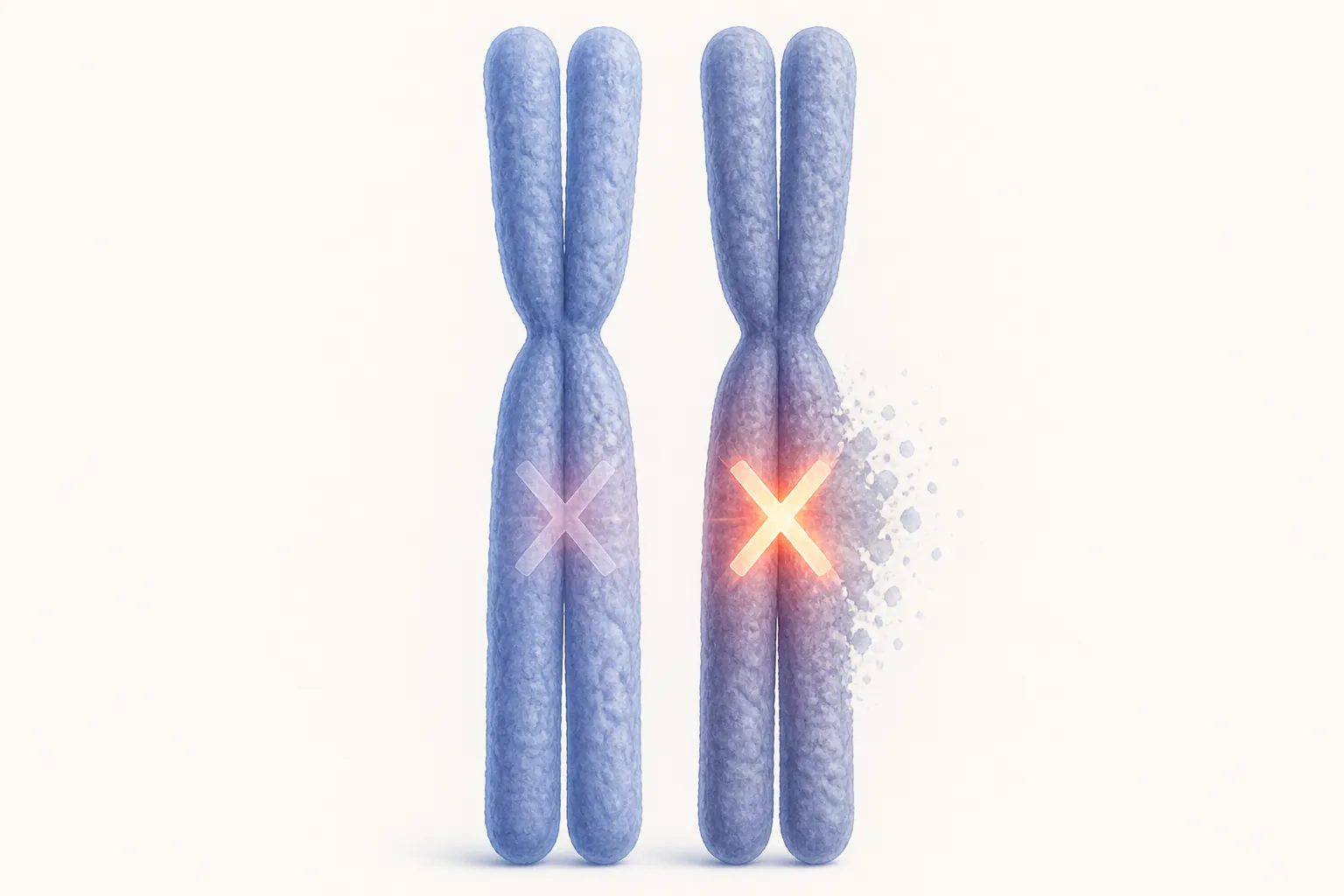
p53 deserves special treatment because it is not just another name in a tumor-suppressor pile. Jack Westin’s MCAT content page identifies p53 as the most-studied tumor suppressor gene and states that it is mutated in over 50% of human cancers [1]. For MCAT purposes, the number is less important than the job: p53 is tied to DNA damage response, checkpoint control, and the decision to stop division or trigger cell death when damage is serious.
Myc is the oncogene example to keep clean. Jack Westin names Myc and links aberrant activation of Myc to Burkitt’s lymphoma [1]. Do not turn that into a sprawling lymphoma table. The MCAT-useful move is to recognize Myc as a growth-promoting transcription-factor example: when its activity is increased in the wrong context, proliferation can be pushed forward.
Pathology Student’s advice is the right memory rule here: there is no dependable shortcut that beats learning what the gene product does. RAS works as a signal transducer, so it fits proto-oncogene logic; RB inhibits cell-cycle progression, so it fits tumor-suppressor logic [6]. Once the function is known, the label becomes easier to reconstruct under pressure.
This is also why a mechanism card outperforms a pretty mnemonic. A card that asks, “Would an activating mutation in this gene behave like an oncogene or tumor-suppressor loss?” can transfer to a new passage. A card that only stores a clinical symptom list usually cannot.
What MCAT-facing resources emphasize
One useful sanity check: Jack Westin’s “Top 10 MCAT Mnemonics” list contains no clinical cancer warning-sign mnemonic [7]. That does not prove a symptom mnemonic could never appear in any prep product. It does support the more practical observation: high-yield MCAT memorization tends to compress formulas, pathways, amino acid properties, psych terms, and mechanism-heavy distinctions—not patient-facing cancer warning signs.
Other MCAT-facing resources point the same direction. Varsity Tutors frames cancer around loss of cell-cycle control in the Biological and Biochemical Foundations section [8]. MedSchoolCoach’s MCAT cancer review also treats cancer as a biology topic, not as a clinical symptom-recognition checklist [9]. Use those signals to set the burden of proof. A cancer fact earns space in your deck when it helps with cell division, gene regulation, signaling, DNA repair, apoptosis, or experimental interpretation.

This same routing problem shows up in other topics. Symptom lists can be useful in medicine while still being low-yield for the MCAT’s mechanism-first style; the same distinction matters in early heart disease signs. Cancer is not special in that respect. The exam rewards the biology it can test in a passage.
Be suspicious of mnemonics that are harder than the content
Some mnemonic pages are honest about their own limits. Epomedicine’s tumor-suppressor gene locus mnemonic labels its set as a “forced mnemonic” and describes it as tedious to learn [10]. That is a useful warning label. If the mnemonic takes more effort than the concept and does not map to an MCAT-style task, it is probably not a memory aid anymore. It is another fact pile wearing a costume.
A good MCAT cancer card should make you do one of a few things:
- Classify a mutation as gain-of-function or loss-of-function.
- Explain why an oncogene can drive proliferation when overactive.
- Explain why loss of a tumor suppressor removes a checkpoint, repair function, or anti-growth signal.
- Connect p53 to DNA damage response and cell-cycle arrest or apoptosis.
- Recognize Myc as a growth-promoting oncogene example, not as an invitation to memorize a lymphoma chapter.
- Use passage data to predict what happens when a gene is knocked out, overexpressed, mutated, silenced, or rescued.
That last bullet is the one students underbuild. Cancer passages often behave like gene-expression, cell-cycle, or signaling passages with oncology vocabulary attached. If a tumor-cell passage intersects with immune recognition, route it into adjacent MCAT biology such as MHC I antigen presentation and tumor cells, not into a clinical warning-sign list.
The deck decision
Suspend CAUTION, CAUTION UP, broad tumor-marker tables, and paraneoplastic syndrome mnemonics from the MCAT core deck. Keep them somewhere else only if another exam or clinical role actually asks for them.
Keep cancer cards that force mechanism: proto-oncogene to oncogene, tumor-suppressor loss, p53, Myc, two-hit reasoning, cell-cycle control, apoptosis, DNA repair, angiogenesis, invasion, metastasis, and passage-based experimental interpretation. If you miss a practice question because one of those links was weak, make or edit a card. If you merely saw a slick acronym in a feed, do not promote it into daily reviews.
Use the same rule for the rest of biology: let practice questions decide what becomes flashcard material. If a cancer fact helps you repair a real miss, it earns a card in your MCAT Anki and practice-question loop. If it is a clinical list with no MCAT mechanism attached, it stays out.
References
- Cancer as a Failure of Normal Cellular Controls: Oncogenes, Tumor Suppressor Genes, Jack Westin
- CAUTION UP: Cancer Warning Signs Mnemonic, Osmosis
- Tumor Markers, Medbullets Step 1
- Our History, American Cancer Society
- Signs and Symptoms of Cancer, American Cancer Society
- How to Remember Which Genes Are Tumor Suppressors vs. Proto-Oncogenes, Pathology Student
- Our Top 10 MCAT Mnemonics, Jack Westin
- 2C: Cancer & Cell Cycle Control, Varsity Tutors
- Cancer, MedSchoolCoach
- Tumor Suppressor Genes Mnemonics, Epomedicine
Related exhibits & inventory
Verified outcomes
Planners
No planner filed for this exam yet
A downloadable timeline template for this exam hasn't been published yet.
Tool verdicts
Questions about this plan
Ask a question about a specific section, timeline, or citation in this plan — or flag something that needs correcting.
Comments
Join the discussion with an anonymous comment.