
SCIENCE Exam Hub
How to Explain a Blood Moon Lunar Eclipse for Science Class
A quiz-ready science-class study guide for the Aug. 27–28, 2026 blood moon lunar eclipse. It covers the eclipse's five stages with real times, why Rayleigh scattering makes the Moon red, and the vocabulary, eclipse types, viewing-safety contrast, and self-quiz questions a lunar-eclipse quiz rewards.
- gre
- mcat
- asvab
- sat
- act
- digital-adaptive
- official-material
- section-strategy
- test-date-timeline
Last reviewed: August 27, 2026
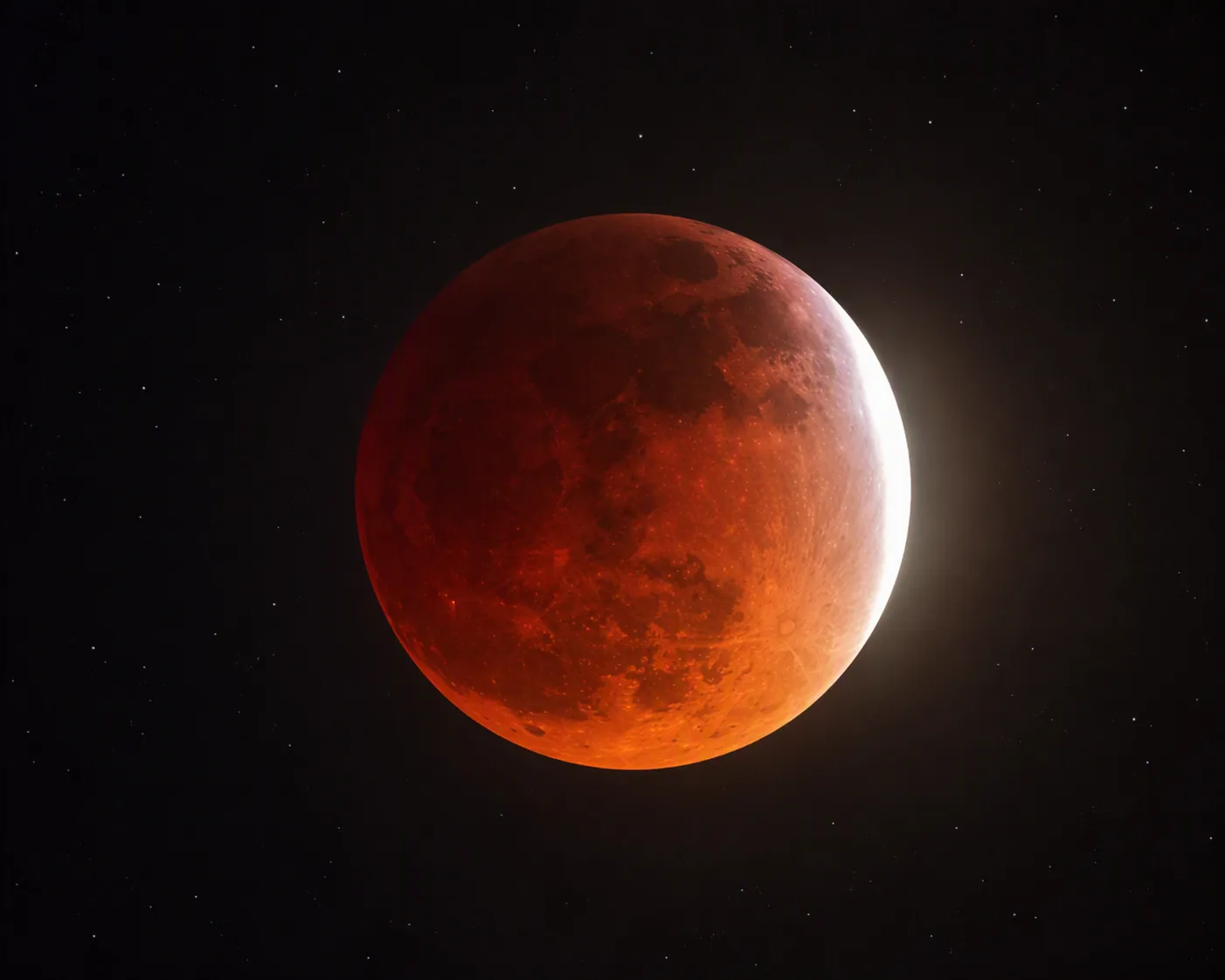
Tonight’s Aug. 27–28 event is a deep partial lunar eclipse—often called a blood moon because much of the Moon may appear red-orange. It is not a total eclipse: a thin part of the Moon remains outside Earth’s darkest shadow even at the peak.
Important timing note: all times below are published in Eastern Daylight Time (EDT). Your local clock time and ability to see each stage depend on your location, time zone, weather, and whether the Moon is above your horizon.[1][2]
The five-stage eclipse timeline
| Stage | Published time (EDT) | What is happening |
|---|---|---|
| 1. Penumbral eclipse begins | 9:23 p.m., Aug. 27 | The Moon enters the faint outer part of Earth’s shadow. |
| 2. Partial eclipse begins | 10:33 p.m. | The Moon begins entering the dark umbra, so a distinct dark edge appears. |
| 3. Greatest eclipse | About 12:12 a.m., Aug. 28 | Roughly 96% of the Moon is within the umbra, while a thin portion remains outside it. |
| 4. Moon exits the umbra | 1:51 a.m. | The partial phase ends as the Moon leaves Earth’s darkest shadow. |
| 5. Penumbral eclipse ends | 3:01 a.m. | The Moon completely leaves Earth’s outer shadow. |
Space.com rounds the peak to about 12:12 a.m. EDT and describes about 96% of the Moon as covered.[1] NASA’s visualization gives the peak as 04:13 UT, equivalent to 12:13 a.m. EDT, and reports 96.3%.[2] That one-minute and decimal-place difference comes from rounding and presentation; it does not describe two different peaks.
Do not confuse that percentage with umbral magnitude, a separate measurement used in technical eclipse tables. If your course expects calculations involving umbral magnitude, Saros cycles, gamma, or Universal Time contacts, use the 2026 astronomy exam study guide. For a regular science-class quiz, the shadow sequence matters more.
How to narrate the eclipse in order
First, the Moon enters the penumbra
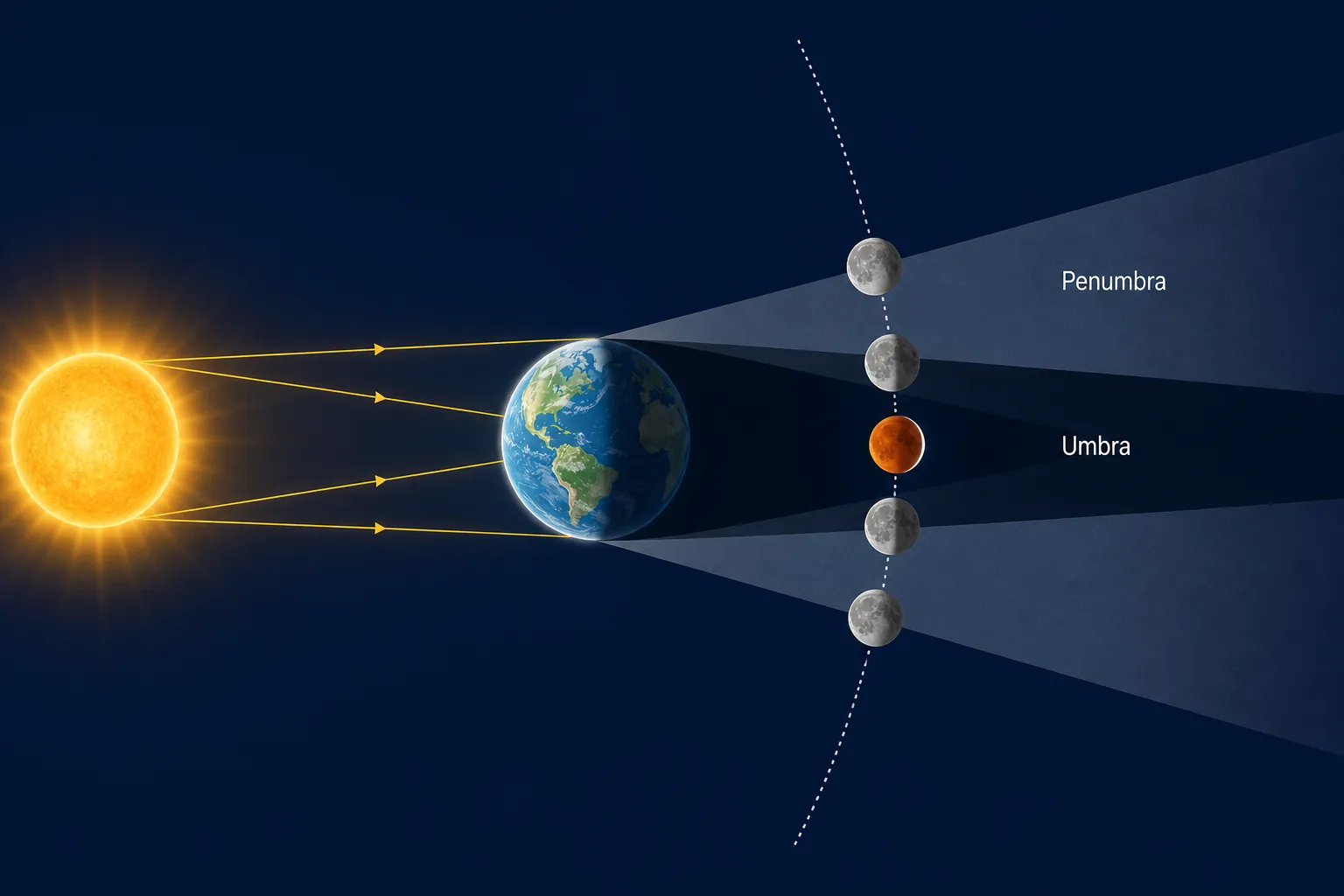
At 9:23 p.m. EDT, the Moon reaches Earth’s penumbra, the lighter outer shadow. From this region, Earth blocks only part of the sunlight that would otherwise reach the Moon.
The earliest shading may be difficult to notice. That does not mean the published start time is wrong; it means the penumbra produces a gradual, low-contrast dimming rather than a sharp dark bite.
Then the Moon enters the umbra
At 10:33 p.m., the partial eclipse begins. The Moon has reached the umbra, the dark inner part of Earth’s shadow where Earth blocks direct sunlight. A curved dark edge appears to move across the lunar disk as more of the Moon enters this region.
A reliable memory rule is that the umbra is the darker shadow responsible for the obvious partial phase. The penumbra surrounds it and causes the weaker shading before and after that phase. If a diagram shows a Moon with a sharply darkened section, that section is in the umbra.
At the peak, it remains a partial eclipse
Greatest eclipse occurs around 12:12 a.m. EDT on Aug. 28. Almost the entire lunar disk is within the umbra, and much of it may look dark red or orange. But a thin part remains outside the umbra, so the correct classification is partial lunar eclipse, not total lunar eclipse.[1][2]
This is a common quiz trap. “Blood moon” describes the popular color impression; it does not guarantee that the whole Moon has entered the umbra.
Finally, the sequence runs in reverse
After the peak, the Moon begins leaving the umbra. At 1:51 a.m., it is completely out of the dark inner shadow, ending the obvious partial phase. It is still in the penumbra, however, so the eclipse is not finished.
At 3:01 a.m., the Moon leaves the penumbra and the event ends. The complete spoken sequence is therefore: penumbra in, umbra in, greatest eclipse, umbra out, penumbra out.
Why the shadowed Moon turns red
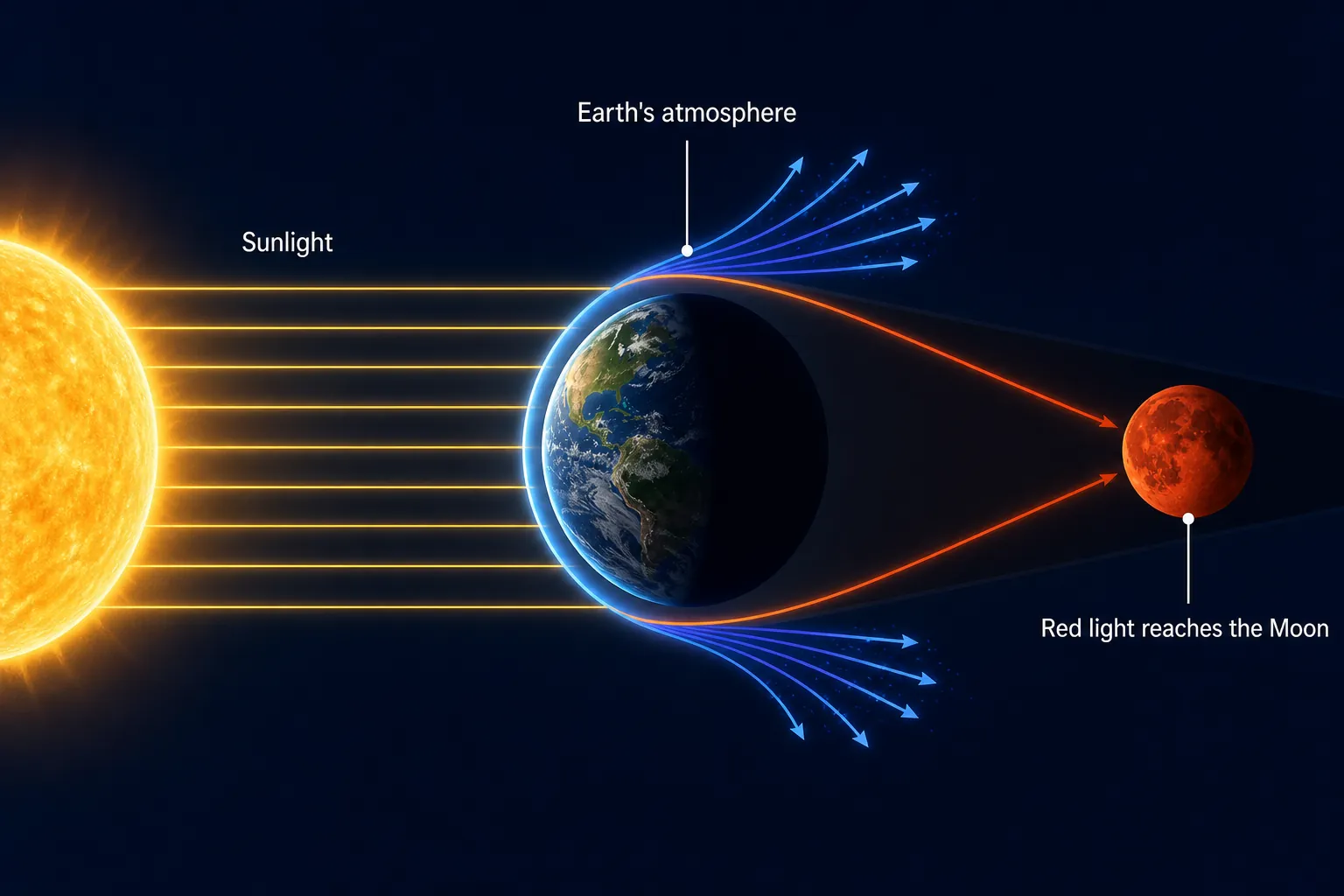
Earth blocks direct sunlight from reaching the part of the Moon inside the umbra, but some sunlight passes through Earth’s atmosphere before reaching the Moon. The atmosphere changes which colors complete that trip.[3][4]
Shorter-wavelength blue and violet light is scattered more strongly in different directions. This process is called Rayleigh scattering. Longer-wavelength red and orange light is more likely to continue through the atmosphere, where it is refracted—bent—toward the Moon.[3][4]
The same basic sorting of colors helps make sunsets look red. During a lunar eclipse, red-orange light passing through the atmospheric ring around Earth reaches the Moon and reflects back toward observers. A useful mental picture is the light of Earth’s sunrises and sunsets being projected onto the lunar surface.
Dust, clouds, and other conditions in Earth’s atmosphere can change how bright or deeply colored the eclipsed Moon appears.[5] That is why one eclipse may look coppery orange while another appears dark brick-red. The nickname “blood moon” refers to this color, not to a separate scientific type of eclipse.[6]
The quiz concepts hidden inside tonight’s event
A lunar eclipse requires a full Moon
A lunar eclipse occurs when Earth is between the Sun and the Moon, allowing Earth’s shadow to fall on the Moon. That geometry requires the full-Moon part of the lunar cycle.[3][4]
A lunar eclipse does not happen at every full Moon because the Moon’s orbit is tilted relative to Earth’s path around the Sun. Most months, the full Moon passes above or below the central part of Earth’s shadow.[3]
Lunar eclipses are visible across Earth’s night side
Anyone on Earth’s night side with the Moon above the horizon can potentially see a lunar eclipse, although clouds and local horizon conditions can interfere. Observers do not need to stand within a narrow path as they do for some phases of a solar eclipse.[4]
It is safe to look at a lunar eclipse directly
A lunar eclipse is safe to watch with your unaided eyes. Binoculars or a telescope can reveal more detail, but they are optional. The Moon is reflecting sunlight; you are not looking directly at the Sun.[3][4]
That is the opposite of the rule for directly observing a solar eclipse. Looking at the Sun requires proper solar-viewing protection except during the brief total phase of a total solar eclipse, when the Sun’s bright face is completely covered. Ordinary sunglasses are not sufficient. The Solar Eclipse 2026 Myth vs. Fact Guide for Students explains that safety contrast in more detail.
Penumbral, partial, and total lunar eclipses
| Type | Shadow position | What an observer sees |
|---|---|---|
| Penumbral | The Moon passes only through the penumbra. | A faint, gradual dimming that can be difficult to detect. |
| Partial | Part of the Moon enters the umbra. | A clearly darkened section advances across part of the disk. |
| Total | The entire Moon enters the umbra. | The whole lunar disk is shadowed and may appear red-orange. |
Tonight’s event includes penumbral and partial phases, but it never reaches totality. As useful upper-limit reference facts, totality can last roughly 107 minutes, while a complete eclipse measured from the beginning to the end of the penumbral phases can last about 236 minutes.[7] Those are approximate model-derived limits, not the duration of every lunar eclipse.
Self-quiz: can you explain it without notes?
- Put tonight’s five stages in order and give the approximate EDT time for each.
- Which is darker, the umbra or the penumbra? What would each look like on the Moon?
- Why is the Aug. 27–28 event partial rather than total, even though about 96% of the Moon enters the umbra?
- Explain the Moon’s red color using the phrases Rayleigh scattering, blue and violet light, red-orange light, and Earth’s atmosphere.
- During which lunar phase can a lunar eclipse occur?
- Name the three scientific types of lunar eclipse.
- Why can people across much of Earth’s night side see a lunar eclipse?
- State the viewing-safety rule for a lunar eclipse and contrast it with the rule for a solar eclipse.
You are ready when you can say, in your own words: the full Moon enters Earth’s faint penumbra, then its dark umbra; it reaches a deep but still partial peak; red-orange light filtered and bent through Earth’s atmosphere colors the shadowed Moon; and the Moon then leaves the umbra and penumbra in reverse order.
For future observation, the next total lunar eclipse is expected on Dec. 31, 2028.[3]
References
- What to expect from each stage of the partial lunar eclipse on Aug. 27-28 | Space.com — Space.com
- NASA SVS | August 27-28, 2026 Deep Partial Lunar Eclipse — NASA Scientific Visualization Studio
- Eclipses and the Moon - NASA Science — NASA Science
- Lunar Eclipses and Solar Eclipses | NASA Space Place — NASA Space Place
- Why Is the Moon Red During a Lunar Eclipse? | timeanddate — timeanddate
- Blood Moon - Red Moon - Total Lunar Eclipse | timeanddate — timeanddate
- Lunar eclipse - Wikipedia — Wikipedia
Related exhibits & inventory
Verified outcomes
No verified outcomes on file for this exam yet
See Methodology for how outcome evidence is disclosed once logged.
Planners
No planner filed for this exam yet
A downloadable timeline template for this exam hasn't been published yet.
Tool verdicts
AI-tool cautions
No AI tools tested for this exam yet
No hands-on AI-accuracy logs have been filed for this exam.
Questions about this plan
Ask a question about a specific section, timeline, or citation in this plan — or flag something that needs correcting.
Comments
Join the discussion with an anonymous comment.