
MCAT Exam Hub
How Black Soldier Fly Larvae Teach MCAT B/B Passage Strategy
When the MCAT B/B section serves up research on a topic you have never seen, memorized facts will not save you. This worked example uses real black soldier fly larvae protein studies — amino acid profiles, digestibility metrics, and experimental design — to teach a repeatable passage-reading protocol that converts unfamiliar data into points.
- gre
- mcat
- asvab
- sat
- act
- digital-adaptive
- official-material
- section-strategy
- test-date-timeline
You turn the page in B/B and the passage is suddenly about black soldier fly larvae protein. Not glycolysis. Not a clean enzyme graph. Larvae. The first wrong move is deciding that the passage is “about insects.” On the MCAT, that label is usually surface noise. The scoring question is smaller and more familiar: what did the researchers change, what did they measure, what comparison did they make, and what conclusion does the data actually permit?
That is why BSFL protein makes a useful biology case study for MCAT practice. The organism is unfamiliar enough to create panic, but the work underneath is ordinary B/B reasoning: protein composition, amino acid profiles, digestibility, controls, confounds, and table interpretation. The AAMC’s Skill 4 description is the official anchor here: students are expected to interpret data in figures, graphs, and tables and distinguish conclusions supported by results from statements that go beyond the evidence [1].
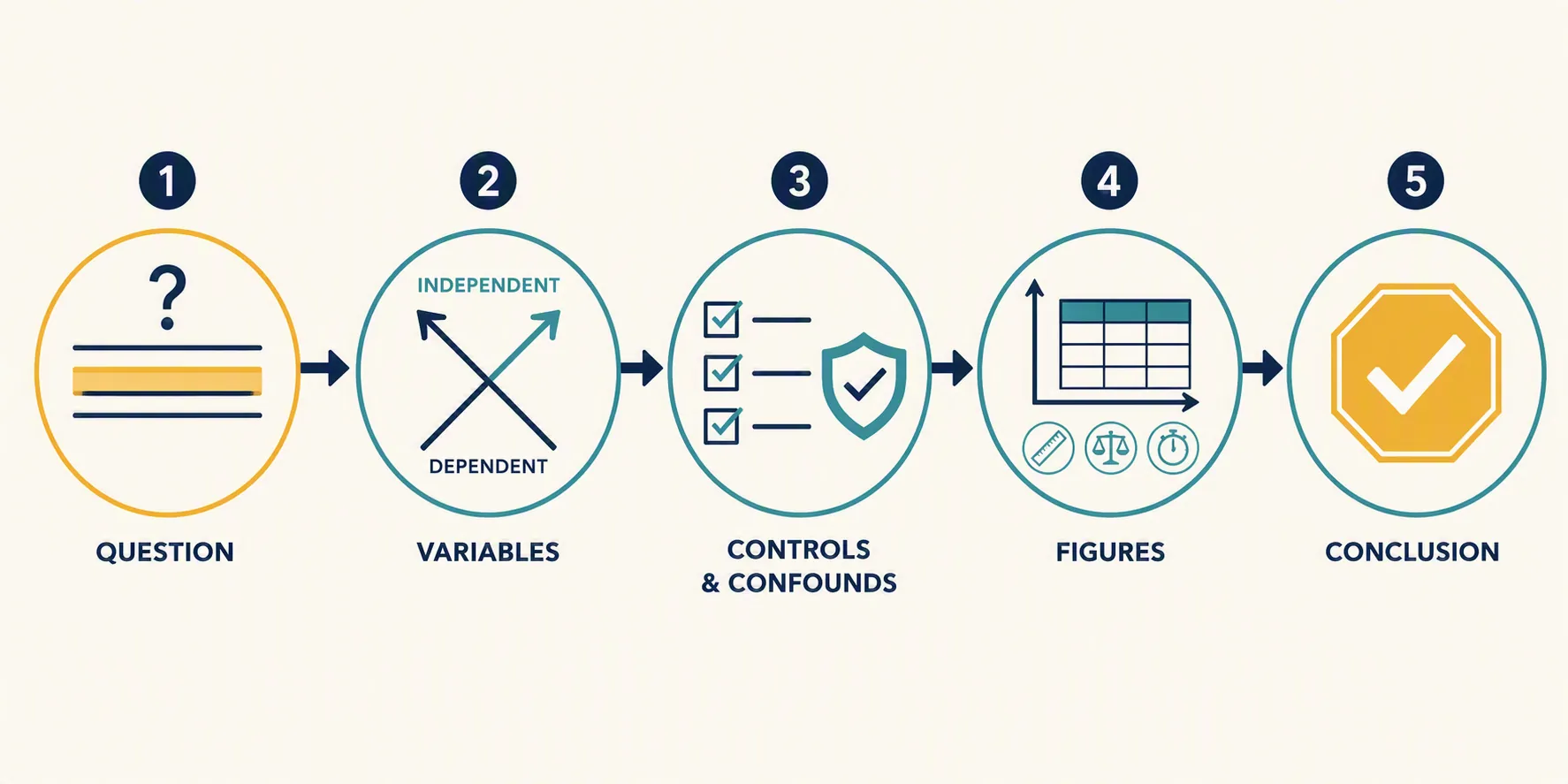
Start with the passage protocol, not the organism
Before reading every sentence, force the passage into a research map. This is not a speed-reading trick. It is a way to keep the strange nouns from taking over your working memory.
- Find the sentence that says what the researchers investigated. If the passage never states it cleanly, infer it from the experiment title, table title, or comparison being made.
- Label the independent variable: diet, processing method, substrate, assay type, protein source, or another condition being changed.
- Label the dependent variable: crude protein, amino acid concentration, digestibility, DIAAS, growth, enzyme activity, absorbance, or whatever outcome is measured.
- Mark controls, comparison groups, and confounds. A comparison is not automatically a controlled experiment.
- Read each table or figure through four checks only: title, axes or units, trend, and supported conclusion.
That last word matters. Supported. A table can show that one sample has more crude protein than another. It may not show why. A digestibility value can be higher under one method. It may not prove that all versions of that protein behave the same way. Most missed B/B research questions are not missed because the student lacks insect biology. They are missed because the student lets a plausible answer outrun the table.
| Passage feature | What to write in the margin | What it protects you from |
|---|---|---|
| “Researchers investigated…” sentence | Research question | Treating the topic as the task |
| Changed condition | Independent variable | Confusing comparison with causation |
| Measured value | Dependent variable | Answering with background knowledge instead of data |
| Control or benchmark group | Comparator | Overstating what the study design can prove |
| Different substrate, preparation, or assay | Possible confound | Attributing an effect to the wrong variable |
| Units and table title | Measurement frame | Comparing unlike quantities |
Worked read: the composition table is amino acid data, not “bug facts”
The Lu et al. review is the best place to practice this because it looks, at first glance, like a nutrition paper outside the MCAT universe. Then the table starts speaking MCAT. The review reports black soldier fly larvae average crude protein at 414.7 g/kg dry matter, with a range of 216 to 655 g/kg dry matter. In the same comparison, soybean meal is listed at 494.4 g/kg dry matter and fish meal at 675.3 g/kg dry matter. The review also identifies leucine, lysine, and valine as the most abundant essential amino acids in the larvae profile [2].
If you read that as an insect passage, you start wondering what black soldier flies eat, whether larvae have chitin, and how sustainable insect farming is. Those may be real science questions. They are not the first MCAT move. The MCAT move is to translate the table:
| What the passage gives | B/B translation |
|---|---|
| Black soldier fly larvae, soybean meal, fish meal | Protein-source comparison groups |
| Crude protein in g/kg dry matter | Dependent variable and unit |
| Average plus range | Central tendency plus variability |
| Leucine, lysine, valine | Essential amino acid profile |
| Fish meal and soybean meal values | Benchmarks, not automatically controls |
Now the answer choices become much less mysterious. If an option says the review table supports the claim that BSFL contains less average crude protein than fish meal, that is supported by the reported averages. If an option says every BSFL sample contains less crude protein than every soybean meal sample, that is not supported by the average alone. The reported BSFL range is wide, and the table values do not let you compare every individual sample against every comparator.
The amino acid line is even more exam-like. Leucine, lysine, and valine are not trivia. They are the passage telling you, “Use your protein chemistry.” Leucine and valine are branched-chain amino acids. Lysine is a basic amino acid. All three are essential amino acids. A student who recognizes only the larvae has learned the least useful noun in the paragraph. A student who sees the amino acid data has found the B/B content.
How far can the Lu table take you?
It can support a composition comparison. It can support statements about reported crude protein averages and listed essential amino acids. It can make BSFL look plausible as an alternative protein source in the narrow sense that it contains substantial crude protein and essential amino acids.
It cannot, by itself, prove that BSFL is nutritionally superior to fish meal. It cannot prove equal bioavailability. It cannot prove that animals grow better on BSFL diets. It cannot prove that all larvae raised under all conditions have the same protein composition. Those would require different dependent variables or a more controlled experimental design.
This is where strong content students sometimes lose points. They know amino acids. They know protein matters. Then they see a table that “feels” favorable and pick the answer that sounds like the big idea of the paper. B/B usually rewards the smaller answer: the one the table actually measured.
Processing case: different methods do not automatically mean a clean experiment
The Zulkifli et al. study is the kind of passage that punishes vague experimental-design reading. The paper examined black soldier fly larvae meals processed by different methods, and reported crude protein values ranging from 39.38% to 48.20% dry matter across spray-dried and oven-dried meals. The important MCAT detail is that substrate is documented as a confound in the processing comparison [3].
A rushed reader writes “processing method” as the independent variable and moves on. That is not enough. If the drying method changes and the substrate also differs, then the study is no longer a clean test of drying method alone. Substrate can affect larval composition before processing ever begins. The measured crude protein value is downstream of more than one condition.
| Element | Careful annotation |
|---|---|
| Drying method | Possible independent variable |
| Substrate | Possible confound if not held constant |
| Crude protein % dry matter | Dependent variable |
| Spray-dried vs oven-dried meals | Comparison groups |
| Causal claim about processing | Only valid if other relevant conditions are controlled or accounted for |
Suppose an answer choice says, “Oven drying caused the higher crude protein content.” If the passage shows that oven-dried and spray-dried samples were also produced from different substrates, that answer is too strong. A better answer would say that crude protein differed among the processed meals, but the design does not isolate drying method as the sole cause.
This is exactly the kind of distinction AAMC-style data reasoning cares about. You are not being asked to dislike the study. You are being asked to respect its conditions. “Different processing methods were associated with different crude protein values in these samples” is a narrower, safer statement than “processing method caused the difference.” On test day, the narrower statement is often the correct one.
Digestibility case: let the passage define the unfamiliar metric
The Trakselė et al. digestibility case is a good antidote to another bad habit: assuming that unfamiliar metrics require outside knowledge. The reported values are passage-perfect: in vivo protein digestibility of 85%, in vitro digestibility of 41%, and DIAAS of 73% for black soldier fly larvae protein in that study [4].
On a real passage, DIAAS would likely be defined or made interpretable through context. Your job would not be to bring in a lecture on every protein-quality scoring system. Your job would be to use the definition the passage gives, identify what increases or decreases the score, and compare only the values reported under the stated conditions.
| Reported measurement | How to read it on B/B | What not to conclude |
|---|---|---|
| In vivo digestibility: 85% | Higher than the in vitro value in this reported comparison | All BSFL preparations are 85% digestible |
| In vitro digestibility: 41% | Lower than the in vivo value in this reported comparison | All in vitro digestibility methods are invalid |
| DIAAS: 73% | A passage-defined protein-quality outcome to compare if the passage supplies benchmarks | The protein is universally superior or inferior without a stated comparator |
The tempting overreach is obvious. A student sees 85% and wants to say BSFL protein is highly digestible. Another sees 41% and wants to say the protein is poorly digestible. The better reading is conditional: in this reported comparison, the in vivo digestibility value is higher than the in vitro value. If the question asks why, you need the passage’s method details. If the question asks what follows from the values alone, you compare the values and stop.
Be especially careful not to merge digestibility numbers from different preparations, assays, or study conditions. A passage may give dried larvae, defatted larvae, isolate, meal, in vitro digestion, in vivo digestion, or a scoring metric such as DIAAS. Those are not interchangeable labels. If the table separates them, your conclusion must separate them too.
Pacing helps, but it is not the core skill
Prep-company guides often describe the B/B section as 59 questions in 95 minutes, with roughly 10 passages plus discrete items, and they commonly emphasize passage-context reading, graph interpretation, and amino acids as major preparation targets [5][6]. That is useful planning context, but it is not the authority for what counts as good reasoning. For this article’s purpose, the official standard is still the AAMC Skill 4 behavior: interpret the displayed data and choose the conclusion the results support [1].
“Read faster” is incomplete advice. If faster reading means skipping the substrate confound in the processing paper, it costs points. If faster reading means missing that leucine, lysine, and valine are amino acid data, it costs points. The better timing goal is to read fewer irrelevant sentences and spend more attention on the sentence, unit, or table note that controls the inference.
For a broader prep stack, question-bank, course, and official-material decisions belong in a different conversation; the 2026 MCAT study tools comparison is the better place for that. If you want more real-science-to-exam practice, the closest companion is the forensic genetics MCAT case study; the Burmese python ecology case study is another example of turning unfamiliar biology into exam concepts without pretending the organism is the point.
Compact practice set
Use these as passage-reasoning drills, not as facts to memorize. The values come from the three BSFL studies above [2][3][4].
Question 1
A review table reports average crude protein values of 414.7 g/kg dry matter for BSFL, 494.4 g/kg dry matter for soybean meal, and 675.3 g/kg dry matter for fish meal. Which conclusion is best supported?
- A. BSFL has a lower reported average crude protein value than soybean meal and fish meal in this table.
- B. Every BSFL sample contains less protein than every soybean meal sample.
- C. Fish meal causes better animal growth than BSFL.
- D. BSFL cannot be considered an alternative protein source.
Answer: A. The table supports a comparison of reported average crude protein values. It does not prove individual-sample ordering, growth outcomes, or suitability by itself.
Question 2
A passage states that leucine, lysine, and valine are among the most abundant essential amino acids in BSFL protein. What is the most useful MCAT connection?
- A. The passage is primarily testing insect taxonomy.
- B. The passage may require amino acid and protein-composition reasoning.
- C. The passage proves BSFL protein is complete for all species.
- D. The passage proves digestibility is high.
Answer: B. The useful recognition is biochemical, not zoological. Amino acid identity and abundance are protein-composition data.
Question 3
A study compares crude protein in spray-dried and oven-dried BSFL meals, but the meals also differ in substrate. Which answer choice handles the design most carefully?
- A. Drying method alone caused all crude protein differences.
- B. Substrate is irrelevant because protein was the measured outcome.
- C. Crude protein differed among processed meals, but substrate prevents a clean causal claim about drying method alone.
- D. The experiment cannot report crude protein values because a confound exists.
Answer: C. A confound does not erase the measurements. It limits the causal inference.
Question 4
A digestibility passage reports in vivo protein digestibility of 85%, in vitro digestibility of 41%, and DIAAS of 73% for a BSFL protein preparation. Which conclusion follows from the values alone?
- A. The in vivo digestibility value is higher than the in vitro value in this reported comparison.
- B. All in vitro digestibility assays underestimate all proteins.
- C. BSFL protein is always more digestible than soybean protein.
- D. DIAAS can be ignored because it is unfamiliar.
Answer: A. The comparison is within the reported values. The other choices require outside comparisons or broader assumptions.
Question 5
A table shows a small apparent difference between two groups, but the passage states the difference is not statistically significant. What should you do?
- A. Treat the numerically larger value as a proven increase.
- B. Conclude that the two variables are unrelated in all contexts.
- C. Avoid claiming a supported difference unless the question asks only about the displayed numerical trend.
- D. Use outside biology knowledge to decide which group should be higher.
Answer: C. If the passage tells you the result is not significant, do not promote a visual or numerical difference into a supported effect.
That is the transferable rule. When B/B gives you unfamiliar biology, do not try to become an expert on the organism. Extract the research question, variables, controls, definitions, and supported conclusions. The larvae can stay unfamiliar. The reasoning cannot.
References
- Scientific Inquiry & Reasoning Skills: Skill 4: Data-based Statistical Reasoning — AAMC
- Nutritional Composition of Black Soldier Fly Larvae (Hermetia illucens L.) and Its Potential Uses as Alternative Protein Sources in Animal Diets: A Review — Insects, 2022
- Nutritional value of black soldier fly (Hermetia illucens) larvae processed by different methods — PLoS ONE, 2022
- Investigation of in vitro and in vivo digestibility of black soldier fly (Hermetia illucens L.) larvae protein — Journal of Functional Foods, 2021
- How to Master MCAT Bio/Bio Passages — Jack Westin, 2026
- How to Read MCAT Biology Experiments & Graphs — Jack Westin, 2026
Related exhibits & inventory
Verified outcomes
Planners
No planner filed for this exam yet
A downloadable timeline template for this exam hasn't been published yet.
Tool verdicts
Questions about this plan
Ask a question about a specific section, timeline, or citation in this plan — or flag something that needs correcting.
Comments
Join the discussion with an anonymous comment.