
GRE Exam Hub
How the Burmese Python Invasion Covers Six Ecology Exam Topics
Learn how to apply Burmese python invasion data from the Dorcas et al. 2012 study to answer invasive-species and population-ecology questions on AP Biology, MCAT, and GRE exams. This guide maps one landmark paper onto core ecology concepts tested in multiple-choice and free-response items.
- SAT
- ACT
- GRE
- MCAT
- ASVAB
- digital-sat
- adaptive-testing
- registration-fee
- content-outline
- score-target
If an AP Biology FRQ or an MCAT passage hands you the Burmese python invasion, the fastest move is not to think “Florida snake story” but to ask what ecology concept is being tested. The Dorcas et al. dataset is unusually useful because one paper gives a clean native-mammal decline pattern: raccoons fell 99.3%, opossums 98.9%, bobcats 87.5%, and rabbits were locally extirpated where pythons were established. That makes the case a strong example of an invasive predator associated with a trophic cascade, as long as the mammal data are treated as correlational evidence rather than proof that pythons were the only driver. [1]
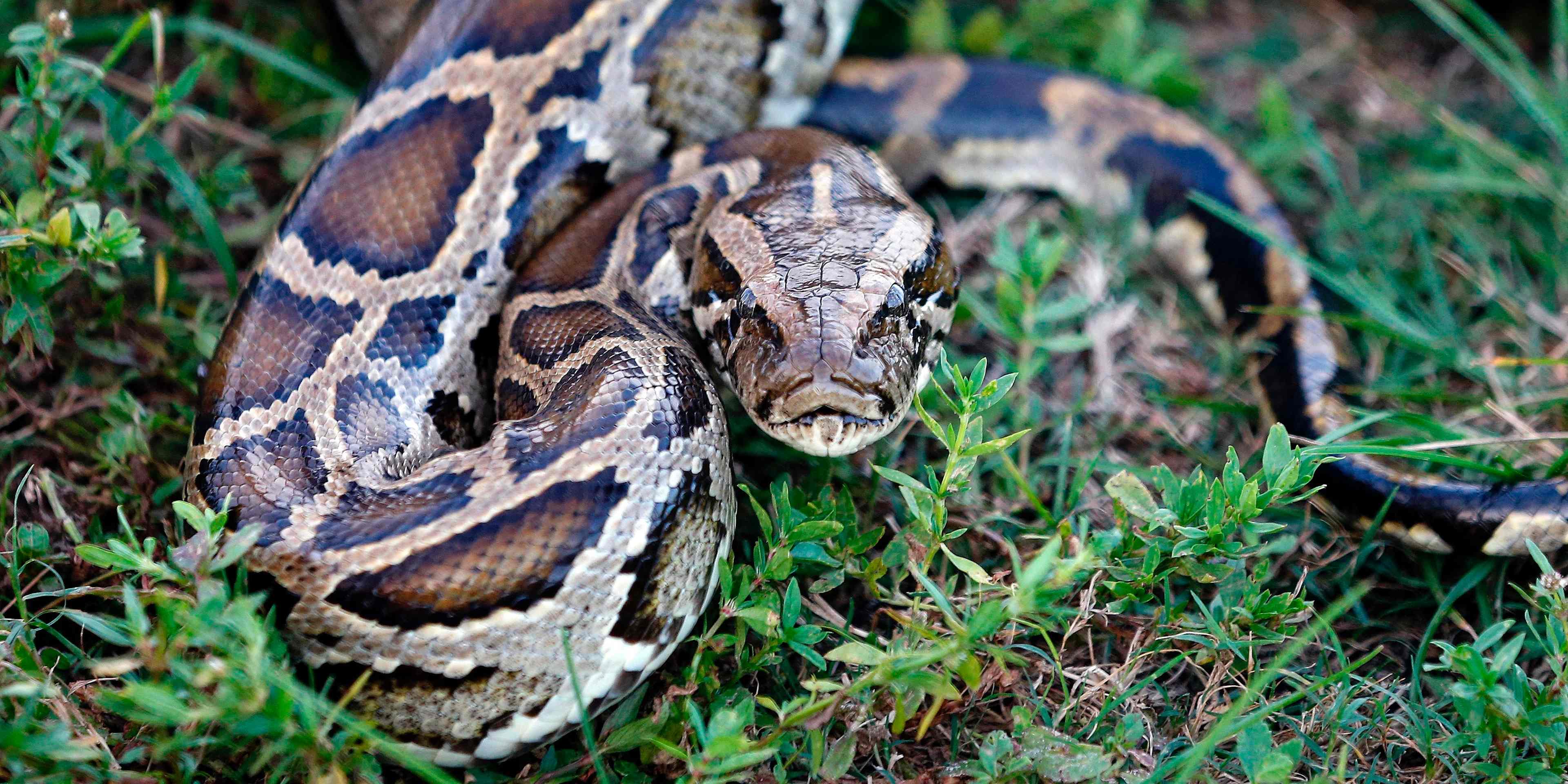
The mammal-decline pattern is the anchor
This is the part exam writers can actually ask about. When a passage describes a nonnative predator and a sharp drop in several native prey species, the likely labels are invasive-species establishment, top-down regulation, and trophic cascade. The key move is to connect the direction of the effect: introduced predator up, susceptible mammals down. You do not need to claim that every decline was caused solely by pythons to use the dataset correctly. You do need to say the pattern is consistent with strong predator-mediated control in the invaded system. [1]

What the same paper lets you say about invasion biology
For population ecology, the case also supports a standard invasion narrative: an introduced species establishes, expands, and begins to reshape the community it enters. On exams, this is the place to think about rapid population growth, release from some native enemies, and downstream effects on prey communities. If a passage asks about exponential growth, this is the kind of introduced-population example that fits the idea of fast spread in a low-resistance environment.
The methods trap is detection, not just counting
This is the section that turns a good story into an exam trap. Nafus et al. estimated a visual detection rate below 1%, which means a survey team can miss almost everything it is looking for. That matters because mark-recapture relies on assumptions such as equal catchability; if a species is cryptic, those assumptions break and abundance estimates become much less secure. So when a passage asks whether control success or population size is known, the safe answer is that detection-limited systems are hard to estimate and easy to undercount. [2]
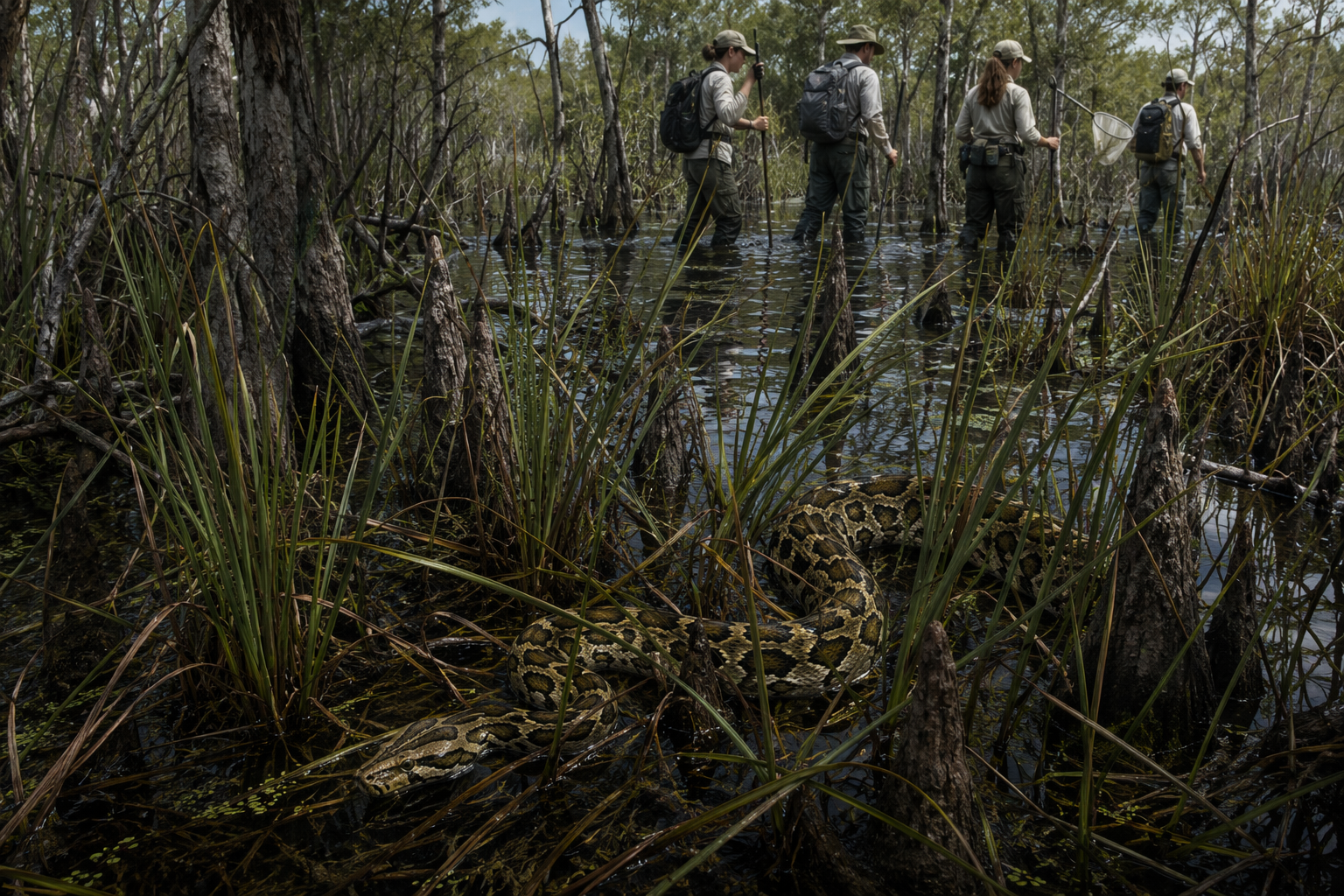
That is also why management numbers can sound contradictory. You can remove thousands of individuals and still have a large, uncertain population if the animals are hard to see and the landscape is expansive. The Burmese python case is a clean reminder that low detection probability is not a footnote; it changes how strongly you can trust any abundance estimate. [2]
Density-independent and density-dependent control do not mean the same thing
If an exam passage mentions a hard freeze, treat that as a density-independent factor: cold acts on the population regardless of how crowded the snakes are. If it mentions food shortage, prey depletion, or crowding effects, that is density-dependent control. The Burmese python case is handy because the same invasion can be used to contrast both ideas. A freeze can sharply reduce numbers without caring about density; prey limitation becomes more important as the predator population and its demand grow. That is the distinction test writers want, not a dramatic weather story.
Life history is the r-selection hook, and urban movement is the extension
The life-history facts are the quick points: females can lay 20–100 eggs per clutch, breed every other year, and live 20+ years. Those traits fit the opportunistic side of an r-selected strategy—high reproductive output, repeated reproduction, and the ability to colonize a new habitat when conditions allow. [3] For urban ecology, Mutascio et al. add a useful extension: movement behavior along a shy–bold continuum helped explain expansion into urbanized Homestead and Miami at about 0.257 km per year. In a Burmese python urban ecology study guide, that is the add-on, not the anchor, but it gives you a behavior-and-habitat angle that can still show up in a passage question. [5]
Why this shows up in AP Bio, MCAT, and GRE passages
AP Biology is the primary home for this material because Unit 8 loves population change, species interactions, and the vocabulary of invasives and trophic cascades. The same case also works on the MCAT Biological Foundations section, where passages often ask you to read methods carefully rather than to name the animal in the headline. GRE Biology can use the same logic for population ecology and experimental design, especially if you practice with the style of GRE Study Plan with Free Tools. The best way to study the case is active recall: write the four mammal declines, the detection-probability trap, the r-selection traits, and the density-independent versus density-dependent contrast from memory, then check yourself against the source summary in Active Recall Examples for Biology.
The management side gives you one more practical note: more than 23,000 pythons had been removed since 2000, yet the population was still estimated in the tens of thousands as of August 2025, which is exactly what detection-limited control looks like in invasive-species management. [6]
References
- Dorcas, M. E., et al. Severe mammal declines coincide with proliferation of invasive Burmese pythons in Everglades National Park, PNAS (2012).
- Nafus, M. G., et al. Estimating Detection Probability for Burmese Pythons in Everglades National Park, Journal of Herpetology (2020).
- Florida Fish and Wildlife Conservation Commission. Burmese Python.
- Pearson. Freeman Biological Science 8th Edition, Chapter 51: Population Ecology — Burmese pythons problem material.
- Mutascio, et al. Investigating movement behavior of invasive Burmese pythons in an urban landscape, Perspectives in Ecology and Conservation (2017).
- Conservancy of Southwest Florida. Ten Years of Burmese Python Research and Removal Efforts.
Related exhibits & inventory
Verified outcomes
Planners
No planner filed for this exam yet
A downloadable timeline template for this exam hasn't been published yet.
Tool verdicts
AI-tool cautions
No AI tools tested for this exam yet
No hands-on AI-accuracy logs have been filed for this exam.
Questions about this plan
Ask a question about a specific section, timeline, or citation in this plan — or flag something that needs correcting.
Comments
Join the discussion with an anonymous comment.