SAT Exam Hub
Back-to-School Online Safety Tips for Spotting Test Scams
Every test-prep season, scammers impersonate College Board, prep companies, scholarship programs, and FAFSA to collect money and personal data. Families can counter these back-to-school scams with a verification-first checklist that checks any official-sounding request before paying or sharing passwords and FSA IDs.
- gre
- mcat
- asvab
- sat
- act
- digital-adaptive
- official-material
- section-strategy
- test-date-timeline
A back-to-school scam rarely announces itself as a scam. It sounds like a parent doing the responsible thing: answering a call about SAT prep materials, opening an email about a scholarship deadline, checking a FAFSA-related message before dinner, or helping a student recover an exam-account login before registration closes. The danger is not that families are careless. It is that the request arrives after trust has already been triggered.
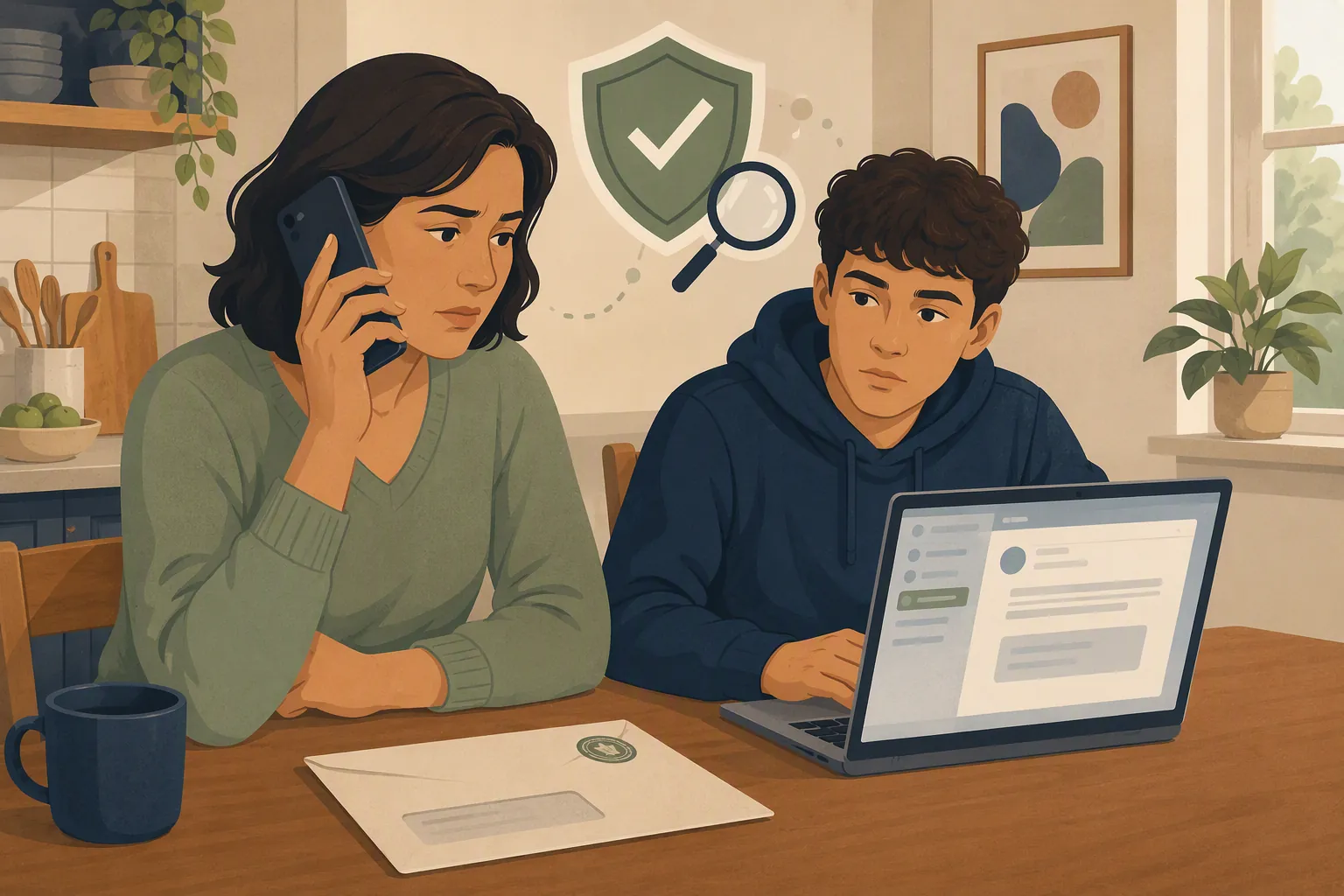
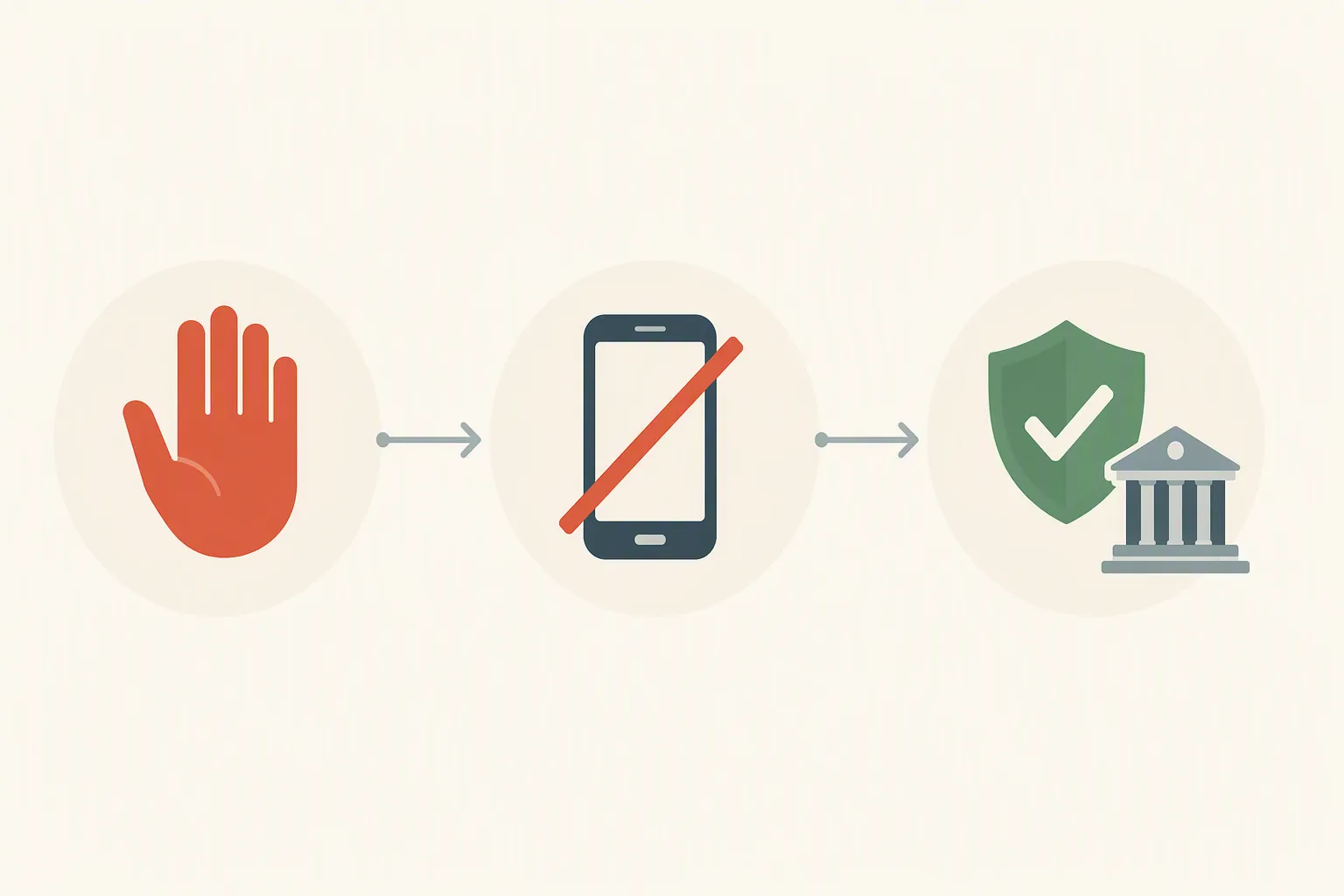
So the first back-to-school online safety tip for students and parents is also the least dramatic: stop the transaction. Do not pay, do not type a password, do not give an FSA ID, and do not continue through the phone number or link the message supplied. Move the question to an independent official channel and verify it there.
The verification habit that protects test-takers
When a message claims to involve College Board, ACT, a prep company, a scholarship, FAFSA, student aid, or a school account, treat verification as part of the exam process. The same way a student checks the test date and admission ticket, the household should check who is actually asking for money or data.
- Pause the request. A real exam, aid, or scholarship matter should survive a short delay while you verify it.
- Do not use the phone number, payment link, reply address, QR code, or login page supplied in the call, text, or email.
- Go to the organization’s official website yourself, use a known official account portal, or call an official number published outside the message.
- For a College Board call, use College Board’s own verification route. College Board says it does not make unsolicited calls requesting credit card, bank, or password information, and it lists 866-680-9990 for verifying the origin of a call claiming to be from College Board.[1]
- Search the organization name plus “scam” before paying a new prep vendor, scholarship service, housing contact, or loan-related company.
- Refuse payment pressure involving wire transfers, gift cards, payment apps, cryptocurrency, or “refundable” deposits that must be paid immediately.
- If you are buying from a legitimate vendor after checking it, use a credit card rather than harder-to-reverse payment methods.
- Never share passwords, school logins, PINs, Social Security numbers, bank information, card numbers, or FSA IDs with unsolicited callers or messages.
That checklist may feel slower than simply resolving the problem, especially when a student is worried about a test date. But it is faster than untangling a stolen login, an unauthorized charge, or a FAFSA problem caused by information handed to the wrong person.
Why the SAT prep call feels believable
The most unnerving part of the classic test-prep scam is that the caller may not sound random. In a 2018 FTC alert, the agency warned that scammers posing as College Board or another educational organization may already know the student’s name, address, and school. The pitch described by the FTC involved test-prep materials, a refundable deposit, and a request for a credit card; the materials never arrived.[2]
That detail matters. A parent hearing the correct school name during SAT season may reasonably assume the call is connected to registration, a counselor’s recommendation, or a prep program the student mentioned in passing. Scammers are exploiting the fact that families are already managing legitimate costs: registration, score sends, prep, transportation, application fees, and sometimes fee-waiver paperwork.
The FTC alert is from 2018, so it should not be treated as proof that every current call follows the exact same script. But the mechanics have not disappeared. A November 2024 New York Department of State consumer alert again warned about SAT preparation scams in which callers claim to be from the College Board or another educational organization, know details about the student, and request payment for materials or a deposit.[3]
| What the message says | What to do before paying |
|---|---|
| “We’re calling from College Board about your child’s SAT prep materials.” | End the call and verify through College Board’s published guidance or official number, not the caller’s number. |
| “We just need a refundable deposit for materials.” | Treat the deposit as a payment request, not a formality. Verify the vendor independently and do not rush. |
| “We already have your student’s name and school.” | Do not treat known details as proof. The FTC has specifically warned that scammers may already have this information. |
| “The deadline is today, so give the card number now.” | Stop. Real programs can be checked through official channels; urgency is not authentication. |
For College Board specifically, the line is unusually clear. College Board says it does not make unsolicited calls to students or families asking for credit card, bank account, or password information. It also provides 866-680-9990 for verifying whether a call claiming to come from College Board is legitimate.[1]
That is more useful than a vague warning to “be careful online.” If the caller asks for payment or credentials, the family does not have to debate whether the voice sounds professional. Hang up, use the official verification path, and then decide.
Prep companies, official platforms, and the safe way to buy
Not every paid prep offer is fake. Many families do buy books, tutoring, classes, or digital practice. The safety problem begins when the seller borrows the authority of a school, exam maker, scholarship committee, or aid office and then pushes the household into a payment path it controls.
Before buying, separate three things that often get blurred in a rushed call: the official exam account, the official practice tools, and third-party prep. For SAT families, start with the official route: the SAT exam prep guide can help keep registration and prep decisions anchored to the right place. If a message mentions Bluebook or Khan Academy, verify how those official tools fit together through the Bluebook and Khan Academy SAT practice guide rather than through a caller’s link.
If the family still wants a paid course, slow down the purchase. Search the company name plus “scam.” Read the cancellation and refund terms on the company’s own site. Use a credit card if you choose to pay. Do not pay by gift card, wire transfer, payment app, or any method that makes the money hard to recover. If you are comparing a known provider, use a buying guide such as the Princeton Review SAT prep course guide with the same verification-first lens: what is being sold, who is selling it, what are the terms, and where is the payment actually going?
Also check whether a paid pitch is solving a problem that has a safer official or low-cost answer. Fee waivers, school-based resources, and official free practice can reduce the pressure that makes a surprise “deposit” sound necessary. Our guide to school funding, fee waivers, and free test-prep alternatives can help families look for safer options before they buy under pressure.
FAFSA and scholarship messages need the same stop sign
Financial-aid messages hit a different nerve. A family may ignore a suspicious shopping coupon, but a scholarship or FAFSA warning can feel like money for college is about to disappear. That is why aid-related requests deserve the same verification rule as test-prep calls, with even less tolerance for credential sharing.
The FTC tells families not to share an FSA ID. It also warns that if someone uses false information on a FAFSA, the student could face serious consequences, including fines up to $20,000 and/or jail time.[4]
That warning is not about making families afraid to ask for help. It is about keeping control of the account and the answers. A helper can explain a question, sit beside a student, or point to official instructions. A stranger who wants the FSA ID, password, or personal identifiers is asking for something different.
Scholarship scams often use familiar pressure points: guaranteed awards, application fees, exclusive lists, or claims that the student has been “selected” before the family remembers applying. The FTC advises families to be cautious of companies that guarantee scholarships or financial aid, ask for payment to get aid, or promise special access to scholarship information.[5]
| Aid or scholarship claim | Verification move |
|---|---|
| “Give us your FSA ID so we can finish the FAFSA for you.” | Do not share it. Keep the student’s and parent’s account credentials under their own control. |
| “You won a scholarship, but you must pay a processing fee.” | Verify the scholarship through its official site and check whether the student actually applied. |
| “We guarantee aid if you pay today.” | Treat the guarantee as a red flag and compare the claim with FTC guidance on scholarship and financial-aid scams. |
| “We need your Social Security number or bank details by phone.” | Stop and move to the official agency, school, or scholarship portal reached independently. |
A scholarship can be real and still require careful handling. The test is not whether the offer sounds generous. The test is whether the family can verify the source, the application history, the terms, and the required information without relying on the message that created the urgency.
Other back-to-school scams that can hit exam families
The FCC’s back-to-school scam guidance, updated August 28, 2025, groups several seasonal threats together, including school shopping scams, fake scholarships, college housing rental scams, and student-loan-forgiveness scams. It also advises people not to share Social Security numbers, bank information, credit card numbers, PINs, passwords, or school-account logins with unsolicited callers and to verify agency contacts through .gov websites.[6]
For test-takers, those categories often overlap with exam logistics. A student traveling for a test date may be searching for housing or transportation. A senior registering for exams may also be applying for scholarships. A parent paying for prep may be buying school supplies from unfamiliar sites at the same time. The safest response stays the same: move the request away from the message and back to a verified channel.
- School-account login request: verify through the school’s official portal or help desk, not through the email link.
- Student-loan-forgiveness language: do not give credentials, bank details, or an SSN to an unsolicited caller; verify through official government sites.
- College housing or travel tied to an exam date: do not send money before confirming the listing and payment path independently.
- Urgent “account problem” text: open a browser yourself and go to the official account page instead of tapping the link.
Password reuse is worth mentioning only because exam season creates a lot of accounts at once: school portals, exam platforms, prep sites, scholarship databases, and aid forms. Reusing the same password across those accounts can turn one weak or stolen login into a wider problem. If your student uses the same password everywhere, the password reuse guide is a better place to handle that cleanup without turning this into a generic cybersecurity lecture.
What to do if you already paid or shared information
If a payment or login already went out, do not spend the next hour proving to yourself that the call might have been real. Move to containment.
- Call the card issuer or bank using the number on the back of the card or the institution’s official website.
- Change the affected password from the official site, and change it anywhere else it was reused.
- If an exam account, school account, or aid account may be involved, contact that organization through its official support channel.
- If an FSA ID or FAFSA information may have been exposed, regain control of the account and seek guidance through official student-aid channels.
- Report the scam to the FTC at ReportFraud.ftc.gov. The FTC directs consumers to use that reporting path for scams and fraud.[4]
- For unwanted calls, texts, spoofing, or related communications issues, use the FCC’s complaint channels described in its back-to-school scam guidance.[6]
Students with fixed test dates or ID complications should be especially careful about account control. A lost login can become a scheduling problem. If timing and documentation are already tight, as they can be for some students managing renewal delays, build account checks into the test-date plan rather than leaving them until the week of the exam. The test-date planning guide for DACA renewal delays is one example of where account access and timing need to be handled together.
Make verification part of the exam routine
A real request will survive verification. A real prep company can be checked. A real scholarship can be traced to an official program. A real FAFSA question does not require handing an FSA ID to an unsolicited stranger. And a real College Board issue can be confirmed through College Board’s own channels.
Official-sounding is not the same as official. For test-takers, the safest back-to-school habit is to move every payment, password, scholarship, and aid question back through a verified channel before the family acts.
References
- Important Information About Telemarketing and Internet Scams, College Board
- College test prep scams are happening, Federal Trade Commission
- Consumer Alert: New York Department of State’s Division of Consumer Protection Warns New Yorkers of SAT Preparation Scams, New York Department of State, November 2024
- Paying for School and Avoiding Scams, Federal Trade Commission
- How To Avoid Scholarship and Financial Aid Scams, Federal Trade Commission
- Back to School Scams, Federal Communications Commission, August 28, 2025
Related exhibits & inventory
Verified outcomes
No verified outcomes on file for this exam yet
See Methodology for how outcome evidence is disclosed once logged.
Planners
No planner filed for this exam yet
A downloadable timeline template for this exam hasn't been published yet.
Tool verdicts
AI-tool cautions
No AI tools tested for this exam yet
No hands-on AI-accuracy logs have been filed for this exam.
Questions about this plan
Ask a question about a specific section, timeline, or citation in this plan — or flag something that needs correcting.
Comments
Join the discussion with an anonymous comment.