
MCAT Exam Hub
The Great Lakes Whitefish Collapse — An MCAT Ecology Case Study
Use the real-world collapse of Great Lakes lake whitefish to master MCAT ecology concepts including trophic cascades, invasive species effects, and phenology mismatch. This case study connects multiple ecosystem stressors into a single high-yield framework for passage-based questions.
- gre
- mcat
- asvab
- sat
- act
- digital-adaptive
- official-material
- section-strategy
- test-date-timeline
Great Lakes lake whitefish harvest has fallen roughly 90% since 1999, a collapse large enough to sound like a simple disaster story until you ask the MCAT question: what changed in the system, and at which trophic level did the change begin? This study guide treats the whitefish population decline as a passage, not a headline. The species here is lake whitefish, Coregonus clupeaformis, in the Great Lakes, not European whitefish and not a generic seafood-counter “whitefish.” The useful model starts with larvae, not with adult fish on a dock.[1]
Start With the Arrow Chain
Draw the system from the bottom upward: dreissenid mussels enter and expand; mussels filter particles out of the lower food web; Diporeia amphipods decline; larval lake whitefish lose a major early-life food source; fewer larvae survive into juveniles; the adult population ages because too few young fish replace the old ones. That is a bottom-up mechanism. The pressure begins with resource availability at lower trophic levels and travels upward into fish recruitment.
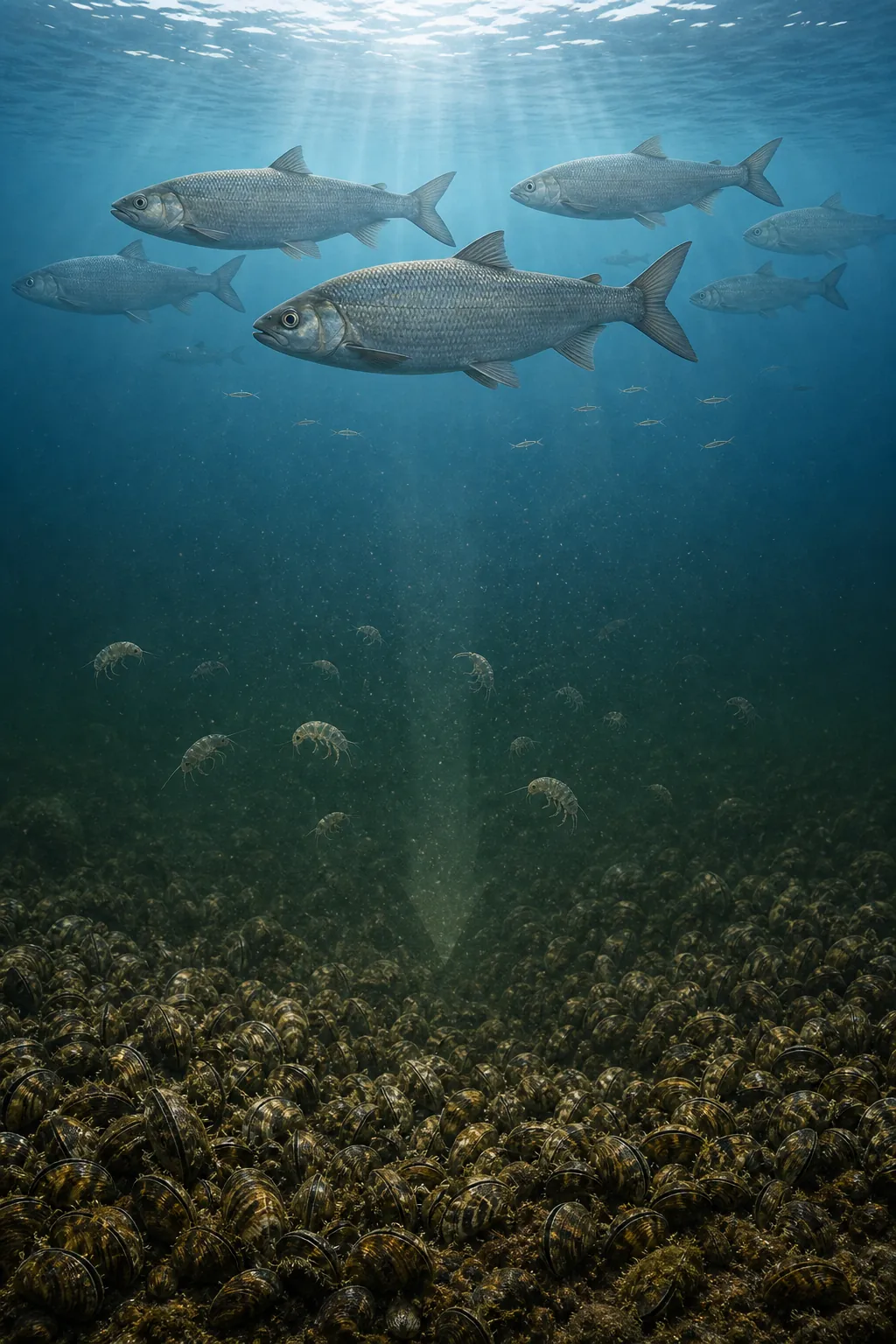
Dreissenid mussels, including zebra and quagga mussels, are ecosystem engineers in the most exam-relevant sense: they change the availability of energy before a predator ever touches a fish. By filtering suspended material and redirecting energy toward the benthic zone, they reduce the food reaching organisms that historically supported larval whitefish. In Great Lakes research, larval whitefish densities after dreissenid establishment dropped to 23% of historical values, which is much more informative than saying “the fish declined” because it points to the life stage where the bottleneck appears.[2][3]
For an MCAT passage, the independent variable might be dreissenid mussel density, time since invasion, or a lake basin comparison. The dependent variable might be Diporeia abundance, larval whitefish density, juvenile recruitment, or age structure. The key is not to call every downstream change an independent variable just because it appears early in the paragraph. Mussels are not “bad” in the abstract here; they are bad for this food web because they interrupt a feeding pathway that larvae depended on.
Age structure makes the failure visible after the larvae have already disappeared from casual view. Survey reporting has described many remaining lake whitefish as older than 20 years, which is the kind of pattern that should make a student think recruitment bottleneck rather than immediate adult mortality alone.[4] A population can still contain large adults and still be in trouble. If young cohorts are missing, the population is spending old biological capital.
Why this is bottom-up, not top-down
A top-down explanation would begin with predators or harvest removing fish and then trace effects downward. That does not fit the strongest whitefish mechanism. The first load-bearing change is lower-food-web filtration, followed by Diporeia loss and larval starvation risk. Predators, fishing pressure, and management decisions still matter, but they are not the cleanest first arrow in this case.
| Passage clue | MCAT interpretation |
|---|---|
| Food source for larvae disappears | Recruitment bottleneck, not just adult harvest |
| Change begins with mussels filtering the lower food web | Bottom-up regulation |
| Adults remain but young fish are scarce | Age structure signals failed replacement |
| Several stressors occur together | Avoid single-cause overclaiming unless the passage tests one pathway |
Winter Ice Adds a Timing Problem
Climate change enters this case as a compounding mechanism, not as a replacement for the mussel-Diporeia pathway. The arrow chain is different: less winter ice cover; more ultraviolet exposure reaching eggs; earlier hatching, by as much as a month in some reporting; larvae entering the water before the right food pulse is available. Great Lakes ice cover has declined about 5% per decade since the 1970s, and 2024 reached only 5.3% ice cover compared with a historical average of about 30%.[5]
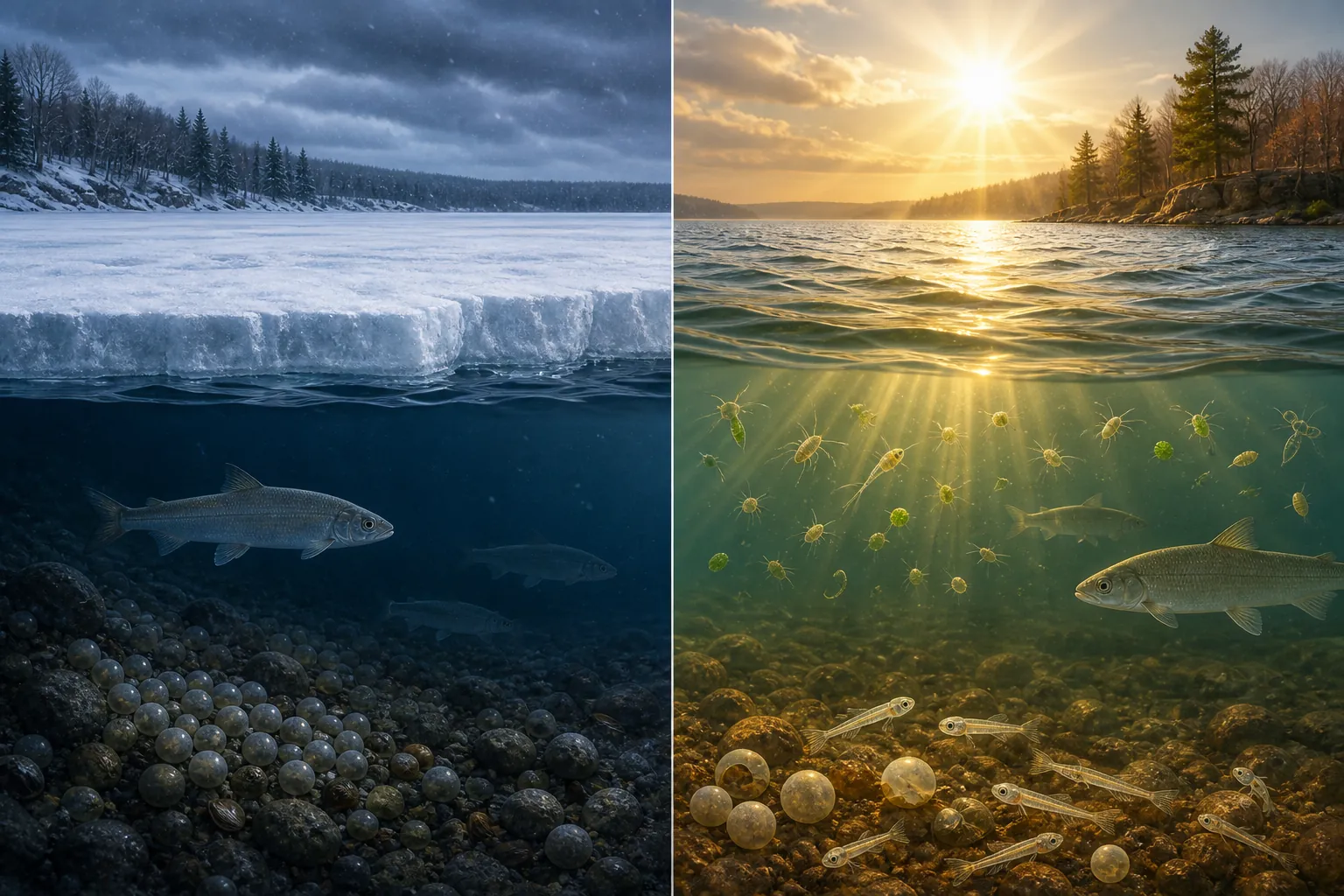
That second pathway is phenology mismatch. Phenology means the timing of seasonal biological events: hatching, plankton blooms, insect emergence, migration, flowering. A larva does not only need food to exist somewhere in the lake. It needs food at the right size, place, and time. If hatching shifts earlier but prey availability does not shift in the same way, survival can fall even if the total annual amount of food looks adequate on a broad graph.
For passage logic, separate the two mechanisms before combining them. Dreissenid mussels reduce larval food supply from below. Ice loss can shift developmental timing and expose eggs to more UV stress. The outcome may be the same—fewer young whitefish entering the population—but the experimental variables and predicted rescue strategies differ.
Lake Superior Is the Comparison That Makes the Model Sharper
Lake Superior helps because it does not ask students to memorize another stressor. It asks them to notice a condition. Lower calcium levels can limit dreissenid mussel shell growth, reducing mussel success compared with more favorable waters, and lake whitefish populations there have been described as relatively more stable.[6] That does not mean Lake Superior is untouched or immune. It means an abiotic factor can buffer an invasive species effect.
This is exactly how comparison logic tends to appear in biology passages. Two lakes receive the same broad invasive-species pressure, but one lake’s chemistry changes the strength of the effect. The conclusion should be conditional: dreissenid mussels can drive bottom-up food-web collapse where abiotic conditions allow them to establish strongly enough to restructure energy flow.
Do Not Flatten the Case Into One Villain
The primary mechanism is strong, but the real fishery is not a diagram with every other arrow erased. Fisheries managers and researchers continue to discuss secondary pressures including round goby interactions, walleye predation, cormorant predation, legacy overfishing, harvest policy, and changing habitat conditions. Bridge Michigan has reported major catch-limit reductions, including a 94% reduction for central Lake Michigan, while also emphasizing that regulation alone cannot solve a recruitment crisis caused by ecosystem change.[7]
For exam purposes, the caveat is simple: distinguish a primary causal pathway from a complete management history. If a passage gives data showing that larvae decline after Diporeia collapse, answer the mechanism in front of you. If it gives predator abundance, fishing effort, and larval food data together, do not pretend one variable explains everything unless the experimental design supports that conclusion.
How to Translate This Case Into MCAT Answers
When an ecology passage describes a population crash, first locate the life stage where the decline begins. Adult harvest numbers are visible, but recruitment failure often happens earlier and more quietly. Eggs, larvae, and juveniles are not background details; they can be the whole mechanism.
- If the stressor changes nutrient flow, prey abundance, or larval food supply, test a bottom-up explanation first.
- If the stressor changes predators, harvest, or mortality imposed on higher trophic levels, consider top-down pressure.
- If adults remain abundant but young cohorts are missing, think recruitment bottleneck.
- If seasonal timing shifts, ask whether hatching, food availability, and environmental protection still overlap.
- If one lake resists a stressor better than another, look for abiotic modifiers such as temperature, chemistry, light, or physical habitat.
The whitefish case also protects against a common passage mistake: treating correlation as permission to narrate causation. Field data often show several changes happening together. Stronger causal claims require timing, mechanism, comparison groups, experiments, or converging evidence. Lake Superior functions like a natural comparison, larval density data identify the bottleneck, and the mussel-Diporeia pathway supplies the mechanism.
This case is most directly useful for MCAT ecology, but the same reasoning carries into GRE science passages and AP Environmental Science: map the arrows, label the trophic level where the first major change occurs, separate resource loss from predator pressure, and watch for timing mismatch.
When a passage describes an ecosystem crash, ask four questions before choosing an answer: did the primary driver change resource availability from below; did seasonal timing create a phenology mismatch; does the age structure show recruitment failure; and do abiotic conditions explain why one location resists the same stressor better than another?
References
- The Great Lakes’ most emblematic fish could be consigned to history books, The Guardian, 2026-07-29
- Cunningham & Dunlop 2023 lake whitefish article, Journal of Great Lakes Research
- The decline of Lake Michigan whitefish, UW-Milwaukee School of Freshwater Sciences
- A crisis: Lake whitefish survey paints an even more dire picture, Michigan Public, 2025-01-20
- Great Lakes whitefish struggle to survive as ice cover melts away, MLive
- Lake Whitefish Climate Change Vulnerability Assessment, University of Michigan GLISA
- We can’t regulate ourselves out of whitefish crisis, experts say, Bridge Michigan
Related exhibits & inventory
Verified outcomes
Planners
No planner filed for this exam yet
A downloadable timeline template for this exam hasn't been published yet.
Tool verdicts
Questions about this plan
Ask a question about a specific section, timeline, or citation in this plan — or flag something that needs correcting.
Comments
Join the discussion with an anonymous comment.