
Anki vs Quizlet for Medical Students: Why Most Choose Anki and the Hidden Costs
This article compares Anki and Quizlet for medical students, examining why Anki has become the dominant tool despite its steep learning curve, and what the research reveals about exam outcomes and lifestyle trade-offs.
Updated:
For a first-year medical student, “Anki vs Quizlet” rarely feels like a neutral app comparison. It sounds more like a risk calculation: if most classmates are using Anki, is choosing Quizlet a harmless preference, or an avoidable academic disadvantage?
The pressure is not imaginary. In one 2025 study at the University of Central Florida College of Medicine, 94% of surveyed first-year students identified as Anki users; the sample was 89 students, with a 74% response rate, so this is a vivid single-institution snapshot rather than a national census. The same paper notes broader reported Anki use across U.S. medical schools in the 60% to 68% range, which is still high enough to explain why new students quickly hear that Anki is the default.[1]
The stronger reason Anki became that default is not the interface, which few people would describe as welcoming. It is the outcome signal. A 2023 study in the International Journal of Medical Students reported a 2.8% USMLE Step 1 failure rate among Anki users compared with 10.94% among non-users.[2] That does not prove that Anki alone caused the difference. Students who adopt Anki may also differ in study habits, consistency, peer networks, or board-prep intensity. But for a student deciding where to put hundreds of review hours, the association is hard to ignore.
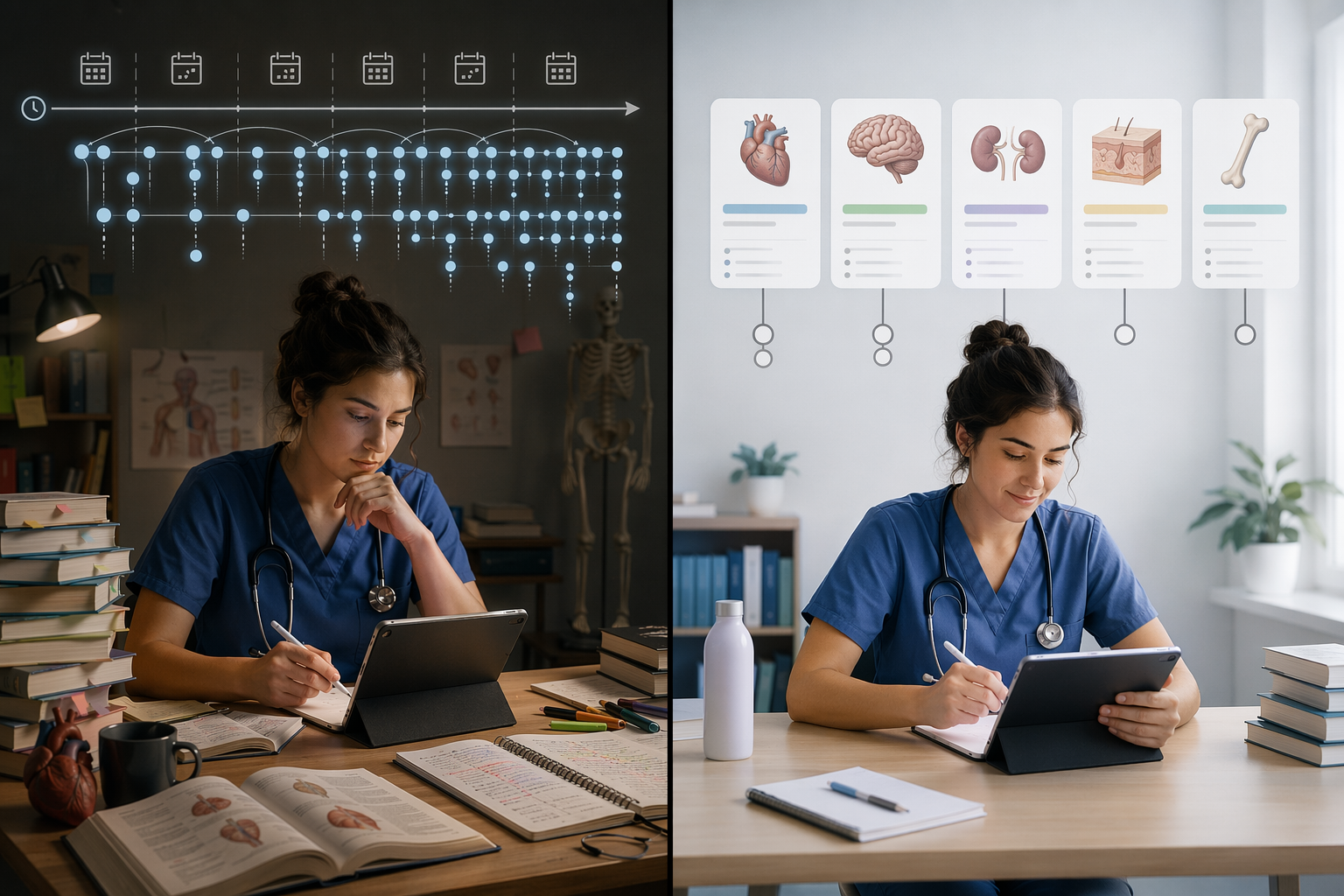
The Short Answer: Anki Is Better for Boards, Quizlet Is Easier to Live With
If the question is “Which tool is stronger for cumulative medical-school retention and board preparation?” the answer is Anki. If the question is “Which tool is easier to start using this afternoon for a class quiz, shared course set, or short-term review?” Quizlet has a real place.
| Decision Point | Anki | Quizlet |
|---|---|---|
| Spaced repetition | Built around algorithmic review scheduling for long-term retention | Useful for review sets, but not the same board-oriented spaced repetition ecosystem |
| Medical deck ecosystem | Strong pre-made deck culture, including AnKing, Zanki, and Lightyear | Better for quick shared sets and course-specific organization |
| Learning curve | Steep; settings, add-ons, burying, suspending, and review load take time to understand | Lower friction; cleaner interface and faster set creation |
| Review burden | Can become heavy quickly, especially with unsuspended pre-made decks | Usually lighter because students tend to use it for narrower review tasks |
| Pricing | $0 to $24.99 total, depending on platform | $35.99 to $44.99 per year |
| Best use case | Long-horizon board prep and cumulative preclinical retention | Short-term course review, shared class materials, and lighter workflows |
The price row matters, but not as much as students expect. The larger cost of Anki is usually not money. It is the daily obligation created by a system that remembers everything you asked it to remember.
Why Anki Fits Medical Training So Well
Medical school punishes forgetting on a long delay. A cardiovascular fact learned in one block may reappear in renal physiology, pharmacology, pathology, clinical rotations, and Step-style questions months later. A tool that only helps you prepare for Friday’s quiz is useful, but it does not solve the main retention problem.
Anki’s advantage is that it turns review into a scheduled queue. Cards you answer correctly come back later; cards you miss return sooner. That basic mechanism fits the rhythm of medical content better than rereading notes or rebuilding study sets every time a course changes topics.
The second advantage is cultural, not technical: medical students do not have to build the whole system from scratch. In the UCF study, 97.6% of Anki users reported relying on pre-made decks such as AnKing, Zanki, or Lightyear.[1] That number says something important about why Anki spreads. The app is awkward, but the shared deck ecosystem lowers the barrier to covering board-relevant material.
This is also where students can get into trouble. A pre-made deck can make the work look already organized, as if the only remaining job is to keep clicking “Again,” “Hard,” “Good,” or “Easy.” But a deck built for broad board coverage is not the same thing as a personal learning plan. If a student unsuspends too freely, Anki stops being a retention aid and becomes a second curriculum.
Students who want a deeper look at that workflow can use this Anki review for medical students as a companion, especially for understanding how decks, settings, and review habits interact.
What Quizlet Still Does Well
Quizlet is not a joke option. It is cleaner, faster to learn, and often more pleasant for students who need to make or share a set quickly. For anatomy terms, pharmacology prefixes, lab values, or a professor’s list of examinable definitions, that lower friction can matter. A tool students will actually open during a crowded week has value.
The best evidence for Quizlet in the research set is not a direct head-to-head win over Anki for Step preparation. It comes from a 2022 international cohort study using Quizlet in advanced clinical review, where Quizlet served as a structured review tool in a defined educational setting.[3] That is a narrower claim, and it should stay narrow: Quizlet can support organized course review, especially when the task is bounded.
That narrower role is still useful. Some students use Quizlet for quick course materials while keeping Anki for long-term retention. Others use Quizlet before they are ready to commit to Anki’s daily queue. The mistake is not using Quizlet; the mistake is expecting a lighter short-term workflow to do the same job as a cumulative board-prep system.
The Hidden Cost of Anki Is the Review Queue
Anki’s strength is also the source of its psychological weight. It does not forget what you assigned yourself. If you miss a day, the cards wait. If you add too many cards during a difficult block, the future bill comes due when you are already tired.
The lifestyle data from the UCF study is the part that should slow down any casual “just use Anki” advice. Among surveyed first-year students, 82.1% found Anki overwhelming, 67.9% reported anxiety related to Anki, 34.5% reported lost sleep, 36.9% skipped meals, and 52.5% skipped exercise.[1]

Those numbers do not mean Anki is bad. They mean Anki is a serious commitment, and students often inherit it socially before they understand its maintenance cost. A classmate can recommend a deck in five seconds. The student receiving that advice has to live with the reviews for months.
The same study found that 75% of students never sustained cross-module reviews.[1] That finding is easy to recognize in real life. Students begin with the ideal of keeping every prior block alive forever, then the queue expands, a new exam approaches, and older reviews become the first thing sacrificed. The system still works best when reviews continue across time, but the daily reality of medical school often pushes students toward triage.
How to Choose Without Turning Anki Into a Second Curriculum
A good Anki plan starts before the deck gets large. The first decision is not which add-on to install. It is what Anki is responsible for. For most medical students, Anki is best assigned to durable, high-yield knowledge that will matter beyond the current block: mechanisms, disease patterns, pharmacology, physiology relationships, and board-style facts that are likely to recur.
- Use Anki for material you want to retain after the course exam is over.
- Use Quizlet for quick lists, shared class sets, and short-term course organization.
- Avoid importing or unsuspending cards just because a deck exists.
- Set a daily review ceiling before you are exhausted enough to ignore it.
- Protect sleep, meals, and exercise as part of the study plan, not as rewards for finishing the queue.
That last point is not wellness decoration. If a study system regularly pushes reviews past midnight, replaces meals, or makes exercise disappear, the system is producing academic work by borrowing from the body that has to keep doing the work.
Quizlet can be the better choice when the task is small and immediate. If a course releases a terminology-heavy objective list, if a lab group wants a shared set, or if a student needs a low-friction way to review before a short quiz, Quizlet’s simplicity is a feature. It does not need to beat Anki at cumulative board prep to deserve a place.
Using both tools can work if each has a defined job. It works less well when students duplicate the same material in two places, then feel guilty for neglecting one of them. The point is not to build the most elaborate study system. It is to reduce the number of decisions between learning something important and seeing it again at the right time.
A Practical Verdict for Medical Students
For most medical students preparing for long-horizon exams, Anki is the stronger default. Its spaced repetition workflow, medical deck ecosystem, and association with lower Step 1 failure rates make it more than a productivity fad. The students using it are not simply choosing the uglier app because they enjoy suffering; they are responding to a tool that fits the cumulative structure of medical training.
But the evidence does not support adopting Anki as an unlimited daily obligation. The documented rates of overwhelm, anxiety, lost sleep, skipped meals, and skipped exercise are too high to treat as background noise.[1] Anki should be used deliberately: selected material, sustainable review limits, and permission to suspend or narrow when the queue starts to compete with basic functioning.
Choose Anki if your main problem is cumulative retention for medical school and board exams. Choose Quizlet if your main problem is quick, organized review for a course or shared class material. Use both only when each tool has a separate job. If neither feels right, it is worth comparing the broader flashcard landscape; this 2026 AI flashcard generator comparison can help you see what other tools are trying to solve.
References
Individual Tool Profiles
Related Comparisons
- Switching from Quizlet to Knowt: A Step-by-Step Migration Guide and Honest Trade-Off Assessment
A practical guide for students who have built up flashcard sets on Quizlet and are considering moving to Knowt for its free features. Covers the one-click import process, what carries over and what gets lost, what you gain and lose by switching, and a verdict on when migration makes sense.
- Quizlet vs Knowt: Which Free Flashcard App Is Better for Students?
A head-to-head comparison of Quizlet and Knowt for budget-conscious students, covering what each platform actually offers for free in 2026, how their paid plans compare, and which tool fits different student profiles — from AP exam preppers to language learners.
- Quizlet Free Trial vs. Free Alternatives: Is the 7-Day Trial Worth Starting?
This article helps budget-conscious students decide whether to start the 7-day Quizlet Plus free trial or use a completely free alternative like Anki, Knowt, or Brainscape. It covers what the trial includes, what you lose when it ends, a feature-parity comparison matrix, and a strategic timing framework to get the most value.
Comments
Join the discussion with an anonymous comment.