Why Grok 4.6 shouldn't generate your exam prep questions
Accuracy Warning — Grok 4.6
Measured 65.7% non-hallucination rate; generated questions can invent answer choices, explanations, or premises and should not replace official practice materials.
- Accuracy:
- Limited
- Tested:
- Generating exam practice questions
- Last tested:
- 2026-08-25
Last reviewed: Aug. 26, 2026. Accuracy warning: Grok 4.6 may be useful around exam prep, but using it as an unlimited practice-question bank is the risky part. Artificial Analysis measured Grok 4.6 at a 65.7% non-hallucination rate, which is the wrong kind of weakness for a tool that might invent answer choices, explanations, or premises you then spend two evenings training on [1].
If you came here after looking for i tested grok 4.6 for exam prep, start with the hands-on verdict in our companion article, I Tested Grok 4.6 for Exam Prep. Does It Work? That trial was last tested Aug. 25, 2026, and it already identifies question generation as the weak task. This article explains why that verdict is not just a wording problem.

The shortcut is tempting because it feels productive
The appeal is obvious. GRE quant sets, MCAT passage practice, SAT reading drills, ACT math, ASVAB word knowledge: once you have burned through the obvious free material, an AI model that can keep making more questions looks like a solution. It can adapt difficulty. It can explain every answer. It can turn a weak topic into a fresh set in seconds.
The danger is quieter. A bad explanation usually feels bad quickly: the algebra does not follow, the biology term is off, or the answer contradicts the passage. A bad practice question can feel fine. It may use the right vocabulary, the right number of answer choices, and the right exam label while training the wrong skill.
That matters most when the calendar is short. With three Saturdays before a real test date, the issue is not whether Grok 4.6 can produce something that resembles an exam item. It can. The issue is whether the item is safe to count as exam-faithful practice.
Good exam questions are not just questions with the right topic label
The best evidence here is not a leaderboard. It is a large field study on AI-generated exams that shows how much work sits between “generate a multiple-choice question” and “produce an item that behaves like an expert-written exam question.”
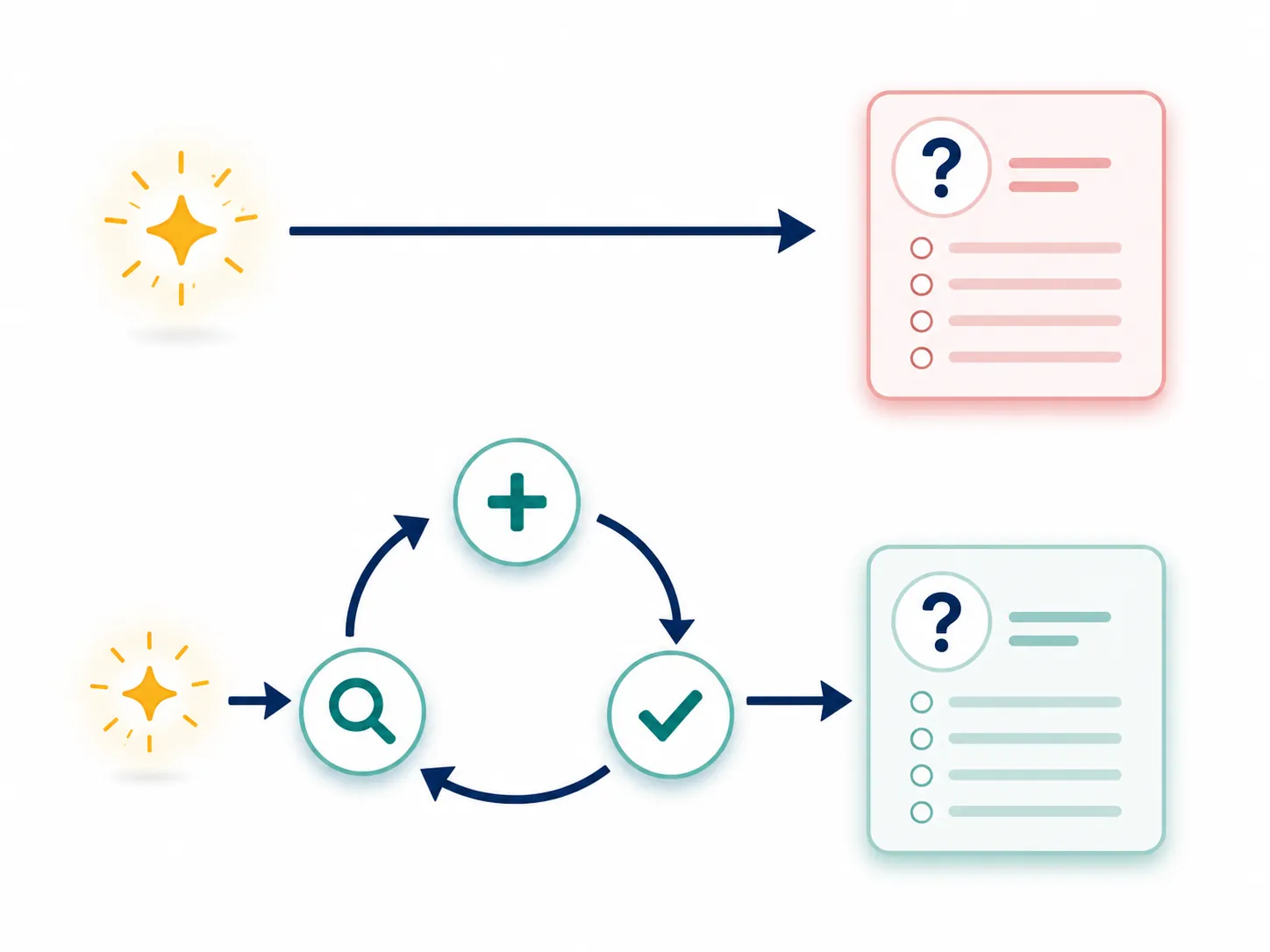
In “Assessing the Quality of AI-Generated Exams: A Large-Scale Field Study,” researchers evaluated AI-generated multiple-choice questions across 91 classes and about 1,686 students. The important finding is not simply that AI could make usable items. It is that expert-comparable item quality emerged through iterative generate-critique-refine cycles, not casual one-pass generation [2].
The study’s useful lesson is the process, not the hype
The study compared AI-generated and expert-written items using student performance data. Its psychometric results were mixed in ways that should interest anyone relying on practice questions. AI items were somewhat easier, with roughly 60% correct compared with 39% correct on AP-statistics items, and they were slightly more discriminating on average, with a mean discrimination value of 1.3 versus 1.2. A larger share of AI items were rated highly or very highly discriminating, 36% versus 21% [2].
Those numbers do not mean “AI questions are better.” They mean that under a controlled workflow, with critique and refinement, AI-generated multiple-choice items can reach useful psychometric behavior in that setting. For a classroom instructor building statistics questions, that is promising. For a student asking Grok 4.6 to “make me 25 hard MCAT CARS-style questions,” it is a warning label.
The consumer chat use case usually skips the expensive part. There is no field test across hundreds of students. There is no item analysis after the fact. There is no expert pass that checks whether the distractors target the misconception the exam actually tests. There is just a model producing a plausible-looking item and a tired student deciding whether to trust it.
The study also has real boundaries. It examined multiple-choice questions, and the subject area was statistics. It should not be stretched into a claim about MCAT CARS passages, GRE issue essays, ACT English nuance, or constructed-response tasks. But its narrowness makes the consumer shortcut look worse, not better: even in a multiple-choice statistics setting, quality depended on an iterative process [2].
Grok 4.6 can be strong and still be unsafe as a question bank
Grok 4.6 is not a weak model in the ordinary sense. Artificial Analysis placed it at 61 on its Intelligence Index and reported strong knowledge-work results, including 1753 on GDPval-AA v2 and 1577 on AA-Briefcase. Those results support using the model for many reasoning-adjacent study tasks: explaining a missed solution, organizing notes, finding patterns in an error log, or turning weak areas into a review plan [1].
The same benchmark profile contains the problem. Artificial Analysis reported a 65.7% non-hallucination rate and 48.2% on AA-Omniscience. It also shows that strength is uneven across precision tasks: Grok 4.6 scored 65.9% on DeepSWE versus Sol at 73%, and 26% on Terminal-Bench v3.0 versus 88.4% on Terminal-Bench v2.1 [1].
For exam prep, hallucination is not a cosmetic defect. A fabricated historical claim in a reading passage, a subtly invalid math condition, a biology distractor that is too obviously wrong, or an answer key that rewards the wrong inference can all become “practice.” The student may then diagnose the wrong weakness: not “I mishandled official SAT command-of-evidence reasoning,” but “I missed Grok’s invented logic.”
That is why general benchmark strength does not settle the question-bank issue. The closer a task gets to verified item construction, the less impressed you should be by a model’s ability to sound like a test writer.
The product details help explain access, not trust
xAI launched Grok 4.6 on Aug. 12, 2026. Its developer documentation lists a 500K-token context window and a Feb. 1, 2026 knowledge cutoff. As of this review date, xAI pricing listed API rates at $2 per 1M input tokens and $6 per 1M output tokens, with rates doubling past 200K prompt tokens; SuperGrok at $30 per month was the cheapest consumer tier naming Grok 4.6 [3][4][5].
Those details matter if you are budgeting or deciding whether a long error log fits in context. They do not prove generated questions match ETS, AAMC, College Board, ACT, or ASVAB item design. A large context window can hold more official-style material, but it does not turn a single generated item into a validated one.
Prep-industry testing points to the same weak spot
The prep-industry checks are less rigorous than the field study, but they match the failure mode test-takers actually see: AI items often look realistic while missing the exam’s reasoning structure.
PrepScholar’s March 2026 discussion of AI for SAT and ACT prep warned that AI-generated questions can lack the same reasoning structure as real SAT and ACT items and cannot simulate full-length pacing [6]. That is exactly the difference students tend to notice too late. A question can cover linear equations without behaving like SAT math. A reading question can ask about a passage without testing the way the SAT or ACT typically turns evidence into an answer.
ApexVision’s 2026 MCAT testing reached a similar practical judgment from the MCAT side: AI was “least valuable for generating practice questions” because AI items “rarely match the exam’s reasoning style” [7]. For the MCAT, that distinction is not minor. A content recall question about amino acids is not the same training stimulus as an AAMC-style passage question that makes you decide which fact matters under experimental constraints.
This is also where “unlimited practice” becomes a bad trade. Extra repetitions help only if the repetitions preserve the skill. If the questions are too direct, too vocabulary-driven, too cleanly worded, or built around distractors the official exam would not use, they can make a student feel faster while leaving the real bottleneck untouched.
Use official questions as the practice engine
The safe division of labor is plain: official banks do the testing; Grok 4.6 helps after the attempt. That means ETS material for GRE-style practice, AAMC material for MCAT, College Board material for SAT, official ACT materials for ACT, and DoD or official ASVAB sources where available. Those sources define the target. Grok 4.6 does not.
| Prep task | Use as primary source? | Safer role for Grok 4.6 |
|---|---|---|
| Taking timed practice sets | Official questions | Help review the set after you finish |
| Learning why an answer is right | Official answer key first | Explain the reasoning in simpler steps, then compare back to the key |
| Finding repeated mistakes | Your error log | Classify misses by topic, reasoning error, timing issue, or careless mistake |
| Planning the next study week | Your real scores and deadlines | Turn weak areas into a review schedule |
| Generating extra questions | Not as exam-faithful practice | Treat as similar but verify against official sources |
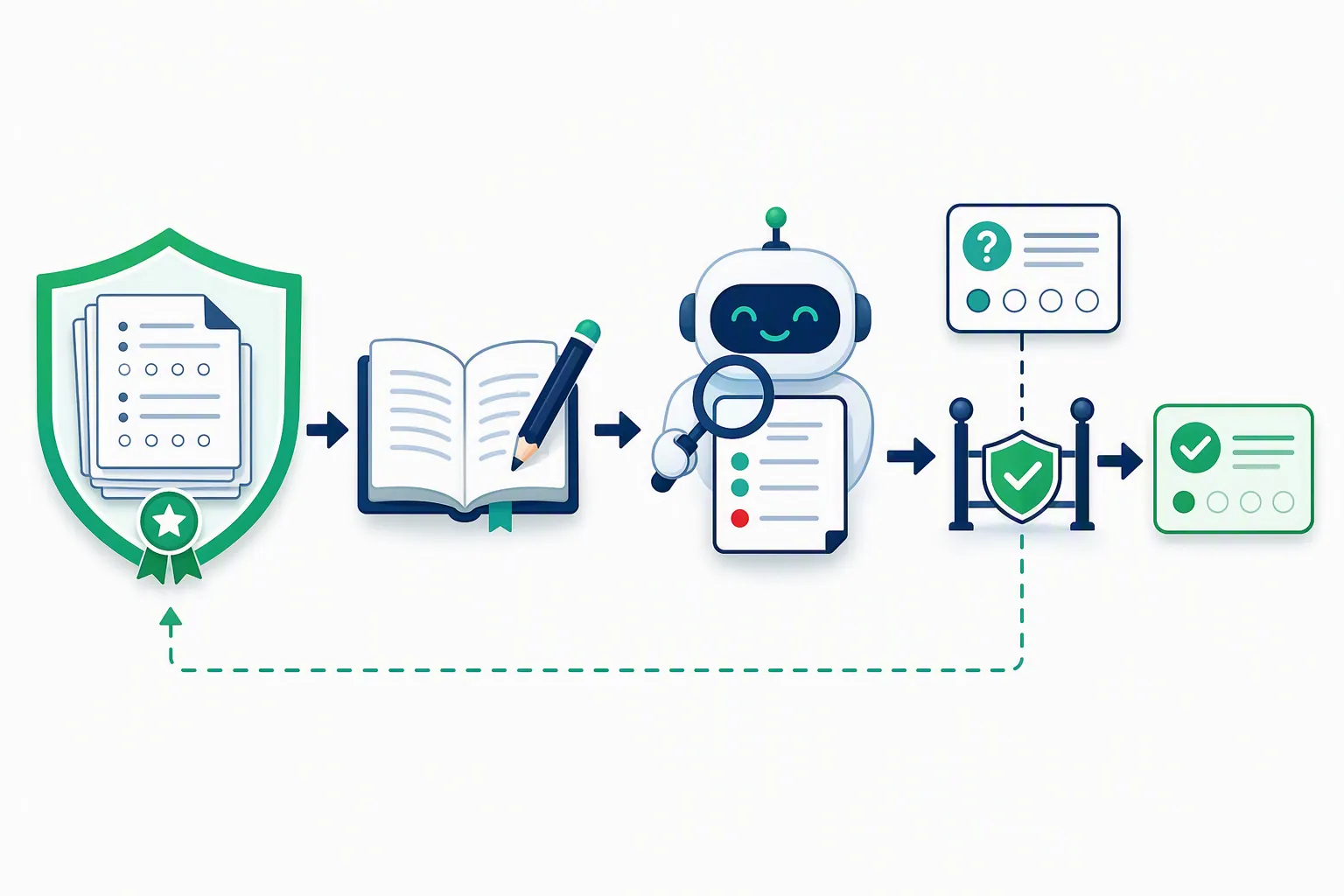
A good workflow looks like this: answer official questions first, mark every miss, write down why you chose the wrong answer, then ask Grok 4.6 to organize the mess. It can group mistakes you would not have noticed: algebra setup errors, passage-detail traps, rushing on the last third of a section, or overusing outside knowledge when the answer had to come from the text.
That is a strong use case because the ground truth stays outside the model. The official answer key decides what is correct. The model’s job is to make your review less chaotic.
A practical error-log prompt
I am studying for [exam]. Below is my error log from official practice questions.

For each miss, classify the likely cause as one or more of:
- content gap
- misread question
- wrong reasoning pattern
- timing pressure
- careless arithmetic or notation
- answer-choice trap

Then find the top 3 patterns and suggest what I should review next. Do not create new practice questions unless I ask. If you are unsure, say what extra information you need.

Error log:
[paste question source label, topic, my chosen answer, correct answer, and my explanation of why I missed it]
The instruction “Do not create new practice questions unless I ask” is not politeness. It keeps the model in the role where it is useful: analyzing your performance on validated material.
If you still ask Grok 4.6 to make questions, label them correctly
There are times when synthetic questions can still help. If you are trying to check whether you remember a formula, practice a vocabulary definition, or warm up before reviewing official material, a generated question can be useful. The mistake is counting it as equivalent to an official item.
- Label every AI-generated item as “similar but verify,” not “official-style.”
- Use generated questions for low-stakes warmups or concept checks, not for score prediction.
- Compare the reasoning structure against official explanations before keeping the item.
- Do not add AI-generated misses to your main error log unless you have verified the question and answer.
- Never let a generated set replace a timed official section close to test day.
The same verification problem appears outside exams. BBC coverage of EBU research reported that 45% of AI answers to news queries had at least one significant issue and 31% had serious sourcing problems [8]. That figure is not exam-prep evidence, and it should not be used as if it were. It is simply a useful reminder that fluent answers still need a checking layer when correctness matters.
For GRE, MCAT, ASVAB, SAT, and ACT prep, the boundary is simple enough to keep: official questions train the exam skill; Grok 4.6 helps you understand what happened after you try them. Letting the model explain, sort, and plan can save time. Letting it replace the question bank is where the shortcut becomes unsafe.
References
- Grok 4.6 Benchmarks and Analysis — Artificial Analysis
- Assessing the Quality of AI-Generated Exams: A Large-Scale Field Study — arXiv
- Grok 4.6 — xAI — Aug. 12, 2026
- Grok 4.6 — xAI Developers
- Pricing — xAI
- ChatGPT and AI SAT/ACT Prep Drawbacks — PrepScholar — Mar. 2026
- Best AI Tools for MCAT Prep — ApexVision
- New EBU research reveals AI assistants distort news content — BBC Media Centre — 2025
Authoritative source
For the authoritative version of this contentHow to Read the '1 in 4 NFL Players CTE' Study
Report an error in this tool's output
Found something this tool got wrong beyond what's documented above? Report it so the accuracy log stays current.
Comments
Join the discussion with an anonymous comment.