How to Use AI for Studying Ethically (Even When Your Professors Disagree)
Accuracy Warning
This tool's exam-prep accuracy has not been fully characterized.
A student can be following the rules in one class and accidentally crossing a line in the next. In one syllabus, generative AI is prohibited for written work. In another, it is allowed if the student discloses how it was used. In a third, the professor builds AI into the learning activity and expects students to experiment with it. Quetext’s 2026 analysis describes these as three coexisting policy categories—prohibited, allowed-with-disclosure, and teaching-integrated—and argues that many violations now come from accidental compliance failures rather than students setting out to cheat.[1]
That is the practical problem behind the ethical use of AI for studying. The question is not only “Is ChatGPT allowed?” or “Can I use NotebookLM?” The same tool can either help you think harder or let you avoid thinking at all. The tool name matters less than the job you ask it to do.

Survey evidence suggests students already feel that tension. In a May 2026 Inside Higher Ed Student Voice survey of 1,038 students across 203 institutions, 60% said AI’s primary value is learning support, while 40% worried about dependence. Only 10% said their institution handles AI well.[2] Those numbers do not settle every campus debate, but they do make one thing believable: many students are not looking for a loophole. They are looking for a usable standard.
The Learning Test
Before you click generate, ask one question:
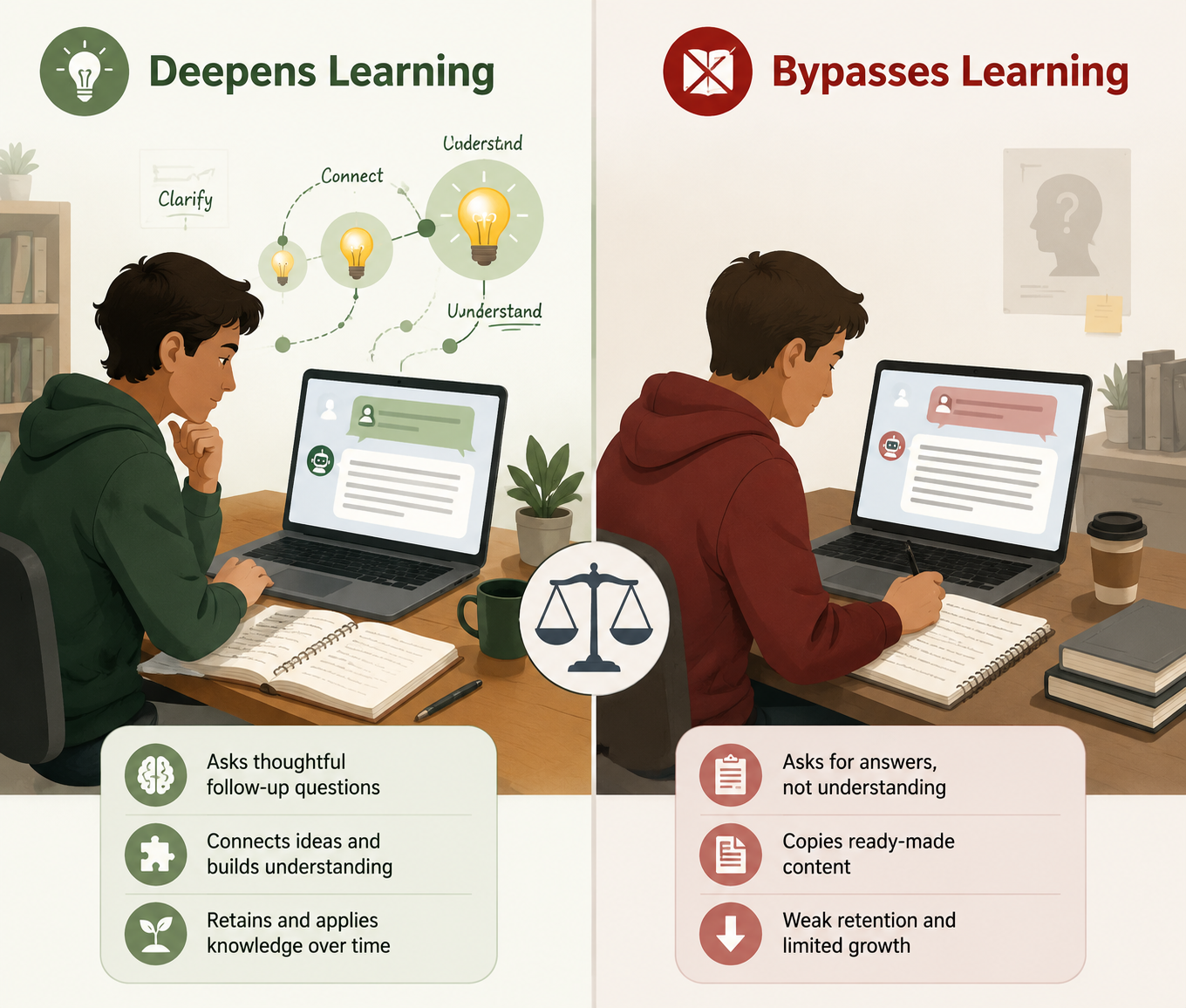
Does this AI use deepen my engagement with the material, or does it bypass that engagement?
That wording comes from Stanford’s AI Learning Guide, which asks students to consider whether generative AI takes away an opportunity to engage more deeply with the material or deepens that engagement.[3] It is a better starting point than trying to memorize a fixed list of “good” and “bad” apps, because AI study tools keep changing and course rules still vary.
A use usually deepens learning when it makes you retrieve, explain, compare, correct, question, or apply course material. A use usually bypasses learning when it produces the thinking your instructor is trying to assess, especially if the result can move straight into a submitted assignment.
| AI use | Likely ethical direction | Why |
|---|---|---|
| Ask an AI tutor to quiz you on your own lecture notes | Usually deepens learning | You still have to recall, answer, and correct yourself |
| Ask a chatbot to explain a confusing concept, then restate it in your own words | Usually deepens learning | The AI supports understanding rather than replacing your response |
| Generate a polished discussion post and submit it with small edits | Usually bypasses learning | The AI has done the composing and reasoning being assessed |
| Use NotebookLM to make a study guide from assigned sources you have uploaded | Depends on use | It can organize reading, or it can become a substitute for reading |
| Use AI to check whether your flashcards match your notes | Usually deepens learning | Verification improves the study material you made |
This test does not override a syllabus. If your professor bans AI for a task, the rule controls the task. But when the policy is vague, or when one class’s AI norm does not transfer cleanly into another, the Learning Test gives you a way to slow the decision down before you create a problem for yourself.
Same Tool, Different Outcome
Students often ask about tools as if each one has a fixed ethical identity. ChatGPT is not automatically cheating. Quizlet is not automatically safe. NotebookLM is not automatically exempt because it works from sources. The use has to be judged in context.
ChatGPT: Socratic Explainer or Paragraph Generator
A student studying cell respiration might ask ChatGPT, “Quiz me one question at a time on glycolysis, and do not give me the answer until I try.” That use asks the student to retrieve information, notice gaps, and repair misunderstanding. A stronger version is to ask, “When I answer, tell me which part of my reasoning is weak.” Used this way, ChatGPT behaves more like a patient study partner than a ghostwriter.
The line changes when the student asks for a complete paragraph that can be pasted into a lab reflection, discussion board, or essay draft. Even if the student “understands the idea,” the generated paragraph may be doing the organization, phrasing, and emphasis the assignment is meant to elicit. A guide to ChatGPT for studying can help with practical workflows, but the ethical distinction is still this: are you using the tool to practice the move, or to avoid making the move yourself?
Quizlet: Flashcards From Your Notes or Work Presented as Yours
Flashcards are one of the clearer learning-support cases when the source material is yours. If you upload your lecture notes, generate cards, edit weak ones, and then test yourself, AI has reduced setup time without removing the retrieval practice. The Campus Journal’s 2025 discussion of student AI use and Quizlet’s own documentation both support the distinction between AI-assisted study materials and AI-generated work presented as original output.[4][5]
The problem appears when a class asks students to create a study set, explanation bank, or vocabulary resource as the graded work itself. If the assignment is to decide what matters, write definitions, choose examples, and show judgment, then submitting AI-generated cards without permission or acknowledgment bypasses the learning target. For tool-specific details, a Quizlet flashcards review is useful, but no feature list can answer the ethical question by itself.
NotebookLM: Source-Grounded Does Not Mean Effort-Free
NotebookLM deserves special care because its design makes the ethical distinction unusually visible. Florida State University’s 2026 Canvas guide and Google’s 2025 blog materials describe NotebookLM as a source-grounded tool that works from materials the user provides, rather than answering only from a broad general chat context.[6][7] That can be genuinely helpful for studying. A student can upload assigned articles, lecture slides, or their own notes, then ask for a study guide, comparison table, practice questions, or a list of places where two readings disagree.
That source-grounded structure is not a magic permission slip. If the student uses NotebookLM after reading to organize themes, check recall, or prepare for office hours, the tool is supporting engagement. If the student uses the generated summary so they do not have to read the assigned chapter at all, the tool is replacing the very encounter the course requires. The output may be tied to course materials and still be ethically weak as a study habit.
A good NotebookLM workflow keeps the original source in view. Read first, even if imperfectly. Mark confusion. Ask NotebookLM to turn that confusion into questions. Then return to the source and test whether the answer is really there. If you want a more detailed setup, a NotebookLM study guide for students or a step-by-step guide on how to use NotebookLM for studying can help, but the core habit is simple: use the generated material to go back into the reading, not to escape it.
A Second Check: Transparency, Accountability, Privacy, and Fairness
The Learning Test tells you whether AI is helping or bypassing your learning. It does not answer every ethical issue. California State University’s AI Commons names six principles for generative AI use: integrity, transparency, accountability, fairness, respect for privacy, and health and safety.[8] For everyday studying, four of those usually need the quickest check.
- Transparency: If AI helped with an assignment-adjacent task, could you honestly describe what it did?
- Accountability: If the AI explanation is wrong, are you prepared to own and correct the mistake?
- Privacy: Are you uploading personal data, classmates’ work, unpublished instructor materials, or sensitive research notes?
- Fairness: Does the tool give you an advantage the course has not allowed, especially on work meant to measure individual performance?
These checks are not there to make every study session feel like a legal review. They are there to catch the cases where “it helped me study” is too quick. A tool can help and still create a disclosure, privacy, or fairness problem.
Disclosure Should Become a Small Habit, Not a Panic Event
When AI use is allowed, many students still get nervous about how much to say. The safest habit is a brief acknowledgment when AI meaningfully shaped assignment-related work. Quetext’s 2026 analysis, CSU’s AI principles, and Carnegie Learning’s 2023 guidance all point toward disclosure as an emerging norm, including in settings where AI is permitted.[1][8][9]
A useful disclosure is specific but not theatrical. For example: “I used ChatGPT to generate practice questions from my lecture notes and to identify concepts I needed to review. I wrote the submitted response myself.” Or: “I used NotebookLM to create a study guide from the assigned readings, then checked the generated points against the original sources.”
If your professor gives a required format, use that instead. If the syllabus says no AI for the assignment, disclosure does not make the use acceptable. But when the policy allows AI or leaves room for study support, a short acknowledgment can prevent a small study choice from looking like concealment later.
Verification Is Part of Ethical Studying
AI can sound more confident than your professor on a bad day, and still be wrong. That matters ethically because studying from false explanations wastes your time and can spread mistakes into group work, lab preparation, or exam review.
One widely cited caution comes from Stanford researchers in 2023, who reported that one version of ChatGPT’s performance on a set of simple math questions dropped from 98% accuracy to 2% over time.[10] That should not be treated as proof of how every current model performs in 2026. It is better read as a reminder that model behavior can change and confident output still needs checking.
For low-stakes review, verification can be light: compare the AI explanation with your notes, textbook, answer key, or lecture slides. For exams, clinical material, legal reasoning, statistics, lab safety, or anything your grade depends on heavily, verification needs to be stricter. If you use AI flashcards, check a sample before you drill them for an hour. A hybrid workflow, like the one discussed in Are AI Flashcard Makers Accurate?, is usually better than trusting generated cards untouched.
What to Do Before You Use AI in a Class
You do not need a private philosophy seminar before every study session. You need a short routine that works even when your classes disagree.
- Check the class rule first. Look for whether AI is prohibited, allowed with disclosure, or built into the activity.
- Name the task. Are you studying, drafting, solving, editing, translating, summarizing, or submitting?
- Apply the Learning Test. Does the use make you engage more deeply, or does it do the engagement for you?
- Decide whether disclosure is needed. If AI meaningfully shaped assignment-related work, prepare a brief note.
- Verify the output. Check AI-generated explanations, examples, citations, formulas, and flashcards against course materials.
- Ask when the stakes are high. If the rule is unclear and the work is graded, ask the instructor before using the tool.
The broader AI study-tool landscape is changing quickly, and there are good reasons to compare apps, costs, and workflows. If you are still deciding what belongs in your study routine, start with a 2026 overview of how AI changed online study tools, a tested list of AI study tools in 2026, or a comparison of AI study tools vs. traditional study tools. If cost is the barrier, a guide to the best free AI study tools in 2026 may be more useful than trying to force one expensive tool into every class.
Still, tool choice comes after judgment. Check the syllabus. Disclose when appropriate. Verify what AI gives you. And when the policy language does not answer the real question, return to the Learning Test: is the work still yours to learn?
References
- AI Writing and Academic Integrity in 2026, Quetext, 2026
- Student Voice Survey on AI in Higher Education, Inside Higher Ed, May 2026
- AI Learning Guide, Stanford Center for Teaching and Learning, 2025
- AI Use in the Classroom: A Student Guide, The Campus Journal, December 2025
- Quizlet Help Center, Quizlet
- NotebookLM Guide, Florida State University Canvas, April 2026
- NotebookLM Updates, Google Blog, September 2025
- AI Commons, California State University, 2024
- Academic Integrity in the Age of AI, Carnegie Learning, 2023
- How Is ChatGPT's Behavior Changing over Time?, Stanford University and UC Berkeley, 2023
Authoritative source
No specific exam hub matched
Browse the exam hubs directory for the authoritative plan on any of the five exams.
Report an error in this tool's output
Found something this tool got wrong beyond what's documented above? Report it so the accuracy log stays current.
Comments
Join the discussion with an anonymous comment.