Does ChatGPT still work for studying after OpenAI's exodus?
Accuracy Warning — ChatGPT
OpenAI warns study mode can be inconsistent and make mistakes; always verify against official exam material.
- Accuracy:
- Moderate
- Tested:
- Product-status check of ChatGPT study mode, pricing, and model access after OpenAI leadership changes
- Last tested:
- 2026-08-25
Evidence label: product-status check. Last reviewed: Aug. 2026. Yes — ChatGPT still works for studying after OpenAI’s 2025–2026 leadership churn. The executive-exit story is real, but the student-facing facts that matter tonight have not changed: study mode has remained available, model releases have continued, and ChatGPT Plus is still listed at $20/month with no active student discount in 2026.[1][2][3]

| Question students are really asking | Status as of Aug. 2026 |
|---|---|
| Did the OpenAI leadership exits shut down ChatGPT study mode? | No. OpenAI’s study mode announcement says the feature was available to Free, Plus, Pro, and Team users from July 29, 2025.[1] |
| Did the exits stop ChatGPT model releases? | No evidence of that in the provided sources. CNBC’s Aug. 2026 coverage describes leadership exits and IPO pressure while also noting continued product/model movement.[2] |
| Did ChatGPT Plus get more expensive for students? | No supported change. The cited 2026 pricing status still lists Plus at $20/month, while the 2025 college promo ended May 31, 2025 and has not returned.[3] |
| Did OpenAI’s business priorities change? | Yes, there are stronger enterprise and IPO signals. That is a business-priority warning, not evidence that student study features were removed.[2] |
That distinction matters if your test date is fixed. A GRE, MCAT, SAT, ACT, or ASVAB student does not need a morality play about corporate governance before starting a timed review set. You need to know whether the tool you used last week still exists, whether the plan you pay for changed, and whether the same accuracy warnings still apply.
What changed at OpenAI, and why the headlines looked alarming
“Leadership change” can mean several different OpenAI episodes. For this status check, the relevant one is the 2025–2026 sequence: the public-benefit-corporation restructure, the April 2026 reshuffle, the July–August executive exits, and the IPO/enterprise pressure around them. Older OpenAI drama may explain why readers are sensitive to instability, but it is not the product-status evidence students should use for a 2026 study decision.
| Date / period | Business evidence | Why it matters for students |
|---|---|---|
| Sept. 2025 | OpenAI moved through a public-benefit-corporation restructure, part of the governance and capitalization story CNBC later connected to IPO preparation.[2] | Relevant as business context; not evidence that ChatGPT study features stopped working. |
| Dec. 2025 | Denise Dresser joined OpenAI as chief revenue officer, according to later departure coverage.[2] | Sets up why her Aug. 2026 exit drew attention. |
| April 4, 2026 | OpenAI reshuffled leadership roles; Brad Lightcap moved toward special projects, and Kevin Weil, Kate Rouch, and Srinivas Narayanan were among the exits or role changes described in the reshuffle coverage.[4] | Looks disruptive on an org chart; still not direct evidence of a study-tool change. |
| June 2026 | OpenAI confidentially filed for an IPO, with CNBC reporting investor attention around a valuation near $852 billion.[2] | Explains why departures were framed as a market signal. |
| July 2026 | Additional senior figures left, including names CNBC and Business Insider later grouped into the 2026 departure wave.[2][6] | Adds to the “exodus” headline, but does not answer whether study mode is live. |
| Aug. 11, 2026 | Axios reported Brad Lightcap’s departure after eight years at OpenAI.[5] | A major executive exit, especially because Lightcap had been a prominent business-side leader. |
| Aug. 13–14, 2026 | CNBC reported Dresser’s departure after roughly eight months, with ex-Wiz COO Dali Rajic succeeding her; Business Insider counted at least 13 senior executive departures in 2026.[2][6] | This is the strongest reason the headlines felt urgent, but it remains business evidence. |
| Still true in Aug. 2026 | Sam Altman remained CEO and Greg Brockman remained president in the cited coverage.[2] | The most visible top product/company leadership roles were not the roles that changed. |
The CNBC framing is not trivial. Its Aug. 2026 report tied the departures to investor meetings, a confidential IPO filing, enterprise momentum, and concern about whether the company could retain leadership ahead of a possible public-market path.[2] Those are valid business questions. They are not, by themselves, evidence that ChatGPT suddenly became worse at explaining a chemistry passage or helping you turn a missed quantitative-reasoning problem into a review drill.
What changed in ChatGPT for students
The student-facing status check is shorter and more useful than the leadership timeline.
| Student-facing item | Status |
|---|---|
| Study mode | Available since July 29, 2025 to Free, Plus, Pro, and Team users, according to OpenAI’s launch post.[1] |
| Study-mode design | Built around guided questions, checks for understanding, and Socratic-style support rather than only giving answers.[1] |
| Model access | The cited Aug. 2026 coverage does not show model shipping stopping because of the executive exits; it references continued model/product movement during the churn.[2] |
| Plus pricing | Still listed at $20/month in the cited 2026 pricing-status source.[3] |
| Student discount | The 2025 college promotion ended May 31, 2025 and has not returned in the cited 2026 pricing-status source.[3] |
For hands-on product evidence, the better question is not “Did a revenue executive leave?” It is “What happens when I ask ChatGPT to teach, quiz, correct, and redirect me?” That is the question behind our ChatGPT Study Mode exam-prep test, which is more relevant to a student schedule than another pass through the IPO narrative.
The pricing point needs one caveat. The source used here for the $20/month Plus and expired student-promo status is a vendor blog from Krater, which sells its own multi-model subscription product.[3] That means it should not be treated as a neutral product review. For this article, it is used only for the narrow pricing-status facts stated in the research brief: Plus remains $20/month, and the 2025 two-free-months college promo ended May 31, 2025 and has not returned.[3]
If you already have ChatGPT in your nightly routine, nothing in the provided leadership evidence says you need to rebuild that routine before your exam. You should still verify your own account screen before paying, because pricing and model labels can drift faster than any article can age. But the evidence here does not support a panic migration.
The enterprise signal is worth watching, but it is not a product-failure signal
There is one business fact students should not ignore entirely: OpenAI’s commercial center of gravity appears to be moving further toward enterprise. In Dec. 2025, Sam Altman told editors that enterprise sales would be a top OpenAI priority in 2026.[8] CNBC’s Aug. 2026 reporting also said OpenAI had 2 million enterprise customers, July run-rate growth above 20% month over month, and enterprise revenue now ahead of the ChatGPT consumer business.[2]
That can matter over time. A company can keep a consumer product alive while putting its best sales attention, support resources, and roadmap energy elsewhere. But the evidence in this record stops there. It does not show that student features were removed, that study mode was discontinued, that Plus pricing changed, or that model access for students was degraded because executives left.
The real study risks are the old ones
The leadership churn did not create the main risks of studying with ChatGPT. Those risks already existed, and they are the ones that can actually cost you points if you treat the tool too casually.
Study mode can still be inconsistent
OpenAI’s own launch post described study mode as a set of “custom system instructions” and warned that this approach “results in some inconsistent behavior and mistakes across conversations.”[1] That is the warning to keep in front of you, not because an executive left, but because the product’s own maker disclosed it at launch.
For exam prep, inconsistency shows up in practical ways: a hint can become too revealing, a correction can skip the step you actually missed, or a study plan can sound organized while underweighting the topic your official diagnostic says is weakest. If you want a task-level read on where ChatGPT helps and where it gets thin, use our ChatGPT exam study assistant test rather than assuming the answer from general AI headlines.
Using it as an answer machine can hurt learning
OpenAI education VP Leah Belsky gave the cleanest version of this warning when study mode launched: when ChatGPT “is just used as an answer machine, it can hinder learning.”[7] OpenAI also said 1 in 3 college-age people already used ChatGPT, which makes that warning less theoretical.[7]
That does not mean students should avoid ChatGPT. It means the way you use it should force retrieval and explanation before the model gives away the result. “Quiz me on this passage and wait for my answer” is a better study move than “summarize everything I need to know.” “Ask me one hint at a time” is better than “solve it.” “Find the flaw in my reasoning” is better than “what is the right answer?”
Exam content still needs an official source check
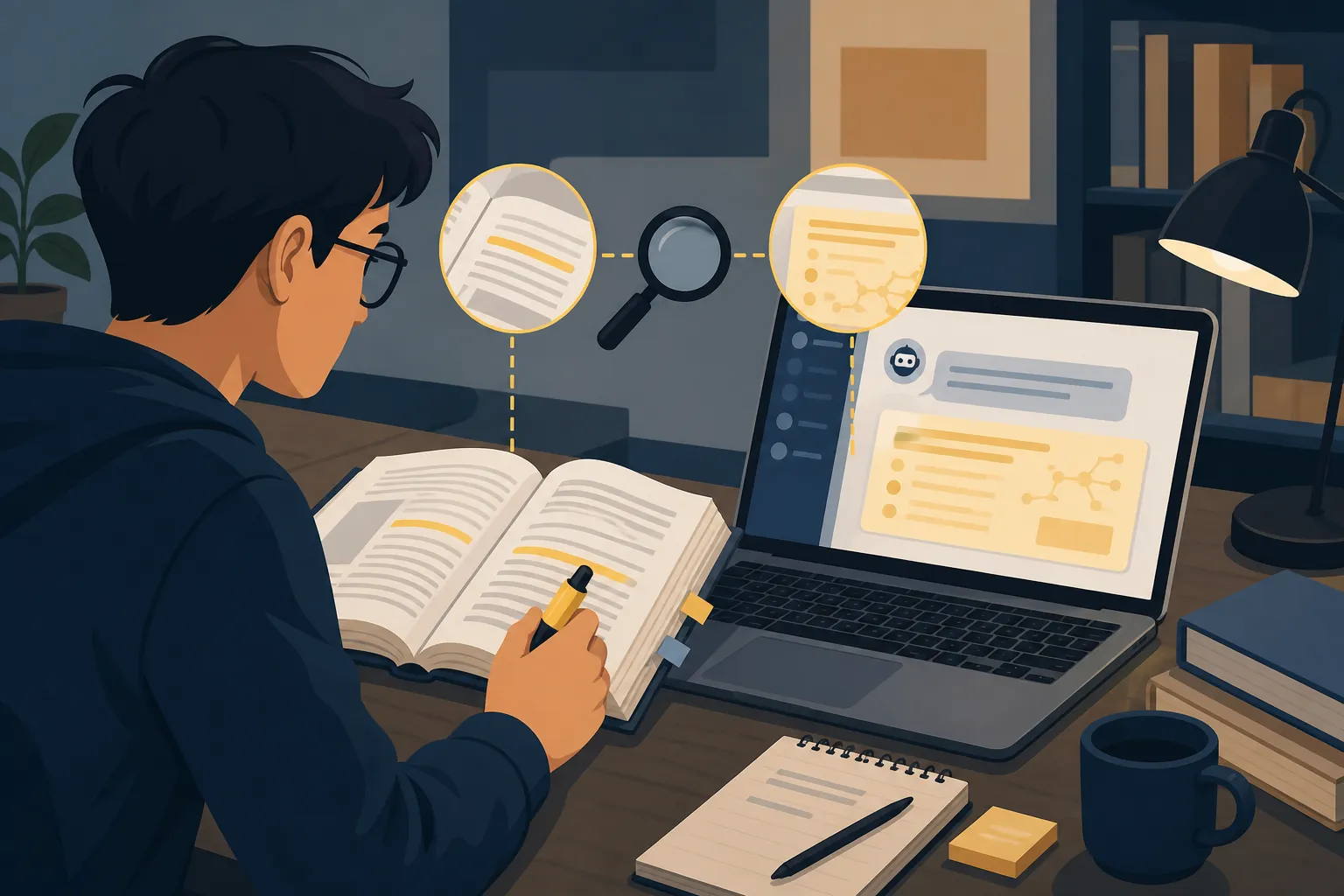
ChatGPT can explain a concept, rewrite a confusing answer, generate a practice prompt, or help you plan a week. It should not become your official answer key. When a generated explanation conflicts with an exam-owner explanation, the exam owner wins. When a generated question uses a format your exam does not use, treat it as extra drilling, not as representative practice.
That is also why our accuracy warning belongs here, after the product-status check. The issue is not that the 2026 executive exits caused a new hallucination problem. The issue is that AI study tools have always needed verification. If you want the broader evidence frame, start with our AI study chatbot hallucination-rate coverage.
What to do if your exam is close
If ChatGPT already fits your workflow, keep it in the workflow for the jobs where it is strongest:
- Explaining a concept you missed in an official practice question.
- Turning your wrong answer into a step-by-step diagnostic conversation.
- Running Socratic drills where it waits for your answer before giving hints.
- Summarizing your own notes or an official explanation you provide.
- Building a weekly review plan around the results of an official diagnostic.
Do not use it as your only source for what is tested, your final authority on answer keys, or a replacement for official practice material. If you are comparing backup tools rather than reacting to OpenAI headlines, our Claude vs. ChatGPT exam-prep comparison is the more useful place to make that decision.
For the exam plan itself, start from the test rather than the chatbot: GRE, MCAT, SAT, ACT, or ASVAB. ChatGPT can support that plan. It should not define the exam for you.
Administrative verdict: the OpenAI leadership churn is real. Student-facing product disruption is not evidenced in the cited record. ChatGPT still works for studying after the exodus headlines, with the same caveats students should have cared about before: verify important content, use official practice as the source of truth, and make the model teach you instead of simply feeding you answers.
References
- Introducing study mode, OpenAI, July 29, 2025
- OpenAI talent exodus raises “huge red flag” ahead of IPO, CNBC, Aug. 14, 2026
- ChatGPT Plus Student Discount 2026: Current Status & Alternatives, Krater Blog
- OpenAI Reshuffles Leadership Roles to Support AI Growth and Strategic Execution, The AI Insider, April 4, 2026
- OpenAI executive Brad Lightcap is leaving, Axios, Aug. 11, 2026
- 13 executives who left OpenAI in 2026, Business Insider
- OpenAI announces new “study mode” product for students, CNBC, July 29, 2025
- Enterprise Will Be a Top OpenAI Priority In 2026, Sam Altman Tells Editors at NYC Lunch, Big Technology, Dec. 2025
Authoritative source
For the authoritative version of this contentHow to Read the '1 in 4 NFL Players CTE' Study
Report an error in this tool's output
Found something this tool got wrong beyond what's documented above? Report it so the accuracy log stays current.
Comments
Join the discussion with an anonymous comment.